A cyber security certification is an exam-based award that shows you know a set part of security work.
This guide is for anyone thinking about a job in cyber security who wonders if they need a degree or a certificate first. It also helps managers who read job adverts full of letters such as CISSP and wonder what they mean.
In short
- You do not always need a degree to work in cyber security. Many people get in through IT jobs, apprenticeships or career changes.
- Entry-level certifications show you know the basic words and ideas. Some ask for no work experience at all.
- Advanced certifications, such as CISSP, ask for years of checked work experience, so they are not a first step.
- Employers look for a mix: some proof of learning, plus hands-on practice you can talk about.
What you will learn
- Explain the difference between a degree, a certification and experience.
- Spot which certifications are made for beginners and which are not.
- Check what a certification asks for before you pay for it.
- Plan a first step that fits where you are now.
- Exam-based award (certification)
- a title you earn by passing a test set by a training or industry body.
- Learn-while-you-work route (apprenticeship)
- a paid job where you train and study at the same time.
- Keeping it up to date (renewal)
- the study or fees you need to keep a certification active after you pass.
What is a cyber security certification?
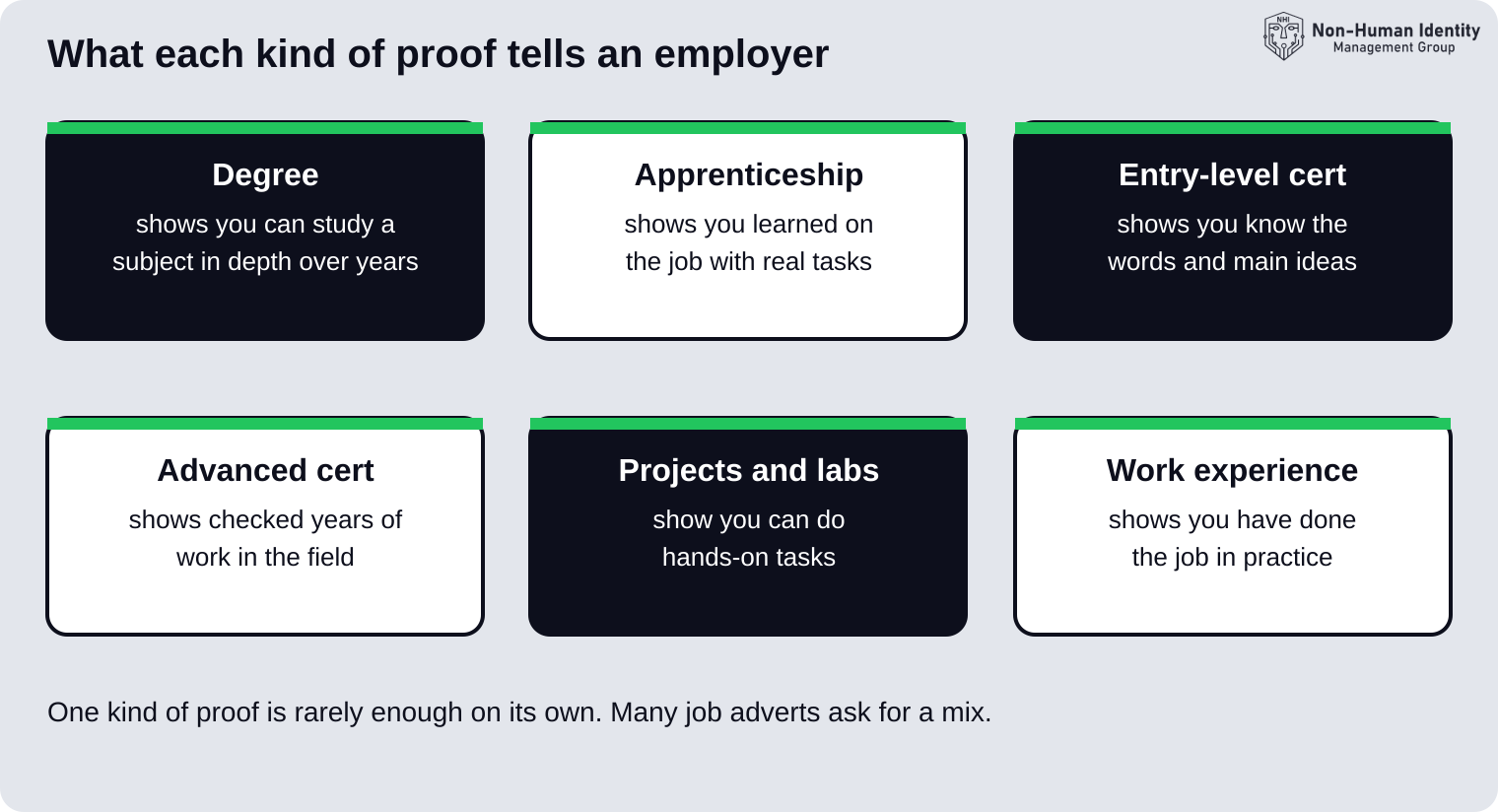
Think of a driving licence. It shows you passed a test on the rules and basic skills. It does not show you have driven for years in every kind of weather.
A cyber security certification works the same way. A body such as ISC2 or CompTIA sets an exam. If you pass, you can use the title after your name. Most titles cover one area, such as the basics, defending networks or running a security team.
A degree is different. It is a long course at a university, often three years or more. A certification is usually one exam that you study for in weeks or months.
Experience is the third kind of proof. It is what you have done in a job, a project or a volunteer role. Employers often weigh it most.
Where the comparison stops working: a driving licence usually lasts for many years. Many certifications need renewal every few years, through more study or a new exam, so they stay current.
Why does it matter?
Certifications cost time and money. Picking the wrong one first can waste both.
If you are changing career
What could happen: you pay for an advanced exam, then find you cannot hold the title without years of work experience.
Check this: read the official experience rules on the body's own website before you book.
If you are at school or college
What could happen: you pick a degree that sounds right but covers little security.
Check this: in the UK, see if the course is on the national cyber agency's list of certified degrees.[5]
If you hire people
What could happen: your advert asks a new starter for a title that needs five years of experience, and good people do not apply.
Check this: match each title in the advert to the level of the job.
What does it look like?
Here is a made-up check you might do before booking an exam. It shows the questions worth asking.
Example only. All values are made up.
Certification:  EXAMPLE Security Basics (ESB)
Awarding body:  Example Cert Body (example.com)   (1)
Level:          Entry level                       (2)
Experience:     None required                     (3)
Exam:           one test, multiple choice, 0000 fee
Renewal:        every 3 years, study hours needed (4)
Fits my goal?   Junior analyst role: yes          (5)
- Check the body's own website, not a reseller's advert.
- The level tells you who the exam is written for.
- Some titles ask for years of work before you can hold them.
- Renewal means more study or fees after you pass.
- Match the title to the job you want next, not the job you want in ten years.
Why this is risky: skipping these checks can mean paying for an exam that does not fit your stage or your goal.
The safer way: fill in a card like this for each option, using only the awarding body's own pages.
How does it work?
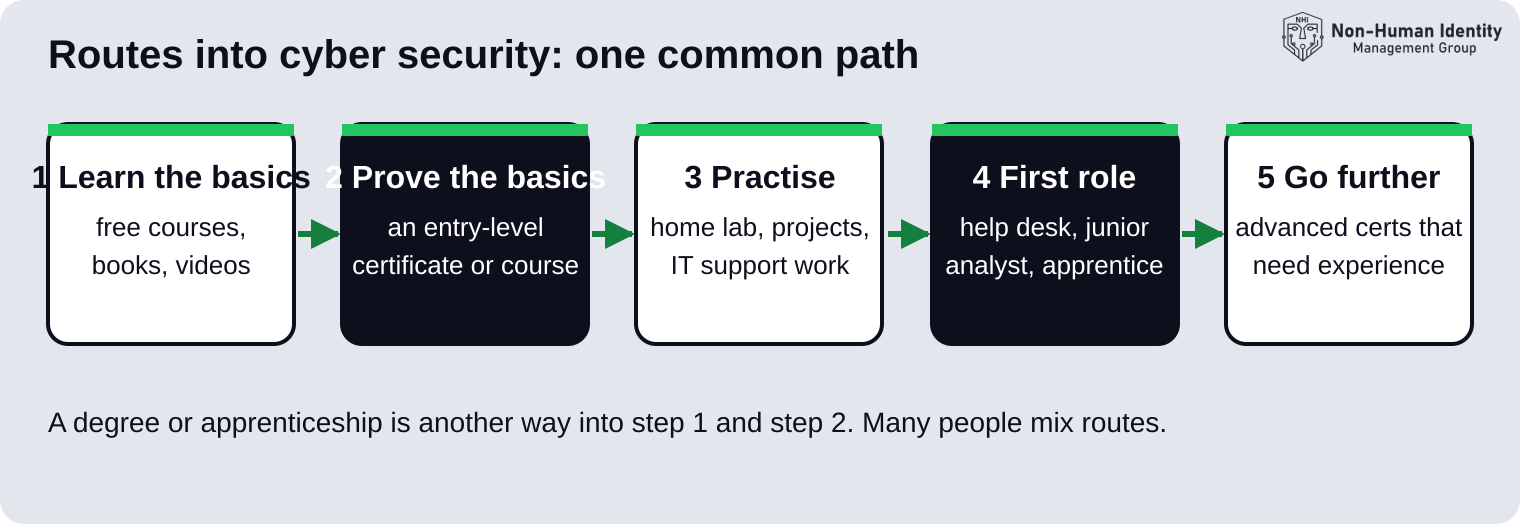
There is no single route in. Here is one common path, in plain steps.
- Learn the basics. Free courses, books and videos teach the main words, such as passwords, networks and attacks.
- Prove the basics. An entry-level certification or course gives you a title to show. ISC2 says its Certified in Cybersecurity title needs no work experience.[1]
- Practise. Build a small home lab, which is a practice setup on your own computer, or take an IT support job. This gives you stories to tell in interviews.
- Get a first role. Common first jobs include help desk work, junior analyst roles and apprenticeships.
- Go further. Later, aim for titles that need experience. ISC2 lists five years of work experience for its CISSP title.[2]
Some titles name the jobs they are written for. CompTIA aims Security+ at roles such as security analyst and systems administrator.[3]
Most certifications also need renewal. For example, CompTIA says its Security+ title lasts three years from the date you pass. You renew it through more study or another exam.[4]
A worked example
This story is made up to show how the choice can work.
Kwame Mensah is 34 and works in a warehouse office in Birmingham. He looks after the stock system and sorts out printer problems for his team. He wants to move into cyber security, but he has no degree.
He searches online and sees adverts asking for CISSP. He nearly books the course. Then he reads the ISC2 page and sees that CISSP needs five years of work experience.[2] That is not his first step.
Kwame makes a simple card for three options, like the one above. He checks each one on the awarding body's own website. He picks an entry-level title that asks for no experience.[1]
While he studies, he asks his manager if he can help the IT team. He sets up user accounts and helps with password resets. He writes short notes on what he learns each week.
Six months later he passes the exam. He applies for a help desk role at a larger firm. In the interview, they ask more about his work helping the IT team than about the exam. His notes give him clear examples.
He gets the job. His plan now is to build two years of hands-on work, then pick his next title based on the area he enjoys most.
What made the difference: Kwame matched his first certification to his stage, and he built experience at the same time.
Myths and mistakes
| What people think | What is true |
|---|---|
| You need a degree to work in cyber security. | A degree helps for some roles, but many people get in through IT jobs, apprenticeships or career changes. |
| The most famous certification is the best place to start. | Some well-known titles need years of experience. Start with one written for beginners.[2] |
| Once I pass, the title is mine for life. | Many titles need renewal through study or fees, often every few years.[4] |
| More certifications always means more job offers. | Employers also want to see what you can do. One title plus hands-on practice often says more than three titles alone. |
| Any course called "cyber security" is a good degree. | Courses vary a lot. In the UK, the NCSC lists the degrees it has checked and certified.[5] |
What can I do this week?
- Write down the kind of job you want next, such as help desk or junior analyst.
- Find three adverts for that job and list the titles and skills they ask for.
- Check one entry-level certification on the awarding body's own website.
- Start a free beginner course, and keep short notes on what you learn.
- Ask at work if you can help with any IT or security task.
Checklist
- I know the job I am aiming for next.
- I have checked the experience rules for any title I plan to take.
- I have read the details on the awarding body's own website.
- I know how long the title lasts and how to renew it.
- I have a way to practise, such as a home lab, a project or IT work.
- I keep notes I can use as examples in interviews.
Common questions
Do I need a degree to get into cyber security?
Not always. Some employers ask for one, especially for graduate schemes. Many others accept people from IT jobs, apprenticeships or other careers. Check the adverts for the job you want, and look at what the people already doing it studied.
Which certification should I take first?
Pick one written for beginners that fits the job you want next. Look for titles marked entry level that ask for no work experience. ISC2 Certified in Cybersecurity is one example. Check the details on the awarding body's own website before you pay.
Can I take CISSP as a beginner?
It is not made for beginners. ISC2 lists five years of work experience for CISSP. It is a common goal for later in a career, once you have worked in security for some years. Start with an entry-level title instead.
Do certifications expire?
Many do, unless you renew them. CompTIA says Security+ lasts three years from the date you pass. You can renew it through approved study, a training course or another exam. Other bodies have their own rules, so check each one.
Is experience more important than certifications?
Often, yes, but they work best together. A title shows you know the ideas. Experience shows you can use them. Even small projects, a home lab or helping an IT team give you examples employers want to hear about.
Where next?
Ready for the detail? Read the practitioner guide: Cybersecurity Certifications Guide. It goes further into exam formats, renewal rules for each body and which titles fit each job family.
Also useful:
- Entry Level Security Certifications Compared
- Career Change into Cyber Security Guide
- Cybersecurity Careers Guide
- SOC Analyst Career Guide
Related NHI Mgmt Group resources: CompTIA Security+ Guide · CISSP Certification Guide · Google Cybersecurity Professional Certificate Guide
Key terms
- Cyber security certification
- A formal award that shows a person's knowledge, skills or experience in one area of security work.
- Continuing professional education
- Learning you do after you pass, to keep a certification active and your skills current.
- Apprenticeship
- A paid job where you train and study at the same time, often towards a qualification.
- Entry level
- Written for people new to a field, usually with no work experience needed.
- Home lab
- A practice setup on your own computer where you can try security tools safely.
- Security Operations Centre
- A team that watches for cyber threats and responds to them, and a common place for first security jobs.
Sources and further reading
- Certified in Cybersecurity (CC). ISC2. https://www.isc2.org/certifications/cc, accessed 28 Nov 2026.
- CISSP: Certified Information Systems Security Professional. ISC2. https://www.isc2.org/certifications/cissp, accessed 28 Nov 2026. See also: CISSP Experience Requirements, ISC2. https://www.isc2.org/certifications/cissp/cissp-experience-requirements.
- CompTIA Security+. CompTIA. https://www.comptia.org/en-us/certifications/security/, accessed 28 Nov 2026.
- How long does the CompTIA Security+ certification last? CompTIA. https://www.comptia.org/en-us/blog/how-long-does-the-comptia-security-certification-last/, accessed 28 Nov 2026.
- NCSC-certified degrees. National Cyber Security Centre (NCSC). https://www.ncsc.gov.uk/information/ncsc-certified-degrees, accessed 28 Nov 2026.