PCI DSS, the Payment Card Industry Data Security Standard, is a set of security requirements for any organisation that stores, processes or transmits payment card data.
If your business takes card payments, PCI DSS almost certainly applies to you in some form. This guide explains it in plain English for small business owners, newcomers to security, students and managers. It covers who writes the standard, who enforces it, what it asks for, how a small merchant works out what to do, a worked example and first steps for this week.
By the end of this guide you will be able to:
- Explain what PCI DSS is and who it applies to.
- Understand what card data must be protected and what must never be kept.
- Describe how scope, self-assessment and validation fit together.
- Identify practical steps to reduce your PCI DSS burden.
Key takeaways
- It applies to anyone handling card data. Merchants, payment processors and service providers that store, process or transmit cardholder data are in its audience.
- The Council writes it, others enforce it. The PCI Security Standards Council maintains the standard; payment brands and your acquiring bank decide what you must do to show compliance.
- Some data must never be kept. Sensitive authentication data, such as the card security code, must not be stored after a payment is authorised, even if encrypted.
- Scope is everything. The fewer systems that touch card data, the fewer requirements apply, so reducing scope is usually the smartest first move.
- Compliance is continuous. Passing a questionnaire once a year does not keep card data safe on the other days.
What it is, in plain English
When a customer pays by card, details such as the long card number travel through tills, websites, networks and payment companies. If criminals steal those details, they can commit fraud. PCI DSS is the rulebook that sets a baseline of technical and operational protections for that payment data.[1]
The standard is maintained by the PCI Security Standards Council (PCI SSC), founded in 2006 by American Express, Discover, JCB International, Mastercard and Visa.[2] The Council develops the standard but does not monitor or enforce it. Whether you must comply, and how you prove it, is decided by the organisations that run compliance programmes, such as the payment brands and your acquiring bank, the bank that lets you accept card payments.[2]
The current version is PCI DSS v4.0.1, published in June 2024. Version 4.0 was retired on 31 December 2024, and the requirements that had been marked as future-dated took effect on 31 March 2025.[3]
A helpful comparison is food hygiene rules for a kitchen. The rules say how to store, handle and clean, and an inspector checks you follow them. A café that only sells sealed drinks has far fewer rules to meet than one that cooks raw meat. PCI DSS works the same way: the less card data you handle, the less you have to protect. Where the analogy breaks down: hygiene inspections are usually run by a public authority, while PCI DSS is a private industry standard enforced through your contracts with banks and card brands.
Why it matters to you
- If you run a small business: the PCI SSC says the standard applies to merchants regardless of size or transaction volume.[4] Your acquiring bank will usually ask you to confirm compliance each year.
- If you are new to a security job: PCI DSS is one of the most common standards you will meet, and its 12 requirements cover many security basics, from firewalls to logging.
- If you are a manager: the choices you make about payment providers and card handling decide how much of the business is in scope, and therefore how much effort and cost compliance takes.
Visa, for example, groups merchants into four levels based on how many Visa transactions they process in a year, and the level sets how a merchant must validate compliance. Visa states that the acquiring bank is responsible for ensuring the merchant's PCI DSS compliance.[5] Other card brands run their own programmes.
How it works, step by step
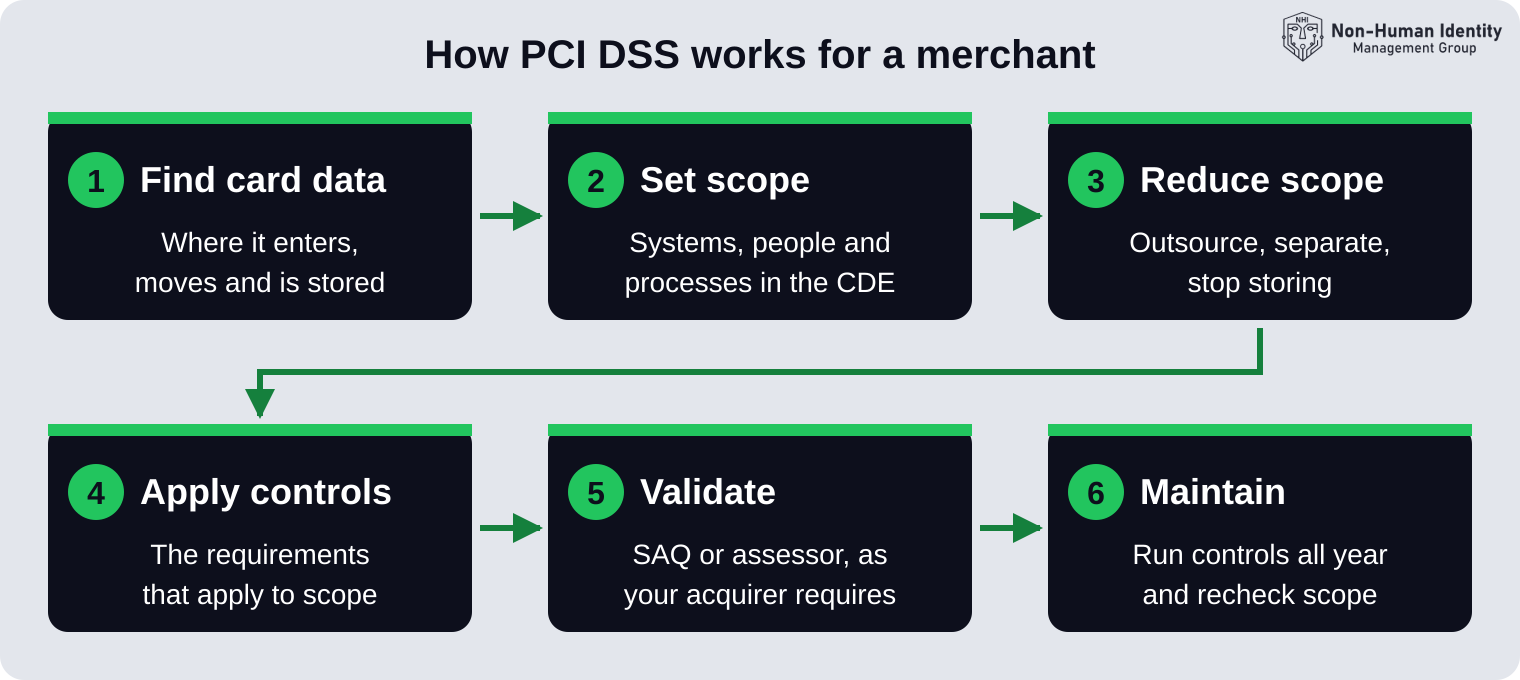
- Understand the card data. PCI DSS calls it account data. It has two parts. Cardholder data is the primary account number (the long card number, or PAN), the cardholder name, the expiry date and the service code. Sensitive authentication data is the full magnetic stripe or chip data, the card verification code and PINs. Sensitive authentication data must not be stored after authorisation, even if encrypted.[6]
- Map where it goes. Draw how card data enters, moves through and leaves your business: card terminals, websites, phone orders, spreadsheets, email.
- Work out your scope. The cardholder data environment (CDE) is the people, processes and systems that store, process or transmit account data, plus systems with unrestricted connections to them.[6] Everything in the CDE must meet the requirements. The standard asks you to confirm scope at least once every 12 months.[6]
- Reduce scope where you can. Separating payment systems from everything else (segmentation) is not a requirement, but the standard strongly recommends it as a way to reduce scope, cost and risk.[6] Using a payment provider's hosted payment page or a validated terminal can also keep card data off your own systems.
- Meet the requirements that apply. Put the controls in place for everything in scope: secure configuration, access control, logging, patching and so on.
- Validate and report. Smaller merchants usually complete a self-assessment questionnaire (SAQ). There are several types, each for a particular way of taking payments, with its own eligibility rules.[7] Larger organisations are typically assessed by a Qualified Security Assessor (QSA). Your acquirer or the card brands tell you which applies.[4]
- Keep it going. Run the controls all year, repeat checks such as scans on schedule and update your scope when anything changes.
The 12 requirements
PCI DSS v4.0.1 has 12 principal requirements.[6] The table gives the official name and a plain English summary.
| # | Official requirement | In plain English |
|---|---|---|
| 1 | Install and Maintain Network Security Controls | Use firewalls and similar controls to limit traffic to and from card systems. |
| 2 | Apply Secure Configurations to All System Components | Change default passwords and switch off what you do not need. |
| 3 | Protect Stored Account Data | Store as little card data as possible and protect what you keep. |
| 4 | Protect Cardholder Data with Strong Cryptography During Transmission Over Open, Public Networks | Encrypt card data when it travels over the internet. |
| 5 | Protect All Systems and Networks from Malicious Software | Defend against malware. |
| 6 | Develop and Maintain Secure Systems and Software | Patch systems and build software securely. |
| 7 | Restrict Access to System Components and Cardholder Data by Business Need to Know | Only people who need card data can reach it. |
| 8 | Identify Users and Authenticate Access to System Components | Everyone has their own login, with strong sign-in. |
| 9 | Restrict Physical Access to Cardholder Data | Protect terminals, paper and premises. |
| 10 | Log and Monitor All Access to System Components and Cardholder Data | Record and review who did what. |
| 11 | Test Security of Systems and Networks Regularly | Scan and test for weaknesses. |
| 12 | Support Information Security with Organizational Policies and Programs | Have policies, training and an incident plan. |
Useful distinctions
- Compliant is not the same as secure. A completed questionnaire shows you met the requirements at the time you checked. Security depends on keeping the controls working every day.
- Encryption alone does not usually take data out of scope. The PCI SSC states that encryption alone is generally insufficient to make cardholder data out of scope, though a PCI-listed point-to-point encryption (P2PE) solution can reduce the requirements that apply.[4]
- Outsourcing reduces scope but not responsibility. If a provider handles payments for you, you still need to check that it is compliant and know which tasks remain yours.
- PCI DSS is not a law. It is an industry standard enforced through contracts. Some laws on personal data may also apply to card data, which is a separate question.
A worked example
Maple & Co is a fictional gift shop with one store and a small website. Jonah, the owner, gets a letter from the acquiring bank asking for this year's PCI DSS validation.
- Mapping: Jonah lists how card data arrives. In the shop, customers use a card terminal supplied by the payment provider. Online, the website sends customers to the provider's hosted payment page. A few customers phone in orders, and staff write the card number on a notepad before typing it into the terminal.
- The problem: the notepad means full card numbers sit on paper in the back office, and sometimes the security code too. Under PCI DSS, the security code must not be kept after the payment is authorised.[6]
- The fix: Jonah stops the notepad practice. Staff now key phone payments straight into the terminal while the customer is on the line, and the old notes are shredded securely.
- Validation: Jonah asks the acquirer which SAQ applies to the shop's set-up, completes it with help from the provider's guidance, and keeps the provider's compliance confirmation on file.
The changes do not make Maple & Co immune to fraud, and Jonah still needs to keep the terminal and website accounts secure. But card data now barely touches the shop's own systems, so far fewer requirements apply and there is much less for a criminal to steal.
Myths and misunderstandings
| What people think | What is true |
|---|---|
| We are too small for PCI DSS. | The PCI SSC says it applies to merchants regardless of size or transaction volume. What changes with size is how you validate.[4] |
| The PCI Council will fine us. | The Council does not enforce compliance. Enforcement runs through payment brands and acquirers under your contracts.[2] |
| Our payment provider handles PCI, so we have nothing to do. | A good provider can remove most card data from your systems, but you usually still complete a validation and keep your side secure. |
| Encrypting stored card numbers means they are out of scope. | Encryption alone is generally insufficient to take card data out of scope. Not storing it at all is often simpler.[4] |
| It is fine to keep the security code if it is encrypted. | Sensitive authentication data must not be stored after authorisation, even if encrypted.[6] |
Key terms
- PCI DSS
- The Payment Card Industry Data Security Standard, a security baseline for organisations that store, process or transmit payment card data.
- Cardholder data
- The card number, cardholder name, expiry date and service code that PCI DSS requires organisations to protect.
- Primary account number (PAN)
- The full card number that identifies a payment account.
- Sensitive authentication data
- Data used to authenticate a card transaction, such as the card verification code, which must not be stored after authorisation.
- Cardholder data environment (CDE)
- The systems, people and processes that store, process or transmit payment card data, plus systems connected to them.
- PCI scope
- The set of systems, people and processes that must meet PCI DSS because they handle or can affect the security of card data.
- Acquiring bank
- The bank that enables a merchant to accept card payments and oversees its PCI DSS compliance.
- Self-assessment questionnaire (SAQ)
- A PCI compliance form for organisations allowed to validate their own controls.
- Qualified Security Assessor (QSA)
- An approved external specialist who assesses PCI DSS compliance.
- Network segmentation
- Dividing a network into zones with controlled traffic between them, so card systems are separated from everything else.
- Tokenisation
- Replacing a sensitive value, such as a card number, with a non-sensitive substitute.
Common questions
Is PCI DSS a law?
No. It is an industry standard. You are usually bound to it through your agreement with your acquiring bank or payment provider.
Who checks that we comply?
The payment brands and your acquiring bank set the validation rules. Depending on your size and set-up, you complete a self-assessment questionnaire or are assessed by a QSA.[4]
Which version of PCI DSS applies now?
PCI DSS v4.0.1, published in June 2024. Version 4.0 was retired at the end of 2024.[3] Check the PCI SSC website for any later changes.
Which SAQ should we use?
It depends on how you take payments, for example a standalone terminal, a fully outsourced website payment page or card data on your own systems. Each SAQ has eligibility criteria, and the PCI SSC advises asking your acquirer or the payment brands if you are unsure.[7]
Can we store card numbers at all?
The card number can be stored if it is protected as Requirement 3 sets out, but sensitive authentication data cannot be kept after authorisation.[6] We suggest not storing card numbers unless there is a clear business need.
Does using a payment provider make us compliant?
It can reduce your scope a lot, but not to zero. You still need to confirm the provider's compliance, protect your own accounts and complete the validation your acquirer asks for.
First steps
Three things you can do this week:
- Map your payment channels. List every way you take card payments: in person, online, by phone, by post. Note which systems and people each one touches.
- Look for stored card data. Check notepads, spreadsheets, email and shared folders for card numbers or security codes. Securely delete anything you do not need, with the change approved and recorded.
- Ask your acquirer two questions. Which merchant level are we, and which validation (SAQ type or assessment) do you need from us?
Checklist
- We know every channel through which we accept card payments.
- We do not keep card security codes, PINs or full stripe or chip data after authorisation.
- Card numbers are not written down, emailed or kept in spreadsheets.
- Payment systems are separated from other systems where possible.
- Default passwords on terminals, routers and payment accounts have been changed.
- Each person has their own login to payment systems, with strong sign-in.
- We have confirmation that our payment providers are PCI DSS compliant.
- We know which SAQ or assessment applies and when it is due.
- We review our scope at least once a year and whenever we change how we take payments.
Check your understanding
1. Who enforces PCI DSS: the PCI Security Standards Council or the payment brands and acquirers?
Answer: the payment brands and acquirers. The Council writes and maintains the standard.
2. Can a merchant keep the card security code if it is encrypted?
Answer: no. Sensitive authentication data, including the security code, must not be stored after authorisation, even if encrypted.
3. Why does reducing scope matter?
Answer: every system in the cardholder data environment must meet the requirements, so fewer systems in scope means less work, lower cost and less data to steal.
4. Is network segmentation a PCI DSS requirement?
Answer: no, but the standard strongly recommends it as a way to reduce scope, cost and risk.
Suggested learning pathway
- For how compliance work fits into the bigger picture, start with Governance, Risk and Compliance for Beginners.
- For the full practitioner view of the current standard, read the PCI DSS 4.0 Guide.
- For choosing the right questionnaire, see PCI DSS SAQ Types.
- For shrinking scope, see the PCI DSS Scoping and Network Segmentation Guide.
- For who can access card data, see the PCI DSS Requirement 7 Guide.
- For a structured self-check, use the PCI DSS Readiness Checklist.
Standards and references
- PCI DSS standard overview. PCI Security Standards Council. https://www.pcisecuritystandards.org/standards/pci-dss/, accessed 27 Nov 2026.
- About us. PCI Security Standards Council. https://www.pcisecuritystandards.org/about_us/, accessed 27 Nov 2026.
- Just Published: PCI DSS v4.0.1. PCI Perspectives blog, PCI Security Standards Council, 11 June 2024. https://blog.pcisecuritystandards.org/just-published-pci-dss-v4-0-1, accessed 27 Nov 2026.
- Merchant resources. PCI Security Standards Council. https://www.pcisecuritystandards.org/merchants/, accessed 27 Nov 2026.
- Security and compliance for small businesses. Visa UK. https://www.visa.co.uk/support/small-business/security-compliance.html, accessed 27 Nov 2026.
- Payment Card Industry Data Security Standard: Requirements and Testing Procedures, Version 4.0.1. PCI Security Standards Council, June 2024. https://docs-prv.pcisecuritystandards.org/PCI%20DSS/Standard/PCI-DSS-v4_0_1.pdf, accessed 27 Nov 2026.
- PCI DSS v4: What's New with Self-Assessment Questionnaires. PCI Perspectives blog, PCI Security Standards Council, 27 March 2024. https://blog.pcisecuritystandards.org/pci-dss-v4-whats-new-with-self-assessment-questionnaires, accessed 27 Nov 2026.
Related NHI Mgmt Group resources: SOC 2 vs ISO 27001 vs PCI DSS · PCI DSS for E-commerce Payment Page Scripts Guide · Payment Card Compromise Response Playbook. This guide summarises PCI DSS for beginners and is not legal or compliance advice.