Privacy enhancing technologies (PETs) are techniques that let organisations use, share or analyse data while revealing less about the individual people in it.
This guide is for newcomers, students, career changers and managers who keep hearing terms such as differential privacy, synthetic data or homomorphic encryption and want to know what they mean. It explains the main families of PETs in plain English, how a team chooses and uses one, a worked example, common myths and simple first steps. It focuses on the technical security side; it does not tell you what the law requires of your organisation.
By the end of this guide you will be able to:
- Explain what privacy enhancing technologies are and what problem they solve.
- Describe the main families of PETs and what each one protects.
- Understand the trade-off between privacy and how useful the results are.
- Identify sensible first steps before choosing a PET.
Status: correct as at 27 November 2026, based on the UK Information Commissioner's Office (ICO) guidance on privacy-enhancing technologies and the UK GDPR text on legislation.gov.uk. Laws change; check the official text.
This guide explains the topic in general terms and is not legal advice.
Key takeaways
- PETs reduce what data reveals, not the need to protect it. They help you get useful answers from personal data while exposing less about each person.
- There are three broad families. Some PETs make people harder to identify, some hide data while it is being used, and some split data so no single party sees all of it.
- There is usually a trade-off. Stronger privacy often means less precise results, more computing cost or more expertise.
- PETs are not a silver bullet. The ICO says you should not treat them as meeting all your data protection requirements, and using one does not automatically make data anonymous.
- Start with minimisation. The simplest privacy step is not collecting or sharing data you do not need; PETs come after that.
What it is, in plain English
Organisations often want answers from data about people: how many patients responded to a treatment, which areas have the most fraud, how customers use a service. The usual way to get those answers is to gather the raw records in one place and look at them. That creates risk: anyone who can see the records, or who steals them, sees everything about everyone.
PETs change the deal. They let you get the answer, or most of it, while showing less of the underlying personal data. The ICO notes that data protection law does not define PETs, and describes them as technologies that help minimise the use of personal information, maximise its security, or empower people.[2]
A helpful comparison is a sealed ballot box. Everyone's vote counts towards the result, and the result is published, but nobody can see how any one person voted. Where the analogy breaks down: a ballot box relies on trusted people and physical seals, while PETs rely on mathematics, cryptography or special hardware, and each type protects against different risks. None of them protects everything.
The main families of PETs
The ICO groups PETs by what they do.[2] The table follows that grouping and names the PETs the ICO lists in its guidance.[1]
| Family | Examples | What it does | Main trade-off |
|---|---|---|---|
| Reduce identifiability | Differential privacy, synthetic data | Weakens the link between the results and real people, for example by adding carefully measured noise or generating artificial records.[2] | Results can be less accurate or less useful.[2] |
| Hide or shield data | Homomorphic encryption, zero-knowledge proofs, trusted execution environments | Protects the data while it is being worked on, without changing the result.[2] | Can be slow, costly or need specialist skills and hardware. |
| Split data | Secure multi-party computation, private set intersection, federated learning | Keeps data with its owners and shares only what is needed, so no single party sees everything.[2] | Needs several parties to coordinate; what is shared can still leak information.[4] |
Each PET in one line
- Differential privacy: adds measured noise so that the result of an analysis is about the same whether or not any one person's data is included. NIST explains that a smaller privacy setting, called epsilon, means stronger privacy but lower accuracy.[5]
- Synthetic data: artificial data generated to mirror the patterns of real data. The ICO says it is not automatically anonymous: that depends on whether real personal information can be inferred from it.[3]
- Homomorphic encryption: lets a computer calculate on encrypted data without seeing the plain inputs or outputs.[6]
- Zero-knowledge proof: proves that something is true without revealing the secret behind it, for example proving you know a solution without showing it.[6]
- Trusted execution environment (TEE): an isolated, hardware-backed area of a processor that protects code and data from being viewed or changed while in use. This is the basis of confidential computing.[7]
- Secure multi-party computation: several parties work out a result together without any of them revealing its own input.[6]
- Private set intersection: two or more parties find the items they have in common without revealing the items they do not share.[6]
- Federated learning: several parties train an AI model on their own data locally and combine only the model updates, so the training data is not shared.[4]
Why it matters to you
- If you run a small business: you may be asked to share customer data with a partner or supplier. Knowing that PETs exist helps you ask whether the partner really needs the raw records, or only an answer.
- If you are new to a security or privacy job: PETs come up in data sharing, analytics and AI projects. You will be expected to know which family fits which problem and where the limits are.
- If you are a manager: PETs can open up projects that would otherwise be too risky, such as research across organisations. They also add cost and complexity, so they need a clear purpose.
The reason this matters is simple. Removing names from a dataset is often not enough to protect people, because other details can be combined to work out who someone is. The US Census Bureau describes a simulated attack on its own 2010 Census data in which researchers reconstructed records for 97 million people, one of the reasons it gave for adding noise to 2020 Census data using a framework based on differential privacy.[9] The Bureau's page now says its approach is under review, which is a reminder that the choice of PET can change over time.[9]
Privacy law also points in this direction. Article 25 of the UK GDPR, "data protection by design and by default", asks organisations to build appropriate technical and organisational measures into their processing, and gives pseudonymisation as one example.[8] The ICO says PETs can help show this approach and support data minimisation and security.[2]
How it works, step by step
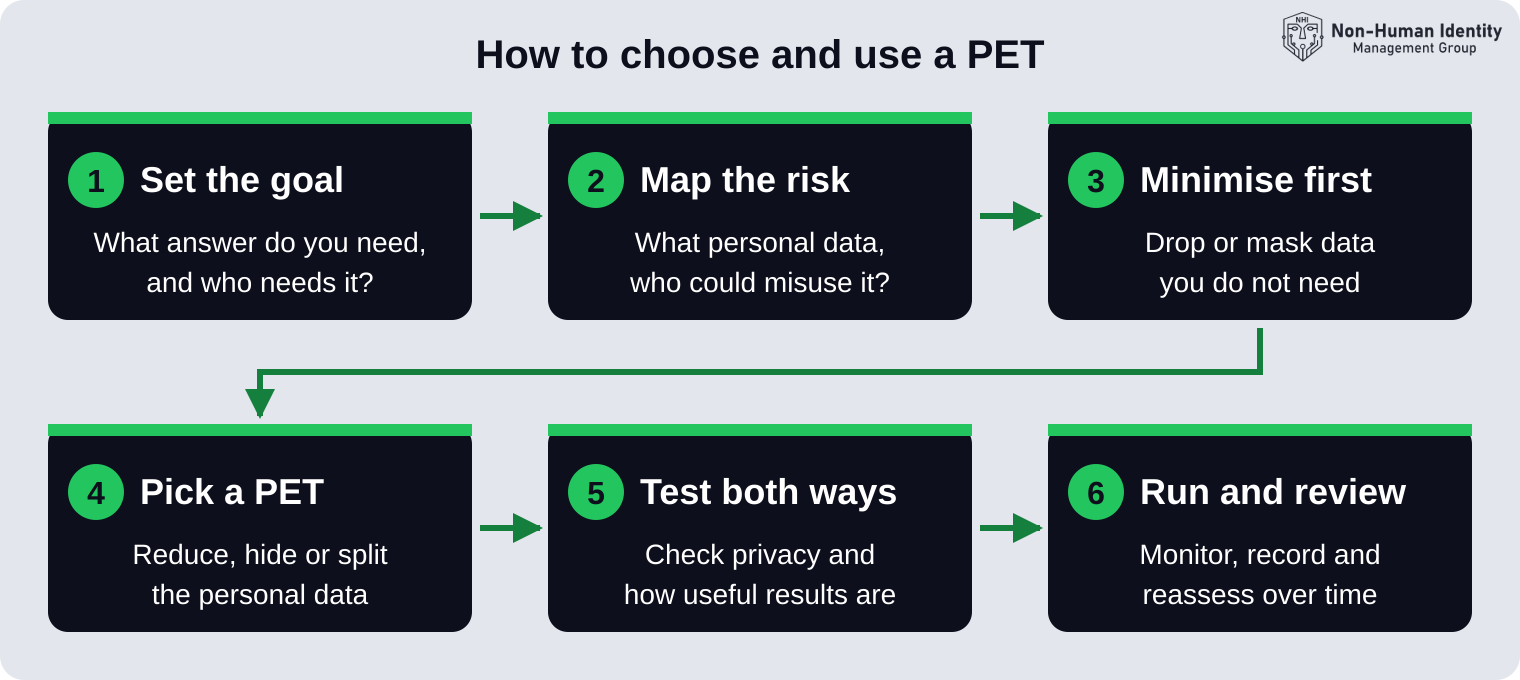
Choosing a PET is a design decision, not a product purchase. A sensible process looks like this.
- Set the goal. Write down the question you need answered and who needs the answer. "We need the average spend per region" needs far less data than "we need every transaction".
- Map the risk. List the personal data involved, who would see it, and what could go wrong. The ICO suggests assessing risks case by case, typically through a data protection impact assessment (DPIA), before deciding whether PETs are appropriate.[2]
- Minimise first. Remove fields you do not need, and consider simpler steps such as pseudonymisation (replacing names with codes) before reaching for advanced techniques.
- Pick a PET family. If the risk is in the published results, look at reducing identifiability. If the risk is the people or systems processing the data, look at hiding it. If the risk is pooling data from several owners, look at splitting it.
- Test both ways. Check that the privacy protection holds up and that the results are still useful enough. The ICO warns that some PETs are not yet mature, and that mistakes in setting them up can leave people unprotected.[2]
- Run and review. Keep the raw data secure, record the settings you chose, and reassess as the data, the people using it and the techniques change.
Matching the problem to a PET
| If your problem is... | PETs worth looking at | Watch out for |
|---|---|---|
| Publishing statistics without revealing individuals | Differential privacy | Each extra query uses up part of a privacy budget; NIST notes privacy loss adds up across analyses.[5] |
| Giving developers or testers realistic data | Synthetic data | Very realistic synthetic data can reveal real people, and biases in the source data carry over.[3] |
| Processing sensitive data in the cloud | Trusted execution environments, homomorphic encryption | Hardware trust and attestation for TEEs; speed and cost for homomorphic encryption.[7] |
| Finding shared customers with a partner | Private set intersection | The overlap itself is still revealed, so agree what both sides may learn.[6] |
| Training an AI model across several organisations | Federated learning, often combined with others | Model updates can leak training data; the ICO suggests adding SMPC, homomorphic encryption or differential privacy.[4] |
A worked example
Northfield Health Partnership is a fictional group of three clinics. Its analyst, Amara, wants to publish a yearly report showing how many patients in each local area attend for a particular condition. Some areas are small, so a table showing "2 patients" in one village could let neighbours guess who they are.
Amara works through the process:
- Goal: counts per area for a public report, not individual records.
- Risk: small numbers in small areas could identify people. The data protection officer, Tom, records this in the DPIA.
- Minimise: the analysis uses only area and condition, not names, dates of birth or addresses.
- Pick a PET: because the risk is in the published results, Amara uses a well-known differential privacy library to add measured noise to each count.
- Test: she compares noisy and true counts. With the strongest privacy setting, small areas become too inaccurate to be useful, so she and Tom agree to combine the smallest areas and choose a moderate setting, and they record why.
The outcome is realistic rather than perfect. The published report is less precise for small areas than the raw data, and the clinics still have to keep the original records secure, because differential privacy does not protect raw data while it is stored or analysed.[5] What they gain is a report that reveals much less about any individual patient.
Myths and misunderstandings
| What people think | What is true |
|---|---|
| Using a PET makes the data anonymous. | The ICO says PETs and anonymisation are separate but related ideas: not all PETs result in effective anonymisation.[2] |
| Once we use a PET, we have met our privacy obligations. | The ICO says PETs are not a silver bullet, and processing must still be lawful, fair and transparent.[2] |
| Synthetic data is fake, so it cannot be personal data. | Whether synthetic data is anonymous depends on whether real personal information can be inferred from it.[3] |
| Federated learning keeps data private because the data never moves. | The model updates that are shared can still leak information about the training data.[4] |
| Differential privacy protects the whole database. | It protects what the published results reveal. The raw data still needs strong access control and security.[5] |
| Encryption at rest is a PET, so we are already covered. | Standard encryption protects stored data, but it is usually decrypted to be used. Hide-the-data PETs aim to protect data while it is in use.[7] |
Key terms
- Differential privacy
- A privacy technique that adds calibrated statistical noise so individual records cannot be easily inferred from query results.
- Privacy budget
- The total amount of allowable privacy loss across one or more queries in a differential privacy system.
- Synthetic data
- Information generated by a simulation or model rather than collected directly from the real world.
- Homomorphic encryption
- A cryptographic method that allows calculations on encrypted data without first decrypting it.
- Zero-knowledge proof
- A way for one party to prove a statement is true without revealing the underlying secret or data.
- Trusted execution environment (TEE)
- An isolated, hardware-backed area of a processor that protects code and data from the rest of the system.
- Secure multi-party computation
- A cryptographic method that lets several parties compute a result without revealing their inputs to one another.
- Federated learning
- A training approach in which a model learns across many devices or organisations that keep their data locally and share only model updates.
- Pseudonymisation
- Replacing direct identifiers with a coded reference so data can still be linked without exposing a person's identity.
- Anonymisation
- Removing or irreversibly obscuring personal identifiers so a person can no longer be readily identified from the data.
- Data minimisation
- Collecting, using and keeping only the personal data needed for a defined purpose.
Common questions
What are privacy enhancing technologies, in one sentence?
They are techniques that let you use or share data about people while revealing less about each individual, by making people harder to identify, hiding the data while it is used, or splitting it between parties.[2]
Is pseudonymisation a PET?
It is a privacy measure that UK GDPR Article 25 gives as an example of an appropriate technical measure.[8] It is simpler than the PETs in this guide, and pseudonymised data is still personal data because it can be linked back to people.
What is the difference between differential privacy and anonymisation?
Anonymisation is an outcome: people can no longer be identified. Differential privacy is a technique with a measurable setting. Depending on how it is configured, it may help achieve anonymisation, but it does not do so automatically.[2]
Do small organisations need PETs?
Often not straight away. Most small organisations get more benefit from collecting less data, controlling access and encrypting devices. PETs become relevant when you need to share or analyse sensitive data in ways that would otherwise be too risky.
Are PETs ready to use today?
Some are widely used and supported by open source libraries and cloud services; others are still maturing. The ICO notes that some PETs may not yet be scalable, standardised or robust against attacks.[2]
Do PETs help with AI projects?
Yes. Federated learning, differential privacy and synthetic data are often used when training models on personal data, usually in combination, because each has limits on its own.[4]
First steps
Three things you can do this week:
- Pick one data sharing or analytics project and write down the exact question it answers. Check whether every field shared is really needed.
- Find your DPIA or risk record for that project, and add a line on whether a PET could reduce the risk, and which family.
- Read the ICO's PETs guidance with a colleague from data or analytics, and agree which one or two techniques are worth a small, controlled trial on test data first.[1]
Checklist
- Each data sharing or analytics project has a written purpose and a list of the personal data it uses.
- Unneeded fields are removed before any PET is considered.
- Risks are assessed, for example in a DPIA, before a PET is chosen.
- The PET family matches where the risk sits: results, processing or pooling.
- Privacy settings, such as a differential privacy budget, are recorded with the reason they were chosen.
- Results are tested for usefulness as well as privacy before go-live.
- Raw data is still protected with access control and encryption.
- Contracts and monitoring are in place where a PET relies on another party or on hardware trust.
Simple measures that show progress: the number of data shares that send aggregated or protected results instead of raw records, the number of fields removed through minimisation, and how many projects have a recorded PET decision.
Check your understanding
1. Name the three broad families of PETs.
Answer: those that reduce identifiability, those that hide or shield data while it is used, and those that split data between parties.
2. Does using a PET automatically make data anonymous?
Answer: no. Some PETs can help with anonymisation depending on how they are set up, but many do not result in anonymous data.
3. In differential privacy, what usually happens to accuracy when you choose stronger privacy?
Answer: accuracy usually goes down, because more noise is added.
4. Why might federated learning still leak personal information?
Answer: because the model updates that are shared can reveal details of the data they were trained on.
Suggested learning pathway
- Start with the basics in Data Privacy for Beginners.
- For the wider security picture, read Data Security for Beginners.
- For swapping sensitive values for stand-ins, read Tokenisation for Beginners.
- For calculating on encrypted data, read Homomorphic Encryption for Beginners.
- For the full practitioner view, see the Privacy-Enhancing Technologies Guide.
- For noise, budgets and settings in depth, see the Differential Privacy Guide.
- For when removing names is not enough, see the Anonymisation and Re-identification Risk Guide.
- For protecting data in use with hardware, see the Confidential Computing Guide.
Standards and references
- Privacy-enhancing technologies (PETs). Information Commissioner's Office (ICO), updated 28 September 2026 (guidance under review). https://ico.org.uk/for-organisations/uk-gdpr-guidance-and-resources/data-sharing/privacy-enhancing-technologies/, accessed 27 Nov 2026.
- How can PETs help with data protection compliance? Information Commissioner's Office (ICO). https://ico.org.uk/for-organisations/uk-gdpr-guidance-and-resources/data-sharing/privacy-enhancing-technologies/how-can-pets-help-with-data-protection-compliance, accessed 27 Nov 2026.
- Synthetic data. Information Commissioner's Office (ICO). https://ico.org.uk/for-organisations/uk-gdpr-guidance-and-resources/data-sharing/privacy-enhancing-technologies/what-pets-are-there/synthetic-data/, accessed 27 Nov 2026.
- Federated learning. Information Commissioner's Office (ICO). https://ico.org.uk/for-organisations/uk-gdpr-guidance-and-resources/data-sharing/privacy-enhancing-technologies/what-pets-are-there/federated-learning/, accessed 27 Nov 2026.
- SP 800-226, Guidelines for Evaluating Differential Privacy Guarantees. National Institute of Standards and Technology (NIST), March 2025. https://csrc.nist.gov/pubs/sp/800/226/final.
- Privacy-Enhancing Cryptography (PEC) project. NIST Computer Security Resource Center, National Institute of Standards and Technology (NIST). https://csrc.nist.gov/projects/pec, accessed 27 Nov 2026.
- About confidential computing. Confidential Computing Consortium, Linux Foundation. https://confidentialcomputing.io/about/, accessed 27 Nov 2026.
- UK GDPR Article 25, Data protection by design and by default. legislation.gov.uk, The National Archives (latest available revised version). https://www.legislation.gov.uk/eur/2016/679/article/25, accessed 27 Nov 2026.
- Understanding Differential Privacy. United States Census Bureau. https://www.census.gov/programs-surveys/decennial-census/decade/2020/planning-management/process/disclosure-avoidance/differential-privacy.html, accessed 27 Nov 2026.
Related NHI Mgmt Group resources: Federated Learning Privacy · Differential Privacy vs Synthetic Data · DPIA Guide: Running a Data Protection Impact Assessment