Subscribe to the Non-Human & AI Identity Journal
OAuth scopes don’t equal secure MCP authorization 

This blog is written by Gergely Dányi , CTO at P0 Security

The MCP Authorization Specification relies on OAuth for the scopes that define the set of actions an authorized client is allowed to take on behalf of the user. Scopes are a useful part of securing MCP servers. They define broad capability sets a client is allowed to exercise. But if you rely on scopes alone to enforce authorization for MCP tools, you will run into real limitations when building secure, multi-user, role-aware systems that require fine-grained access controls.

OAuth scopes were designed to signal high-level API privileges, like “read contacts” or “write calendar”. They work well for delegated access where a client needs permission to call an API on a user’s behalf. The challenge is that MCP authorization is a more nuanced control problem than delegation can solve on its own:

  • Scopes control what area of functionality you can touch
  • MCP authorization must control who can run which tool under what conditions

Scopes don’t provide the structure needed to map least-privileged user roles to permitted actions in a dynamic tool ecosystem. This matches general OAuth guidance that scopes are for broad API permission surfaces, not fine-grained role models.

Tokens are static, MCP policies must be dynamic

OAuth tokens are static snapshots of what the client was allowed to do at the time they were issued. Once a token is minted, those permissions don’t change until it expires.

But user roles and organizational policies are constantly evolving. Users get promoted, responsibilities shift, standards are introduced and tool access needs to adapt immediately. Embedding all permissions into a token means:

  • You either issue a multitude of tokens for every variation of policy combinations
  • Or you accept the risk of tokens that are too permissive and too persistent

Neither is ideal. True RBAC systems let the server evaluate user role and permissions at runtime, instead of inherently trusting a pre-issued token.

Scopes quickly take on a life of their own

If you try to model every MCP tool with a distinct OAuth scope, you quickly hit practical limits:

  • OAuth scopes become big and unwieldy
  • Tokens grow large because JWT headers must stay within HTTP size limits
  • Every new tool or operation requires a new scope definition.

This leads to scope sprawl that is hard to manage and consumes token space inefficiently. It’s a common anti-pattern in APIs that start with scopes and then try to extend them to fine-grained permissions.

Scopes lack contextual awareness

Scopes say what, but not when, why, or on whose behalf.

Consider a scenario where:

  • Alice can use the billing:update tool for her own projects.
  • Bob can use the same tool across all projects.

Both might have a scope like mcp.billing.update. Scopes alone cannot distinguish context such as:

  • Which project the user is targeting.
  • Whether the action is allowed for this user on this resource.

True RBAC systems embed this logic either server-side or via richer policy languages. Scopes cannot express it without becoming deeply unwieldy.

Scopes don’t capture intent or sequencing

An MCP server must consider the semantics of multi-step operations. A single scoped call might be valid, but a sequence of calls could exceed what the user should actually be allowed to do (e.g., a low-privilege user chaining several tool calls to achieve a high-impact effect). That kind of sequence-aware authorization is outside the scope (pun intended) of simple OAuth scopes.

Roles are essential

In RBAC, the unit of authorization is the role: a named bundle of permissions aligned with organizational responsibilities. Scopes are not roles, they are just flags on a token. In contrast, RBAC systems typically support:

  • Role hierarchies (admin > editor > viewer)
  • Permission grouping
  • Dynamic reassignment

Scopes do none of this. At best, scopes can mirror roles, but only if you duplicate role logic into scope names which quickly becomes messy and brittle.

Scopes + server-side RBAC: The right balance

OAuth scopes are useful for coarse access boundaries because they help a resource server quickly determine if a client has broad permission to a domain (e.g., “this client is allowed to talk to MCP billing tools”).

But fine-grained, role-aware MCP authorization belongs on the server, where user identity, role context and organizational policy can be enforced at the time of the request.

This hybrid approach combines:

  • Scopes for binding tokens to broad capabilities
  • RBAC/permissions enforced in the MCP server at the tool level

It gets you strong security, manageable tokens and flexible policy enforcement.

Conclusion

OAuth scopes solve an important part of the authorization puzzle: delegated capability. But they are only one piece. MCP access control that relies on scopes alone will struggle with:

  • Dynamic user roles
  • Per-tool permissions
  • Contextual resource access
  • Runtime policy evaluation

To do MCP authorization properly, you need scopes for the big picture and server-side RBAC for least-privilege enforcement.

Get started today with P0 Security, www.P0.dev

Identity: The Operating System of AI Security

Securing the AI Enterprise: An Identity-First Approach Blog Series – Saviynt

AI agents are transforming how enterprises operate—but without proper governance, they’re also creating unprecedented security risks. In this five-part series, Saviynt CPO, Vibhuti Sinha, will explore a complete framework for developing strong identity-driven AI governance. We’ll start by examining why identity must become the operating system of AI security, then dive deep into Posture Management for discovering and monitoring AI agents, Identity Lifecycle Management—from registration to retirement, Access Management for runtime control, and Audit & Provenance for building trust through evidence. Each post builds on the last, creating a comprehensive approach to making AI not just powerful, but governable. 

Post 1 – Identity: The Operating System of AI Security 

Trust Is the New Barrier to AI Adoption 

Over the past year, I’ve facilitated dozens of workshops with CISOs, architects, and security leaders, and I keep witnessing the same paradox: the excitement for AI’s transformative potential matched only by the anxiety over trust. These aren’t technologists asking if AI can revolutionize their operations—they already know it can. The questions that keep surfacing are far more urgent: Can we trust AI to behave responsibly? How will it be governed, auditable, and secure?  

The answer I keep returning to is identity. Identity, already serving as the control plane for human users and machine accounts, must evolve to become the control plane for AI agents, models, and orchestration systems. Without this foundation, scale doesn’t mean progress. It means chaos. 

AI, Not as One Identity But Many 

When enterprises adopted cloud services a decade ago, each new application created a new identity category, leading to sprawling complexity. AI, however, doesn’t just add to this complexity—it multiplies it. Modern AI ecosystems introduce entirely new identity classes and entities, each with distinct characteristics:

  • AI Agents act as copilots, workflow bots, and reasoning engines that make autonomous decisions.  
  • MCP (Model Context Protocol) Servers function as orchestration layers between agents and models, managing context and routing.  
  • Model Endpoints serve as APIs delivering LLMs with specific versioning and context requirements.  
  • Agent Frameworks and Registries—platforms like LangChain, AutoGen, and CrewAI—define agent behavior and capabilities at scale. 

The new agentic identity types carry unique access patterns, lifecycle needs, and attack surfaces. They authenticate to systems, consume sensitive data, initiate actions across your infrastructure, and often interact autonomously without human oversight. 

Gartner predicts that by 2027, 50% of enterprise business decisions will be augmented or automated by AI agents. 

This isn’t science fiction, it’s a fast-approaching reality that’s already beginning to materialize in forward-thinking enterprises. Without identity-first governance, the risk grows exponentially with each newly deployed agent. 

The Explosive Risk Surface: AI’s Unique Blast Radius 

When a developer’s credentials are compromised, you rotate keys, revoke access, and change the locks. The blast radius, while serious, is contained. But when an AI identity is compromised, the stakes escalate dramatically. Consider the cascading effects:  

  • Privilege chaining allows a single hijacked AI identity to propagate access across interconnected systems in seconds, not hours.  
  • Prompt injection attacks enable malicious prompts embedded in one workflow to ripple into critical downstream processes, potentially affecting everything from customer service to financial transactions. 
  • Shadow AI agents—rogue or forgotten instances quietly operating in your environment—can access sensitive corporate data without anyone noticing until it’s too late. 
Callout 1@2x

What’s the antidote to this nightmare scenario? Identity governance: comprehensive registration, rigorous lifecycle enforcement, and runtime policy controls. Without these foundational elements, AI becomes a fault line running through your security architecture. 

Identity as the AI Operating System 

We’ve largely accepted the principle that “identity is the perimeter” in modern security architectures. For AI, identity must become something even more fundamental—the governance fabric itself: 

  • Every AI agent, MCP Server and Tool must be registered in your identity system—no exceptions, no bypassing 
  • Every entitlement and tool must be governed—not just API keys, but the actions those keys enable 
  • Every decision must be auditable and provable, with traceable prompts, policies, and outputs 

Identity isn’t just another security layer to bolt onto AI systems. It’s the Operating System of AI security—a centralized nervous system that underpins all governance pillars and ensures accountability at every level. 

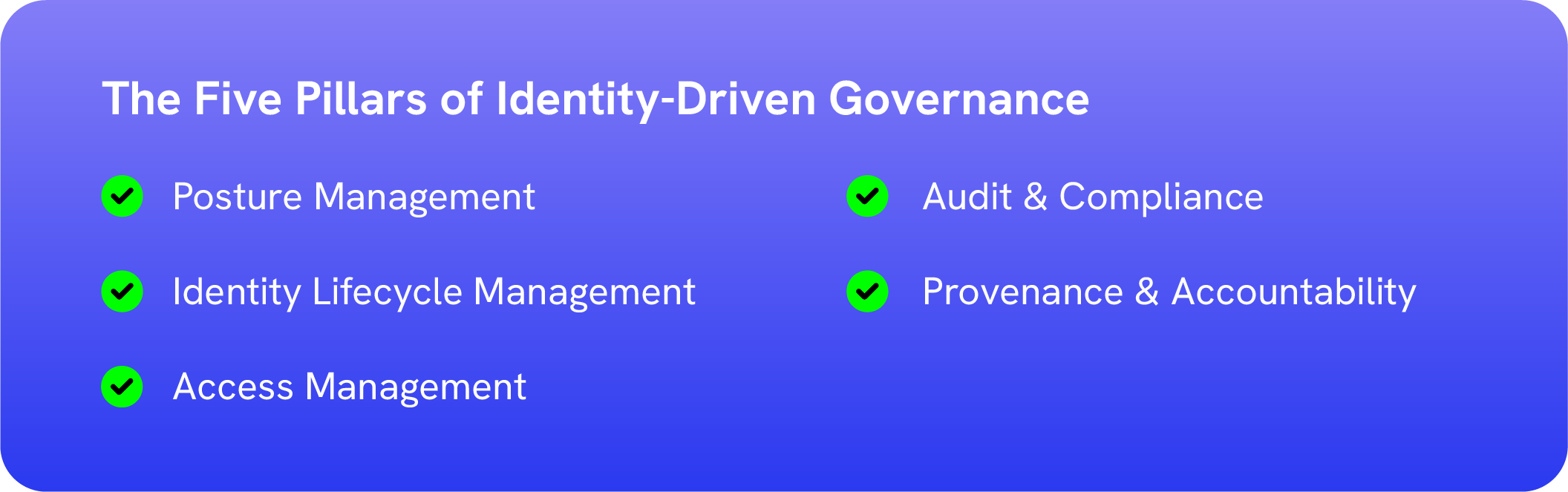
The Five Pillars of Identity-Driven AI Governance 

Through countless workshops and real-world implementations, five pillars have consistently emerged as the essential path to securely governing AI identities:

1. Posture Management (You cannot protect what you don’t see) 

Start with comprehensive discovery—you need to know every AI identity operating in your environment, whether sanctioned or shadow. Establish visibility by mapping actual resource access across your infrastructure. Implement timeline-based tracking to maintain historical records of who accessed what, and when. 

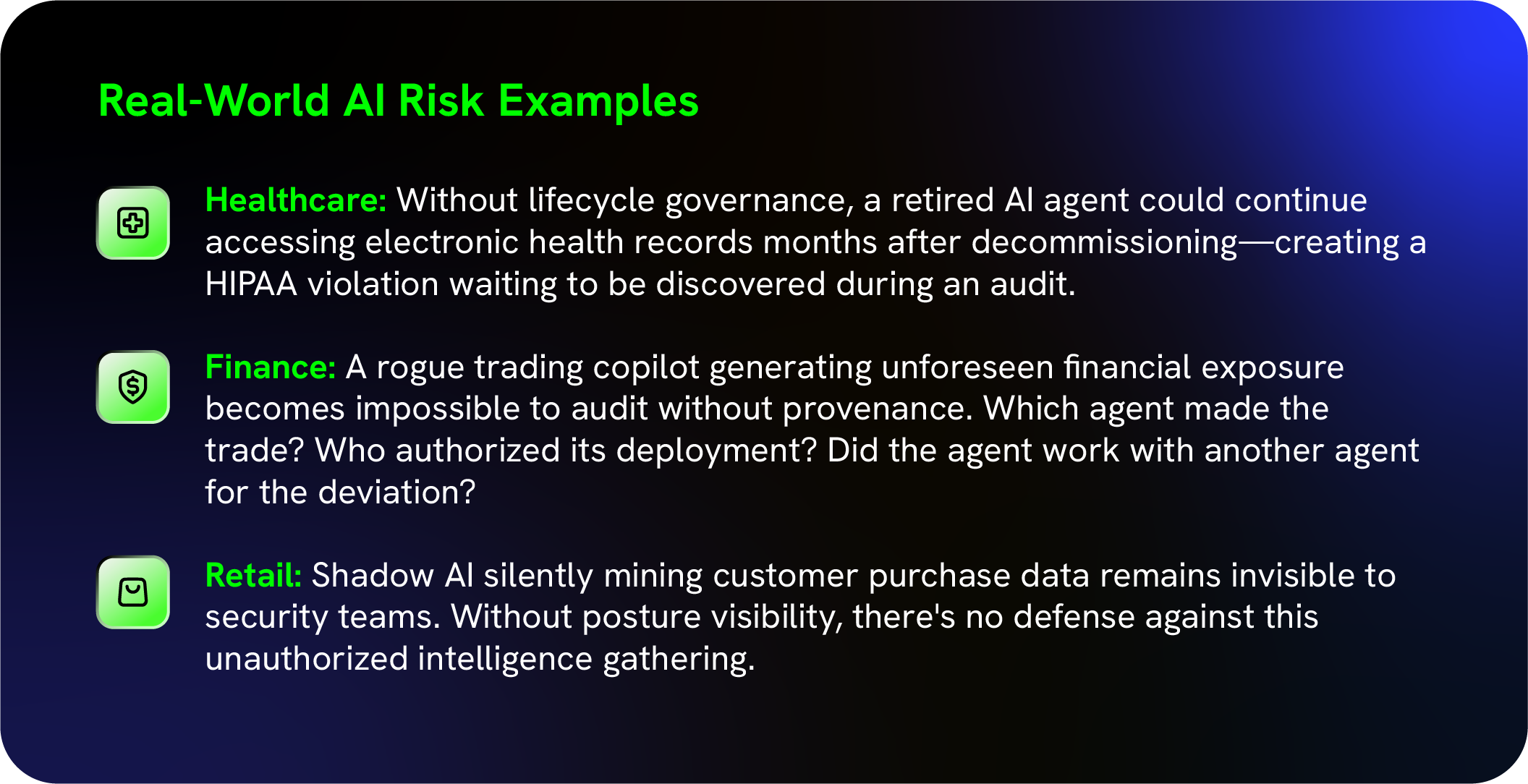
Consider this potential risk moment: A customer support bot that suddenly begins querying HR databases flags a potential breach instantly. Without posture management, this anomaly might go undetected for weeks.

2. Identity Lifecycle Management (Every Agent is an identity. Every identity needs governance) 

Enroll AI agents and MCP servers through formal registration services, just as you would human employees. However, the registration process could be completely invisible, automated, and embedded in your agent development pipelines. Assignment of least-privilege policies is a must — no agent should launch with broader access than necessary. Enforce continuous certifications, access reviews, and offboarding workflows that might mirror your processes for human users but is predominantly agentic, invisible and automated.  

Missing Identity Lifecycle Management (ILM) could result in an uncertified finance bot receiving a capability upgrade but retaining its privileged access to sensitive financial systems. Without lifecycle controls, this dangerous combination persists indefinitely.

3. Access Management

Shadow AI risks spiral unchecked without proper gatekeeper controls in place. Deploy runtime access gateways that verify and validate each AI request against current policy. Enable scoped delegation tokens for agent-to-agent workflows, ensuring that access is contextual and time-bound. 

An example of a best practice would be a development bot that can read source code repositories but cannot push changes to production environments without a human in the loop making the necessary decisions. Enforcement of authorization checks at run time is an absolute must for designing identity security systems for agents. 

4. Audit & Compliance

Maintain agent activity that ties every AI action to specific run IDs, creating an unbreakable chain of accountability. Generate audit-ready posture reports that can definitively show whether AI agents accessed personally identifiable information, or even events such as ownership changes, guard rail changes or any kind of security configuration changes.  

A key use case is where your access timeline becomes a critical audit artifact during compliance reviews, proving exactly which agents accessed regulated data along with the authorization policies used. 

5. Provenance & Accountability (Autonomous behavior of agentic workflows make this really hard)

Building comprehensive provenance chains in agentic workflows both for impersonation and delegation scenarios is an absolute must to achieve decision attribution and demonstrate accountability. Retain human accountability alongside explainable AI agent actions—automation shouldn’t obscure responsibility. Provide transparency that regulators and customers increasingly demand, offering full context rather than just outcomes. 

Here’s an example involving loan approvals: When an AI system denies or approves a loan application, you must be able to show the exact policy, data inputs, and agent or group of agents reasoning that led to that decision. Without provenance, you’re flying blind into regulatory scrutiny. 

Callout 2@2x

Weaving Identity into AI Systems – Security Fabrics 

Imagine an architectural hub—an Identity Security Fabric—that weaves together all these pillars: 

Posture Engine continuously discovering and inventorying agents.

  • Lifecycle Service registering and applying policies to each agent throughout its operational lifespan.  
  • An Access Gateway enforcing runtime checks before any action executes.  
  • An Audit Ledger recording actions immutably for compliance and forensics.  
  • Provenance Graph anchoring every output to its origins. 

This fabric integrates seamlessly in your ecosystem to protect all identities including humans, non-humans and now AI agents. The missing piece in most architectures today? Identity-first governance specifically designed for AI. 

Callout 3@2x

Why This Matters—Not Just Tech, But Strategic 

Each of the scenarios listed throughout this post underscores an inescapable truth: identity is where AI security begins and ends

AI is here, and enterprises stand at a critical inflection point. Those that build identity-first structures—governing posture, lifecycle, access, audit, and provenance—will define competitive advantage for the next decade. Others will find themselves trapped in perpetual compliance catch-up mode, reacting to breaches and regulatory penalties. 

Companies that fail to evolve their identity infrastructure stand to lose far more than data. They risk losing customer trust, regulatory favor, and brand integrity—assets that, once damaged, take years to rebuild.  

Closing Thought 

We’ve been here before—with cloud adoption, SaaS proliferation, and container orchestration. It took years, and often painful security incidents, for the industry to realize that identity must underpin security architecture. AI accelerates faster than any technology wave before it. We don’t have years to figure this out 

Embedding identity at the heart of AI governance isn’t optional anymore—it’s imperative. The organizations that act now will transform AI from existential risk into strategic trust advantage. And they’ll do it with identity at the core. 

Coming Up: In our next post, we’ll dive into the first critical pillar: Posture Management. We’ll explore how to discover Shadow AI lurking in your environment, establish comprehensive visibility, and build risk scoring that lets you prioritize what matters most. 

AI agents are here. Your identity strategy isn’t ready.

AI agents are here. Your identity strategy isn’t ready – SailPoint

AI agents don’t behave like humans. They don’t behave like machines. They’re something entirely new, and that’s exactly the problem.

These autonomous, goal-seeking entities are capable of reasoning, deciding, and acting on their own. They spin up in minutes, operate 24/7, and make millions of decisions per hour. With access to sensitive systems and data, they don’t follow predefined workflows or wait for human direction. They execute. Relentlessly.

While human identities are onboarded through HR systems and machines follow structured, predictable rules, AI agents operate with human-level intelligence at machine speed. They don’t show up in your HRIS. They’re not provisioned through traditional IT channels. And yet, they are rapidly multiplying across enterprise environments, often without anyone noticing.

This shift is creating a crisis of speed and scale in identity governance and security.

Traditional identity playbooks are breaking

Identity programs were designed around two fundamental models: human users and machine accounts. Both come with clear ownership, predictable behavior patterns, and lifecycle hooks for onboarding, offboarding, and access management.

AI agents don’t fit these models. They’re ephemeral, dynamic, and self-directed. They use OAuth tokens and SSO credentials, bypass traditional provisioning processes, and often act outside established governance frameworks. They’re already operating in your environment: connecting to APIs, ingesting data, and making decisions with far-reaching consequences.

Manual oversight doesn’t scale here. Static roles and infrequent access reviews won’t keep up. And the further enterprises lean into AI, through copilots, assistants, and intelligent automation, the wider this visibility gap grows.

A new identity model for autonomous agents

Two central security and governance problems have emerged in my conversations with business leaders: How do you ensure that agents are bound by the same entitlements as the humans they represent, and how do you ensure that humans don’t get access to more data than they are permitted through the agents they are accessing?

To solve these problems and secure AI agents more broadly, we need to redefine what governance looks like. That starts by treating these agents as first-class identities—just like humans and machines—but governed according to their unique behaviors and risks.

Here’s what that requires our industry to work towards:

  • Governing the entire access chain. You can’t secure what you can’t see. You need visibility into the non-deterministic agent access pathways: Human User/Owner –> Agent -> Machine -> App -> Data -> Cloud resources, or different combinations of this chain.
  • Real-time policy engines. Organizations need continuous visibility into every agent in their environment: what it’s doing, where it’s operating, and what it can access, to be able to enforce policies in real-time.
  • Short-lived credentials and dynamic scoping. Agents must operate with the least privilege possible. That means short-lived, narrowly scoped credentials that expire quickly and don’t grant persistent access.
  • Just-in-time, context-aware access controls. Access should be granted only when needed, and only if contextual signals (like location, workload, or user approval) support it.
  • Continuous, behavioral monitoring at machine speed. Governance doesn’t stop at access control. Continuous, real-time monitoring is essential to detect anomalous behavior and stop agents that go off-script before they cause harm.
  • Assigned accountability. Every AI agent should have a designated human owner responsible for reviewing its activity, governing its access, and decommissioning it when it’s no longer needed.

Ask the hard questions

Despite the growing adoption of AI agents, most organizations still can’t answer some of the most basic questions, like:

  • How many AI agents are operating in your environment right now?
  • What systems do they have access to?
  • Who is responsible for managing them?
  • Can you stop them if they begin to behave unexpectedly?

If your identity strategy doesn’t account for AI agents, the answer to most of these questions is likely “no.”

The agent economy has arrived

This isn’t a future problem. Thousands of AI agents are already active in enterprise environments, deployed by business units, third-party platforms, and external vendors. Some are governed. Most are not.

If you can’t govern it, you can’t secure it.

At SailPoint, we believe AI agents must be brought into the fold of identity security: monitored, controlled, and governed with the same rigor as any other identity. But doing so requires a shift from manual oversight to intelligent automation. From static controls to real-time enforcement. From old playbooks to new models.

The agent economy is already here. Now it’s up to identity leaders to catch up.


Securing Identity in the Age of AI: A Buyer’s Guide to Teleport

Securing Identity in the Age of AI: A Buyer’s Guide to Teleport – Teleport

As enterprises embrace AI, identity has become the defining security challenge. Every new database, Kubernetes cluster, SaaS app, and now every AI agent introduces yet another identity that must be governed and protected. At the same time, attackers are weaponizing AI to accelerate identity-based threats, exploiting fragmentation and credential sprawl to devastating effect.

For buyers evaluating how to secure modern infrastructure in this new landscape, the question is not whether identity is central to security — that debate is over. The question is how to unify and govern identity across both humans and AI systems without slowing down the pace of innovation.

This guide is designed for security leaders, engineering teams, and decision-makers exploring how Teleport addresses this challenge. You’ll find:

  • A breakdown of the problem and why AI compounds existing risks
  • Teleport’s approach to modern identity security
  • How Teleport secures new frontiers like MCP and AI agents
  • The risks you must consider as a buyer
  • Evaluation criteria and a phased adoption roadmap

💡 The Takeaway

By the end of this guide, you’ll understand why Teleport is not just another access tool, but a unified identity platform built for the realities of AI-powered infrastructure.

Executive Overview

The AI Identity Challenge

Modern infrastructure has outpaced traditional identity security models. Scale, complexity, and fragmentation of identity are now the root causes of today’s security challenges. Every new silo of identity — databases, Kubernetes, SaaS apps, or AI agents — expands the attack surface. IT teams can’t keep up, so responsibility falls to engineering and infrastructure groups already under pressure to move faster.

AI only accelerates these challenges. On one hand, it lowers the cost of executing identity-based attacks. On the other hand, the rise of LLMs and agentic AI — autonomous systems that plan, act, and interact across tools — introduces a flood of unpredictable events and new classes of identities that legacy security tools cannot govern.

Teleport’s Answer: Cryptographic Identity

Teleport redefines identity for modern infrastructure. The Teleport Infrastructure Identity Platform implements trusted computing at scale, delivering unified cryptographic identities for humans, machines, workloads, endpoints, infrastructure assets, and AI agents.

Unlike fragmented point solutions, Teleport vertically integrates:

…into a single platform.

With Teleport, anonymous actors disappear. Every access request is tied to a cryptographic identity bound to a fingerprint, device, and short-lived certificate. Access is scoped to a single unit of work and expires as soon as that task is complete. Teleport calls this steady-state computing: when nothing is happening, no one has access.

The Final Outcome

The result is a consistent security foundation that scales with modern infrastructure and AI. Humans and agents alike are provisioned, governed, and audited under one model. Standing privileges vanish, policies remain consistent, and every action is attributable and accountable.

With this foundation in place, organizations can turn to two of the fastest-growing frontiers in enterprise security — MCP and AI agents.

Understanding MCP and AI Agents

As organizations embrace AI, new protocols and workflows emerge that require first-class governance. Teleport extends its identity-first approach into this evolving landscape.

MCP

The Model Context Protocol (MCP) is an open standard that connects large language models to enterprise resources and applications. In Teleport, MCP is treated no differently than SSH, Kubernetes, or databases — a protocol governed by the same identity-based, policy-driven controls.

By applying Secure MCP, organizations gain consistent access control and identity governance across humans and workloads. Every MCP privilege is:

  • Short-lived
  • Scoped to the task
  • Fully auditable

Agentic AI

Agentic AI describes autonomous systems capable of chaining actions across APIs, databases, and internal tools. Today, many of these agents operate outside proper governance, often using static credentials or ad hoc integrations.

Teleport changes that model by treating agents as first-class identities. Each receives:

  • Cryptographic certificates
  • Task-scoped privileges
  • Automatic expiration

This ensures AI agents cannot accumulate excessive privileges or persist beyond their intended unit of work.

Humans in the loop

Teleport preserves human oversight. By linking prompts to agent actions, every step an AI system takes is tied back to a human origin, creating a transparent audit trail that maintains accountability and policy alignment.

With MCP and agentic AI secured under one model, the next challenge is addressing the risks they bring.

Risks & Challenges

Every organization faces a dual set of risks: long-standing security weaknesses in infrastructure, and new AI-specific threats that compound them. Teleport addresses both.

General risks

1. Over-privileged access
Agents or users requesting broad access can wreak havoc. Teleport enforces least privilege through just-in-time, task-scoped access.

2. Credential sprawl
Passwords, SSH keys, and tokens remain the #1 attack vector. Teleport replaces them with short-lived cryptographic certificates.

3. Audit blindness
Fragmented logs obscure accountability. Teleport provides end-to-end monitoring and real-time alerts across the identity chain.

4. Human error
Misconfigurations, phishing, and mistakes remain common. Teleport removes the conditions that make errors exploitable by design.

AI-specific risks

AI introduces novel risks, which organizations must now factor into their security posture. In 2025, OWASP elevated AI/LLM security to Flagship Project status, identifying three top threats:

OWASP ThreatWhat It MeansHow Teleport Solves
Prompt Injection / Tool Description PoisoningHidden malicious instructions embedded in tool descriptions.End-to-end identity chain monitoring, session recording, and least privilege bound by task.
Insecure Plugin DesignWeak plugins or static credentials expose back-end resources.Secure MCP eliminates static credentials, enforcing cryptographic, short-lived identities.
Excessive AgencyOver-privileged AI agents chaining across APIs.Agentic AI Identity provisions ephemeral, task-scoped certificates and just-in-time requests contextualized to intent.

Teleport extends these protections further with MCP Catalog, a curated list of approved AI tools wrapped in identity governance and policy enforcement.

💡 The Takeaway

Together, these guardrails prevent AI from becoming an unmanaged silo, giving buyers the confidence that AI adoption won’t expand risk exposure.

Securing the Full Surface Area

Modern infrastructure demands security that spans every layer of interaction. Teleport’s principle is simple but powerful:

Treat every prompt, API call, and agent action as an identity event.

Here’s what this principle looks like in practice.

1. LLMs & users
Guardrails, dual attribution (human + model), and boundary controls guarantee accountability.

2. Agents & backend
Ephemeral, cryptographic IDs scoped by RBAC/ABAC provide traceability. Session recording and interactive controls offer full auditability.

3. Unified identity everywhere
From SSH to databases to APIs, Teleport enforces zero-trust, policy-driven access while eliminating shared secrets.

This unified approach makes identity the connective tissue for security across both classic infrastructure and AI-driven systems.

Buying Criteria

Choosing a security platform today requires forward-looking criteria that address both legacy infrastructure and the realities of AI.

Teleport delivers on the following:

✔ Unified cryptographic identity for humans, workloads, and AI agents.
✔ Just-in-time, task-scoped ephemeral certificates.
✔ One governance language spanning Zero Trust Access and Identity Governance.
✔ End-to-end, audit-grade accountability.
✔ Identity-based zero trust enforcement across all protocols.
✔ Shadow access detection and remediation.
✔ Cloud-agnostic integration across AWS, Azure, GCP, and on-prem.

These are not “nice-to-haves.” They are the baseline requirements for securing the future of identity.

Implementation Path

Modernizing identity doesn’t have to be overwhelming. Teleport recommends a phased approach:

1. Start in steady state
No one has access unless a change is occurring. All access is issued as short-lived certificates tied to specific work.

2. Deploy in phases
Replace VPNs and secrets with Zero Trust Access, then layer on Identity Governance, and finally expand into Identity Security.

3. Add AI incrementally
Treat MCP as just another protocol. Secure MCP, Agentic AI Identity, and MCP Catalog are natural first steps for AI infrastructure.

This path allows organizations to quickly eliminate risk while building toward long-term resilience.

Why Teleport for AI Security

Teleport is not just another access tool. It’s a new approach to identity security, adapted for modern infrastructure and AI.

  • Eliminate secrets and standing privilege.
  • Unify access and governance across humans, workloads, and AI.
  • Expose and remediate hidden identity risks.
  • Adopt steady-state computing: no access unless work is happening.
  • Treat agents as first-class identities, not unmanaged silos.

By securing every identity — human or machine, static or dynamic, classic or AI — Teleport delivers the foundation organizations need to innovate confidently in the era of AI.

Learn more about Teleport for securing AI infrastructure and identity, or reach out to see how it works in person.


Why Full Non-Human Identity Coverage Requires Connecting to Systems Everyone Else Can’t See

Why Full Non-Human Identity Coverage Requires Connecting to Systems Everyone Else Can’t See – Token Security

There’s a foundational difference between human and Non-Human Identity (NHI) infrastructure, and it’s critical to securing the systems that actually run your business.

First, human identity management centralized and then moved to the cloud. IDPs like Active Directory, Okta, and Google Workspace enabled centralized employee access and made single sign-on the standard. It was a straightforward shift because human access follows predictable patterns: users log in, use a few approved apps, and leave an audit trail.

Nonhuman identity never had that luxury.

Instead of centralizing, NHI has gone the opposite way by fragmenting across services, environments, protocols, and networks. Every database, workload, CI/CD pipeline, API client, and server has its own authentication mechanism, secrets model, and identity silo. And nowhere is this more visible than in the infrastructure no one wants to touch: self-hosted databases, on-prem servers, and air-gapped networks.

The Blind Spot No One Talks About

Most modern security tools were built with SaaS-first assumptions where everything is internet-accessible, API-driven, and easy to integrate with agentless methods. That works for part of the problem.

But what about the Postgres server in your private subnet? Or the Active Directory instance running in your telecom’s local data center? Or the Snowflake environment that’s deliberately disconnected from the public internet to comply with healthcare data regulations?

These aren’t edge cases. They’re common. They’re critical. And they’re almost entirely invisible to agentless security platforms.

This is a problem Token Security has solved.

Reaching the Unreachable

To provide full enterprise coverage of NHIs including the ones no one else can see, we built a lightweight, container-based reverse proxy that allows secure, encrypted access to internal environments.

Here’s how it works:

  • A Token Security proxy agent is deployed inside your private network. It’s just a container that can run on Docker, Kubernetes, or any other standard environment.
  • The proxy establishes an outbound connection to the Token Security platform using a tunneling protocol with mutual TLS encryption. It’s based on the Fast Reverse Proxy open-source project.
  • Once connected, Token Security can securely query internal services as if it had local access without introducing new attack surface or requiring intrusive network changes.

This isn’t theoretical. Customers are using it in production:

  • A federal healthcare organization needed visibility into service accounts accessing Snowflake, but its Snowflake instance is disconnected from the internet because it hosts patient data. Our proxy made secure visibility possible without changing their network posture and violating compliance boundaries.
  • A global telecom provider with an extensive on-prem Active Directory environment uses Token Security to monitor service accounts and identity configurations across a sprawling, disconnected infrastructure.
  • Nearly every software company still runs some self-hosted databases like Postgres, either on-prem or in cloud VMs. These systems often rely on local, unmanaged credentials that fall outside of standard identity tooling. Token Security’s proxy makes those visible and governable.

Why This Matters for NHI Security

These isolated systems aren’t edge cases. They’re often where the most critical data and workloads live. And, they’re precisely the systems most vendors can’t reach.

We’re not trying to be an asset discovery tool or scan every subnet. If a customer wants Token Security to monitor an internal service, we give them a secure, low-friction way to connect it, even if it’s technically offline.

This capability gives Token a NHI discovery and visibility advantage that’s hard to overstate:

  • We secure NHI across cloud and self-hosted environments
  • We monitor systems that are invisible to agentless solutions
  • We do it without requiring architectural concessions or internet exposure

If you’re building infrastructure with real-world complexity, hybrid networks, legacy systems, compliance boundaries, you need NHI visibility that goes beyond cloud services and SaaS applications.

To learn more, request a demo of the Token Security Platform today.

Non-Human Identities (NHIs) vs. Machine Identities: Key Differences & Security Best Practices

Non-Human Identities (NHIs) vs. Machine Identities: Key Differences & Security Best Practices – P0 Security

What Are Non-Human Identities (NHIs) & Why Do They Matter?

Identity extends far beyond human users. Non-Human Identities (NHIs) have become an essential component of modern IT ecosystems, facilitating communication between devices, applications, and services. However, there is growing confusion in the market about what NHIs truly encompass, particularly when differentiating them from machine identities. Understanding these distinctions is crucial for organizations aiming to secure their environments effectively.

Defining Non-Human Identities (NHIs)

Non-Human Identities (NHIs) refer to digital identities that are not associated with individual human users. These identities can belong to:

  • Devices – IoT sensors, network routers, laptops, and mobile devices
  • Applications & Software – Cloud services, microservices, APIs
  • Automated Processes – Bots, service accounts, CI/CD pipelines
  • Legal Entities – Organizational identifiers, such as Legal Entity Identifiers (LEIs)
  • Animals – RFID-chipped pets or livestock in agricultural and regulatory settings

While NHIs encompass a broad category, machine identities are a specific subset of NHIs.

Machine Identities vs. NHIs: Key Differences Explained

Although machine identities fall within the broader NHI category, they are distinct in scope, management practices, and security concerns.

FactorMachine IdentitiesOther NHIs (e.g., Legal Entities, Service Accounts)
Scope & ApplicationDevices, workloads, cloud servicesSoftware bots, service accounts, legal entity identifiers
ManagementX.509 certificates, cryptographic keysPasswords, tokens, API keys
Security RisksUnauthorized machine-to-machine communicationUnauthorized API access, leaked credentials
Use CasesCloud infrastructure security, DevOps automationRegulatory compliance, organizational identity management

Understanding these distinctions helps organizations implement appropriate security measures for each type of NHI.

How to Secure NHIs: Best Practices for Identity Management

As NHIs proliferate, organizations face growing security and operational challenges. Here’s how to mitigate risks and improve NHI security:

1. Discover and Inventory All NHIs

  • Implement automated discovery tools to detect all NHIs in cloud and on-premises environments.
  • Maintain an up-to-date inventory of machine identities, service accounts, and automated processes.
  • Learn more about how service account key origins affect NHI security in this guide.

2. Centralize NHI Management

  • Use a unified identity management platform to handle machine and non-human identities in a single interface.
  • Establish governance policies for lifecycle management—ensuring NHIs are provisioned, monitored, and deprovisioned when no longer needed.

3. Enforce Least Privilege Access

  • Assign minimal permissions to NHIs based on their function.
  • Implement role-based access control (RBAC) and attribute-based access control (ABAC) to restrict identity permissions dynamically.
  • Understand how transitive access in GCP impacts privilege escalation risks in this article.

4. Strengthen Authentication & Credential Security

  • Use strong authentication mechanisms like X.509 certificates and OAuth tokens for machine identities.
  • Rotate and securely store API keys, secrets, and service account credentials to prevent unauthorized access.

5. Implement Continuous Monitoring & Threat Detection

  • Set up real-time monitoring for unusual NHI behavior, such as unexpected credential usage.
  • Use Identity Threat Detection and Response (ITDR) solutions to detect and mitigate identity-based threats.

FAQ: Addressing Common NHI Security Questions

Q: What’s the biggest risk with Non-Human Identities?

A: Unmanaged NHIs, like stale service accounts or exposed API keys, can be exploited by attackers for lateral movement.

Q: How should organizations prioritize NHI security?

A: Start with discovery, enforce least privilege, and implement automated monitoring to detect unauthorized NHI usage.

Q: How is a machine identity different from an NHI?

A: All machine identities are NHIs, but not all NHIs are machines. Machine identities specifically apply to workloads, devices, and cloud services, whereas NHIs also include software bots, legal entities, and RFID-tagged animals.

Conclusion

Non-Human Identities (NHIs) are essential to digital ecosystems, but organizations must clearly differentiate between machine identities and other NHIs to implement effective security controls. While machine IAM focuses on securing workloads and devices, broader NHI governance includes service accounts, API keys, and even legal entities.

By following best practices in discovery, management, access control, and monitoring, organizations can reduce security risks and ensure NHIs remain an asset rather than a liability. The key is to implement identity-first security strategies that account for the growing complexity of non-human entities in cloud-driven environments.

Additional Resources & References

Beyond Secrets: How Managed Identities Are Transforming Multicloud Security

Beyond Secrets: How Managed Identities Are Transforming Multicloud Security – GitGuardian

Managed identities offer a paradigm shift from “what fo you have”to “who you are” authentication, providing automated, short-lived credentials that eliminate credential sprawl across multicloud environments.

As organizations embrace cloud-native architectures and microservices, the number of machine identities such as applications, containers, CI/CD pipelines, and IoT devices has exploded. Security experts call this a “machine-first world” where non-human actors vastly outnumber human users.

This transformation has exposed the fundamental weakness of traditional secret management. For decades, organizations have relied on static secrets like API keys, passwords, and tokens that function as unique identifiers for workloads.  While this approach provides clear traceability, it creates an operational nightmare of manual lifecycle management, rotation schedules, and the constant risk of credential leakage.

What Are Managed Identities

Rather than embedding static credentials into applications, modern platforms now provide identity services that issue short-lived, automatically rotated credentials to authenticated workloads. This includes cloud providers, CI/CD systems, and other infrastructure platforms.

How Major Platforms Are Eliminating Static Credentials

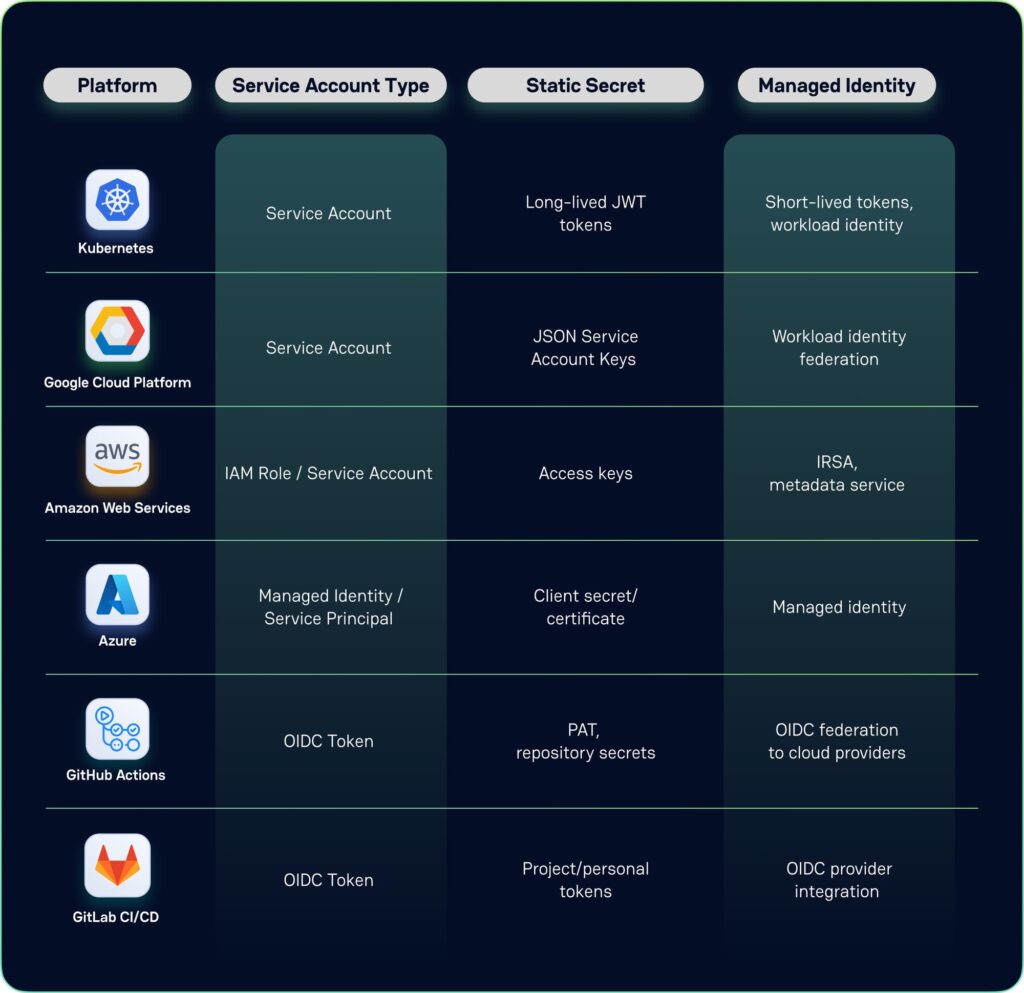
Each major cloud provider has developed sophisticated managed identity systems, though their approaches differ significantly. AWS pioneered the concept with IAM Roles for EC2 instances, where the metadata service automatically provides temporary credentials without requiring any static keys. This pattern has expanded to Lambda functions, EKS clusters through IAM Roles for Service Accounts (IRSA), and virtually every AWS service.

Azure took this concept further with Managed Identities that extend across their entire service portfolio. A Function App can seamlessly authenticate to Key Vault, Storage, and other Azure services using its managed identity, eliminating the need for connection strings entirely. Google Cloud’s approach centers on Service Accounts enhanced with Workload Identity Federation, enabling sophisticated scenarios where workloads running outside Google Cloud can authenticate using their existing identities.

The revolution extends beyond cloud providers to CI/CD platforms. GitHub Actions now supports OpenID Connect (OIDC) tokens that allow workflows to authenticate directly to cloud providers and other services without storing long-lived secrets. Similarly, GitLab’s OIDC provider enables CI/CD pipelines to obtain temporary credentials for cloud deployments, eliminating the need to store AWS access keys or Azure service principal secrets in pipeline variables.

The evolution is perhaps most visible in Kubernetes, where service accounts have transformed from simple static token holders to sophisticated identity bridges that can map to cloud IAM roles without ever exposing static credentials.

The Cross-Cloud Authentication Challenge: Why Static Secrets Don’t Scale

The complexity of this transformation becomes apparent when organizations operate across multiple clouds. Consider the perspective of a DevOps engineer managing a multicloud environment: “Having a workload in Azure that needs to read data from AWS S3 is not ideal from a security perspective. Cross-cloud authentication and authorization complexity makes it hard to set this up securely, especially if we choose to simply configure the Azure workload with AWS access keys to access S3.”

This real-world challenge has traditionally driven organizations toward centralized secret management solutions like CyberArk Secrets Manager or HashiCorp Vault, which provide a universal broker for secrets across platforms. While this approach offers centralized management and native synchronization capabilities, it perpetuates the fundamental problem: the proliferation of static secrets that require careful management and rotation.

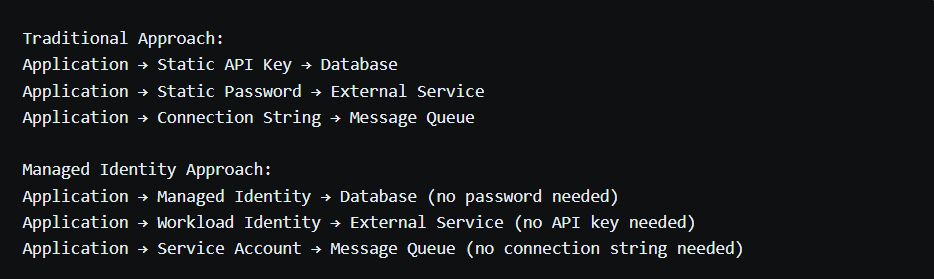
Managed identities fundamentally change this equation by eliminating many of the secrets that require synchronization in the first place. Instead of managing database passwords, service API keys, and connection strings across multiple clouds, organizations can leverage native identity systems that handle authentication dynamically.

What Managed Identities Replace: From Database Passwords to API Keys

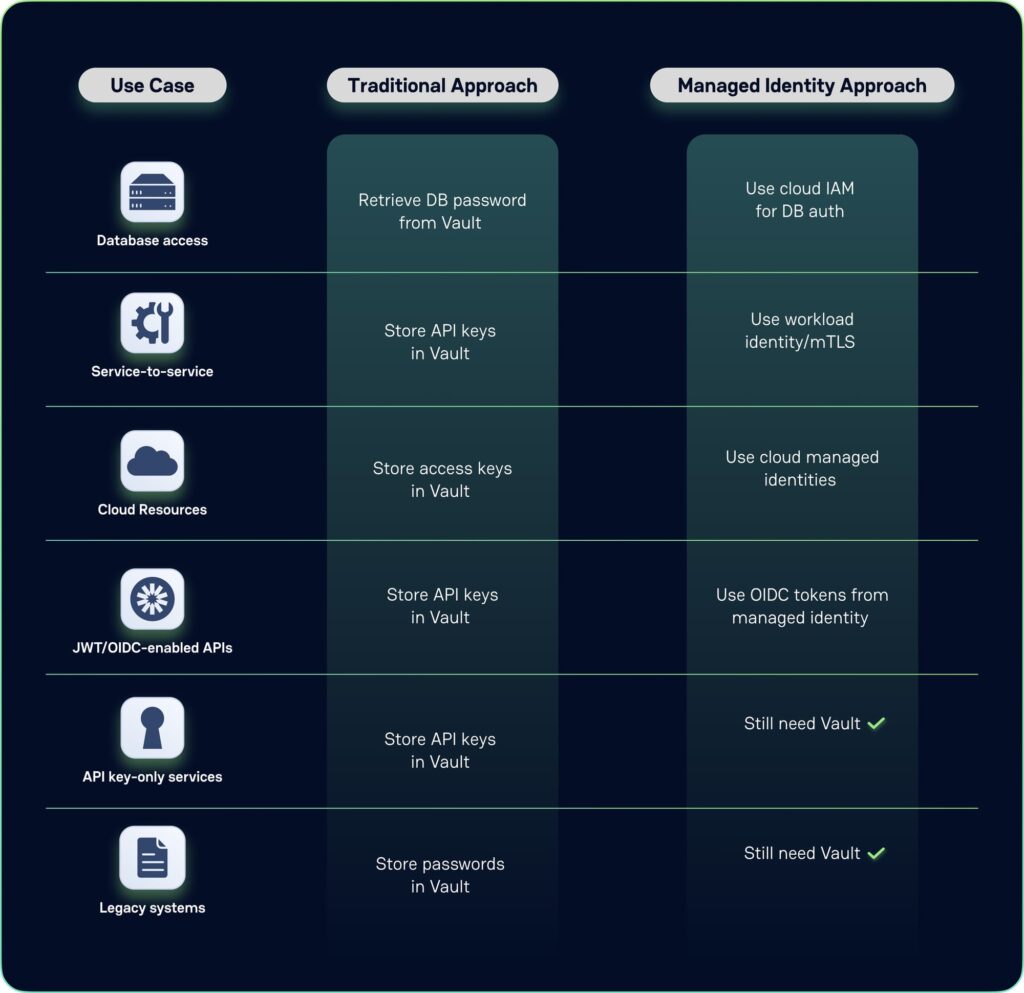
The transformation becomes clear when comparing traditional and managed identity approaches:

However, the reality is more nuanced. While managed identities eliminate many secrets, they don’t solve every authentication challenge. Third-party APIs still require API keys, legacy systems often can’t integrate with modern identity providers, and cross-organizational authentication may still require shared secrets.

The authors of “Solving the Bottom Turtle — a SPIFFE Way to Establish Trust in Your Infrastructure via Universal Identity” say: “using a secret manager dramatically improves the security posture of systems that rely on shared secrets, but heavy use perpetuates the use of shared secrets rather than using strong identities”. The goal isn’t to eliminate secret managers entirely, but to dramatically reduce their scope.

Architecture Patterns for the Real World

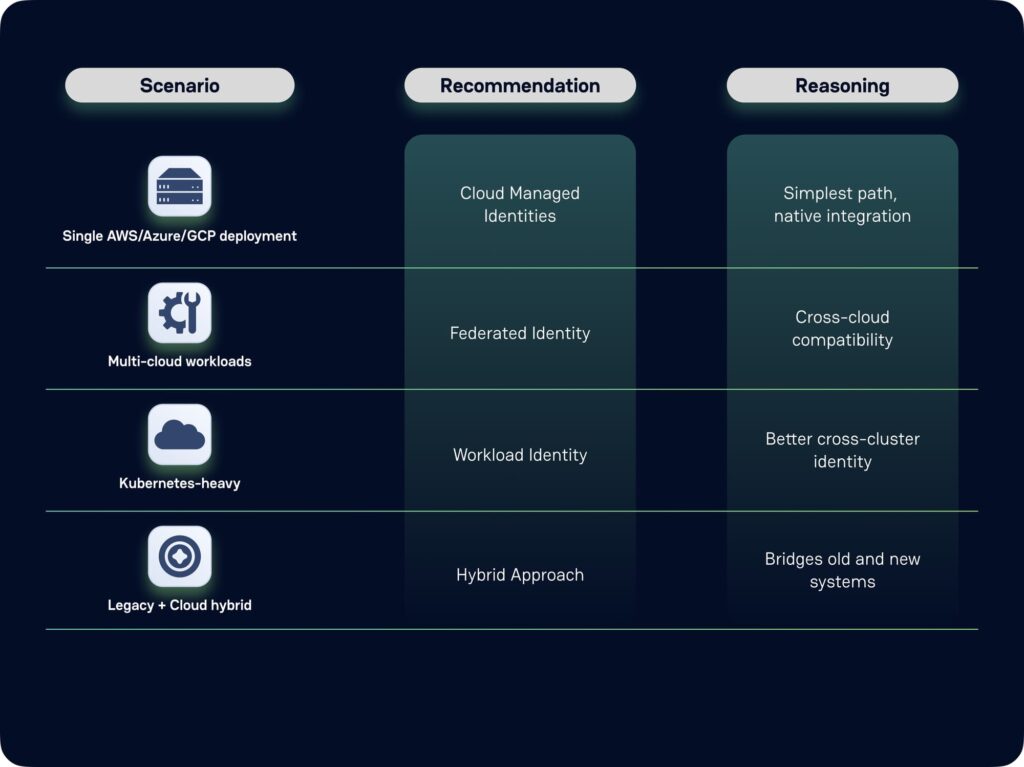
Modern multicloud architectures increasingly adopt a hybrid approach that strategically combines managed identities with traditional secret management:

This architectural pattern reflects the practical reality. Some workloads can fully embrace managed identities. Others need hybrid approaches that bridge different identity systems. And some still require traditional secret management for legacy systems that can’t be modernized.

The Economics of Identity

The business case for managed identities extends beyond security improvements. Organizations implementing these systems report dramatic productivity gains. Enterprise case studies document a 95% reduction in time spent managing credentials per application component, and a 75% reduction in time spent learning platform-specific authentication mechanisms, resulting in hundreds of saved hours annually.

The security benefits are equally compelling. By shifting from static credentials to cryptographic identities, organizations enable automatic rotation, reduce their attack surface, and create better audit trails. As one healthcare organization implementing managed identities noted, “We wanted to shift away from secret management practices in general. Instead of asking a service, ‘what do you have,’ we want to ask, ‘who are you'”.

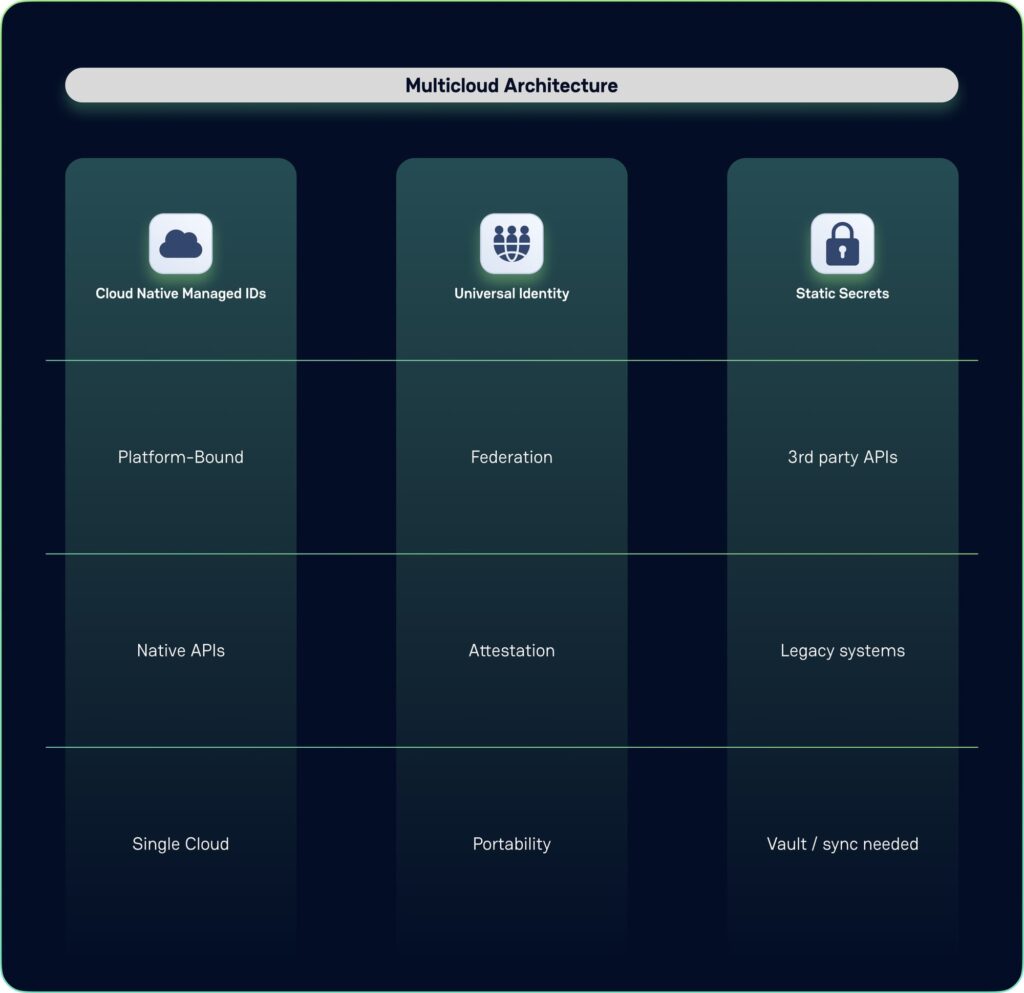
When to Use Cloud-Native vs. Universal Identity Solutions

The decision framework for managed identities depends heavily on your architectural context:

The migration path typically follows a predictable pattern: start with cloud-native workloads using platform-native managed identities, expand to cross-cloud scenarios through federation, and gradually reduce reliance on static secrets through automation and integration.

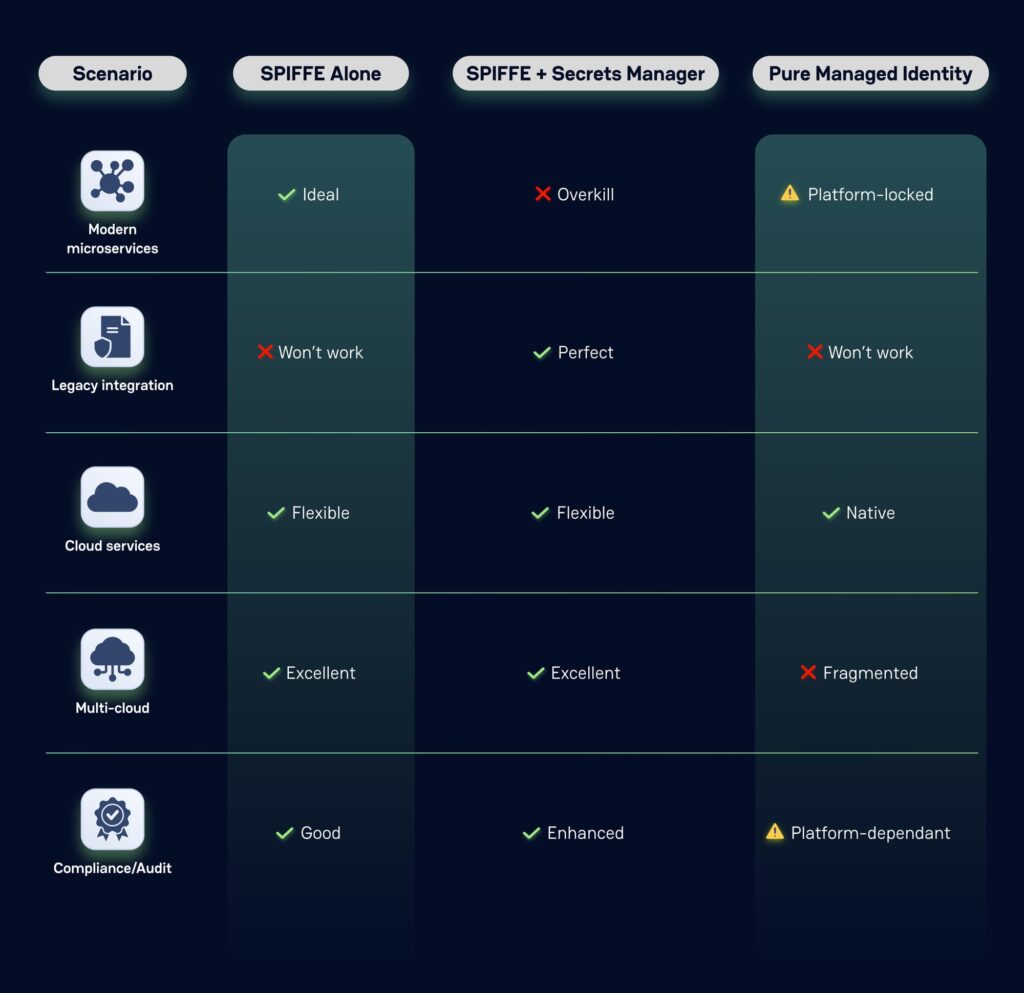
It’s important to understand how managed identities compare to other identity approaches. The choice isn’t always binary – sometimes you need a combination of strategies:

This comparison reveals why many organizations end up with hybrid approaches. Pure managed identities excel for cloud-native scenarios but struggle with legacy systems and true multi-cloud portability. Universal identity solutions provide flexibility but add operational complexity compared to simple, single-cloud managed identities.

Emerging Standards: Building Interoperable Identity Across All Platforms

The industry is converging on standards that will make managed identities even more powerful and interoperable. Emerging frameworks aim to create “a common language for workload identities across clouds and platforms,” enabling standard translation between identity formats and eliminating the custom integration work that currently complicates multicloud authentication.

This standards-driven future promises to resolve the tension between vendor-specific managed identities and the need for universal, portable workload identity. Organizations that begin their managed identity journey today are positioning themselves to take advantage of these emerging standards as they mature.

The transformation from secret management to identity management represents more than a technical upgrade—it’s a fundamental shift toward more secure, scalable, and maintainable authentication architectures. In a world where machine identities outnumber human users by orders of magnitude, managed identities provide the foundation for the automated, auditable, and secure systems that modern organizations require.

Defining Agentic Identity Security Platforms (AISP): Security for the Age of AI Agents

Defining Agentic Identity Security Platforms (AISP): Security for the Age of AI Agents – Britive

AI agents are already acting inside your cloud, querying systems, making decisions, and triggering workflows. But very few organizations have security models that account for how these agents behave. 

Agentic Identity Security Platforms (AISP) are emerging not as a niche toolset, but as a strategic imperative for CxOs tasked with securing tomorrow’s workforce, digital, human, and every combination in between. 

What Is AISP and Why Does It Matter? 

In their research note, Aragon defines AISP as essential infrastructure for organizations deploying AI agents and agentic systems. 

AI agents are not static scripts or bots with limited actions. They’re autonomous actors. They collaborate, reason, and take action across your cloud environment. 

But unlike humans, they can’t be gated with MFA. Unlike service accounts, they don’t follow static patterns and use tools on the fly to complete requests. 

And unlike legacy systems, their scale and scope are growing exponentially across departments, data sources, and workflows. They operate with machine-scale speed and unpredictability. 

Without real-time, context-aware access controls, these agents create an “Access-Trust Gap,” which describes the space between what an AI agent can do and what they should be allowed to do. 

As that gap grows, so are the risks. Over-permissioning, data leaks, lateral movement, prompt-driven attacks, and AI misuse becomes top of mind. 

AISP isn’t just a buzzword. It’s a strategic necessity. 

The Six Pillars of an Agentic Identity and Security Platform 

Every AISP must include the following capabilities: 

  • Agent Identity & Access Management: The ability to define, track, and authenticate autonomous agents. 
  • Data and Knowledge Protection: Prevent sensitive data misuse via exploits such as prompt injection or indirect access. 
  • Agent Operational Integrity and Resilience: Ensure agents act within safe bounds, even when communicating and orchestrating with other tools. 
  • Agentic Governance, Risk, and Compliance (GRC): Apply policy and controls for audit, regulation, and trust. 
  • Runtime Policy Enforcement: Authorize access dynamically based on intent, context, and allowed behavior. 
  • Human Oversight, Accountability, and Attribution: Maintain accountability with approvals, logging, and action traceability. 

Together, these capabilities allow organizations to apply Zero Trust principles like Just-in-Time access and least privilege, not just to users and service accounts, but to AI agents, as well. 

Why Britive’s Pioneering Efforts Were Recognized in AISP 

Britive’s foundation as a cloud-native, agentless, and API-first platform was built to solve identity sprawl across humans and machines. 

Today, it seamlessly extends these controls to AI agents by delivering: 

  • Ephemeral, task-based access for agentic workflows 
  • Dynamic policy enforcement based on behavior, context, risk, and intent.  
  • A unified access control plane across multi-cloud, hybrid, and SaaS environments 
  • Native support for emerging protocols like Model Context Protocol (MCP), and other emerging AI orchestration standards to enable fine-grained access for AI systems 

Britive isn’t just adapting to AI. We’re helping define how to secure it. AISP: Enabling Zero Trust for AI, Now 

Zero Trust isn’t just about human access anymore. In the age of AI, every autonomous system becomes a potential insider. 

Agentic Identity and Security Platforms offer a clear, actionable way to enforce least privilege, gain visibility, and reduce risk without waiting for complete security re-architecture. 

The shift to AI-powered operations is already underway. The time to establish strong foundations for security is now. 

Download a complimentary copy of the research note to learn how AISP is shaping the next chapter of enterprise security. 

The Fundamentals of NHI

The Fundamentals of NHI – Andromeda Security

NHIs (non-human identities) have become a top risk as enterprises adopt Cloud and SaaS, and breaches involving NHIs rise, driving this vulnerability to the top of CISO priority lists. 

An NHI is a digital identity linked to an application or service, empowering it to execute actions on target systems or resources. Developers, systems, and applications rapidly generate NHIs to enable automated interactions during cloud adoption, software development, and integration of third-party services. These identities are pivotal in driving automation and facilitating seamless integration across cloud services, SaaS platforms, and on-premises applications. 

NHI challenges for security

With the rising prevalence of NHIs in modern ecosystems, implementing robust management and security is vital to protecting against unauthorized access and mitigating risks. The main challenges that have increased the need for greater security include:

  • Lack of NHI visibility: NHIs’ dynamic and ephemeral nature impacts visibility and traceability. It is challenging to know how many NHIs have been created or where they live across multiple platforms, directory services, and cloud integrations. Many NHIs operate in the shadows, making tracking their numbers, usage, and access permissions extremely difficult.
  • Excessive and Uncontrolled Permissions: NHIs are granted more privileges than necessary, creating significant security risks through potential privilege escalation.
  • Ineffective Lifecycle Management: NHIs often become stale or inactive, with some accounts remaining unused for years, dramatically increasing the potential attack surface. In addition, human lifecycles are tied to NHI and must be addressed simultaneously. 

In this blog post, we discuss three core elements that play a role in NHI security: entitlements, credentials, and client security. We outline how their use dictates your security plan, explain why entitlements are critical, and offer best practices for securing credentials and clients. 

Note: the term ‘credential’ in this article refers to authentication secrets such as API keys, access keys, certificates, etc., and the term ‘provider’ refers to a public cloud or SaaS provider.

The Elements of NHI for Security

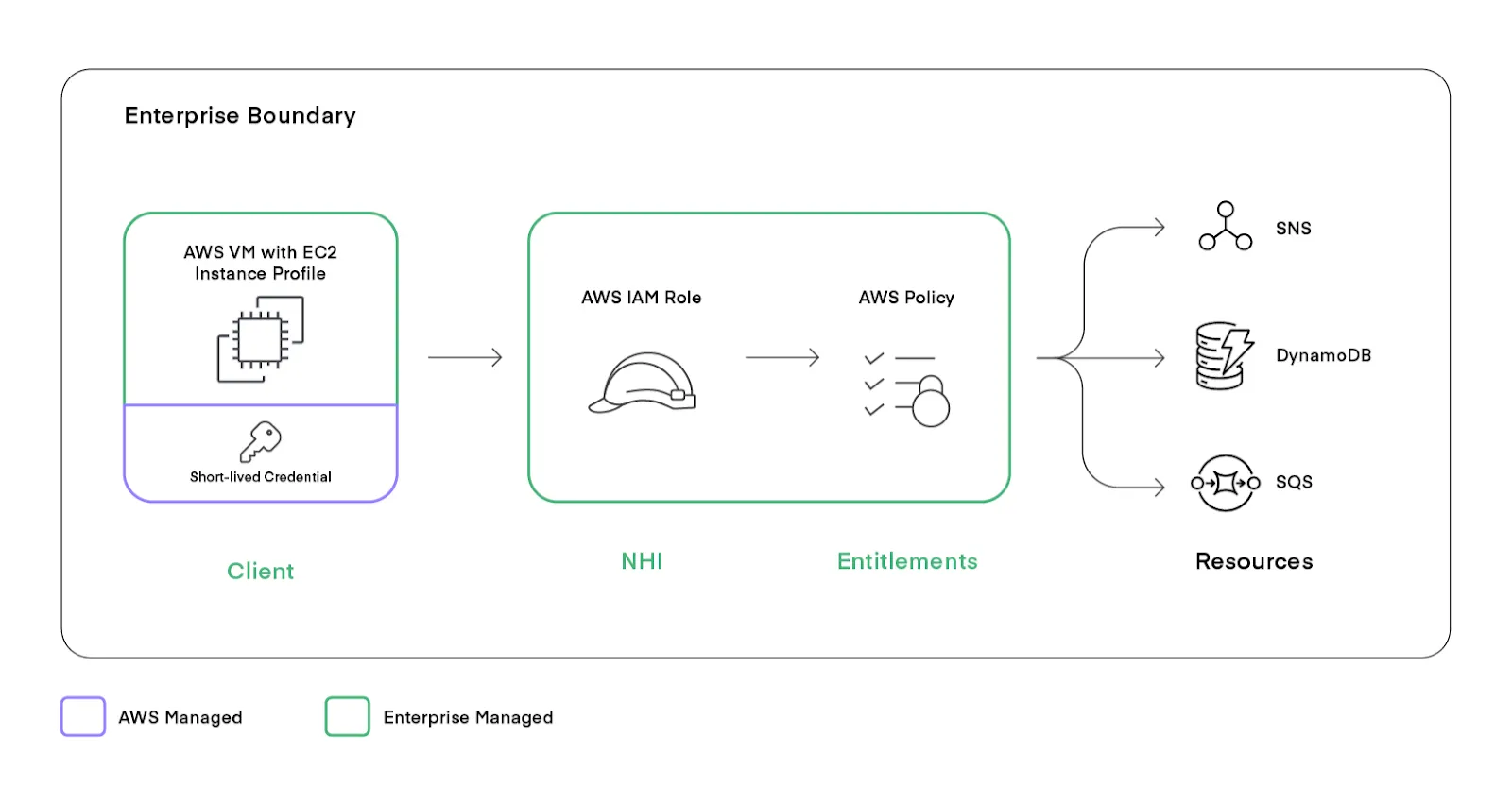
When an NHI is created, three elements must be managed and secured: its credentials, entitlements, and the client that uses it.

A client (an application or a workload) uses an NHI to perform actions on one or more resources using a set of entitlements (permissions). In this process, the client application authenticates using a credential to establish its identity.

The Elements of NHI for Security
  1. Credentials

    Non-Human Identities (NHIs) must use one of the supported authentication methods (username/password, access keys, API keys, key pairs, certificates) to authenticate and establish their identity.

    Advanced authentication methods like multi-factor authentication and passwordless solutions are not supported for NHIs.

    Credential management is crucial to reduce the risk of a compromise, and it may be owned by the enterprise or the cloud provider.

    Best Practice: Utilize short-lived credentials wherever possible to limit the chance of a compromise.
  2. Entitlements

    NHIs are assigned specific privileges that define the actions they can perform on a target system or resource.

    If an NHI is compromised, the attacker gains access to these privileges, determining the scope of the potential attack surface.
    The enterprise is responsible for ensuring that only the necessary privileges are assigned.

    Sometimes, the entity requiring the NHI may provide a predefined role with the necessary privileges. In other cases, the enterprise must determine and assign the appropriate privileges.

    Best Practice: Ensure the least privilege for entitlements as it is the enterprise’s final line of defense and is under its control.
  3. Client Using the NHI

    The client application or workload using the NHI must be secured against unauthorized access.

    Responsibility for the security of the workload or the client application lies with the cloud provider, the enterprise, or a third party, depending on who controls it.

The key takeaway is that entitlements control your attack surface. While securing all three elements is essential, if entitlements are rightsized to least privilege, even if a credential or client is compromised, the business impact is greatly reduced. The attacker is severely constrained. 

NHI Security Implications

An NHI can be used in four ways, depending on who is responsible for credential management, who is responsible for entitlement management, and where the client workload is located. Below, we discuss these use cases and their security implications.

  • Provider-managed NHI
  • Shared ownership NHI
  • Enterprise-managed NHI
  • External Client NHI

Provider-managed NHI

In this case, the enterprise creates an NHI for a required cloud service, which the cloud provider completely manages.

The three aspects of NHI security discussed above apply in this case:

  • Credentials: The enterprise has no explicit credentials to manage. The provider creates short-lived credentials within the workload and is responsible for the credentials’ lifecycle (periodic rekey). 
  • Entitlements: The provider also manages entitlements for the NHI.
  • Client: The ​​workload/application where the NHI is used. The provider owns and manages the client and is responsible for its security.

Example: 

In AWS, the AWSServiceRoleForBackup is an example of Provider-Managed NHI. It helps backup resources in AWS and has entitlements to list/read resources and copy them to the S3 bucket/EBS volume for backup.

The Enterprise is only responsible for creating the NHI when they require the backup service. The AWS cloud provider is responsible for defining NHI and its short-lived credentials. AWS also defines the NHI’s entitlement and is accountable for the security of the workload (AWS Backup Service) where the NHI is used.

Provider-managed NHI

Shared ownership NHI

In shared ownership,  the provider and the enterprise jointly manage the NHI:

  • Credentials: The enterprise has no explicit credentials to manage. The provider creates short-lived credentials within the workload and is responsible for the credentials’ lifecycle (periodic rekey). 
  • Entitlements: The enterprise controls entitlement management. It decides what permissions are required for the NHI. 
  • Client: While the workload/application runs within the cloud provider, the enterprise is responsible for securing access to the workload.

Example: 

In AWS, an EC2 instance with an instance profile or a Lambda service can be linked to an IAM Role with a list of permissions. An Azure-managed Identity with role assignment would also fall into this category. The application runs in the cloud provider’s VM service, which manages the lifecycle and injection of temporary credentials. The enterprise is responsible for defining the permissions required for the application and the security of the client VM, and AWS is responsible for managing the short-lived credentials. 

Shared ownership NHI

Enterprise-managed NHI

 When the NHI is entirely managed by the enterprise, the security looks like: 

  • Credentials: The NHI requires explicit credentials, which the enterprise manages.
  • Entitlements: The enterprise controls entitlement management. The enterprise decides which permissions the NHI requires.
  • Client: Two scenarios exist:
    • The application/workload runs within the enterprise’s network boundary, and the enterprise is responsible for injecting the credentials into the workload/application and securing the workload where the application is running.
    • The application/workload runs externally in a third-party application. The enterprise shares the credentials with the third party, who is responsible for injecting the credentials into the workload/application and securing the workload where the application is running.

Example:

An AWS IAM User with an Access Key and Role assignment or Entra/Azure Service Principal with Key and Role assignment falls into this category. The NHI can be used from anywhere: inside the enterprise network (case 1 below) or externally (case 2 below) to perform actions on the target system or resource.

Case 1:

Enterprise-managed NHI

Case 2:

External (Third-party) Client NHI

In this case, a third party (external entity) creates and manages the NHI credentials. The enterprise trusts the NHI and manages the entitlements. The NHI is used by the third-party entity to perform actions in the enterprise’s cloud environment. 

  • Credentials: No explicit credential is created in the enterprise. Instead, a cross-organization trust is established between the enterprise and the third-party entity. The external third party creates and manages the NHI credentials.
  • Entitlements: The enterprise controls entitlement management. The enterprise decides which permissions are required for the NHI.
  • Client: The third-party entity owns the workload/application and, in collaboration with the enterprise, is responsible for its security. 

Example: 

An example of an NHI in this category is a role-to-role trust established between a third-party entity’s AWS account and a role in the target enterprise’s AWS Account. In Azure, the Service Principal in the customer’s Entra domain trusts a registered Application in a third-party Entra domain, and the Service Principal has assigned roles in the target enterprise’s Azure environment.

External (Third-party) Client NHI

Summary

Credentials, entitlements, and clients/workloads must all be managed to secure your NHIs. Credential and client compromises will happen; in many cases, they are outside the enterprise’s control. To maximize security, the two best practices an enterprise can follow are

  1. Whenever possible, use the NHIs with short-lived credentials. This will reduce the need to manage and secure credentials and the chance of a credential compromise.
  2. Entitlements are the most important aspect. Maintain least privilege on the entitlements, which guarantees a limited attack surface even in case of a breach.

How Andromeda Security Can Help

Andromeda Security discovers all NHI credentials, entitlements, and workloads and helps customers manage and secure them through:

  • Full discovery of NHIs and all credentials and details of clients using these NHIs
  • Complete lifecycle management of NHI credentials
  • AI-driven insights into NHI behavior patterns with recommendations and remediation steps to remove unused credentials and inactive NHIs
  • Least privilege Entitlement management, including access and usage visibility at the fine-grained permissions level, with recommendations and remediation steps to remove all unused permissions
  • Identification of shared NHIs across multiple applications with permissions rightsizing recommendations for each application
  • Behavior analytics and anomaly alerts on client NHI usage

Mastering Machine Identity Management: The Key to Securing Non-Human Identities (NHIs)

Mastering Machine Identity Management: The Key to Securing Non-Human Identities (NHIs) – Akeyless

Posted by Miryam Brand

Introduction: The Silent Threat of Non-Human Identities

Today’s enterprise environments are no longer composed only of human users. Applications, services, containers, and IoT devices, collectively known as non-human identities (NHIs), far outnumber human counterparts. These machine identities require authentication and authorization to interact with systems and data, just like users do. However, while organizations often invest heavily in securing human identities through SSO, MFA, and IAM policies, machine identities are typically underprotected, creating a significant and growing vulnerability.

Failure to manage NHIs effectively exposes organizations to breaches, operational disruptions, and regulatory violations. This gap is where Machine Identity Management (MIM) steps in.

Machine Identity Management Explained

Machine Identity Management (MIM) refers to the processes, tools, and policies used to manage and secure the identities of non-human entities such as applications, services, devices, and containers. These identities are authenticated via secrets—API keys, certificates, credentials—that must be properly issued, rotated, and revoked to minimize risk.

The primary types of NHIs include:

  • APIs: Secured through API keys, tokens, and certificates.
  • Service Accounts: Non-human users with often excessive privileges.
  • Virtual Machines and Containerized Services: Foundational elements of modern cloud-native and DevOps environments.
  • Databases: Critical repositories of enterprise data requiring secure authentication methods.
  • Physical Devices and IOT: Requiring secure certificate-based communication.

Each NHI typically uses secrets to authenticate, making secrets management a core component of machine identity security.

Why Machine Identity Management Is Critical

Securing non-human identities is no longer optional in today’s digital landscape. As machine identities continue to proliferate at an unprecedented pace, organizations must recognize the essential role Machine Identity Management (MIM) plays in protecting their environments.

1. Expanded Attack Surface

Each unmanaged or outdated NHI credential represents a potential vulnerability attackers can exploit. As enterprises increasingly adopt cloud-native technologies with vast numbers of interconnected workloads, the attack surface multiplies rapidly, making effective management of machine identities paramount.

2. Enabling Zero Trust and Least Privilege

The Zero Trust security paradigm—embodied by the principle “never trust, always verify”—demands rigorous authentication and restricted access for all entities, including NHIs. Enforcing least privilege ensures machine identities only have minimal permissions required to perform their tasks, significantly mitigating risks.

3. Compliance and Auditability

Regulatory frameworks such as GDPR, HIPAA, and DORA mandate auditable, traceable access controls that extend explicitly to NHIs. Robust MIM practices enable organizations to meet these requirements effectively, demonstrating comprehensive oversight of non-human access to sensitive resources.

Learn more about MIM: Akeyless Glossary: Machine Identity Management

How Machine Identity Management Works: Key Practices

Inventory and Discovery: Visibility First

You cannot protect what you don’t know exists. Building a comprehensive inventory of NHIs and their associated secrets is the foundational step in effective machine identity management. Organizations must deploy automated discovery tools to continuously scan infrastructure, pipelines, and applications. These tools help identify hidden machine identities, often automatically generated in dynamic cloud environments, and uncover shadow credentials—such as API keys or tokens embedded directly in source code or configuration files.

A centralized inventory system is essential to maintain visibility. It should document each NHI’s ownership, purpose, location, and credential status, regularly audited to address unmanaged or orphaned identities. This proactive approach prevents hidden vulnerabilities from becoming entry points for attackers.

Lifecycle Management: From Issuance to Revocation

Machine identities, like human identities, must be carefully managed through every phase of their lifecycle.
Neglecting any stage, especially early ones like issuance, can lead to severe security vulnerabilities.

Key lifecycle stages:

1. Issuance: Establishing Trusted Identities

Issuance refers to the secure generation and validation of a machine identity at the moment of creation, often involving a cryptographic binding between a public key and the entity’s metadata (such as its service name or role).

For certificates, this step is critical:

  • A Certificate Authority (CA) must validate the NHI’s legitimacy.
  • A digital certificate must be securely generated and signed.
  • Trust chains must be established to ensure the machine identity can be verified across environments.

Example:A Kubernetes workload issues a certificate signing request (CSR) at deployment time. The CA validates the request, signs the certificate, and delivers it securely back to the workload.

Why Issuance Matters:
If an identity is issued without strong validation, attackers can impersonate legitimate services. Poorly controlled issuance undermines all downstream security efforts.

2. Provisioning: Credential Distribution and Initialization

After issuance, credentials, whether certificates, API keys, tokens, or SSH credentials, must be securely distributed to the intended workload or device.

  • Credentials must be injected securely (e.g., via dynamic secret injection).
  • Secrets should never be hardcoded into application code or static configuration files.
  • Least-privilege policies should be applied immediately.

Example:A newly provisioned database container automatically retrieves an API key from a secure vault during its startup process.

Key Pitfall to Avoid:
Provisioning credentials manually or insecurely often leads to secret exposure, especially through misconfigured pipelines.

3. Rotation: Minimizing Credential Lifetime

Once credentials are in use, they must be rotated regularly to minimize the risk window in case they are compromised.

  • Secrets like tokens, API keys, and certificates should have built-in expiration times (time-to-live or TTL).
  • Rotation workflows should be automated to avoid human error or missed updates.
  • DevOps teams should design pipelines to handle rotated secrets without service interruptions.

Example:A production web server automatically renews its TLS certificate 30 days before expiration without requiring manual intervention.

Key Pitfall to Avoid:
Relying on long-lived credentials increases exposure time if they are leaked.

4. Revocation: Immediate Shutdown of Compromised Identities

When an identity is no longer needed, or if a credential shows signs of compromise, it must be revoked immediately.

  • For certificates, revocation lists (CRLs) or Online Certificate Status Protocol (OCSP) services should be updated.
  • API keys, tokens, and service accounts must be disabled and decommissioned.
  • Monitoring systems should alert when revoked credentials are still used (indicating possible attacks).

Example:A service account detected exhibiting anomalous behavior is immediately disabled and its credentials revoked through an automated security orchestration playbook.

Key Pitfall to Avoid:
Leaving old or unused credentials active creates major opportunities for attackers to hijack abandoned access.

Why Full Lifecycle Management Matters

Each stage—IssuanceProvisioningRotation, and Revocation—builds on the previous one.
A weak issuance process cannot be fixed by good rotation practices. Similarly, revoking credentials only matters if you had clear ownership tracking from the moment of provisioning.

Bottom line:
MIM without a disciplined, complete lifecycle model is like locking your front door but leaving the windows wide open.

Secure Access and Least Privilege Enforcement: Reducing Risk

Strong access controls are crucial for minimizing the risks tied to machine identities. To be effective, identity-based access policies must clearly define the specific permissions assigned to each machine identity, ensuring they can only interact with the resources necessary for their role. Precision is key: even minor over-permissioning can create serious vulnerabilities.

Role-Based Access Control (RBAC) offers a practical way to organize and streamline permission management. By categorizing machine identities based on their functions, organizations can efficiently assign appropriate access rights, reducing administrative complexity and human error.

Additionally, adopting Zero Standing Privileges (ZSP) strengthens security by removing persistent access rights. Instead of maintaining continuous permissions, machine identities receive temporary, just-in-time access when required, closing off potential avenues for abuse. Regular audits and dynamic adjustments of permissions are essential to ensure that machine identities maintain only the access they truly need, blocking lateral movement and escalation opportunities.

Combining clearly scoped access policies, RBAC grouping, and ZSP practices creates a layered, resilient defense against unauthorized activities, aligning perfectly with Zero Trust principles.

Automation and Monitoring: Scaling Without Losing Control

Managing machine identities at scale demands a strategy built on automation and proactive monitoring. Manual processes simply cannot keep pace with the sheer volume and velocity of identities created in modern cloud-native environments.

Automation ensures that critical steps in the credential lifecycle, from issuance to provisioning, rotation, and revocation, are handled swiftly and consistently. Automating these processes not only reduces human error but also enforces security policies uniformly across highly dynamic systems. In addition, dynamic secret injection at runtime eliminates the risk of credentials being hardcoded into applications or exposed during deployment.

Equally important is continuous monitoring. By leveraging advanced analytics and behavioral baselines, organizations can quickly detect anomalies or suspicious activities linked to machine identities. This real-time visibility enables faster threat detection and response. Automated incident response workflows, triggered by specific monitoring alerts, allow security teams to act immediately, minimizing potential damage and maintaining a resilient security posture.

Integration with Existing Security Infrastructure: No Identity Left Behind

Machine Identity Management (MIM) cannot operate in isolation. For security to be truly effective, MIM must seamlessly integrate into an organization’s broader security ecosystem. This integration ensures that machine identities are managed with the same rigor as human ones and that security gaps do not emerge between systems.

Embedding secret management directly into CI/CD pipelines is critical. Doing so ensures that credentials are securely handled throughout the software development lifecycle without relying on manual processes that introduce risk. Similarly, integrating with Certificate Authorities (CAs) automates the issuance, renewal, and revocation of certificates, maintaining continuous trust across dynamic environments.

Connecting MIM to Security Information and Event Management (SIEM) systems enhances visibility and enables real-time threat detection. Centralized logging and analysis allow security teams to quickly spot anomalies related to machine identity usage. Additionally, using advanced vulnerability scanners to identify misconfigured or exposed secrets across infrastructure proactively closes potential security gaps before they can be exploited.

By weaving MIM into existing security infrastructure, organizations can create a unified, resilient defense: one where no identity is overlooked, and every machine identity is accounted for and protected.

Looking Ahead: Secretless Authentication and Securing Agentic AI

As enterprise environments evolve, Machine Identity Management (MIM) must stay ahead of new challenges. One major trend is the shift toward secretless authentication—a model that eliminates the reliance on static secrets such as passwords, tokens, or embedded keys. Instead, secretless authentication uses identity-based trust frameworks, dynamic validation, and real-time attestation. By validating identities without transmitting or storing long-lived credentials, organizations dramatically reduce their attack surface. This approach pairs perfectly with ephemeral architectures like microservices, containers, and serverless workloads, where identities must be established and verified in milliseconds. The adoption of secretless methods will enhance scalability, simplify operations, and deliver a much higher standard of security in increasingly complex, distributed environments.

At the same time, the rise of autonomous, agentic AI systems presents new and unique security challenges. These AI-driven entities are capable of making decisions, interacting with other systems, and even spawning new processes without human intervention. Traditional static access policies are insufficient for securing such dynamic behaviors. To protect agentic AI, organizations must implement adaptive security frameworks based on continuous behavior monitoring, dynamic risk scoring, and context-aware access decisions. Strong cryptographic proofs of identity, real-time anomaly detection, and policy engines capable of evaluating AI-generated actions on the fly will be critical. As agentic AI becomes more central to business operations, securing these identities will be essential to maintaining trust, preventing rogue behavior, and safeguarding enterprise environments from an entirely new class of sophisticated threats.

Why Akeyless is the Right Partner for Machine Identity Management

As the complexity of securing machine identities continues to grow, organizations need a trusted partner capable of delivering comprehensive, scalable solutions. Akeyless is uniquely positioned to meet these evolving demands with a platform that addresses every critical aspect of Machine Identity Management (MIM).

Our Unified Secrets and Non-Human Identity Management Platform provides end-to-end coverage, including the issuance, rotation, and revocation of credentials, keys and certificates, across dynamic, hybrid, and multi-cloud environments. With built-in automation and Just-in-Time credential creation and revocation capabilities, Akeyless eliminates manual credential management processes, reducing human error and enabling seamless scaling as your environment grows.

Akeyless also empowers organizations to integrate secretless authentication practices, aligning with future-forward security architectures designed for ephemeral workloads and serverless operations. Our platform supports continuous monitoring and real-time visibility into credential usage, providing proactive detection of anomalies and rapid incident response.

Powered by our proprietary Distributed Fragments Cryptography™ (DFC) technology, Akeyless ensures that even we cannot access your secrets, delivering unparalleled privacy, security, and regulatory compliance. Additionally, by embedding secret management into CI/CD pipelines, automating certificate lifecycle processes, and integrating tightly with SIEM and vulnerability management tools, Akeyless fits naturally into your existing security ecosystem without creating silos.

From securing modern DevOps workflows to protecting emerging agentic AI identities, Akeyless helps enterprises future-proof their security strategies while reducing operational complexity and total cost of ownership. Discover how Akeyless can help you master machine identity management and build a resilient, future-ready digital enterprise.

Want to learn more? Sign up for a free demo today.