AI governance is the set of roles, rules and checks an organisation uses to decide which AI it uses, who is responsible for it, and how its risks are kept under control.
This guide is for newcomers, students, career changers and managers who keep hearing the phrase "AI governance" and want to know what it means in practice. It explains the idea in plain English, walks through how a simple governance process works, gives a worked example and suggests first steps a small team can take this week. You do not need any security or legal background.
By the end of this guide you will be able to:
- Explain what AI governance is and what it is not.
- Understand why every AI tool needs a named owner.
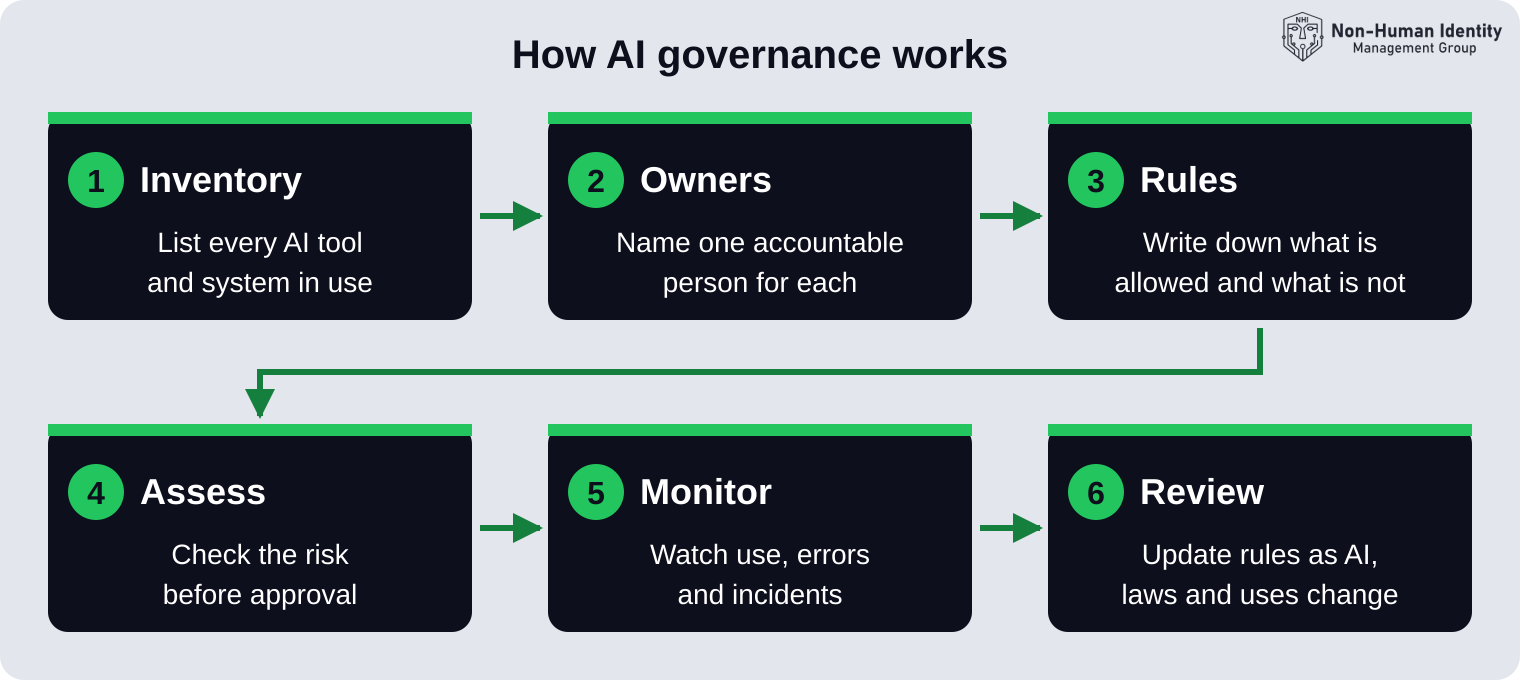
- Describe the six basic steps of a simple governance process.
- Identify the main frameworks and laws people mean when they talk about AI governance.
Key takeaways
- Governance is about decisions and ownership. It answers "who decides, who is responsible, and what are the rules" for every AI tool you use.
- You cannot govern what you cannot see. A simple list of the AI tools in use is the starting point.
- It is not only for big companies. A small business using a chatbot or an AI writing tool already has governance choices to make.
- Frameworks help you avoid starting from scratch. The NIST AI Risk Management Framework and ISO/IEC 42001 are widely used reference points.
- Some rules are now law. In the European Union, the AI Act places legal duties on many organisations that build or use AI.
What it is, in plain English
Artificial intelligence (AI) here means software that makes predictions, recommendations, decisions or new content, such as a chatbot that answers customers or a tool that sorts job applications. Governance means the way an organisation is directed and held to account. Put together, AI governance is how an organisation makes sure its AI is used on purpose, by the right people, for the right reasons, with someone answerable when things go wrong.
In practice, AI governance usually includes:
- An inventory: a list of the AI tools and systems in use.
- Owners: a named person who is accountable for each one.
- Policies: written rules, such as what staff may paste into a public chatbot.
- Approval and assessment: a check on the risks before a new AI use goes live.
- Oversight and monitoring: people watching how the AI behaves once it is in use.
A useful comparison is the rules for company vehicles. A business decides who may drive, which vehicles it owns, who maintains them, what driving is allowed and what happens after an accident. Those rules do not exist to stop people driving; they make driving safer and make someone responsible. AI governance does the same for AI tools. Where the analogy breaks down: a van behaves the same way every day, while an AI tool can give different answers to the same question and can change when its supplier updates it, so it needs more ongoing checking.
The US National Institute of Standards and Technology (NIST) puts governance at the centre of its AI Risk Management Framework. It describes the Govern function as one that cultivates a culture of risk management, and as a cross-cutting function that is infused throughout the other parts of AI risk management.[2]
Why it matters to you
- If you run a small business: staff may already be using free AI tools with customer data. Simple rules help you avoid leaking information or relying on wrong answers without anyone checking.
- If you are new to a security job: you are likely to be asked "which AI do we use, and who approved it?". Governance gives you a way to answer.
- If you are a manager: you may be accountable for decisions an AI tool helps to make. Governance gives you a clear record of who agreed to what, and why.
AI brings familiar risks, such as data leaks, and some newer ones, such as confident but wrong answers or unfair outcomes. NIST lists the characteristics of trustworthy AI as valid and reliable; safe; secure and resilient; accountable and transparent; explainable and interpretable; privacy-enhanced; and fair with harmful bias managed.[3] Governance is how an organisation decides which of these matter most for each use, and who checks them.
Law is catching up as well. The EU Artificial Intelligence Act, Regulation (EU) 2024/1689, was adopted on 13 June 2024.[6] The European Commission says it entered into force on 1 August 2024, that its bans on certain practices and its AI literacy obligations have applied since 2 February 2025, and that it sorts AI into four risk levels: unacceptable, high, transparency and minimal risk.[5] If your organisation works in or sells into the EU, governance is one way to keep track of these duties.
How it works, step by step
Different frameworks use different words, but a simple governance process usually follows these steps. Before you begin, someone senior needs to agree that AI governance matters and give a person or small group the authority to run it.
- Inventory. Find and list every AI tool and system in use, including features built into software you already pay for. Record what each one does and what data it touches.
- Owners. Name one accountable person for each AI use. That person answers for how it is used, even if a supplier runs the technology.
- Rules. Write a short policy: which tools are approved, what data may and may not go into them, and when a person must check the output before it is used.
- Assess. Before a new AI use goes live, check the risks: what could go wrong, who could be harmed, and what controls are needed. Higher-risk uses get a closer look.
- Monitor. Once the AI is in use, watch for errors, complaints, misuse and incidents, and make it easy for staff to report problems.
- Review. Revisit the inventory, rules and assessments on a regular schedule and whenever the AI, the law or the way you use it changes.
Useful distinctions
- Governance is not the same as risk management. Governance sets who decides and what the rules are. AI risk management is the work of finding, rating and reducing specific risks inside those rules. NIST treats governance as the function that informs the others.[2]
- Governance is not the same as AI security. AI security protects AI systems and data from attack. Governance is broader: it also covers fairness, legal duties, accountability and whether an AI use should happen at all.
- A framework is not a law. NIST describes its AI Risk Management Framework as intended for voluntary use.[1] ISO/IEC 42001 is an international standard that sets requirements for an AI management system, and organisations can choose to be certified against it.[4] The EU AI Act, by contrast, is law where it applies.[6]
- Principles are not procedures. High-level principles, such as the OECD AI Principles adopted in 2019 and updated in 2024, set values like transparency and accountability.[7] Governance turns those values into owners, rules and checks.
A worked example
Harbour Dental is a fictional group of three dental practices with 30 staff. Maya, the operations manager, notices that receptionists are using a free AI chatbot to draft patient letters, and that the booking software has just switched on a new "AI assistant" feature.
Maya does not ban AI. She starts small:
- Inventory: she asks each practice which AI tools they use. The list has four items, including one nobody in management knew about.
- Owners: she makes herself owner of the booking assistant and asks Tom, the senior receptionist, to own the letter-drafting tool.
- Rules: a one-page policy says staff may use the approved tool for drafting, must not paste patient names, health details or contact details into a public chatbot, and must read every letter before it is sent.
- Assess: before approving the booking assistant, Maya checks the supplier's documentation on where data is stored and whether it is used to train the supplier's models. She records what she found and the questions still open.
A month later, Tom spots that a drafted letter gave the wrong opening hours. Because there is a named owner and a "read before sending" rule, the error is caught before it goes out, and Tom adds a line to the policy about checking dates and times. Governance did not make the AI perfect. It made sure a person was watching, and that the lesson was written down.
Myths and misunderstandings
| What people think | What is true |
|---|---|
| AI governance is only for companies that build AI. | Organisations that buy or use AI tools have governance choices too, such as what data staff may put into them. |
| Governance means banning AI. | Good governance usually enables safe use: approved tools, clear rules and a named owner, rather than a blanket ban that staff work around. |
| Our supplier is responsible for everything. | Suppliers run the technology, but you decide how you use it and what data you give it. Responsibility is shared. |
| Once we have a policy, we are done. | AI tools, laws and uses change. Governance needs regular review and monitoring, not a one-off document. |
| Following a framework makes us compliant with the law. | Voluntary frameworks help organise the work, but they are not the same as meeting a specific law such as the EU AI Act. Check each legal duty separately. |
Key terms
- AI governance
- The roles, rules and controls an organisation uses to discover, approve, restrict, monitor and retire AI use, so it can manage what AI can reach and do.
- AI inventory
- A maintained record of the AI tools and systems in use, with owner, purpose, access and risk details.
- Risk owner
- The person accountable for a specific risk and for decisions to reduce, accept, transfer or monitor it.
- Acceptable AI use
- The conditions under which AI may assist, automate or influence decisions in a business process.
- AI impact assessment
- A structured review of how an AI system may affect people, operations and legal obligations.
- Human oversight
- A person remains responsible for reviewing, approving or correcting AI output before it leads to a significant action.
- AI management system
- The governance structure used to define accountability, monitor risk and control how AI is developed and operated; ISO/IEC 42001 sets requirements for one.
- AI literacy
- Enough understanding of what AI can do, where it fits and where it creates risk to use it sensibly.
- Responsible AI
- An approach that expects transparency, accountability, privacy protection and human oversight when AI influences decisions.
Common questions
What is AI governance in simple terms?
It is how an organisation decides which AI it uses, who is responsible for each use, and what rules and checks apply.
Is AI governance a legal requirement?
It depends on where you operate and what you do. The EU AI Act places legal duties on many providers and users of AI in the EU.[5] Frameworks such as the NIST AI RMF are voluntary.[1] Check with a legal adviser for your situation.
Who should own AI governance?
There is no single right answer. In a small business it may be the owner or operations manager. In larger organisations it is often a group that brings together legal, security, data, risk and business leaders. What matters is that someone has clear authority.
What is the difference between NIST AI RMF and ISO/IEC 42001?
The NIST AI RMF is a voluntary framework organised around four functions: Govern, Map, Measure and Manage.[1] ISO/IEC 42001, published in December 2023, sets requirements for establishing, running and improving an AI management system.[4] Many organisations use both.
Do we need special software?
Not to start. A spreadsheet inventory, a one-page policy and named owners are a sensible start. Dedicated platforms can help as AI use grows.
How often should we review our AI governance?
We suggest a regular review, for example every six or twelve months, plus a review whenever you add a new AI tool, a supplier changes a tool, or the law changes.
First steps
Three things you can do this week:
- Make a list. Ask each team which AI tools they use, including AI features inside existing software. Put them in one spreadsheet with what each does and what data it uses.
- Name owners. Give every item on the list a named owner who can answer questions about it.
- Write a one-page rule. State which tools are approved, what data must never go into public AI tools, and that people check AI output before relying on it. Where someone needs an exception, such as trialling a new tool, make it approved, recorded and time-limited, with a date to review it.
Checklist
- We have a current list of the AI tools and systems we use.
- Each AI use has a named, accountable owner.
- We have a short written policy on approved tools and the data that may go into them.
- New AI uses get a risk check before they go live.
- A person reviews AI output before it is used for important decisions.
- Staff know how to report an AI problem or mistake.
- Exceptions to our AI rules are approved, recorded and time-limited.
- We review the list, policy and assessments at least once a year and after major changes.
Check your understanding
1. What are the three questions AI governance answers for every AI tool?
Answer: who decides whether to use it, who is responsible for it, and what rules and checks apply.
2. Why is an inventory the first step?
Answer: you cannot set owners, rules or checks for AI tools you do not know about.
3. Is the NIST AI Risk Management Framework a law?
Answer: no. NIST describes it as intended for voluntary use. Laws such as the EU AI Act are separate.
4. How is AI governance different from AI risk management?
Answer: governance sets the roles and rules; risk management is the work of finding, rating and reducing specific risks within them.
Suggested learning pathway
- Governance, Risk and Compliance for Beginners: a related beginner guide to read next.
- Responsible AI for Beginners: a related beginner guide to read next.
- For the bigger picture of protecting AI, start with AI Security for Beginners.
- For safe day-to-day use of chatbots by staff, read the Safe Use of AI Chatbots Guide.
- For the risk work inside governance, continue with AI Risk Management for Beginners.
- For how governance and risk management fit together, see AI Governance vs AI Risk Management.
- For a full practitioner programme, read the AI Governance Guide.
- To build your first inventory, use the AI Register and AI Inventory Template.
- For the main framework and law, see the NIST AI RMF Guide and the EU AI Act Compliance Guide.
Standards and references
- AI Risk Management Framework. National Institute of Standards and Technology (NIST). AI RMF 1.0 (NIST AI 100-1) released 26 January 2023. https://www.nist.gov/itl/ai-risk-management-framework, accessed 27 Nov 2026.
- AI RMF Core, Section 5. NIST AI Resource Center, National Institute of Standards and Technology. https://airc.nist.gov/airmf-resources/airmf/5-sec-core/, accessed 27 Nov 2026.
- AI Risks and Trustworthiness, Section 3. NIST AI Resource Center, National Institute of Standards and Technology. https://airc.nist.gov/airmf-resources/airmf/3-sec-characteristics/, accessed 27 Nov 2026.
- ISO/IEC 42001:2023 Information technology, Artificial intelligence, Management system. IEC Webstore, International Electrotechnical Commission, published 18 December 2023. https://webstore.iec.ch/publication/90574, accessed 27 Nov 2026.
- AI Act: regulatory framework for AI. European Commission, Shaping Europe's digital future. https://digital-strategy.ec.europa.eu/en/policies/regulatory-framework-ai, accessed 27 Nov 2026.
- Regulation (EU) 2024/1689 of the European Parliament and of the Council of 13 June 2024 laying down harmonised rules on artificial intelligence (Artificial Intelligence Act). EUR-Lex, Official Journal of the European Union. https://eur-lex.europa.eu/legal-content/EN/TXT/HTML/?uri=CELEX:32024R1689, accessed 27 Nov 2026.
- OECD AI Principles. OECD.AI Policy Observatory, Organisation for Economic Co-operation and Development (OECD); adopted 2019, updated May 2024. https://oecd.ai/en/ai-principles, accessed 27 Nov 2026.
Related NHI Mgmt Group resources: AI Security for Beginners · Safe Use of AI Chatbots Guide · AI Risk Management for Beginners