HIPAA is a United States federal law that sets national rules for how certain healthcare organisations, and the companies that work for them, protect people's health information.
This guide is for newcomers, students, career changers and managers who keep hearing "HIPAA" and want to know what it really means. It explains who the law covers, the main rules that sit under it, what happens when health data is exposed, and simple first steps. It stays at beginner level and links to our deeper guides on each rule.
By the end of this guide you will be able to:
- Explain what HIPAA is and who it applies to.
- Describe the Privacy, Security and Breach Notification Rules in plain English.
- Understand what a business associate is and why contracts matter.
- Identify practical first steps for a small team that handles health data.
Status: correct as at 27 November 2026, based on guidance from the US Department of Health and Human Services (HHS). Laws change; check the official text.
This guide explains the topic in general terms and is not legal advice.
Key takeaways
- HIPAA covers specific organisations, not all health data. It applies to health plans, healthcare clearinghouses, most healthcare providers, and the business associates that handle health information for them.
- Three rules do most of the work. The Privacy Rule says who may use and share health information, the Security Rule says how electronic health information must be protected, and the Breach Notification Rule says who must be told when it is exposed.
- Vendors are part of the picture. Cloud providers, IT firms and billing companies that handle patient data on behalf of a covered organisation are business associates and need a written agreement.
- The Security Rule is flexible, not a product list. It asks for a risk analysis and sensible safeguards that fit the size and complexity of the organisation.
- Many health apps sit outside HIPAA. Other laws, such as the US Federal Trade Commission's Health Breach Notification Rule, may apply to them instead.
What it is, in plain English
HIPAA stands for the Health Insurance Portability and Accountability Act of 1996, a US federal law (Public Law 104-191).[1] Congress recognised that electronic technology could erode the privacy of health information, so it required federal protections, and HHS wrote the detailed rules.[1] The HHS Office for Civil Rights (OCR) administers and enforces them.[2]
The information HIPAA protects is called protected health information (PHI): health information that identifies a person, or could reasonably be used to identify them, held or sent by a covered organisation or its business associate. It can be electronic, on paper or spoken, and it includes details about a person's health, their care and payment for that care.[2] When PHI is held or sent electronically, it is called electronic protected health information (ePHI).[3]
HIPAA has several rules issued by HHS. The four you will hear about most are:[1]
| Rule | What it covers, in one line | Where it lives |
|---|---|---|
| Privacy Rule | When PHI may be used or shared, and the rights people have over their own records. | 45 CFR Part 160 and Part 164, Subparts A and E[2] |
| Security Rule | Administrative, physical and technical safeguards for ePHI. | 45 CFR Part 164, with the safeguards in 164.308, 164.310 and 164.312[3] |
| Breach Notification Rule | Who must be told, and by when, after a breach of unsecured PHI. | 45 CFR 164.400 to 164.414[4] |
| Enforcement Rule | How HHS enforces all of these rules. | Described by HHS[1] |
A helpful comparison is a hospital's locked records room with a visitor book. The Privacy Rule decides who is allowed into the room and why. The Security Rule is the lock, the camera and the visitor book. The Breach Notification Rule says who must be told if the door is found open and files are missing. Where the analogy breaks down: most PHI today lives in software and cloud services, not one room, so the "room" is spread across many systems, suppliers and accounts.
Why it matters to you
- If you run a small business: a dental practice, therapy clinic or IT supplier to a clinic may be covered. The Security Rule is described as flexible and scalable, so safeguards can fit the size of the organisation.[3]
- If you are new to a security job: in US healthcare, many security tasks, such as access reviews, audit logging and vendor checks, trace back to HIPAA requirements, so you will be asked to show evidence for them.
- If you are a manager: you need to know whether your organisation is a covered entity or a business associate, who owns the risk analysis, and what happens in the first days after a breach.
The stakes are real. In the Change Healthcare Breach 2024, Change Healthcare reported to OCR that a ransomware attack resulted in a breach of PHI, and on 31 July 2025 it reported that about 192.7 million individuals were affected.[7] OCR's guidance on that incident shows how HIPAA links organisations together: business associates must tell the covered entities they serve, and the covered entities remain responsible for making sure people, HHS and, where needed, the media are notified.[7]
How it works, step by step
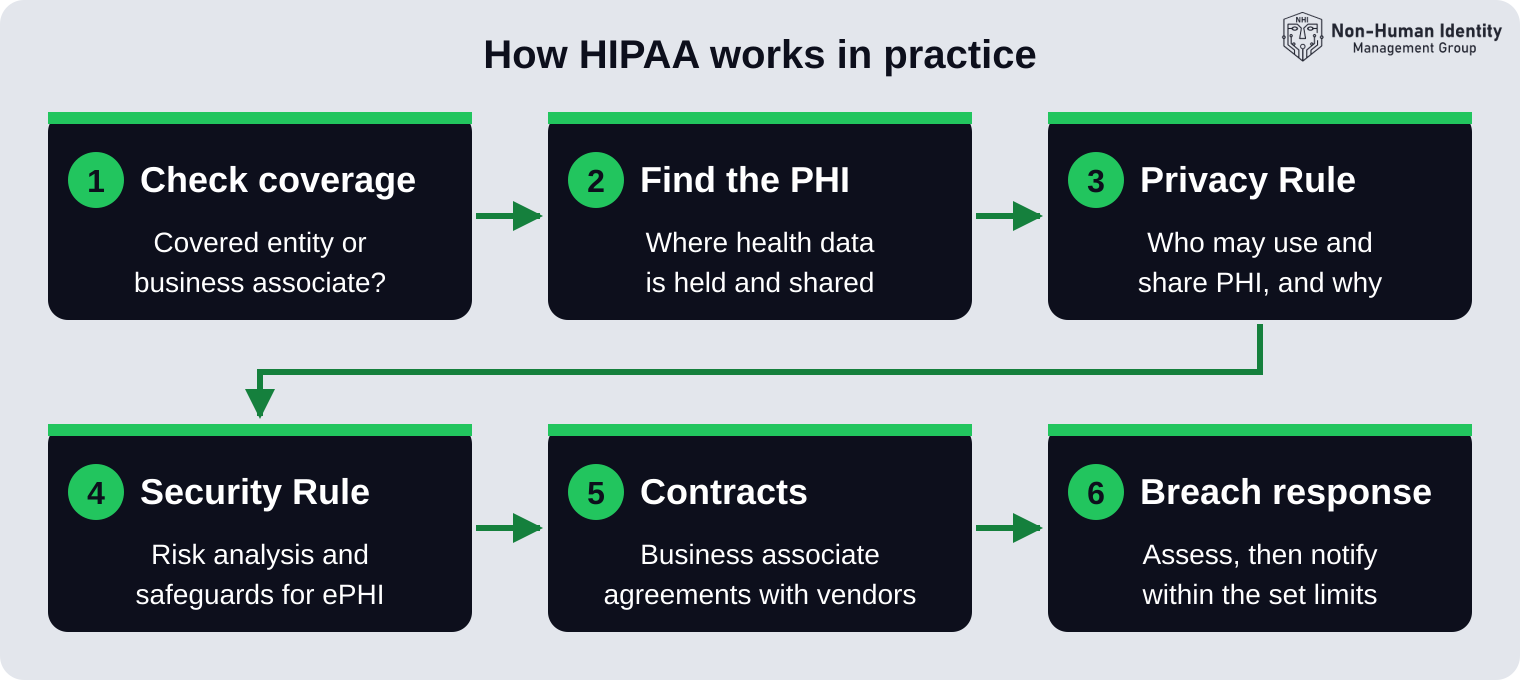
Here is how HIPAA plays out for a typical organisation, in the order a newcomer should think about it.
- Check whether you are covered. There are three types of covered entity: health plans, healthcare clearinghouses (which convert health information between non-standard and standard formats), and healthcare providers that send health information electronically in standard transactions such as claims.[2] A business associate is a person or organisation, outside the covered entity's own workforce, that performs functions or services involving PHI on its behalf. Subcontractors that handle PHI for a business associate are business associates too.[5]
- Find the PHI. List where health information is created, stored and sent: patient systems, email, spreadsheets, cloud storage, backups and the suppliers who touch it. You cannot protect data you have not found.
- Follow the Privacy Rule. A covered entity may use and share PHI for its own treatment, payment and healthcare operations. Most other uses need the person's written authorisation unless the Rule permits or requires them.[2] It must also make reasonable efforts to use, share and request only the minimum necessary PHI for the purpose, with some exceptions such as disclosures for treatment.[2] People have rights too, including to see and get a copy of their records and to ask for corrections.[2]
- Protect electronic PHI under the Security Rule. Start with a risk analysis: an "accurate and thorough assessment" of the risks and vulnerabilities to ePHI, then put measures in place that reduce those risks to a reasonable and appropriate level.[3] Safeguards fall into three groups: administrative (such as training and security incident procedures), physical (such as workstation and device controls) and technical (such as access control, audit controls and transmission security).[3]
- Put contracts in place with vendors. A business associate agreement (BAA) sets out what the vendor may do with PHI, stops it using or sharing PHI beyond that, and requires it to follow the relevant Security Rule requirements and report security incidents, including breaches.[5]
- Respond to breaches. An impermissible use or disclosure of PHI is presumed to be a breach unless a risk assessment shows a low probability that the information was compromised.[4] Affected people must be told without unreasonable delay and no later than 60 days after discovery. HHS must also be told, and large breaches affecting more than 500 residents of a state or jurisdiction also require notice to local media.[4]
Useful distinctions
- "Required" and "addressable" are not "mandatory" and "optional". Under the Security Rule, required items must be put in place. Addressable items must be put in place if reasonable and appropriate; if not, the organisation can use an alternative that meets the same purpose and must document why.[3]
- Not every supplier is a business associate. HHS gives examples that are not, such as cleaning or electrical services with only incidental access, and postal services that only carry PHI.[5] A cloud provider that stores ePHI is one.[5]
- De-identified data is treated differently. HHS states there are no restrictions on using or sharing de-identified health information, which can be produced by expert determination or by removing specified identifiers.[2] Our HIPAA De-identification guide explains both methods.
- A proposed update is not the current rule. HHS issued a proposed rule to update the Security Rule on 27 December 2024, and says the current Security Rule remains in effect while that rulemaking continues.[6] See the HHS HIPAA Security Rule Update (2025 NPRM) Guide for what it proposes.
A worked example
Harbourside Physio is a fictional physiotherapy clinic with 12 staff in the United States. It bills insurers electronically, so it is a healthcare provider covered by HIPAA. Dana, the practice manager, has been asked to "sort out HIPAA".
- Finding the PHI: Dana lists the booking system, the clinical notes app, the shared mailbox, a billing company and an online backup service. She finds a spreadsheet of patient phone numbers and conditions on a reception laptop.
- Vendors: the billing company and the backup service both handle PHI for the clinic, so Dana checks that each has a signed BAA. The backup service has one; the billing company's contract is old and has no HIPAA terms, so she asks the company to agree a BAA.
- Security basics: with help from an IT contractor, she writes a short risk analysis. The top risks are shared logins on the front desk computer and the laptop spreadsheet. The clinic gives each person their own login with multi-factor authentication, moves the spreadsheet into the booking system and turns on audit logging.
- Minimum necessary: reception staff can see appointments and contact details, but not full clinical notes.
Three months later, a receptionist sends an appointment list to the wrong email address. Because Dana has a simple incident procedure, the team records what happened, asks the recipient to delete the email, and works through the four-factor risk assessment HHS describes to decide whether it counts as a notifiable breach.[4] The clinic does not become "HIPAA certified" by doing this; it has simply taken sensible, documented steps and can show its reasoning if OCR asks. For a decision like this, a sensible step is to involve the clinic's legal adviser.
Myths and misunderstandings
| What people think | What is true |
|---|---|
| HIPAA covers all health data, everywhere. | It covers PHI held by covered entities and their business associates. Many companies that collect health information are not covered by HIPAA, and the FTC's Health Breach Notification Rule may apply to some of them instead.[8] |
| HIPAA only applies to hospitals. | It applies to health plans, clearinghouses and providers that bill electronically, plus their business associates, such as cloud, IT and billing firms.[2][5] |
| Addressable means optional. | Addressable items must be implemented if reasonable and appropriate, or replaced by a documented alternative.[3] |
| A product can make you "HIPAA compliant". | The Security Rule is technology neutral and does not prescribe specific products.[3] Compliance depends on your own risk analysis, policies and practices. |
| Signing a BAA means the vendor carries all the risk. | Business associates are directly liable for certain HIPAA requirements, but covered entities remain responsible for their own obligations, including making sure breach notifications happen.[5][7] |
| HIPAA stops doctors sharing records with each other. | Sharing PHI for treatment is permitted, and sending a chart to a specialist for a patient's care does not need a BAA.[2][5] |
Key terms
- HIPAA
- A US law that sets rules for protecting health information, including privacy, security and breach notification duties.
- Protected health information (PHI)
- Health-related information that can identify a person and is covered by HIPAA protections.
- Electronic protected health information (ePHI)
- PHI stored, processed or sent in digital form.
- Covered entity
- An organisation that must follow HIPAA: a health plan, a healthcare clearinghouse or a healthcare provider that bills electronically.
- Business associate
- An outside organisation that handles PHI on behalf of a covered entity, such as a cloud, IT or billing provider.
- Business associate agreement (BAA)
- The written contract that sets out what a business associate may do with PHI and how it must protect it.
- Minimum necessary standard
- The rule that organisations use, share and request only the smallest amount of PHI needed for a purpose.
- Security Rule
- The HIPAA rule that sets administrative, physical and technical safeguards for ePHI.
- Risk analysis
- The process of identifying threats, weaknesses and possible impacts so risks can be prioritised and treated.
- Breach notification
- Deciding, documenting and reporting a data breach to regulators and affected people.
- HITECH Act
- A US law that strengthened HIPAA enforcement and led to the breach notification duties.
Common questions
What does HIPAA stand for?
The Health Insurance Portability and Accountability Act of 1996.[1] The name is often misspelt "HIPPA".
Does HIPAA apply outside the United States?
HIPAA is a US federal law. A company outside the US can still be a business associate if it handles PHI for a US covered entity. For EU and UK personal data, see our GDPR for Beginners guide.
Who enforces HIPAA?
The HHS Office for Civil Rights administers and enforces the rules and can investigate complaints and impose civil money penalties. Criminal violations are prosecuted by the Department of Justice.[2]
Is my fitness or period-tracking app covered by HIPAA?
Often not, unless it works for a covered entity. The FTC says many companies that collect health information are not covered by HIPAA.[8] See the Health Data Privacy Beyond HIPAA Guide (My Health My Data) for state laws that may apply.
How long do we have to report a breach?
People must be told without unreasonable delay and no later than 60 days after discovery. Breaches affecting fewer than 500 people can be reported to HHS annually, within 60 days after the end of the calendar year.[4]
Is there a HIPAA certification?
HHS does not describe any official HIPAA certification in its rule summaries. Organisations show compliance through their risk analysis, policies, training records and other documentation, which the Security Rule says must be kept for six years.[3]
Can a state law be stricter than HIPAA?
Yes. State laws that are contrary to the Privacy Rule are generally overridden, but a state law that gives greater privacy protection is not.[2]
First steps
Three things you can do this week:
- Work out your role. Decide, with your legal or compliance lead, whether your organisation is a covered entity, a business associate, both or neither, and write the answer down.
- Make a simple PHI map. List every system, mailbox, spreadsheet and supplier that holds or touches PHI, and who can access each one.
- Check your vendor contracts. For each supplier that handles PHI for you, confirm there is a signed BAA. We suggest starting with cloud, IT support, billing and backup providers.
Checklist
- We know whether we are a covered entity, a business associate or both.
- We have a current list of where PHI and ePHI are stored and shared.
- We have a written risk analysis for ePHI, reviewed at least once a year and after big changes.
- Every person has their own login; shared accounts on systems with PHI have been removed.
- Access to PHI follows the minimum necessary idea: people see only what their role needs.
- Audit logging is on for key systems that hold ePHI, and someone reviews it.
- Every supplier that handles PHI for us has a signed BAA.
- Staff have had security and privacy training, and we keep records of it.
- We have a written incident and breach procedure, including who decides on notification.
Simple measures that show progress: the percentage of PHI systems with named owners, the number of suppliers handling PHI without a BAA (aim for zero), the date of the last risk analysis, and how quickly incidents are logged after they are spotted.
Check your understanding
1. Name the three types of covered entity.
Answer: health plans, healthcare clearinghouses, and healthcare providers that send health information electronically in standard transactions.
2. A cloud company stores a clinic's patient records. What is it under HIPAA, and what document is needed?
Answer: it is a business associate, and the clinic needs a business associate agreement with it.
3. Does the Security Rule cover patient notes kept only on paper?
Answer: no. The Security Rule covers electronic PHI. Paper records are still PHI and are covered by the Privacy Rule.
4. What is the latest a covered entity can notify affected people after discovering a breach?
Answer: no later than 60 days after discovery, and without unreasonable delay.
Suggested learning pathway
- For privacy ideas in general, start with Data Privacy for Beginners.
- For how laws and frameworks fit together, see Cyber Security Compliance for Beginners.
- For the use and sharing rules in depth, read the HIPAA Privacy Rule Guide.
- For safeguards and risk analysis in depth, read the HIPAA Security Rule Guide.
- For notification timelines and the risk assessment, read the HIPAA Breach Notification Rule Guide.
- For vendor contracts, read the HIPAA Business Associate Agreements Guide.
- For watching who opens patient records, read the EHR Access Monitoring and Patient Privacy Guide.
- For health data that HIPAA does not reach, read the Health Data Privacy Beyond HIPAA Guide (My Health My Data).
Standards and references
- HIPAA for Professionals. US Department of Health and Human Services (HHS). https://www.hhs.gov/hipaa/for-professionals/index.html, accessed 27 Nov 2026.
- Summary of the HIPAA Privacy Rule. HHS Office for Civil Rights. https://www.hhs.gov/hipaa/for-professionals/privacy/laws-regulations/index.html, accessed 27 Nov 2026.
- Summary of the HIPAA Security Rule. HHS Office for Civil Rights. https://www.hhs.gov/hipaa/for-professionals/security/laws-regulations/index.html, accessed 27 Nov 2026.
- Breach Notification Rule. HHS Office for Civil Rights. https://www.hhs.gov/hipaa/for-professionals/breach-notification/index.html, accessed 27 Nov 2026.
- Business Associates. HHS Office for Civil Rights. https://www.hhs.gov/hipaa/for-professionals/privacy/guidance/business-associates/index.html, accessed 27 Nov 2026.
- HIPAA Security Rule Notice of Proposed Rulemaking to Strengthen Cybersecurity for Electronic Protected Health Information. HHS Office for Civil Rights, 27 December 2024. https://www.hhs.gov/hipaa/for-professionals/security/hipaa-security-rule-nprm/index.html, accessed 27 Nov 2026.
- Change Healthcare Cybersecurity Incident Frequently Asked Questions. HHS Office for Civil Rights, last reviewed 13 August 2025. https://www.hhs.gov/hipaa/for-professionals/special-topics/change-healthcare-cybersecurity-incident-frequently-asked-questions/index.html, accessed 27 Nov 2026.
- Complying with FTC's Health Breach Notification Rule. US Federal Trade Commission. https://www.ftc.gov/business-guidance/resources/complying-ftcs-health-breach-notification-rule-0, accessed 27 Nov 2026.
Related NHI Mgmt Group resources: Healthcare Identity Security Guide · GDPR vs HIPAA · HIPAA Security Rule Compliance Checklist