The General Data Protection Regulation (GDPR) is the European Union law that sets the rules for how organisations collect, use, store and protect information about people, and gives those people rights over it.
It has applied since 25 May 2018 and reaches well beyond Europe.[1] This guide is for newcomers, students, career changers and managers who need a clear starting point. It explains the core ideas in plain English: who the law covers, its seven principles, the six legal reasons for using data, people's rights and the main duties on organisations. Each topic links to a deeper practitioner guide, so this page stays a map rather than a manual.
By the end of this guide you will be able to:
- Explain what the GDPR is and who it applies to.
- Describe the seven principles and the six lawful bases in plain words.
- Identify the main rights people have and the deadline for answering them.
- Understand the core duties an organisation takes on, including security and breach reporting.
Status: correct as at 27 November 2026, based on the GDPR text on EUR-Lex, European Commission guidance and ICO guidance. Laws change; check the official text.
This guide explains the topic in general terms and is not legal advice.
Key takeaways
- It is about people, not files. The GDPR protects any information that relates to an identifiable living person, from a name to an IP address.
- It can apply outside Europe. Organisations outside the EU are covered when they offer goods or services to people in the EU or monitor their behaviour.
- You need a reason, and you must be able to prove you follow the rules. Every use of personal data needs one of six lawful bases, and the accountability principle means keeping evidence.
- People have strong rights. They can see, correct, delete and move their data and object to some uses, and organisations usually have one month to respond.
- Security is a legal duty. Organisations must protect data with suitable measures and report qualifying breaches, with fines of up to 20 million euros or 4% of worldwide turnover for the most serious failings.[1]
What it is, in plain English
The GDPR is a single law for the whole EU, adopted on 27 April 2016 and applying from 25 May 2018.[1] It is a regulation, so it applies directly in every member state, although countries can add their own rules in some areas, which the GDPR Variations in Six EU Member States guide explains.
Four words do most of the work:
- Personal data: any information relating to an identified or identifiable person.[1] The European Commission gives examples such as a name and home address, an email address, an IP address, a cookie ID and health identifiers held by a doctor.[2]
- Processing: any operation on personal data, such as collecting, storing, using, sharing or deleting it.[1]
- Controller: the organisation that decides why and how personal data is processed.[1]
- Processor: an organisation that processes personal data on the controller's behalf, such as a payroll or cloud provider.[1]
A helpful comparison is borrowing something valuable from a friend. You should only use it for the reason you borrowed it, look after it, give it back or dispose of it when asked, and be able to show what you did with it. Where the analogy breaks down: under the GDPR the "owner" often never sees what you do, so the law puts the burden on you to be open and to keep records.
The GDPR applies to organisations established in the EU, and also to organisations outside the EU when they offer goods or services to people in the EU or monitor their behaviour there.[1] Purely personal or household use is outside its scope.[2] After Brexit, the UK keeps its own version, the UK GDPR, which the Information Commissioner's Office (ICO) oversees; the ICO notes that the Data (Use and Access) Act has changed some of its guidance.[3] See UK GDPR for Beginners for the UK picture.
Why it matters to you
- If you run a small business: the GDPR applies whatever your size, though the Commission notes that some duties do not apply where processing is not a core activity or is unlikely to be risky.[2] Customer lists, staff records and website analytics are all in scope.
- If you are new to a security job: Article 32 makes security a legal requirement, so your everyday work on access control, encryption, backups and testing is also compliance work.[1]
- If you are a manager: you will sign off decisions that need a lawful basis, a risk assessment or a supplier contract, and you may be asked to show the evidence.
The consequences are serious. Breaking the core principles, people's rights or the rules on international transfers can bring fines of up to 20 million euros or 4% of worldwide annual turnover, whichever is higher. Many other duties, such as security and breach reporting, carry fines of up to 10 million euros or 2%.[1] People can complain to a regulator and claim compensation for damage.[1]
How it works, step by step
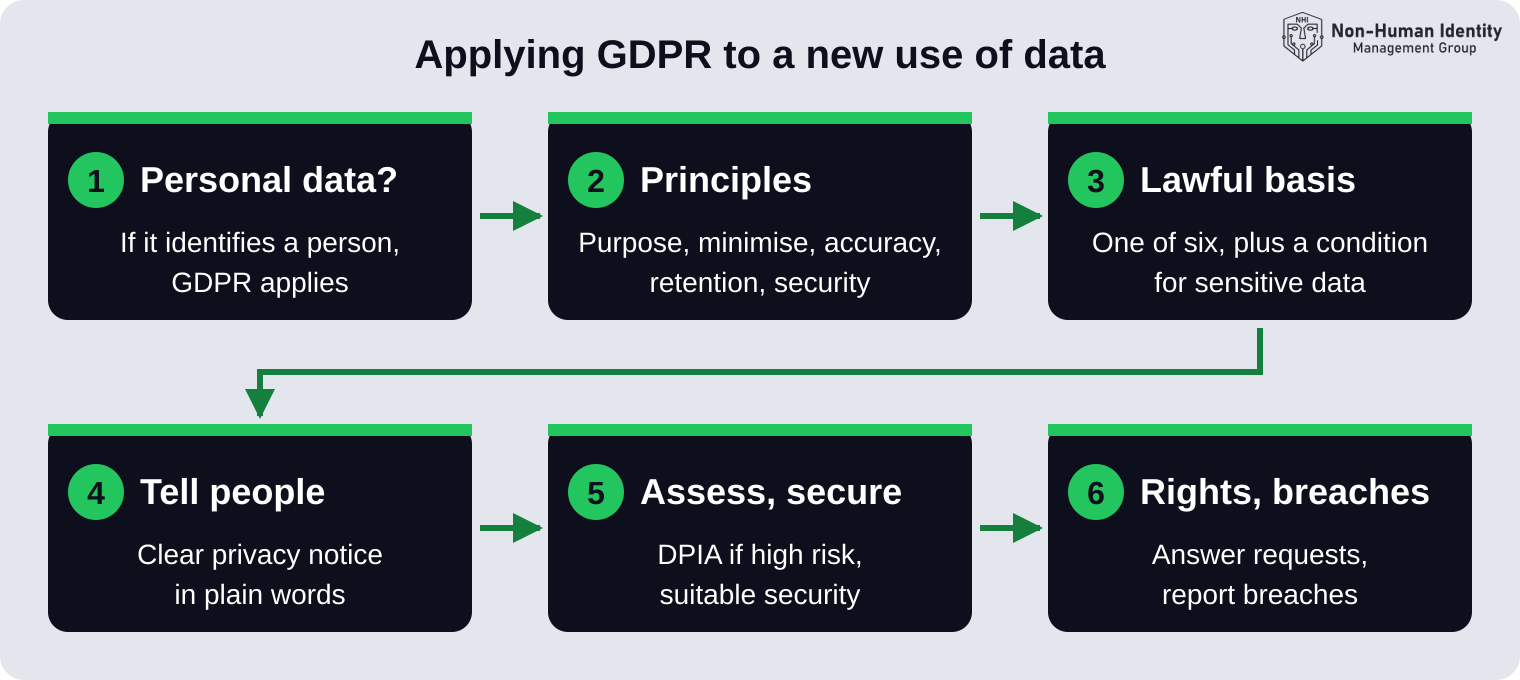
The GDPR is long, but for a new activity that uses personal data, it boils down to a sequence of questions.
- Is it personal data? If the information relates to an identifiable person, the GDPR applies. Pseudonymised data, where names are replaced with codes, still counts if it can be traced back to a person.[2]
- Follow the seven principles. Article 5 sets them out: lawfulness, fairness and transparency; purpose limitation; data minimisation; accuracy; storage limitation; integrity and confidentiality; and accountability.[1][3]
- Pick a lawful basis. Article 6 gives six: consent, contract, legal obligation, vital interests, public task and legitimate interests.[1] Sensitive types of data, called special category data, such as health or biometric data, need an extra condition under Article 9.[1]
- Tell people. Explain clearly what you collect, why, how long you keep it and who you share it with, usually in a privacy notice. The GDPR Articles 12 to 14 guide covers what to include.
- Assess the risk and design it in. Build protection in from the start (Article 25, data protection by design and by default). Where processing is likely to result in a high risk to people, carry out a data protection impact assessment (DPIA) first.[1]
- Secure it and choose suppliers carefully. Use measures that suit the risk, such as pseudonymisation and encryption, resilience, the ability to restore data, and regular testing.[1] Use only processors that can show they will protect the data properly, with a written contract.[1]
- Respect rights and respond to problems. Answer people's requests, usually within one month, and report qualifying breaches to the regulator within 72 hours where feasible.[1] The Data Breach Notification for Beginners guide covers the breach steps.
People's rights at a glance
Articles 15 to 22 give individuals, known as data subjects, a set of rights. Organisations must respond without undue delay and within one month, which can be extended by two further months where necessary, telling the person within the first month.[1]
| Right | Article | In plain words |
|---|---|---|
| Right of access | 15 | See the data held about you and get a copy. See GDPR Article 15. |
| Right to rectification | 16 | Have wrong data corrected. |
| Right to erasure ("right to be forgotten") | 17 | Have data deleted in certain cases. See GDPR Article 17. |
| Right to restriction of processing | 18 | Have use of the data paused in certain cases. |
| Right to data portability | 20 | Receive your data in a usable format to move it elsewhere. |
| Right to object | 21 | Object to some uses, such as direct marketing. |
| Automated decision-making, including profiling | 22 | Protection against decisions made solely by automated means. See the GDPR Article 22 Automated Decision-Making Guide. |
Sending data outside the EU
Personal data can leave the EU only if the conditions in Chapter V are met, for example where the European Commission has made an adequacy decision for the destination or where appropriate safeguards are in place.[1] The United States is covered for organisations in the EU-US Data Privacy Framework.[4] See the EU-US Data Privacy Framework Guide and Data Sovereignty for Beginners.
A worked example
Bloom and Co is a fictional online plant shop in Lisbon with eight staff, selling across the EU. The owner, Inês, wants to add a loyalty scheme that tracks customers' purchases and sends personalised offers.
- Personal data? Yes: names, email addresses, delivery addresses and purchase history.
- Principles: Inês decides to collect only what the scheme needs. Birthdays are optional, and she sets a rule to delete loyalty data two years after a customer's last purchase.
- Lawful basis: she uses contract for delivering orders, and asks for clear, separate consent for marketing emails, with an easy way to withdraw it.
- Tell people: she updates the privacy notice in plain language, naming the email marketing provider the shop uses.
- Assess and secure: the processing is not large-scale or sensitive, so after a short check she records why she does not think a full DPIA is needed. She turns on multi-factor sign-in for the shop platform and checks the email provider's contract covers GDPR processor terms.
- Rights: two months later a customer asks for a copy of their data. Inês exports it and replies in nine days, well within the one-month limit.
The scheme does not make Bloom and Co "fully compliant" overnight, and Inês may need advice if she later adds features such as automated profiling. But she can show what data she holds, why, for how long and how it is protected, which is what the accountability principle asks for.
Myths and misunderstandings
| What people think | What is true |
|---|---|
| The GDPR only applies to companies based in Europe. | It also applies to organisations outside the EU that offer goods or services to, or monitor, people in the EU.[1] |
| You always need consent. | Consent is one of six lawful bases. Contract, legal obligation and legitimate interests are often more suitable.[1] |
| Small businesses are exempt. | They are covered, though some duties do not apply where processing is not core or is unlikely to be risky.[2] |
| Pseudonymised data is not personal data. | It still is if it can be traced back to a person. Only irreversibly anonymised data falls outside.[2] |
| The GDPR is just a privacy policy and a cookie banner. | It covers the whole life of the data: purpose, security, suppliers, rights, breaches, transfers and records. |
| Every company must appoint a data protection officer. | A DPO is required for public bodies and where core activities involve large-scale monitoring or large-scale processing of sensitive data.[1] |
Key terms
- GDPR
- The General Data Protection Regulation, the EU law that governs how organisations collect, process, store and protect personal data, and gives individuals rights over it.
- Personal data
- Information that can identify a person directly or indirectly, such as a name, account number, device identifier or location history.
- Data subject
- The identified or identifiable person that personal data relates to.
- Data controller
- The organisation that decides why personal data is collected and how it is used, and which stays accountable for it.
- Data processor
- An organisation that handles personal data on behalf of a controller, under the controller's instructions.
- Lawful basis
- The legal reason an organisation is allowed to process personal data, which must be specific, documented and matched to the activity.
- Consent
- A person's informed permission for their data to be used in a stated way, which must be specific and can be withdrawn.
- Special category data
- Sensitive personal data, such as health, biometric or genetic data, that the law protects more strongly.
- Data minimisation
- Collecting, using and keeping only the personal data needed for a defined purpose.
- Accountability
- The principle in Article 5(2) that the controller is responsible for complying with the principles and must be able to demonstrate it.
- Data protection impact assessment (DPIA)
- A structured review of how a new system or change could affect people's privacy, carried out before it starts.
- A public regulator that enforces the GDPR in its country, handles complaints and breach reports and can issue fines.
Common questions
Does the GDPR apply to my business outside the EU?
It can, if you offer goods or services to people in the EU or monitor their behaviour there.[1] The GDPR Article 3 guide works through the tests.
What is the difference between the GDPR and the UK GDPR?
The UK GDPR is the UK's own version, kept after Brexit and overseen by the ICO. It follows the same seven principles, and the ICO notes that recent UK legislation has changed some details.[3]
How long do we have to answer a request from a customer?
Without undue delay and within one month of receiving it, extendable by two further months where necessary.[1]
Do we need a data protection officer?
Only in certain cases: public authorities, and organisations whose core activities involve regular and systematic monitoring of people on a large scale or large-scale processing of sensitive data.[1]
What does the GDPR say about security?
Article 32 asks for measures suited to the risk, naming pseudonymisation and encryption, ongoing confidentiality, integrity, availability and resilience, timely restoration after an incident, and regular testing.[1] See the GDPR Article 32 Security of Processing Guide.
Does the GDPR apply to AI?
Yes, whenever an AI system processes personal data, including training data and outputs. The AI and GDPR Guide covers this in depth.
First steps
Three things you can do this week:
- List what you hold. Write down the main sets of personal data you keep (customers, staff, website visitors), where each is stored and who has access.
- Write a lawful basis next to each. For every use, note which of the six bases applies and why. Gaps are where to focus first.
- Check your privacy notice and rights process. Make sure the notice matches what you actually do, and that someone knows how to answer an access or deletion request within a month.
Checklist
- We know what personal data we hold, where it is and who can access it.
- Each use of personal data has a recorded lawful basis.
- Our privacy notice is clear and matches what we do.
- We keep data only as long as needed and delete it on schedule.
- We have security measures suited to the risk, including access control and backups.
- Suppliers that handle personal data have GDPR processor terms in their contracts.
- We can answer access, correction and deletion requests within one month.
- We know how to spot, record and, where required, report a breach within 72 hours.
- We know whether we need a DPO and when a DPIA is required.
Simple measures that show progress: the share of data sets with a recorded lawful basis, the average time to answer rights requests, the number of suppliers without processor terms (aim for zero) and the number of records kept past their deletion date.
Check your understanding
1. A US online shop sells to customers in France. Can the GDPR apply to it?
Answer: yes. It applies to organisations outside the EU that offer goods or services to people in the EU.
2. Name three of the six lawful bases.
Answer: any three of consent, contract, legal obligation, vital interests, public task and legitimate interests.
3. What is the usual deadline for answering a data subject's request?
Answer: one month, extendable by two further months where necessary.
4. What does the accountability principle ask of an organisation?
Answer: to be responsible for following the principles and to be able to show it, with evidence such as records and assessments.
Suggested learning pathway
- Start with Data Privacy for Beginners for the general idea of privacy.
- Read Data Breach Notification for Beginners for what to do when things go wrong.
- Read Data Sovereignty for Beginners for where data lives and transfer rules.
- For the UK version of the law, read UK GDPR for Beginners.
- For the principles in depth, see GDPR Article 5.
- For security teams, see the GDPR Compliance Guide for Security Teams.
- For running a risk assessment, see the DPIA Guide: Running a Data Protection Impact Assessment.
- For how fines are worked out, see GDPR Article 83.
- For a task list to work through, use the GDPR Compliance Checklist.
Standards and references
- Regulation (EU) 2016/679 (General Data Protection Regulation). European Parliament and Council, 27 April 2016, EUR-Lex. https://eur-lex.europa.eu/legal-content/EN/TXT/HTML/?uri=CELEX:32016R0679, accessed 27 Nov 2026.
- Data protection explained. European Commission. https://commission.europa.eu/law/law-topic/data-protection/data-protection-explained_en, accessed 27 Nov 2026.
- A guide to the data protection principles. Information Commissioner's Office (ICO). https://ico.org.uk/for-organisations/uk-gdpr-guidance-and-resources/data-protection-principles/a-guide-to-the-data-protection-principles/, accessed 27 Nov 2026.
- Adequacy decisions. European Commission. https://commission.europa.eu/law/law-topic/data-protection/international-dimension-data-protection/adequacy-decisions_en, accessed 27 Nov 2026.
Related NHI Mgmt Group resources: GDPR Article 28 Processor Guide · GDPR Fines and Enforcement Statistics · EU AI Act vs GDPR