An IT governance framework is a shared rulebook for deciding, running and checking how an organisation uses technology.
This guide is for new IT staff, students and managers who keep hearing the names COBIT and ITIL. You do not need a technical background. If your organisation depends on computers to serve customers, someone has to decide what IT is for and check it works, and these frameworks help with that.
In short
- Governance means deciding what IT should achieve and checking it does. Management means running IT day to day.
- COBIT is mainly about governance: goals, decisions, risks and checks, from the board down.
- ITIL is mainly about running IT services well: the help desk, fixing problems and making changes safely.
- Security fits into both. Leaders set the rules and accept the risks, and the service teams carry out the controls.
What you will learn
Status: correct as at 28 November 2026, based on the official ISACA, PeopleCert, ISO and NCSC pages. Frameworks change; check the official pages.
This guide explains the topic in general terms and is not legal advice.
- Steering (governance)
- deciding goals, setting limits and checking results.
- Running the service (service management)
- the daily work of keeping IT useful for the people who rely on it.
- Shared rulebook (framework)
- a published set of good practice that organisations adapt to their own needs.
What is an IT governance framework?
Think of a football club. The board decides the club's goals, sets the budget and checks the results each season. The coaches and staff run training, match days and the kit room every week.
IT works the same way. Someone must decide what technology is for, how much risk is acceptable and how to check it is working. That is governance. Someone else must run the systems, answer calls and make changes safely. That is management.
A framework is a shared rulebook for this work. COBIT sits closer to the board. It helps leaders set goals for technology and check they are met. ITIL sits closer to the staff. It describes good ways to run IT services, such as a help desk.
Neither is a law. Organisations choose to use them, and they adapt the parts that fit.
Where the comparison stops working: a football club has one board and one team. In a real organisation, the same person may set rules one day and fix a laptop the next. The frameworks describe the jobs, not the people.
Why does it matter?
Without clear governance, security work can drift. Teams fix what is in front of them, while nobody decides which risks matter most. The UK's cyber security agency says boards have a key role, and lists risk, strategy, people, incident planning and oversight as their areas.[5]
If you are new to IT work
What could happen: you make a quick change to a system, it breaks something, and nobody knows who approved it.
Check this: ask how changes are approved and recorded in your team.
If you manage a team
What could happen: IT spends money on tools, but nobody can say which business goal they help.
Check this: ask who decides IT priorities and how results are reported.
If you are a student
What could happen: a job advert asks for "ITIL awareness" and you are not sure what it means.
Check this: learn the basic ideas in this guide first, then look at the official pages.
What does it look like?
Here is a made-up page from a small organisation's IT plan. It shows governance and management side by side.
Example only. All values are made up.
EXAMPLE Group: IT plan, one page
Goal: booking system works 99% of opening hours  (1)
Risk limit: no customer data on personal laptops (2)
Owner of IT risk: Operations Director            (3)
Help desk: answers within 4 working hours        (4)
Changes: approved before going live, logged      (5)
Report to directors: every quarter               (6)
- Governance. A goal set by leaders, so IT knows what matters.
- Governance. A limit on risk that leaders have agreed.
- Governance. A named person who answers for the risk.
- Management. A service promise the IT team keeps day to day.
- Management. A routine for making changes safely.
- Governance. Leaders check results, which closes the loop.
Why this is risky: if the top three lines are missing, the IT team has rules for working but no agreed goals or risk limits.
The safer way: keep both halves. Leaders set goals, limits and owners, and teams run the service and report back.
How does it work?
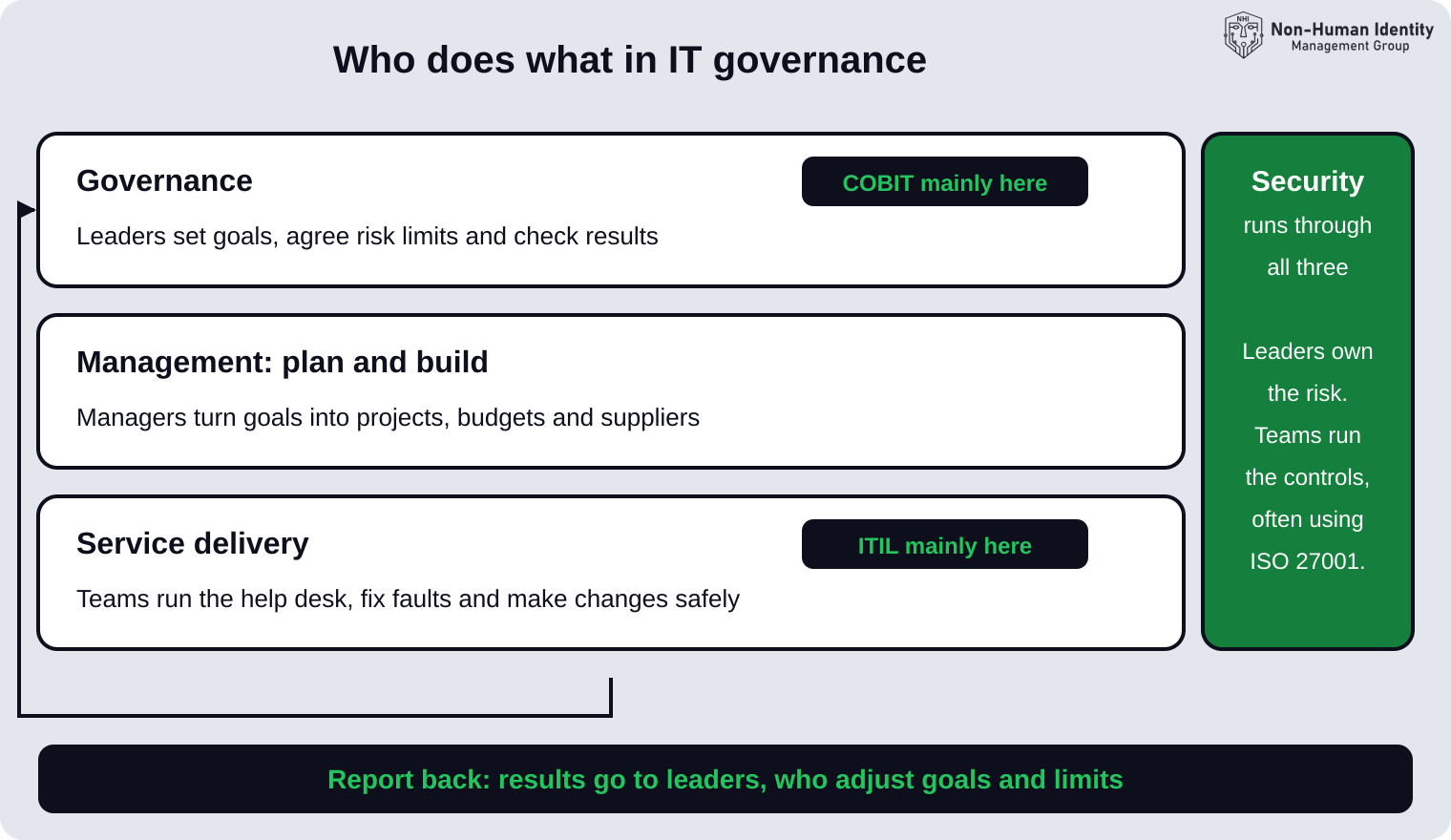
Most organisations use these frameworks as a loop.
- Set direction. Leaders decide what technology should achieve and how much risk is acceptable. COBIT helps here. Its owner, ISACA, says it covers governance and management across business and IT, with 40 objectives in five areas.[1]
- Plan and build. Managers turn those goals into projects, budgets and suppliers.
- Run the service. IT teams handle requests, fix faults and make changes. ITIL helps here. Its practices include incident management (fixing faults), change enablement (making changes safely), the service desk, supplier management and information security management.[2]
- Protect it. Security controls run inside the service, such as access checks and backups. Many organisations use an international standard, ISO 27001, for this. It sets out how to run an information security management system, a managed set of rules and checks.[4]
- Check and report. Results go back to leaders, who adjust goals and limits. Then the loop starts again.
Both frameworks keep changing. ISACA now presents COBIT 7 as its latest version.[1] PeopleCert, which runs ITIL certification, now offers ITIL (Version 5) alongside ITIL 4, and describes it as covering both products and services.[2][3] Check the official pages for the version your organisation uses.
A worked example
Milo Falk has just joined the IT team at Birch Vets, a group of six animal clinics. On his first week, the booking system goes down for an hour on a busy Saturday.
Milo helps restore it. On Monday, his manager, Hana Jensen, asks what went wrong. Nobody is sure. Someone had changed a setting on Friday, but there was no record of who or why.
Hana uses this to start a simple change routine, based on ITIL ideas. Every change now has a short form: what, why, who approves it and how to undo it. Milo keeps the change log.
Hana also raises the outage with the directors. They had never agreed how much downtime was acceptable. Using COBIT ideas, they set a goal for the booking system and name the operations director as owner of IT risk. They ask for a short report every quarter.
The directors also ask about security. Hana explains that the clinics hold customer contact details and payment records. The directors agree a rule that customer data stays off personal phones and laptops. Milo's team adds a check for this to the help desk routine.
Three months later, the first report shows two outages, both short and both linked to approved changes. Milo can see why his change log matters: it lets the directors check results, not just hope for them.
Myths and mistakes
| What people think | What is true |
|---|---|
| COBIT and ITIL do the same job. | They overlap, but COBIT leans towards governance and ITIL towards running services. |
| You must adopt every part of a framework. | Organisations adapt the parts that fit their size and risks. |
| These frameworks are only for big companies. | Small teams can borrow simple ideas, such as a change log or a named risk owner. |
| Governance is just paperwork. | Done well, it means clear goals, clear owners and real checks on results. |
| Security is a separate department, so the frameworks do not cover it. | Both include security. Leaders own the risk, and service teams run the controls. |
| A framework is a law we must follow. | COBIT and ITIL are voluntary good practice. Some laws and contracts may still ask for similar controls. |
What can I do this week?
- Ask who in your organisation owns IT risk.
- Find out how changes to systems are approved and recorded.
- Look for written goals for your most important system.
- Read the official COBIT and ITIL pages to see the current versions.
Checklist
- Leaders have agreed goals for key IT systems.
- A named person owns IT risk.
- Risk limits are written down, such as where customer data may go.
- Changes are approved before they go live and logged.
- Faults and requests have a clear route to the help desk.
- Security controls have owners in the IT team.
- Results are reported to leaders on a set schedule.
Common questions
What is the difference between COBIT and ITIL?
COBIT leans towards governance. It helps leaders set goals, manage risk and check results. ITIL leans towards running IT services day to day, such as the help desk, fixing faults and making changes. Many organisations use both, with COBIT guiding leaders and ITIL guiding service teams.
Where does ISO 27001 fit?
ISO 27001 is a standard for managing information security. It sits beside COBIT and ITIL and does not replace them. A firm might use COBIT for IT goals, ITIL for running services and ISO 27001 for its security rules.
Do I need a certificate to use these frameworks?
No. Anyone can use the ideas. Personal certificates exist for both COBIT and ITIL, and they can help with job applications. ISO 27001 is different. A whole organisation can choose to be certified against it by an outside body.
Is a small business expected to use COBIT or ITIL?
Not usually. Both are voluntary. A small business can still borrow simple ideas. Name an owner for IT risk and set a goal for your key system. Keep a change log, and send a short report to the owner each quarter.
Which version should I learn?
Start with the version your employer or course uses. ISACA now presents COBIT 7 as its latest version, and PeopleCert offers ITIL (Version 5) alongside ITIL 4. The core ideas of governance, service and checking results carry across versions.
Where next?
Ready for the detail? Read the practitioner guide: COBIT 2019 Guide. It goes further into the governance objectives and domains, how organisations tailor them and how COBIT maps to other security standards.
Also useful:
- COBIT vs ITIL vs ISO 27001
- COBIT vs COSO
- Governance, Risk and Compliance for Beginners
- Cybersecurity Frameworks Compared Guide
Related NHI Mgmt Group resources: Board Cyber Risk Reporting Guide · ISC2 CGRC Certification Guide · Cyber Essentials vs ISO 27001
Key terms
- IT governance
- How leaders set goals for technology, agree risk limits and check results.
- COBIT
- A framework from ISACA for governing and managing an organisation's information and technology.
- ITIL
- A widely used set of good practice for running IT services.
- Service management
- The work of planning, running and improving IT services for the people who use them.
- Change management
- A routine for approving, recording and safely making changes to systems.
- Risk appetite
- How much risk leaders are willing to accept to reach their goals.
- ISO 27001
- An international standard for running a managed set of rules and checks to protect information.
Sources and further reading
- COBIT. ISACA. https://www.isaca.org/resources/cobit, accessed 28 Nov 2026.
- ITIL certifications. PeopleCert. https://www.peoplecert.org/browse-certifications/it-governance-and-service-management/ITIL-1, accessed 28 Nov 2026.
- ITIL news and announcements. PeopleCert. https://www.peoplecert.org/Itil-News-and-Announcements/news-and-announcements, accessed 28 Nov 2026.
- ISO/IEC 27001: Information security management systems. International Organization for Standardization. https://www.iso.org/isoiec-27001-information-security.html, accessed 28 Nov 2026.
- Cyber Security Toolkit for Boards. National Cyber Security Centre. https://www.ncsc.gov.uk/collection/board-toolkit, accessed 28 Nov 2026.