A multisig wallet is a crypto wallet that needs several people's keys to approve each payment.
This guide is for anyone new to crypto, and for small firms that hold or receive it. You do not need to be technical. If one person's key can move all of a firm's crypto, one mistake or one theft can empty it.
In short
- "Multisig" is short for multi-signature. A payment goes ahead only when enough key holders approve it.
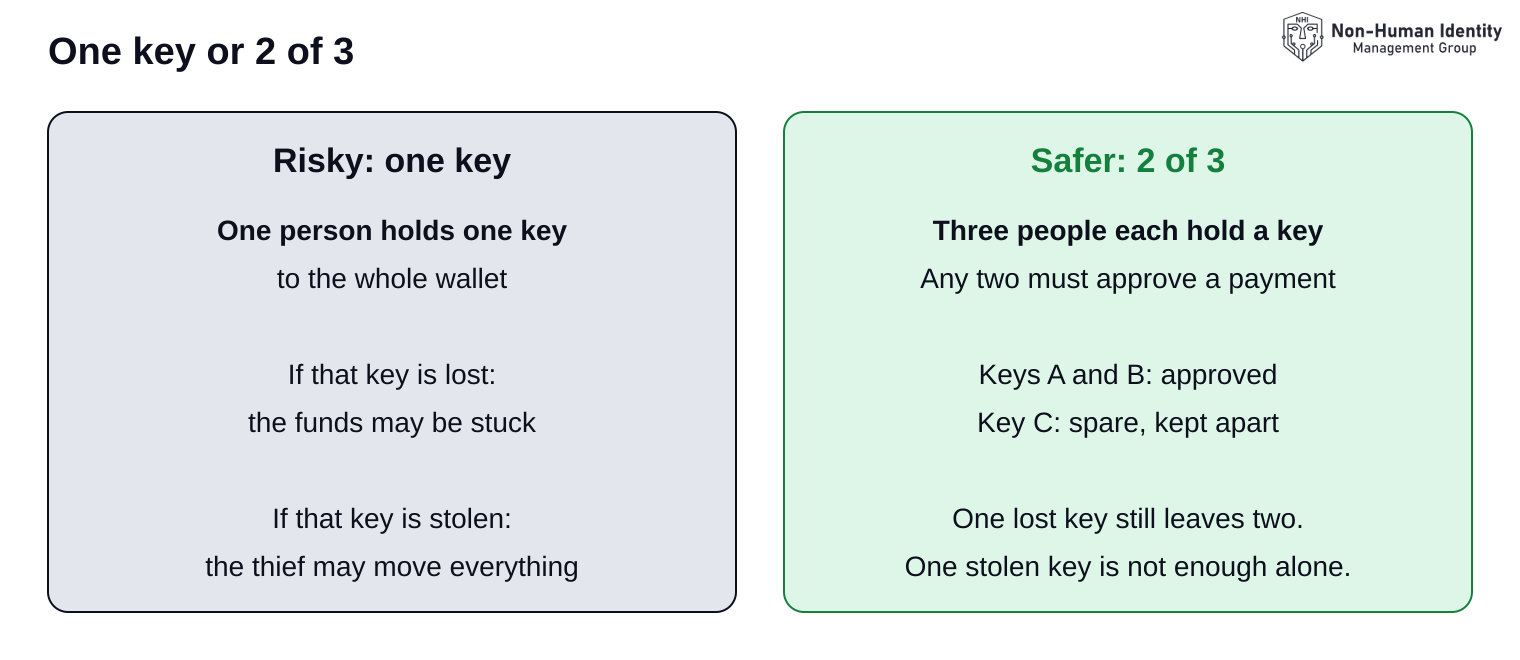
- A common set-up is "2 of 3": three people hold keys, and any two can approve a payment.
- It protects against one lost key or one stolen key, but not against everyone being fooled at once.
- Each signer should check what they approve on their own device, and keys should not share one weak point.
What you will learn
- Explain what a multisig wallet is and what "2 of 3" means.
- Spot the weak points that a multisig does not fix.
- Check who holds your organisation's keys and how they approve payments.
- Ask good questions before your firm holds crypto.
- Secret signing code (private key)
- the secret that lets its holder approve a crypto payment.
- Number of approvals needed (threshold)
- how many key holders must agree before a payment can go.
What is a multisig wallet?
Think of a treasure chest with three locks. Three trusted people each hold one key, and any two keys together will open it. One person alone cannot open the chest, and losing one key does not lock everyone out.
A normal crypto wallet is controlled by one private key, a secret code that approves payments. Whoever has that code can move the funds. A multisig wallet instead needs approvals from several keys, called signatures, before it will send anything.
The number of approvals needed is called the threshold. The idea is old. A 2011 Bitcoin proposal described payments that need any M of N signatures. It gave uses such as protected wallets and escrow.[1]
Where the comparison stops working: a chest sits in one room, and you can see who opens it. Crypto keys are files or small devices that can be copied from anywhere, and a payment cannot usually be reversed once it is sent.
Why does it matter?
With one key, one stolen laptop or one dishonest person can move everything. A multisig spreads that power, so a single failure is less likely to cost the lot.
If you run a small business that takes crypto
What could happen: the only key sits on one staff member's phone, and the phone is lost or stolen.
Check this: ask how many people must approve a payment, and where each key is kept.
If you are new to crypto
What could happen: you assume a firm holding your funds is safe, without knowing who controls its keys.
Check this: look for a plain statement on how the firm protects the keys to its wallets.
If you are asked to be a signer
What could happen: a fake payment request looks normal on screen, and you approve it.
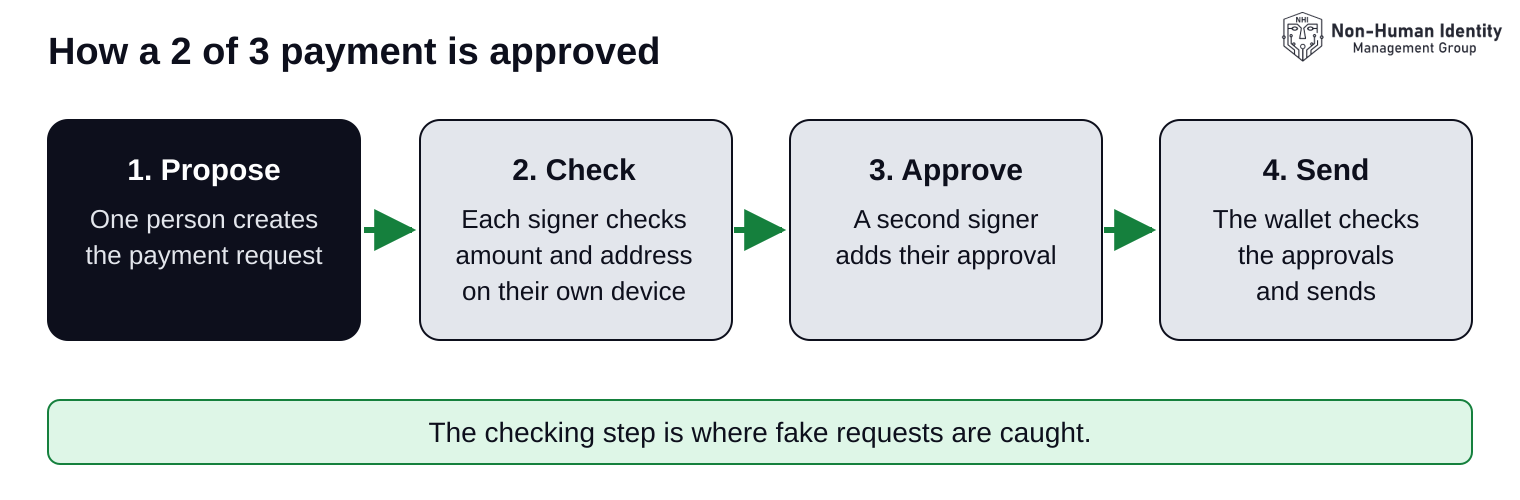
Check this: confirm the amount and address on your own signing device before you approve.
Next: Multisig Treasury Operations Guide for Protocols and Companies
What does it look like?
Here is a made-up approval screen for a "2 of 3" wallet.
Example only. All values are made up.
Wallet: EXAMPLE-company-wallet        Rule: 2 of 3 approvals   (1)
Payment request #0000
  Send:  0.0000 FAKE-COIN
  To:    0xEXAMPLE0000000000000000000000000000FAKE         (2)
  Note:  "supplier invoice 0000"
Approvals: 1 of 2 needed                                  (3)
  [x] Signer A   [ ] Signer B   [ ] Signer C
Last change to signers: none in 90 days                   (4)
- The rule: three key holders, and any two must approve.
- In a real screen, this line would contain the full address the funds go to. Check every character, not just the start and end.
- One person has approved. The payment waits for a second.
- Changes to who can sign matter as much as payments, because they change who controls the wallet.
Why this is risky: every signer may trust the same screen. A faked screen could then fool them all.
The safer way: each signer checks the amount and address on their own signing device. Large payments are also confirmed another way, such as a phone call.
How does it work?
- Set up the wallet. The team picks the key holders, called owners, and the threshold. One wallet design lets the threshold be set anywhere from one up to the number of owners.[2]
- Propose a payment. One person creates the payment request: the amount and the address.
- Collect approvals. Each signer reviews the request and approves it with their own key.
- Check and send. The wallet checks that each approval comes from a real owner. If enough owners have approved, the payment goes. If not, it is refused.[2]
- Look after the signers. Owners can be added or removed, and the threshold changed, so the list stays up to date when people join or leave.[2]
A multisig is not a cure-all. In February 2025 the exchange Bybit lost about 1.5 billion US dollars in crypto, according to the FBI.[3] The wallet provider said a developer's computer had been compromised, which led to a disguised payment request being shown to signers.[4] The lesson for beginners: the approval rule helps only if each signer can trust what they see.
A worked example
Darius Castell owns Elm Garage, a made-up car repair firm. Some customers now pay in crypto, and the funds sit in a wallet on Darius's phone. His bookkeeper, Leila Rinaldi, asks a simple question: "What happens if you lose that phone?"
Darius has no good answer. The one key controls everything. If the phone is stolen and unlocked, the funds could be moved. If it breaks and there is no backup, the funds may be stuck.
They decide to move to a "2 of 3" wallet. Darius holds one key, and Leila holds another. A third key is kept on a separate signing device in the firm's safe, as a spare. No two keys sit on the same device or in the same place.
Next they agree some simple rules. Leila proposes payments, and Darius checks and approves them. For any large payment, Darius rings the supplier on a number he already has to confirm the address.
A month later, Leila gets an email that looks like a supplier's, with "new bank and wallet details". She creates the payment request, but Darius rings the supplier first. The supplier has not changed anything. Darius does not approve, and the payment never goes.
The wallet rule did not catch the fake email. The habit of checking did. The multisig made sure no single person, and no single stolen phone, could move the funds alone.
Myths and mistakes
| What people think | What is true |
|---|---|
| A multisig wallet cannot be hacked. | It lowers the risk from one lost or stolen key. Signers can still be fooled by a faked request, as the 2025 Bybit theft showed.[4] |
| Three keys on one laptop is still a multisig. | On paper, yes. In practice one stolen laptop gives away all three. Keep keys apart. |
| Signers only need to click approve. | Each signer should check the amount and address on their own device. Approving without checking defeats the point. |
| Once set up, nothing needs to change. | When a signer leaves, remove their key and add a new one. Old keys in old hands are a risk. |
| A higher threshold is always better. | Needing every key means one lost key can lock everyone out. "2 of 3" leaves a spare. |
What can I do this week?
- Find out who holds the keys to any crypto your firm holds, and how many approvals a payment needs.
- Check where each key lives. Make sure no two keys share one device, one account or one place.
- Agree a call-back rule for new payment addresses, using a number you already have.
- Write down what happens if a signer leaves or loses their key.
Checklist
- No single person can move our crypto alone.
- We know the threshold, for example "2 of 3", and why we chose it.
- Each key is kept on a separate device, in a separate place.
- Signers check the amount and address on their own signing device.
- New or changed payment addresses are confirmed by a second route.
- We remove a signer's key when they leave, and review the signer list regularly.
- We have a written plan for a lost or stolen key.
Common questions
What does "2 of 3" mean?
It means three people hold keys, and any two of them must approve before a payment can go. One person alone cannot move the funds. If one key is lost, the other two can still approve payments and replace the lost key.
Do I need a multisig for my own small savings?
Not always. Many people use a single wallet with a good backup. Multisig adds work and needs care to set up. It suits firms, groups and larger amounts, where one person's mistake or theft would be too costly.
What happens if a signer loses their key?
If enough keys remain to meet the threshold, the other signers can usually swap the lost key for a new one. If too many keys are lost, the funds may be stuck. That is why spare keys matter.
Is a multisig the same as a hardware wallet?
No. A hardware wallet is a small device that keeps one key off your computer. A multisig is a rule that needs several keys. Many teams use both: each signer keeps their key on their own hardware wallet.
Can a multisig payment be reversed?
Usually not. Once a crypto payment is sent, it generally cannot be undone. That is why the checks happen before approval. If you think funds were stolen, report it to the police and your exchange quickly.
Where next?
Ready for the detail? Read the practitioner guide: Multisig Treasury Operations Guide for Protocols and Companies. It goes further into sizing thresholds, protecting signers, time delays and emergency procedures.
Also useful:
- Crypto Wallets and Keys for Beginners
- Crypto Wallet Security Guide
- Crypto exchange breaches
- Crypto Scams for Beginners
Related NHI Mgmt Group resources: Account Abstraction and Smart Wallet Security Guide · Crypto Inheritance Planning Guide · CryptoCurrency Security Standard Guide
Key terms
- Multi-signature
- A rule that needs approvals from several keys before a crypto payment can go.
- Private key
- The secret code that lets its holder approve payments from a wallet.
- Crypto wallet
- Software or a device that holds the keys used to send and receive crypto.
- Hardware wallet
- A small device that keeps a private key away from your computer and shows payments for checking.
- Seed phrase
- A list of words that can rebuild a wallet's keys, so it must be kept as safe as the keys.
- Cold storage
- Keeping keys on a device that is not connected to the internet.
Sources and further reading
- BIP 11: M-of-N Standard Transactions. Gavin Andresen, Bitcoin Improvement Proposals, 2011 (status: Deployed). https://github.com/bitcoin/bips/blob/master/bip-0011.mediawiki, accessed 28 Nov 2026.
- Smart account concepts (owners, threshold, signature checks). Safe documentation. https://docs.safe.global/advanced/smart-account-concepts, accessed 28 Nov 2026.
- North Korea Responsible for $1.5 Billion Bybit Hack (Public Service Announcement). Federal Bureau of Investigation, Internet Crime Complaint Center, 26 February 2025. https://www.ic3.gov/PSA/2025/PSA250226, accessed 28 Nov 2026.
- Safe Ecosystem Foundation Statement (preliminary findings on the Bybit incident). Safe Ecosystem Foundation, 28 February 2025. https://safefoundation.org/blog/safe-ecosystem-foundation-statement, accessed 28 Nov 2026.