A crypto scam is a trick that gets you to send cryptocurrency, or buy it, for profits that never come.
This guide is for anyone who has seen a crypto advert, a "trading tip" or a message about easy profits and wants to know how to stay safe. You do not need to own any crypto to be a target.
In short
- Most crypto scams promise big or guaranteed profits. Real investments can fall as well as rise.
- Fake trading sites can show a growing balance that you are not able to take out.
- Crypto payments are usually hard to reverse, so check before you pay, not after.
- Anyone who offers to get your lost crypto back for a fee is likely running a second scam.
What you will learn
- Spot the common signs of a crypto scam.
- Explain how a fake trading site keeps people paying.
- Check a firm before you send it any money.
- Know who to tell if it happens to you.
- Digital money (cryptocurrency)
- money that exists only online and moves between digital wallets, not through a bank.
- Digital purse (crypto wallet)
- an app or device that holds the secret codes that control your crypto.
- Online coin shop (exchange)
- a company where you buy, sell or swap crypto for ordinary money.
What is a crypto scam?
Think of a cash machine that shows your balance going up every day but never pays out. The screen looks real, and the numbers look good. A crypto scam often works the same way.
A cryptocurrency is digital money that moves between wallets without a bank in the middle. Scammers like it because payments are quick and hard to undo.[1]
Many crypto scams are old tricks in new clothes. A stranger offers to grow your money, pretends to be a company or official, or promises free coins. The only new part is that they want crypto.[1]
Where the comparison stops working: a broken cash machine is fixed by the bank. With a crypto scam there is often no bank to call, and the money may already have moved on.
Why does it matter?
Crypto scams can take savings, loans and pension money. Once crypto has gone, getting it back is often hard.
If you are thinking about investing
What could happen: a slick advert leads to a fake trading site that keeps your money.
Check this: look the firm up on your financial regulator's register before you pay anything.
If you already own some crypto
What could happen: a fake "support" chat asks for your wallet's secret words and empties the wallet.
Check this: never type your recovery phrase into a website or chat.
If you help an older relative
What could happen: a caller talks them into buying crypto to "keep their savings safe".
Check this: agree a rule together: no crypto payment to anyone met by phone or online.
What does it look like?
Example only. All values are made up.
From: Alex, FakeCoinPro Account Manager           (1)
"Hi! You were picked for our VIP plan.
 Our members made +38% this week. Guaranteed."    (2)
"Only 3 places left. Offer ends at midnight."     (3)
"Send 0.00 EXAMPLE coin to wallet FAKE-0000.      (4)
 Do not tell your bank, they block profits."      (5)
- A stranger with a friendly job title gets in touch out of the blue.
- A promise of big profit with no risk.
- A rush, so you do not stop and check.
- A request to pay in crypto. In a real message, this line would hold a long wallet address.
- A push to keep it secret from your bank.
Why this is risky: the UK money watchdog says a surprise contact and a rush to invest are warning signs. A US consumer agency says only scammers promise sure profits or ask to be paid in crypto.[1][2]
The safer way: stop replying. Look the firm up yourself on the official list of approved firms. Talk to someone you trust before you pay.
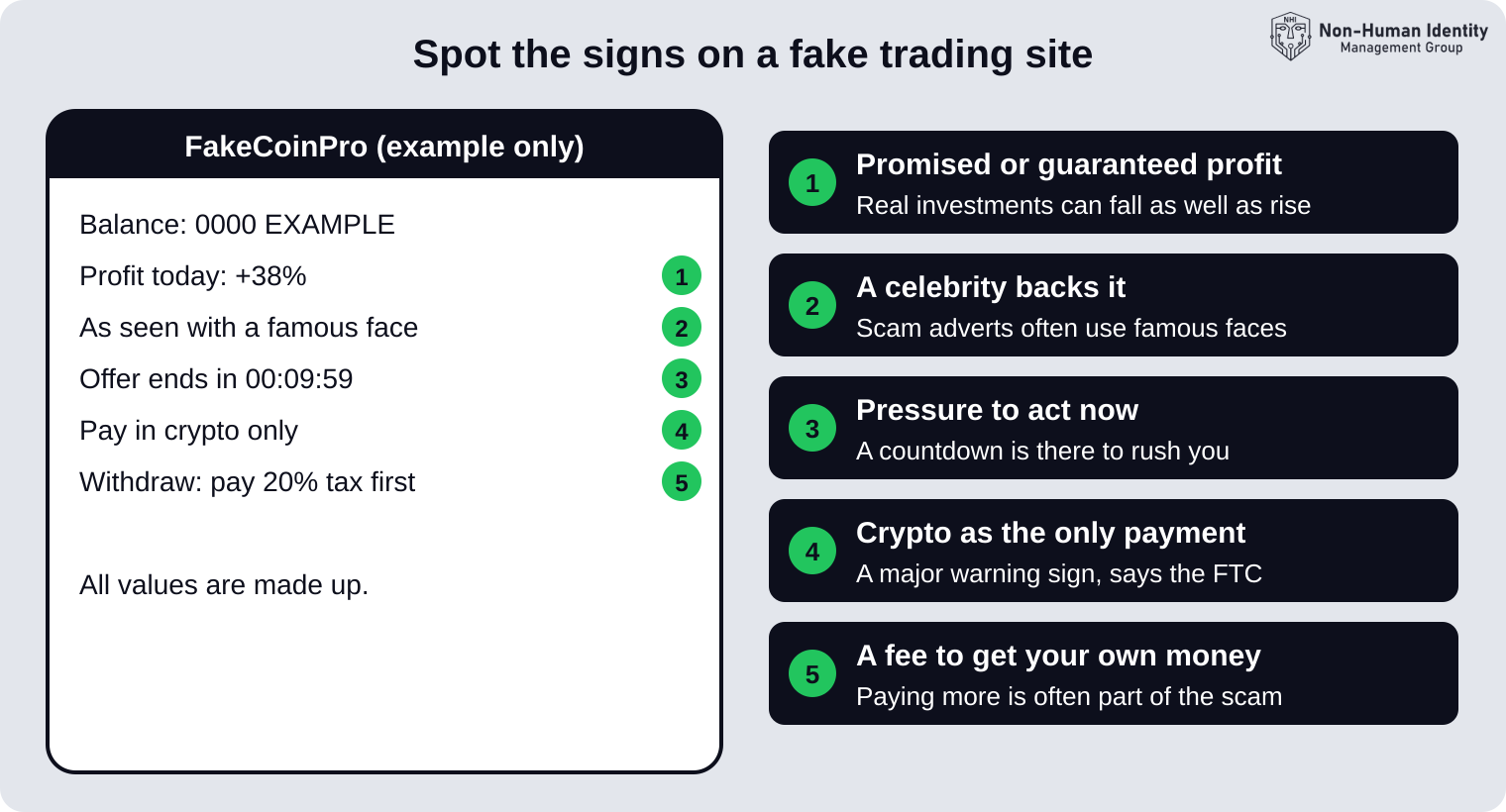
How does it work?
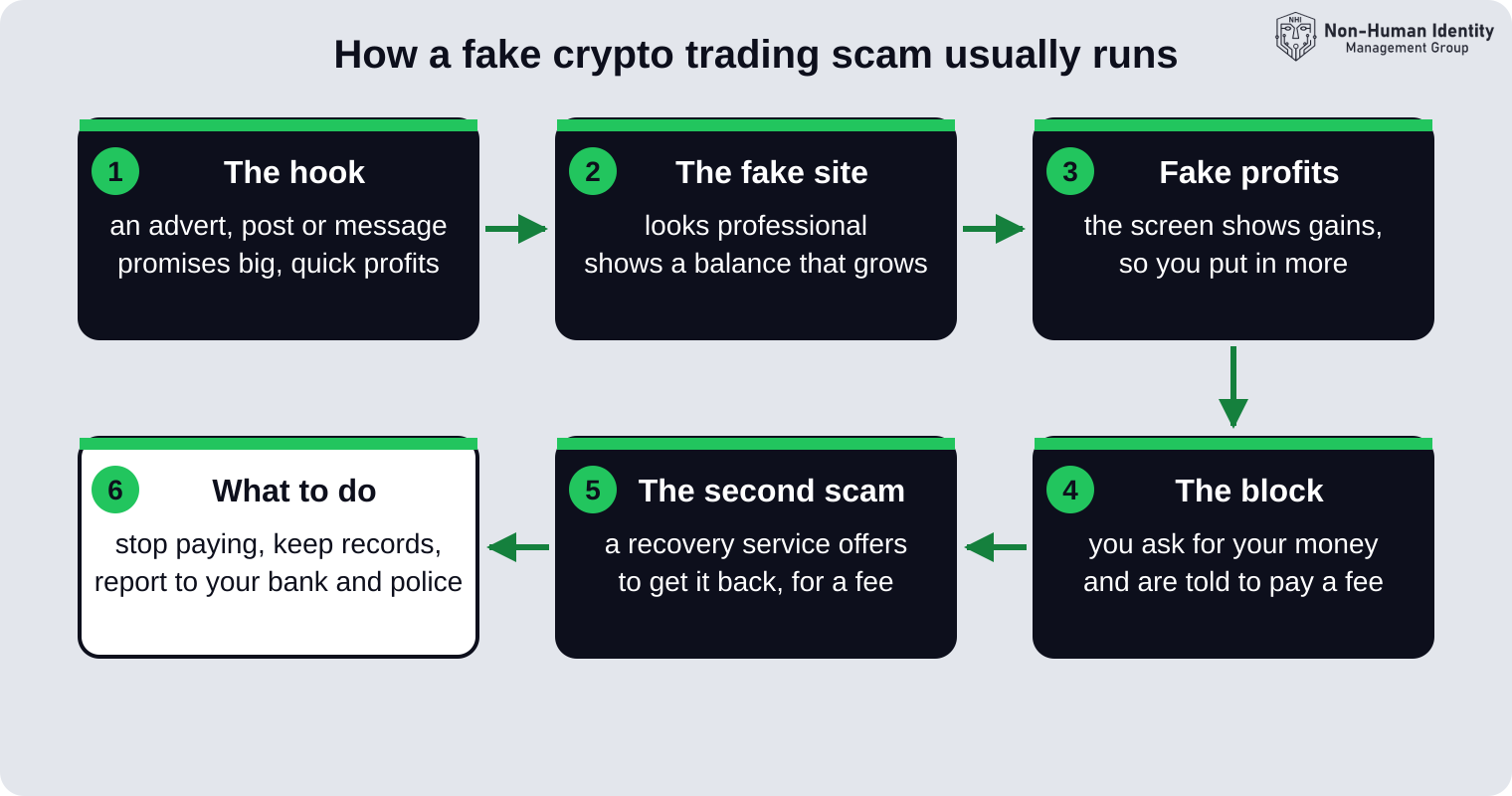
This is a simple view so you can spot it. Scams change, but most follow a pattern like this one.
- The hook. An advert, social media post or message promises quick profits. Scam adverts often use pictures of famous people without their permission.[2]
- The fake site. The advert links to a professional-looking website or app. It may show prices and profits that are made up.[2]
- Fake profits. Your balance seems to grow, so you are urged to put in more.[4]
- The block. When you try to take your money out, you are told to pay a fee or tax first.[4]
- The second scam. Later, someone may offer to recover your money for a fee. Some pretend to be lawyers or to work with the police.[3][6]
It is common. In 2024, people told the FBI they lost more than $9.3 billion in fraud linked to cryptocurrency.[5]
A different trick targets people who already own crypto. A fake website asks you to "connect your wallet" and approve a request. That approval can give a stranger's program, called a wallet drainer, permission to move your coins.[7] The practitioner guide explains this in more detail.
A worked example
This story is made up to show how it can happen.
Jess Whitfield works in a garden centre in Norwich. She is saving for a house deposit. One evening she sees a video advert with a well-known TV presenter. He says he made a fortune with a new crypto trading app.
Jess clicks the link and leaves her number. The next day a friendly "account manager" calls. He helps her open an account and buy a small amount of crypto, which she sends to the app.
The app looks smart. Within a week her balance has nearly doubled. The manager says she should add more before "the next price jump". She is tempted, and sends a bigger sum.
A few weeks later Jess wants to take some money out for a car repair. The app says she must first pay a "tax" on her profit. The manager tells her to hurry, or her account will be frozen.
Something feels wrong. Jess looks up the app's firm on the regulator's register. It is not listed. She calls her bank on the number on her card. The bank tells her it looks like a scam and helps her report it.
She reports it to Report Fraud, the UK fraud reporting service, and keeps screenshots of every message.[8] A month later a "recovery lawyer" emails her, offering to get her money back for a fee. Jess does not reply, and forwards it to the police with her report number.
What made the difference: Jess stopped paying when she was asked for a fee. She also did not trust the people who offered to fix it.
Myths and mistakes
| What people think | What is true |
|---|---|
| A famous person in the advert means it is real. | Scam adverts often use famous faces without permission.[2] Check the firm, not the face. |
| The app shows I am in profit, so my money is safe. | The balance on a fake site can be made up. Money you cannot take out is not safe. |
| Paying the fee will release my money. | A fee or "tax" to withdraw is a common scam step.[4] Stop paying and get help. |
| A recovery firm can get my crypto back if I pay first. | Offers to recover lost money for a fee are often a second scam.[3] |
| A firm on a regulator's register means I am fully protected. | Not always. In the UK, most crypto activity is not covered by the compensation scheme, even with a registered firm.[2] |
What can I do this week?
- Save a link to the official list of approved firms, so you can check a firm fast.
- Agree a family rule: no crypto payment to anyone met online or by phone, without a second opinion.
- If you own crypto, write your recovery phrase on paper and keep it somewhere safe. Never type it into a website.
- Save your bank's fraud number from the back of your card in your contacts.
Checklist
- I check a firm on the regulator's register before I invest.
- I treat promises of guaranteed or very high profits as a warning sign.
- I do not pay in crypto to someone who contacted me out of the blue.
- I never share my recovery phrase or wallet password with anyone.
- I do not pay a fee or tax to take my own money out of a site.
- I ignore offers to recover lost crypto for a fee.
- I know how to report fraud: Report Fraud in England, Wales and Northern Ireland, or Police Scotland in Scotland.
Common questions
Can I get my money back after a crypto scam?
Sometimes, but it is often hard. Crypto payments usually cannot be reversed the way a card payment can. Tell your bank and the exchange you used straight away, and report it to the police. Fast reports give the best chance of freezing funds.[1]
How do I check if a crypto firm is real?
Look it up yourself on your financial regulator's register and warning list. In the UK that is the FCA. Do not use links or phone numbers from the advert or message. If the firm is not on the register, the FCA advises you not to use it.[2]
Is all crypto a scam?
No. Cryptocurrency itself is a real technology, and many people buy it through registered firms. The scam is the trick around it: fake sites, fake profits and pressure to pay. Crypto is also high risk, so only put in money you could afford to lose.
What is a recovery scam?
A recovery scam targets people who have already lost money. Someone offers to get it back, often posing as a lawyer, investigator or official, and asks for a fee first. The UK regulator and the FBI both warn about this second scam.[3][6]
Where next?
Ready for the detail? Read the practitioner guide: Crypto Scam and Drainer Guide. It goes further into wallet approvals and drainers, controls for firms that hold crypto, and how to respond to a loss.
Also useful:
- Romance and Investment Scams for Beginners
- Crypto Wallets and Keys for Beginners
- Cryptocurrency Scam Awareness Guide
- Crypto ATM Scams Guide
Related NHI Mgmt Group resources: Online Scams for Beginners · Address Poisoning and Airdrop Scams Guide · Crypto Wallet Security Guide
Key terms
- Cryptocurrency
- Digital money that lives on a shared online record and moves between wallets without a bank in the middle.
- Crypto exchange
- A marketplace where people buy, sell or swap crypto, often for ordinary money.
- Crypto investment scam
- A fraud that promises high returns from crypto, often with fake dashboards, then blocks you from taking money out.
- Recovery scam
- A fraud aimed at people who have already lost money, promising to get it back for a fee.
- Seed phrase
- A list of words that can rebuild a wallet, so anyone who has it can control the crypto inside.
- Wallet drainer
- A trick, often hidden in a fake website, that gets you to approve a request that empties your crypto wallet.
Sources and further reading
- What To Know About Cryptocurrency and Scams. Federal Trade Commission (FTC), Consumer Advice. https://consumer.ftc.gov/articles/what-know-about-cryptocurrency-and-scams, accessed 28 Nov 2026.
- Crypto investment scams. Financial Conduct Authority (FCA), ScamSmart, last updated 16 February 2026. https://www.fca.org.uk/scamsmart/cryptoasset-investment-scams, accessed 28 Nov 2026.
- Recovery room scams. Financial Conduct Authority (FCA). https://www.fca.org.uk/consumers/recovery-room-scams, accessed 28 Nov 2026.
- The FBI Warns of a Spike in Cryptocurrency Investment Schemes (Alert I-031423-PSA). Federal Bureau of Investigation, Internet Crime Complaint Center (IC3), 14 March 2023. https://www.ic3.gov/PSA/2023/PSA230314, accessed 28 Nov 2026.
- Internet Crime Report 2024 (losses table: cryptocurrency $9,322,335,911). Federal Bureau of Investigation, Internet Crime Complaint Center (IC3), 2025. https://www.ic3.gov/AnnualReport/Reports/2024_IC3Report.pdf, accessed 28 Nov 2026.
- Fictitious Law Firms Targeting Cryptocurrency Scam Victims (Alert I-081325-PSA). Federal Bureau of Investigation, Internet Crime Complaint Center (IC3), 13 August 2025. https://www.ic3.gov/PSA/2025/PSA250813, accessed 28 Nov 2026.
- How to revoke smart contract allowances/token approvals. MetaMask Help Center (one wallet provider's documentation). https://support.metamask.com/more-web3/learn/how-to-revoke-smart-contract-allowances-token-approvals, accessed 28 Nov 2026.
- Report Fraud service goes live. Report Fraud (City of London Police), 4 December 2025. https://www.reportfraud.police.uk/news/report-fraud-service-goes-live/, accessed 28 Nov 2026.