AppViewX Launches Agent Identity Security Solution to Address Machine Identity and Post-Quantum Cryptographic Readiness


TL;DR
- AppViewX launches a solution to manage and govern autonomous AI agent identities.
- The platform addresses "shadow AI" risks using an Agent Bill of Materials (AIBOM).
- Centralized control ensures AI agents comply with NIST, SOC 2, and EU AI Act.
- Built-in post-quantum cryptographic readiness protects against future quantum-based threats.
- Extends proven machine identity and PKI expertise to the emerging AI ecosystem.
AppViewX Tackles the "Shadow AI" Problem: Managing Agent Identity and Quantum Readiness
The enterprise is currently undergoing a quiet, chaotic transformation. Autonomous AI agents are popping up everywhere, often without IT’s blessing or oversight. We call this "shadow AI," and it’s become the latest headache for security teams who are already stretched thin. These agents aren't just chatbots; they are active participants in our workflows, capable of moving data, executing tasks, and—if left unmanaged—wreaking havoc.
AppViewX is stepping into this fray with its new Agent Identity Security solution. The goal? To treat AI agents not as random software, but as a distinct identity class that needs the same level of governance as a human employee or a server. It’s a centralized control plane designed to bring order to the chaos while simultaneously prepping organizations for the inevitable cryptographic shifts of the quantum computing era.
The math is sobering. According to research cited by Help Net Security, Gartner predicts that Fortune 500 companies will be juggling over 150,000 AI agents by 2028. Even worse, they estimate that a quarter of all enterprise breaches by that time will involve some form of AI agent abuse. When an agent has broad system access but zero human oversight, it’s not just a productivity tool—it’s a massive, blinking security blind spot.
Governance: Knowing What You Have
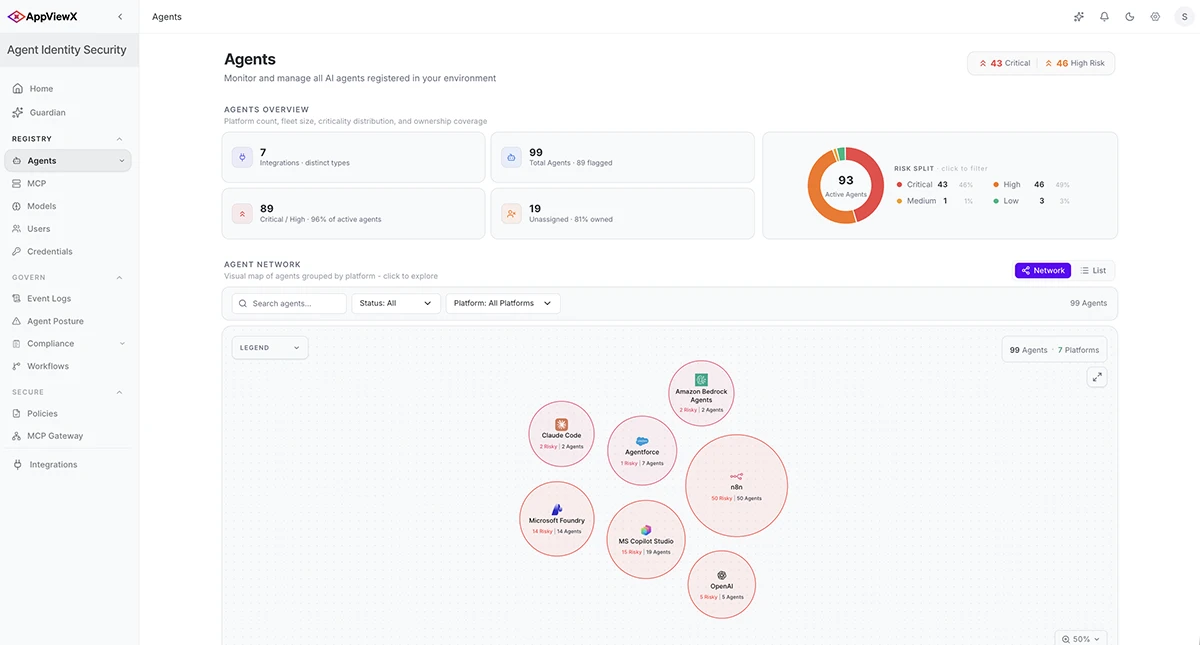
You can’t secure what you can’t see. To combat the "shadow AI" problem, AppViewX is introducing an "Agent Bill of Materials" (AIBOM). Think of it as a manifest for your AI ecosystem. It tracks who owns an agent, what Model Context Protocol (MCP) servers it’s talking to, and exactly what cryptographic dependencies it relies on.
By building this inventory, security teams can finally apply consistent policies that actually stick. Whether you’re trying to meet the strict requirements of the EU AI Act, NIST guidelines, or SOC 2, having a baseline is the first step toward compliance.
The platform leans heavily on the existing AppViewX platform, which has long been a heavyweight in the world of machine identity and Public Key Infrastructure (PKI). By porting that expertise over to the AI space, they’re essentially forcing autonomous agents to play by the same rules as every other machine identity in the network.
The Four Pillars of Agent Security
The Agent Identity Security feature set isn't just a dashboard; it’s a lifecycle management engine. It breaks down the security challenge into four distinct pillars:
- Policy-Based Governance: No more "wild west" deployments. This allows teams to set guardrails that ensure agents stay within their lane.
- Adaptive Agent Access: This is the principle of least privilege, applied to code. If an agent doesn't need access to a specific database to do its job, it shouldn't have it.
- Real-Time Threat Detection: The system monitors for weird behavior. If an agent suddenly starts acting outside of its normal parameters, the system flags it.
- The Guardian Agent: When things do go sideways, this integrated AI companion helps security teams figure out what happened and how to fix it, providing guided remediation rather than just dumping a pile of logs on an analyst's desk.
As SiliconANGLE recently pointed out, this shift toward identity-centric security is the only logical response to the rise of autonomous agents. We are moving away from traditional user management and into a world where machines are the primary actors. Integrating these controls directly into the security stack is the only way to bridge the gap between rapid innovation and basic operational safety.
Preparing for the Quantum Horizon
While managing current threats is priority number one, AppViewX is also looking down the road. Quantum computing is coming, and it’s going to break a lot of the encryption we rely on today. This platform is built with "cryptographic agility" in mind. It allows organizations to manage, rotate, and update their cryptographic assets as post-quantum standards evolve.
Integration is also a major focus. The platform plays nice with existing Security Operations Centers (SOCs) by supporting the Open Cybersecurity Schema Framework (OCSF). This means your SIEM can ingest these logs without a massive, custom engineering project. It keeps the view unified—human identities, machine identities, and AI agents all in one place.
| Feature | Primary Function |
|---|---|
| AIBOM | Inventory of agents, owners, and dependencies |
| Guardian Agent | AI-driven threat intelligence and remediation |
| OCSF Support | Standardized logging for SIEM integration |
| Policy Engine | NIST, EU AI Act, and SOC 2 compliance enforcement |
As detailed in the official AppViewX announcement, this move represents a broader industry shift toward standardizing non-human actor management. We are moving beyond simple access control and into a comprehensive governance model.
The reality is that autonomous agents are here to stay, and they are only going to become more integrated into our critical business processes. The challenge for cybersecurity professionals isn't just to stop them, but to manage them. By focusing on visibility, lifecycle management, and a quantum-ready foundation, AppViewX is offering a blueprint for how to keep the lights on—and the data safe—in an increasingly automated world.