Promo abuse is claiming a discount, bonus or free trial many times, usually by posing as several customers.
This guide is for anyone who plans, runs or approves special offers, such as marketing, sales or small business owners. You do not need any technical background. If your business gives new customers a welcome discount, a referral reward or a free trial, this topic affects your budget.
In short
- Most promo abuse is one person or group posing as many new customers to claim the same offer again and again.
- It often hides inside good-looking numbers: more sign-ups, more code use, more referrals.
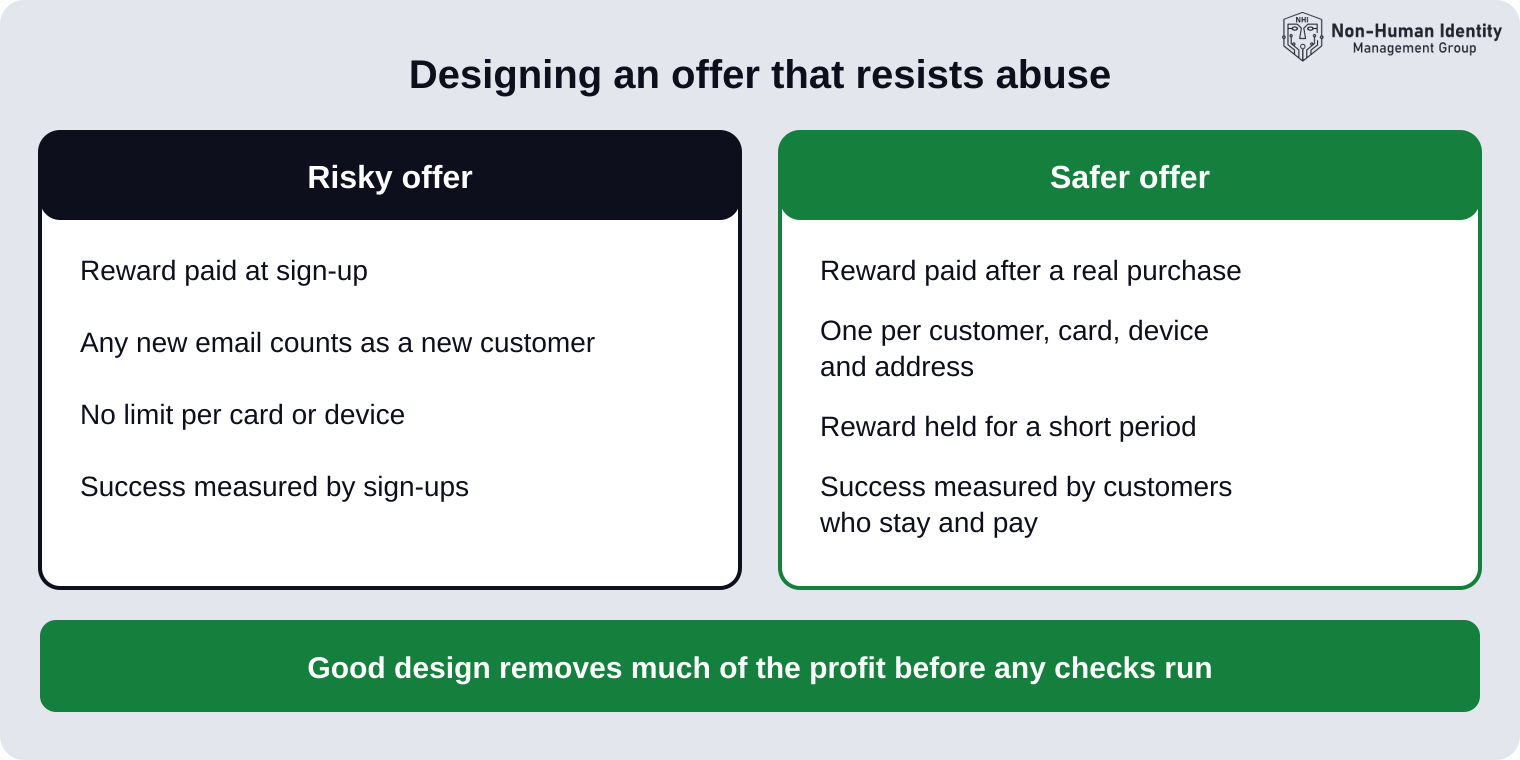
- Offer design does a lot of the work: pay rewards after a real purchase, set limits per card and device, and hold rewards for a short time.
- Measure what each offer costs per customer who stays and pays, not per sign-up.
What you will learn
- Explain what promo abuse is and how it differs from smart deal-hunting.
- Spot the warning signs in your sign-up and offer numbers.
- Check an offer for weak points before it goes live.
- Ask your team the right questions about linked accounts.
- Many accounts, one person (multi-accounting)
- one person opening several accounts to look like several customers.
- Welcome reward (promotion)
- a discount, credit, bonus or free trial offered to win or keep customers.
- Linked accounts
- accounts that share clues, such as the same card, device or address, suggesting one owner.
What is promo abuse?
Think of a supermarket stall giving out free samples, one per person. Most shoppers take one and move on. One shopper keeps coming back in a different hat and coat, taking a sample each time.
Promo abuse is the online version. A business offers something to new or loyal customers. Someone claims it many times, or in a way the offer was never meant to allow. The usual trick is to open many accounts, called multi-accounting.
It can be one person with a few spare email addresses. It can also be a gang running thousands of fake accounts. Software that opens accounts in bulk is a known threat on security experts' lists.[1] So is software that guesses many coupon codes to find ones that work.[2]
Where the comparison stops working: the stall worker might recognise the face under the hat. Online, each new account can look like a stranger, so the business has to look for shared clues instead.
Why does it matter?
Promo abuse rarely looks like crime. It looks like success: a busy launch, lots of new sign-ups and codes being used. The cost shows up later, as customers who never pay again and a budget that ran out early. Real new customers may miss the offer altogether.
If you work in marketing
What could happen: your campaign reports record growth, but much of it is the same few people.
Check this: how many new customers from the last offer made a second, full-price purchase.
If you run a small online business
What could happen: a welcome code shared on a deals forum gets used hundreds of times by the same few people.
Check this: whether each code is limited to one use per customer, card and address.
If you are new to fraud or IT work
What could happen: you are asked to "just block the fakes", with no clear rule for what counts as fake.
Check this: the offer's terms, and what action is fair for a genuine deal-seeker.
What does it look like?
Here is a made-up extract from a weekly offer report. Nothing here proves abuse on its own. The pattern is what matters.
Example only. All values are made up.
Offer: WELCOME-EXAMPLE (40% off first box)
New sign-ups this week:              1,000 (EXAMPLE)
Accounts sharing one device:         120              (1)
Accounts sharing one payment card:   85               (2)
Same delivery address, many names:   60               (3)
Cancelled after first box:           70%              (4)
Referral credits to one account:     35               (5)
- In a real screen, this line would count new accounts opened from a device already linked to other accounts.
- One card paying for many "new" customers is a strong clue.
- Many names at one address can be a household, a shared flat or one person.
- A high drop-off after the reward is used suggests the reward, not the product, drew them in.
- Many referrals to one account may mean someone is referring themselves.
Why this is risky: a simple report counts every one of these sign-ups as a "new customer". Each one also cost the business a discount.
The safer way: look at linked accounts, not single accounts. Then decide on a fair response, such as holding the reward, before anyone closes accounts.
How does it work?
Most promo abuse follows the same simple pattern.
- An offer is launched. For example, a first-order discount, a free trial or a reward for referring a friend.
- Someone spots the gap. The offer is limited "per customer", but a customer is just a new email address.
- Accounts are multiplied. The person opens many accounts, sometimes with software that does it in bulk.
- Rewards are claimed. Each account takes the offer once, so each one looks innocent.
- Value is taken out. The discounts are used, the free trials run out, or credits are moved and resold.
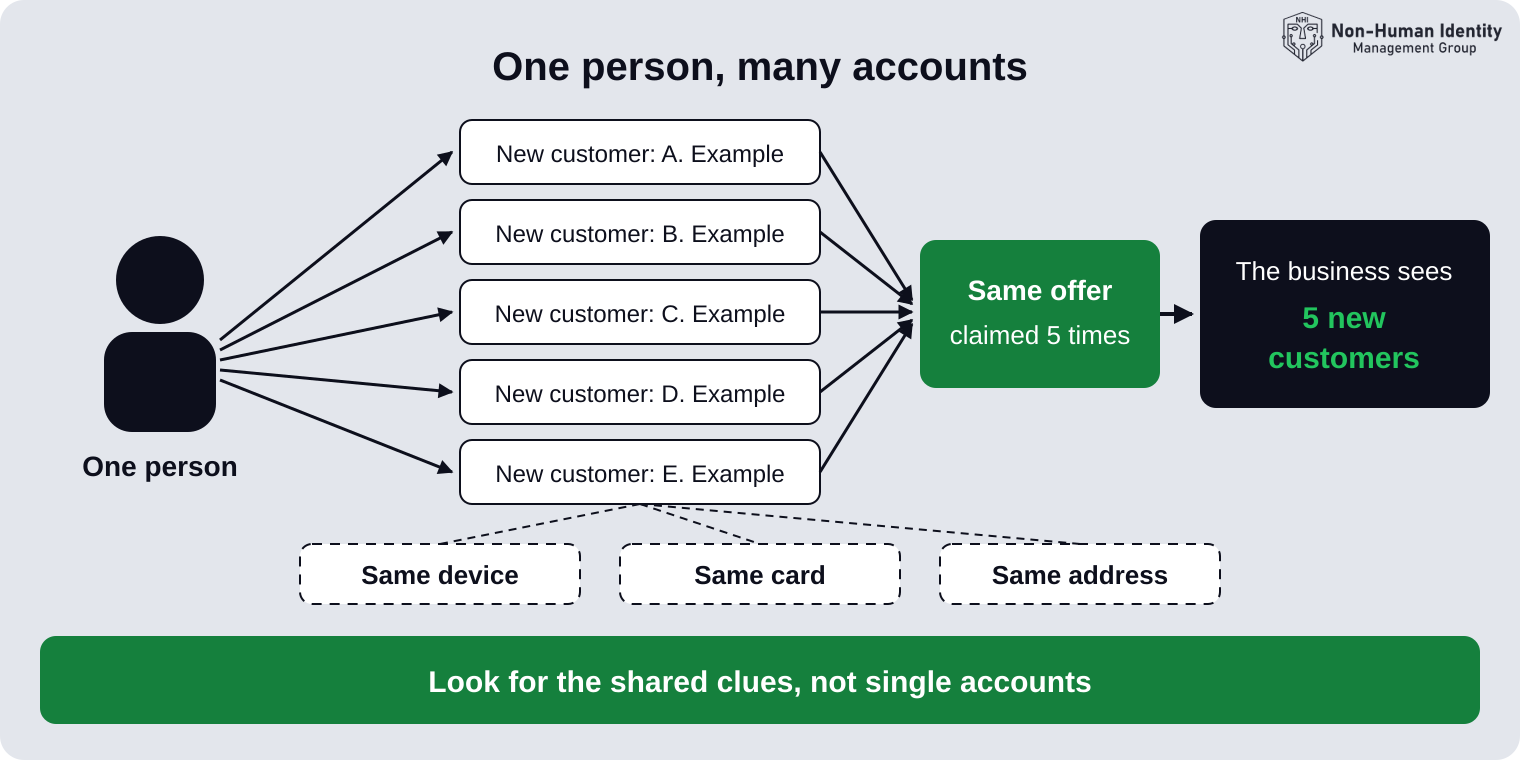
How businesses spot linked accounts
The key is to look for clues that many accounts share. Common clues are the same payment card, the same delivery address and the same device. Phone makers offer tools for this. Apple lets an app store two bits of data per device, for example to mark a device that has already used a promotional offer.[3] Google's Android tool, in beta, stores three bits per device. Google's examples include devices that already claimed a free trial and devices used again and again to open accounts.[4]
Google says these marks must only be used to fight abuse and fraud, not to track people.[4] Apple says its tool does this while maintaining user privacy.[3]
A worked example
Lina Vance is the marketing manager at a small meal-kit company. In spring she launches an offer: a big discount on the first box, plus credit for every friend you refer. Within a week, sign-ups have tripled. Her boss is delighted.
A month later, the finance team asks why the discount budget is gone. Lina asks Dana Zamora, who looks after the company's customer data, to take a look.
Dana sorts the new accounts by payment card and delivery address. A small number of cards and addresses sit behind hundreds of "new" customers. Most of those accounts ordered one discounted box and cancelled. One account earned referral credit from dozens of accounts that all used the same card.
They agree a calm plan. Accounts that look like ordinary families keep their discount. For the clearly linked groups, the referral credit is held and future offers are switched off. Nobody is accused in public.
For the next campaign, Lina changes the design. The referral credit is paid only after the friend's second paid box. Each card and address can claim the welcome offer once. She also reports cost per customer still ordering after three months, not cost per sign-up.
The next launch brings fewer sign-ups. But more of them stay, and the budget lasts the full campaign.
Myths and mistakes
| What people think | What is true |
|---|---|
| More sign-ups always means the offer worked. | Count customers who stay and pay. Abuse inflates sign-ups. |
| Anyone who uses lots of offers is a fraudster. | Deal-seekers using each offer once are normal customers. Focus on one person posing as many. |
| "One per customer" in the terms is enough. | Terms need checks behind them: limits per card, device and address. |
| The fix is to close every suspicious account. | Holding a reward or limiting offers is often fairer, and avoids hurting real customers. |
| Promo abuse is only the fraud team's problem. | Marketing designs the offer, so marketing can remove most of the profit from abuse. |
What can I do this week?
- Pick your biggest current offer and write down exactly when the reward is paid.
- Check whether the offer is limited per card and per delivery address, not just per email.
- Ask for one number: how many offer users made a second full-price purchase.
- Agree with your team what fair action looks like for linked accounts.
Checklist
- Each offer has a written goal and a budget limit.
- Rewards are paid after a real purchase, not at sign-up.
- Each offer is limited per card, address and device, not only per email.
- Referral rewards are held until the referred friend is a real paying customer.
- Coupon codes are hard to guess, and single-use codes are used where possible.
- Reports show cost per retained customer, not per sign-up.
- We have a fair, agreed response for linked accounts.
- Marketing and fraud teams review new offers together before launch.
Common questions
Is promo abuse illegal?
Sometimes. Breaking an offer's terms is often a contract matter, dealt with by holding rewards or closing accounts. It becomes fraud when people use stolen cards, stolen identities or other people's accounts. Where that happens, treat it as fraud, not as a marketing problem.
What is the difference between a deal-seeker and an abuser?
A deal-seeker uses each offer once, as one customer, and is playing by the rules. An abuser pretends to be many customers to claim the same reward again and again. Or they use an offer in a way its terms do not allow.
Can't we just block people who share an address?
Not on that alone. Families, flatmates and students often share an address, and some share a card or device too. Use several clues together, and choose a mild response first, such as holding the reward.
Are coupon codes on deal websites a problem?
Not always. Some businesses want codes shared widely. It becomes a problem when a code meant for one person spreads, or when software guesses codes in bulk. Single-use codes and limits per customer help.
Do free trials get abused the same way?
Yes, often. Someone opens a new account each time a trial ends. Linking accounts by card and device, and limiting one trial per device or card, are common ways to reduce this.
Where next?
Ready for the detail? Read the practitioner guide: Promotion and Bonus Abuse Guide. It goes further into abuse patterns for each kind of offer, duplicate account detection signals and how to measure promotion abuse over time.
Also useful:
- Subscription and Free Trial Abuse Guide
- Loyalty Points and Gift Card Fraud Guide
- Affiliate Fraud Guide
- Bots and Bot Traffic for Beginners
Related NHI Mgmt Group resources: Fraud Prevention Guide for Digital Businesses · Device Intelligence and Fingerprinting Guide · Bot Management Guide
Key terms
- Promotion abuse
- Claiming an offer more times, or in other ways, than its terms allow.
- Multi-accounting
- One person running several accounts to look like several customers.
- Bonus abuse
- Repeatedly claiming sign-up or deposit bonuses, often through linked accounts.
- Referral fraud
- Earning refer-a-friend rewards by referring yourself or fake accounts.
- Account creation fraud
- Opening accounts with fake or stolen details, often in bulk.
- Device fingerprint
- A set of device details that can help recognise the same device again.
Sources and further reading
- OAT-019 Account Creation. OWASP Automated Threats to Web Applications, OWASP Foundation. https://owasp.github.io/www-project-automated-threats-to-web-applications/assets/oats/EN/OAT-019_Account_Creation.html, accessed 28 Nov 2026.
- OAT-002 Token Cracking. OWASP Automated Threats to Web Applications, OWASP Foundation. https://owasp.github.io/www-project-automated-threats-to-web-applications/assets/oats/EN/OAT-002_Token_Cracking.html, accessed 28 Nov 2026.
- DeviceCheck. Apple Developer Documentation, Apple. https://developer.apple.com/documentation/devicecheck, accessed 28 Nov 2026.
- Device recall (beta), Play Integrity API. Android Developers, Google. https://developer.android.com/google/play/integrity/device-recall, accessed 28 Nov 2026.