The Non-Human Identity Management Group recently launched a LinkedIn poll asking:
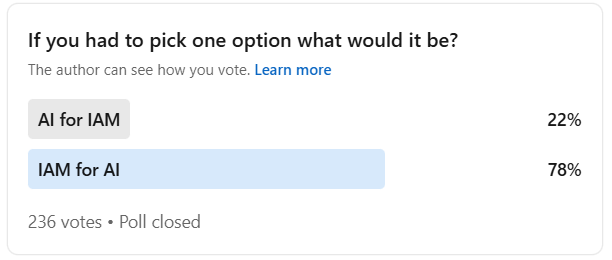
If you had to pick one option, what would it be?
“AI for IAM or IAM for AI?”
With 236 total votes, the results were very telling:
- IAM for AI – 78%
- AI for IAM – 22%
The strong preference for IAM for AI reflects a growing consensus that as AI systems, models, and agentic workloads become more autonomous, identity can no longer be treated as an afterthought. Modern AI increasingly interacts directly with sensitive data, APIs, cloud services, and even makes decisions that have real operational impact. In this context, identity becomes the control plane for AI.
While AI-driven capabilities can certainly enhance IAM, through behavioral analytics, risk-based access decisions, automation, and operational efficiency, the poll results show that professionals recognize a more fundamental requirement: AI itself must be subject to IAM governance. Without well-defined identities, strong authentication, precise authorization, privilege management, and lifecycle controls, AI systems quickly become powerful but opaque actors operating outside traditional security boundaries.
This poll highlights a growing maturity in how the community thinks about AI security. Rather than asking how AI can improve IAM, more organizations are asking how IAM can be applied to AI. As Agentic AI adoption accelerates, IAM for AI will be critical to ensuring accountability, control, and trust across modern digital environments.
As Agentic AI adoption accelerates, IAM for AI will be critical to ensuring accountability, traceability, least privilege, and trust across modern digital environments. Identity-first security is no longer just a best practice, it is becoming a foundational requirement for secure and responsible AI adoption.
