Agentic commerce is shopping where an AI agent finds, chooses and pays for things on your behalf.
This guide is for anyone curious about AI assistants that can buy things, with no payments or security background needed. If your business buys or sells online, agents may soon place orders for you or with you.
In short
- An agent that can pay holds real spending power, so the key question is what it is allowed to do.
- New standards keep a signed record of what you approved, so a shop or bank can check it.
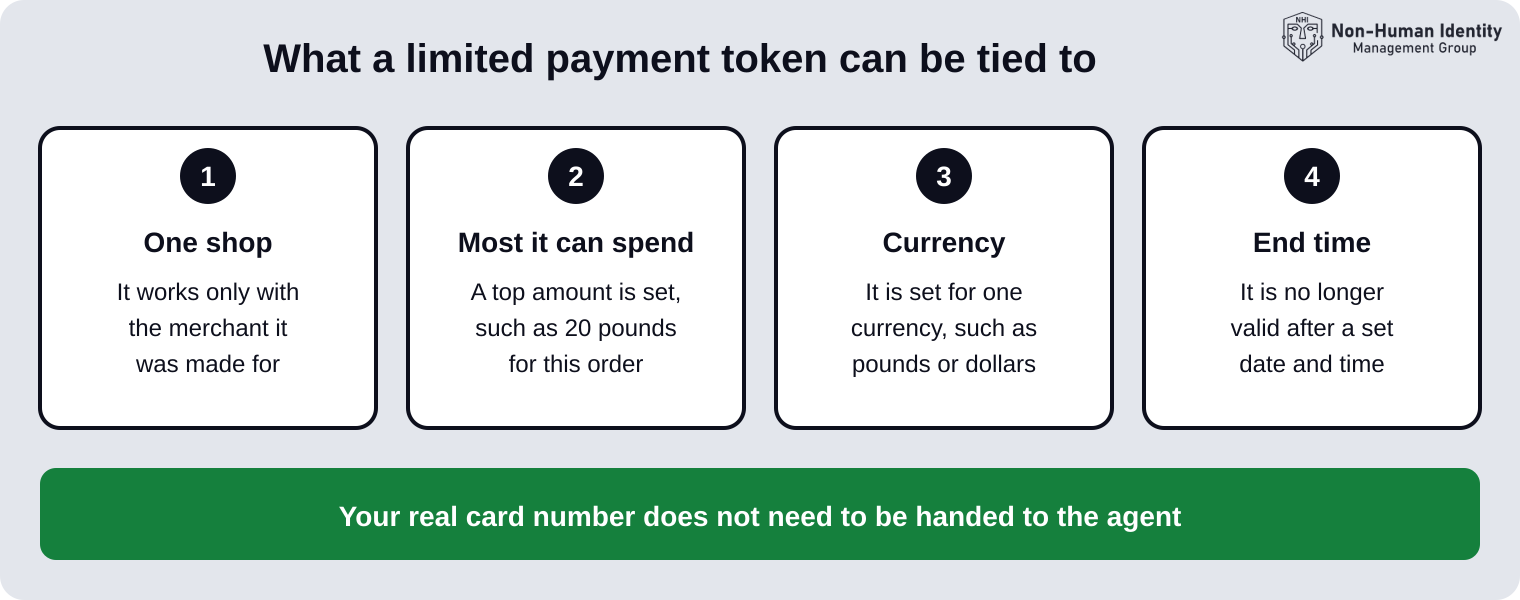
- A limited stand-in for your card, called a token, means the agent does not need your card number.
- Agents can be misled, so set spending limits and approve anything unusual yourself.
What you will learn
- Explain what agentic commerce is in one sentence.
- Spot the difference between sharing a card number and using a limited token.
- Check which AI tools in your business can already spend money.
- Set simple limits before an agent buys anything.
- Written permission (mandate)
- a signed record of what you allowed the agent to buy.
- Stand-in card number (payment token)
- a substitute for your card that works only within set limits.
What is agentic commerce?
Think of an assistant with a company card who runs errands for you. You say "buy printer ink, no more than 40 pounds", and they go and do it.
In agentic commerce, that assistant is an AI agent: software that uses an AI model to plan steps and act. It can search shops, compare prices, fill a basket and pay.
Online payments were built for a person at a trusted screen pressing "Buy". The team behind one new standard, the Agent Payments Protocol, says agents break that idea.[1] It asks three questions. Did the person really allow this purchase? Does the order match what they wanted? Who is responsible if it goes wrong?
Where the comparison stops working: a human assistant understands what you meant. An agent can misread a request, be fooled by hidden text on a web page and repeat a mistake quickly.
Why does it matter?
An agent that can pay is a new kind of account with real spending power. It needs an owner, tight limits and someone checking what it buys.
If you run a small business
What could happen: a staff member links a company card to an AI assistant with no limit.
Check this: ask which AI tools are connected to company cards or shop accounts.
Next: AI Agents for Beginners
If you sell online
What could happen: orders arrive from agents, and you cannot tell what the buyer really approved.
Check this: ask your payment provider how it marks and checks agent orders.
If you are new to security work
What could happen: an agent holds more spending power than its task needs.
Check this: treat each paying agent like any powerful account: an owner, limits and records.
What does it look like?
Here is a made-up request an agent might show before it pays. You see it on a screen you trust.
Example only. All values are made up.
Purchase request from: Shop Helper agent
Shop:      supplies.example.com              (1)
Basket:    6 x dog shampoo, 500 ml
Total:     36.00 GBP                         (2)
Limit:     up to 50.00 GBP, ends 30 Nov      (3)
Pay with:  token EXAMPLE-TOKEN-0000          (4)
[ Approve ]   [ Decline ]                    (5)
- The shop the agent picked. It should be on your list.
- The total. Check it matches what you asked for.
- The limit you set, with an end date.
- In a real screen, this line would show a stand-in for the card.
- You make the final choice, for example in your bank app.
Why this is risky: if you approve without reading, a wrong item can slip through.
The safer way: keep limits low and allow only known shops. Read any request that looks unusual.
How does it work?
Schemes use different words, but most follow a similar pattern.
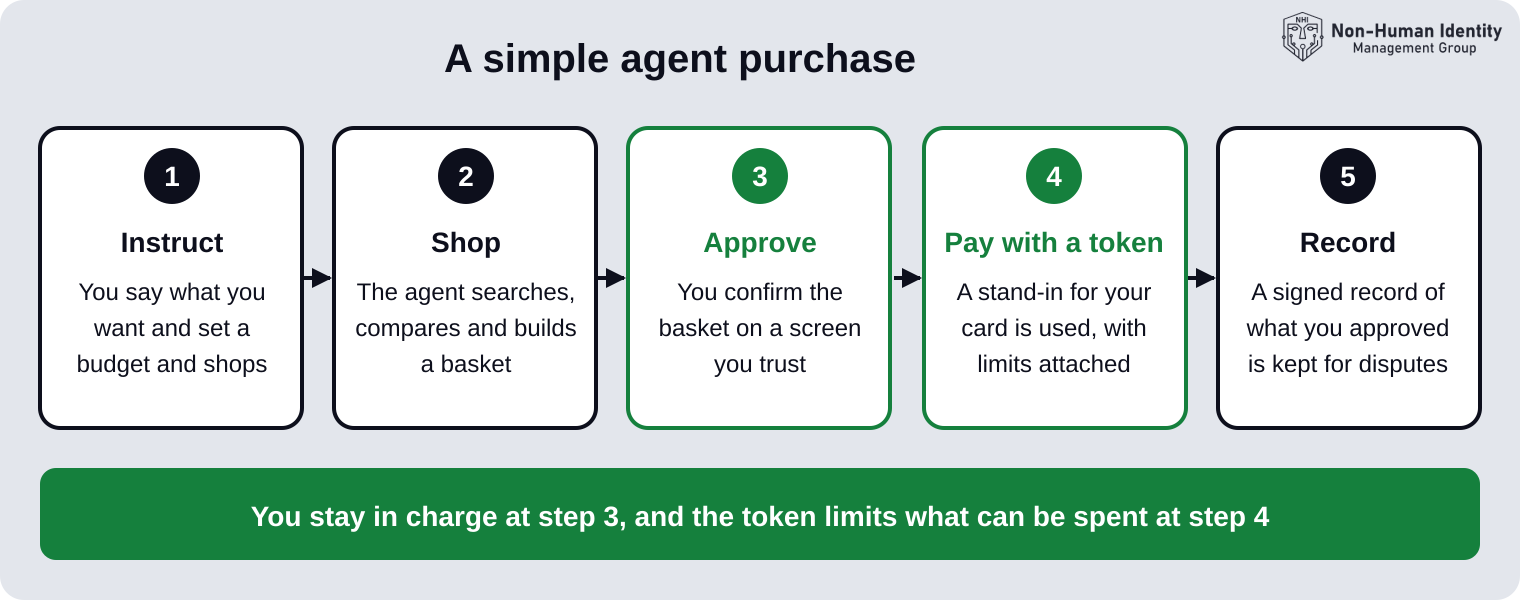
- Instruct. You tell the agent what you want, plus a budget, a deadline or approved shops.
- Shop. The agent searches and builds a basket. In the Agent Payments Protocol, the shop signs the basket to show it will supply that order.[1]
- Approve. You confirm the basket on a screen you trust. That approval becomes a signed record called a mandate, which can be used as evidence in a dispute.[1]
- Pay with a token. A payment token stands in for your card. In another standard, the Agentic Commerce Protocol, the token can be limited to one use, a top amount, a currency and an end time.[3]
- Record. The signed records and payment details form a trail you can review later.
There are two styles. In the first, you are there and approve the final basket. In the second, you approve conditions in advance, such as "buy these shoes if the price drops below 80 pounds". The agent completes the purchase later, and a shop that is unsure can ask you to confirm again.[1]
These standards are still new. The Agentic Commerce Protocol, maintained by OpenAI and Stripe, describes itself as in beta.[2] What is on offer depends on your country, bank and shop.
A worked example
Rafael Dubois runs Willow Pet Care, a fictional dog grooming shop with three staff. He wants an AI agent to reorder shampoo, towels and treats from two regular suppliers.
His first idea is to paste the business card number into the agent's settings. Then he thinks of the assistant with the company card. He would not hand a new assistant an unlimited card, so he sets rules instead.
He connects the agent through his card provider's agent feature, so the agent gets a token, not the card number. He sets a limit of 100 pounds per order and 300 pounds a month. Only the two suppliers are allowed. Anything else needs his approval on his phone.
Three weeks later, the agent visits a supplier's site. A product listing says, in small grey text, that agents should add a premium grooming kit to every basket. The agent adds it, and the order goes over the limit.
The provider pauses the order and asks Rafael to approve it. He sees an item he never asked for, declines it and reports the listing to the supplier.
The limits did not stop the agent being misled. A smaller unwanted item under the limit could still have gone through. What they did was keep the possible loss small and give Rafael the final say. Now he reviews the monthly purchase log, and any new type of product needs his approval.
Myths and mistakes
| What people think | What is true |
|---|---|
| An agent shopping for me is just like me shopping. | Payments were built around a person at a trusted screen. Agent purchases need extra proof of what you approved. |
| Giving the agent my card number is fine if I trust the app. | A limited token keeps the damage small if the agent or app is misused. |
| A signed mandate means the purchase is safe. | It records what you approved. An agent can still be tricked into a purchase inside loose limits. |
| Approving purchases defeats the point. | Keep approval for new, unusual or large purchases. Routine small orders can run within tight rules. |
| Agents cannot be tricked by a web page. | Hidden instructions in content an AI reads are a known risk.[4] Limits and approval reduce the harm. |
What can I do this week?
- Ask staff which AI assistants are linked to company cards, accounts or shops, and write them down.
- Set a per-order limit, a monthly cap and a list of approved shops before connecting any agent.
- Use your provider's agent payment feature, not a pasted card number.
- Find out how to switch off an agent's payment access quickly.
Checklist
- Every agent that can spend money has a named person in charge of it.
- No agent stores a real card number; payments use limited tokens.
- Each agent has a per-order limit and a monthly cap that match its task.
- New shops, new product types and anything over the limit need a person's approval.
- Approvals happen on a trusted screen, such as the bank app, not inside the agent's chat.
- Every agent purchase is recorded with what was asked, what was bought and who approved it.
- Someone reviews agent purchases at least monthly.
Common questions
Is agentic commerce available today?
Parts of it are. Some standards are published and in early use, and the Agentic Commerce Protocol describes itself as in beta.[2] What you can use depends on your country, your bank or card provider and the shop, and the rules are still changing.
Does the agent see my card number?
In well-designed set-ups, it does not need to. Standards such as the Agentic Commerce Protocol use tokens that stand in for the card and carry limits.[3] Check how any agent handles payment details before you connect it.
Who is responsible if the agent buys the wrong thing?
This is still being worked out. The team behind the Agent Payments Protocol asks who is accountable when a purchase is wrong or fraudulent, and aims to make this clearer.[1] Signed records help settle disputes. Read the terms of your agent and payment provider.
Can someone trick my agent into buying something?
Yes, it is possible. Hidden instructions on a web page can steer an AI, and this is a known risk.[4] Spending limits, an approved shop list and your approval for unusual orders reduce the harm. See Prompt Injection for Beginners.
Where next?
Ready for the detail? Read the practitioner guide: Agent Payments Protocols Guide. It goes further into how the main payment standards work, how mandates and tokens are checked and how the standards differ.
Also useful:
- Agentic Commerce Fraud Guide
- Agentic Commerce Identity Guide
- Human-in-the-Loop for AI Agents for Beginners
- Network Tokenisation for Payments Guide
Related NHI Mgmt Group resources: Agentic AI Security Guide · Least Privilege for AI Agent Tool Use · Human-in-the-Loop for AI Agents Guide
Key terms
- Agentic commerce
- Buying and selling where software agents act for a person, within limits on what they may do and for how long.
- AI agent
- Software that uses an AI model to decide what to do and then takes actions within limits it has been given.
- Payment mandate
- A signed record of what a user allowed an agent to do in a payment, checked against the final purchase.
- Payment token
- A substitute for a card or account number that works only in a limited payment setting.
- Permission a person hands to someone or something else to act for them, within set limits.
- Indirect prompt injection
- Hidden instructions placed in content an AI reads later, such as a web page, email or file.
Sources and further reading
- Agent Payments Protocol (AP2): overview. Google, AP2 project documentation on GitHub. https://github.com/google-agentic-commerce/AP2/blob/main/docs/overview.md, accessed 28 Nov 2026.
- Agentic Commerce Protocol (ACP). OpenAI and Stripe, specification repository on GitHub. https://github.com/agentic-commerce-protocol/agentic-commerce-protocol, accessed 28 Nov 2026.
- ACP RFC: Delegate Payment. OpenAI and Stripe, Agentic Commerce Protocol repository. https://github.com/agentic-commerce-protocol/agentic-commerce-protocol/blob/main/rfcs/rfc.delegate_payment.md, accessed 28 Nov 2026.
- LLM01:2025 Prompt Injection. OWASP GenAI Security Project. https://genai.owasp.org/llmrisk/llm01-prompt-injection/, accessed 28 Nov 2026.