An AI benchmark is a fixed set of test questions used to score and compare AI models.
This guide is for anyone who sees AI scores in adverts, news or sales pitches and wonders what they mean. You do not need to build AI to be affected: if your team is choosing an AI tool, a benchmark score may be part of the sales pitch.
In short
- A benchmark score shows how a model did on one set of tasks, under one set of conditions.
- The same model can get different scores in different places, because the test set-up changes the number.
- Scores published by the model maker and scores from independent groups are worth telling apart.
- Public scores help you make a shortlist. A small test on your own tasks shows whether a tool suits you.
What you will learn
- Explain what a benchmark score measures in one sentence.
- Spot the questions to ask before you trust a score.
- Explain why an old test can give misleading results.
- Check a tool against your own tasks before you buy.
- Standard test (benchmark)
- a fixed set of tasks plus a scoring rule, used to compare AI models.
- Score table (leaderboard)
- a ranked list of models and their benchmark results.
- Leaked answers (contamination)
- when test questions end up in the material a model learned from.
What is an AI benchmark?
Think of a driving test. Passing shows you handled one route, on one day, with one examiner. It does not prove you can drive well in snow or in a city you have never seen.
An AI benchmark works in a similar way. It is a fixed set of tasks, such as quiz questions or coding jobs, with a rule for marking the answers. A model, the trained program behind an AI tool, takes the test and gets a score, often a percentage.
Each benchmark has three parts. There is the set of tasks, the way the model is asked to do them and the way the answers are marked. Change any of the three and the score can change.
One well-known example is a test with questions from 57 subjects, such as maths, US history, computer science and law.[1] Other benchmarks test coding, or ask people which of two answers they prefer.
Where the comparison stops working: a driving test is run by an official examiner under fixed rules. AI benchmarks are often run by the company selling the model, with settings it chooses.
Why does it matter?
Scores are used to sell AI tools. A high number can be real and still tell you little about the job you need done.
If you are choosing an AI tool for work
What could happen: you buy the tool with the top score, and it struggles with your kind of documents.
Check this: ask which test the score comes from and who ran it.
If you read tech news
What could happen: a headline says a model "beats experts", but the test was narrow.
Check this: look for what the test contained, not just the headline number.
If you manage a team using AI
What could happen: staff trust a tool's answers because it scored well, and stop checking its work.
Check this: keep a person checking answers that matter, whatever the score.
What does it look like?
Here is a made-up score table, like the ones in AI sales material.
Example only. All values are made up.
Model           QuizTest-FAKE   CodeTest-EXAMPLE
ExampleModel A  91.0%  (1)      62.0%  (2)
ExampleModel B  89.5%           64.5%
Source: maker's own tests  (3)
Settings: best of 5 tries  (4)
- A score on a well-known quiz test. Many top models now score close to the top on older tests.
- A coding score. The exact version of the test matters.
- The model maker ran these tests itself.
- Each model had five attempts and only the best one counted.
Why this is risky: the gap between A and B looks clear, but it is small. The tests were run by the seller, with generous settings, so other groups may get different numbers.
The safer way: read the small print for who ran the test and how. Then look for independent results, and try the tools on a few of your own tasks.
How does it work?
Here is how a score usually travels from a test to a sales page, step by step.
- The test is built. Researchers write a set of tasks and a rule for marking answers.[1]
- The model takes it. Someone runs the model on every task. They choose the settings, such as how many attempts it gets.
- The answers are marked. The marks become a score, often a percentage of tasks done right.
- The score is published. It appears in the maker's own reports, in news stories or on a leaderboard.
- The test ages. Questions that are public can end up in the material later models learn from. Scores can then look higher than the model's real skill.[3]
Tests can have faults too. When OpenAI reviewed a popular coding test, its reviewers found some tasks were unclear and some marking checks were too narrow. It published a smaller set of 500 tasks that people had checked.[2]
Some leaderboards work differently. On one, people see answers from two unnamed models, pick the one they prefer and only then learn which models they were. The votes feed the public rankings.[4] This shows what people like, which is not the same as what is correct.
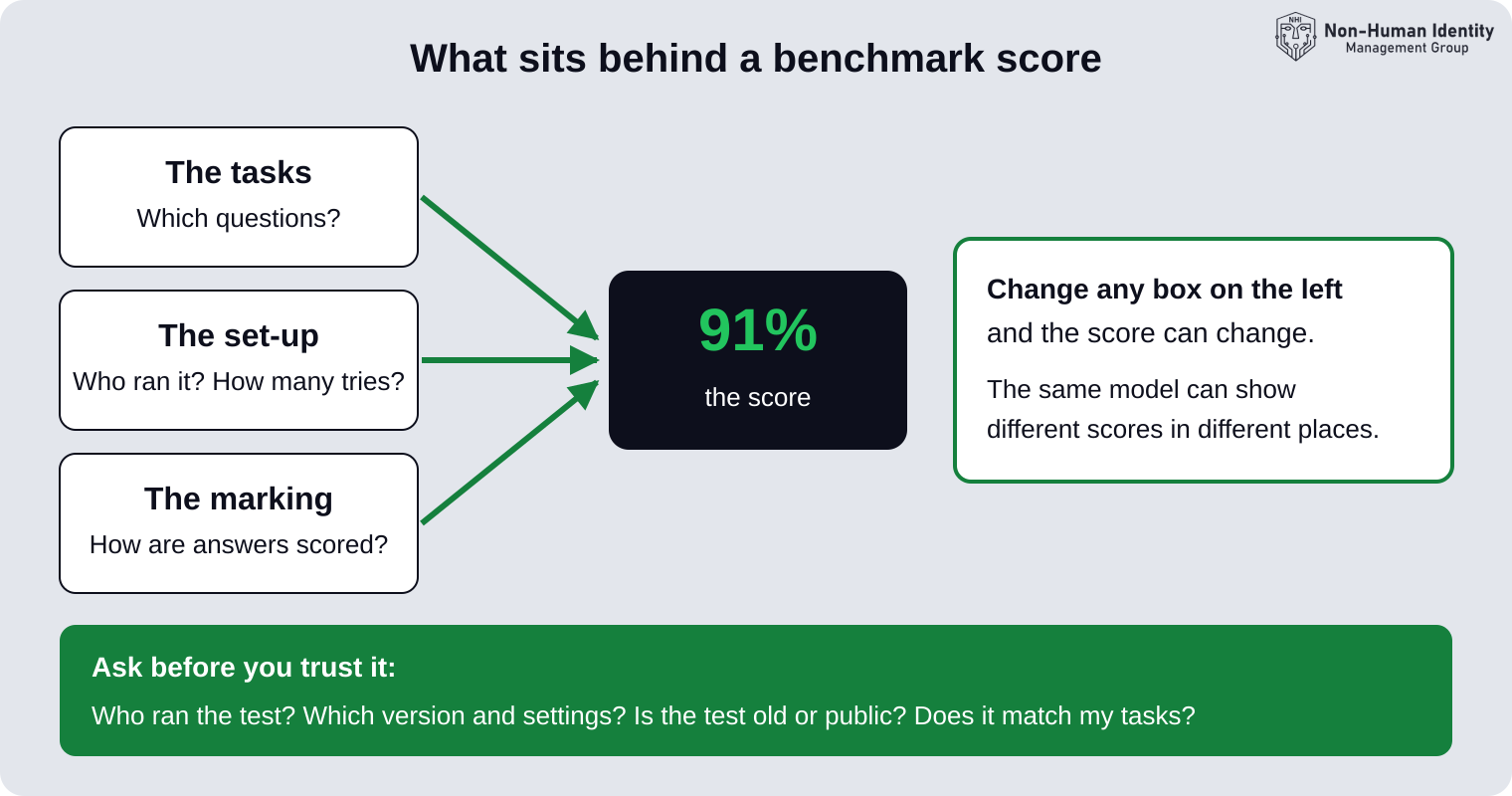
A worked example
This story is made up to show how it can happen.
Halima Jansson is office manager at Summit Ridge Law, a law firm of fifteen people. The partners want an AI tool to summarise client letters.
A sales email from one supplier says its tool "tops the leaderboard" on a well-known test. A rival tool scores a little lower. One partner, Ilyas Albrecht, wants to buy the top scorer straight away.
Halima remembers the driving test, where a pass on one route does not prove you can drive anywhere. So she asks the supplier three questions. Which test gave the score? Who ran it? What settings were used?
The answers help a lot. The top score came from a general quiz test that the supplier ran itself. It had nothing to do with summarising letters. The supplier also could not say whether the quiz questions were public when the model was trained.
Halima picks ten old client letters with the names removed. She asks both tools to summarise each one. Ilyas marks the summaries without knowing which tool wrote them.
The lower-scoring tool wins on seven of the ten letters. It misses fewer key dates, such as court deadlines. The firm starts a trial with that tool, and a person still checks every summary before it goes to a client.
The test took one afternoon. Halima notes that the scores were a useful starting point, but her own small test made the choice.
Myths and mistakes
| What people think | What is true |
|---|---|
| The highest score means the best tool. | It means the best result on that test, under those settings. Your tasks may be different. |
| A score is a fixed fact about a model. | Scores change with the set-up, such as the number of attempts and how questions are asked. |
| Older, famous tests are the most reliable. | Public questions can leak into what models learn from, which can push scores up.[3] |
| A 2-point lead is a clear win. | Small gaps can come from settings or chance. Look for the same lead in independent results. |
| Leaderboard votes measure accuracy. | Preference votes show which answers people liked, not whether the answers were right.[4] |
What can I do this week?
- Find one AI score in an advert or article and check which test it came from.
- Note whether the model maker or an independent group ran the test.
- Write down five real tasks you would want an AI tool to do well.
- Ask any AI supplier you use how their scores were produced.
Checklist
- I know which test a score comes from.
- I know who ran the test, the maker or an independent group.
- I know the settings, such as the number of attempts allowed.
- I have checked whether the test is old or widely public.
- I treat small gaps between models with care.
- I have tried the tool on a few of my own tasks.
- A person still checks AI answers that matter.
Common questions
Should I trust AI benchmark scores?
Trust them as a rough guide, not a final answer. A score shows how a model did on one test under one set-up. Check who ran it and how, look for independent results, and test the tool on your own tasks before you rely on it.
Why does the same model have different scores in different places?
Because the set-up differs. Groups may use different test versions, give the model more or fewer attempts, or ask questions in different ways. Each change can move the number, so compare scores only when they come from the same test and settings.
What is benchmark contamination?
It is when test questions, or their answers, end up in the material a model learned from. The model may then score well because it has seen the questions before. Researchers have found signs of this in some popular tests.[3]
Is a leaderboard the same as a benchmark?
Not quite. A benchmark is the test itself. A leaderboard is a ranked list of results, which may come from one test or many. Some leaderboards rank models by people's votes on which answer they prefer, rather than by right and wrong answers.
Do benchmarks tell me if an AI tool is safe?
Mostly no. Most scores measure skill at tasks, not how a tool handles your data or resists misuse. Safety needs its own checks, such as asking where data goes and testing how the tool behaves. See AI Security for Beginners.
Where next?
Ready for the detail? Read the practitioner guide: How to Read LLM Benchmarks. It goes further into the main types of benchmark, how independent groups run their tests and a checklist for reading a full score table.
Also useful:
- AI Agent Benchmarks Explained
- How Large Language Models Work
- Buying AI Tools Safely for Beginners
- AI Hallucinations for Beginners
Related NHI Mgmt Group resources: Generative AI for Beginners · AI Literacy for Beginners · AI Pricing and Tokens for Beginners
Key terms
- Benchmark
- A fixed set of tasks with a scoring rule, used to measure and compare AI models.
- Leaderboard
- A ranked list of models and their results on one or more tests.
- Large language model
- An AI model trained on large amounts of text to read and write language.
- Data contamination
- When test questions or answers appear in the material a model learned from, which can inflate scores.
- Benchmark saturation
- When most top models score near the maximum, so a test no longer separates them well.
- Model card
- A document from a model maker describing the model, its test results and its limits.
Sources and further reading
- Hendrycks, D. et al. Measuring Massive Multitask Language Understanding. arXiv:2009.03300, 7 September 2020. https://arxiv.org/abs/2009.03300, accessed 28 Nov 2026.
- Introducing SWE-bench Verified. OpenAI. https://openai.com/index/introducing-swe-bench-verified/, accessed 28 Nov 2026.
- Deng, C. et al. Investigating Data Contamination in Modern Benchmarks for Large Language Models. arXiv:2311.09783 (NAACL 2024), 16 November 2023. https://arxiv.org/abs/2311.09783, accessed 28 Nov 2026.
- How it works. LMArena. https://arena.ai/how-it-works, accessed 28 Nov 2026.