AI token pricing means paying for the small chunks of text an AI tool reads and writes.
This guide is for anyone who pays for an AI tool, or signs off the bill for one. You do not need to write code to be affected: if your business uses an AI tool that connects to a provider, the bill may grow with every question it asks.
In short
- AI providers that sell access to their models usually charge per token, a small chunk of text.
- You pay for the text you send in and the text the AI writes back, and the writing often costs more.
- Long chats, big documents and busy automated tools can make bills grow quickly.
- Spending limits, shorter prompts and protected keys help keep costs under control.
What you will learn
- Explain what a token is in one sentence.
- Spot the parts of a request that add to the bill.
- Check that your AI account has a spending limit.
- Ask your supplier how they keep token costs down.
- Text chunk (token)
- a small piece of text, often part of a word, that an AI model reads or writes.
- Text you send (input)
- everything sent to the model with a request, including earlier messages and files.
- Text it writes (output)
- the words the model produces in reply.
What is AI token pricing?
Think of a taxi meter. The fare is not set when you get in. It ticks up with every mile, so a longer trip costs more.
AI token pricing works in a similar way. A business that uses an AI model through its provider, often through a link between programs called an API, pays for what it uses. Use is counted in tokens.
A token is a small chunk of text. For English, OpenAI says one token is roughly four characters, or about three quarters of a word.[1] So 100 tokens are roughly 75 words. Other providers split text in their own ways, so the same words can give different counts.
The bill usually has two main parts. You pay for the input, which is what you send. You also pay for the output, which is what the AI writes back. The two parts often have different prices.[2]
Where the comparison stops working: you can watch a taxi meter as it runs. Token costs often appear only later, on a dashboard or a monthly bill.
Why does it matter?
Small costs per request can add up when a tool runs all day. A leaked key can also let someone else run up your bill.
If you run a small business
What could happen: a chatbot on your website answers thousands of questions, and the monthly bill is a shock.
Check this: set a monthly spending limit and an alert in your AI account.
If you are trying AI as a developer
What could happen: your provider key ends up in shared code, and a stranger uses it at your cost.
Check this: keep keys out of code and turn on usage alerts.
Next: API Keys for Beginners
If you approve budgets
What could happen: an AI helper that runs tasks on its own keeps going far longer than planned.
Check this: ask who watches usage and what stops a runaway task.
Next: AI Agents for Beginners
What does it look like?
Here is a made-up usage summary, like the ones on an AI provider's billing page.
Example only. All values are made up.
EXAMPLE-AI usage summary, account FAKE-0000
Model: ExampleModel-Small
Input tokens:        2,000,000  at FAKE rate A   (1)
Output tokens:         500,000  at FAKE rate B   (2)
Cached input tokens: 1,500,000  at FAKE rate C   (3)
Monthly limit: not set                          (4)
- In a real file, this line would contain the text sent in, including earlier chat messages.
- In a real file, this line would contain the text the model wrote. Rate B is often higher than rate A.
- Text the provider recognised as repeated and charged at a lower rate.
- No spending limit is set, so the bill can keep growing.
Why this is risky: nothing caps the spend. If a tool loops, or a key leaks, the bill may grow until someone notices.
The safer way: set a monthly limit and alerts, check the usage page each week and keep the account's keys in a safe place.
How does it work?
Here is how a single question turns into a line on the bill.
- The text is split. The provider breaks your message, and anything sent with it, into tokens.
- The input is counted. In a chat, earlier messages are often sent again with each new question, so input grows as the chat goes on.
- The reply is written. The model writes its answer token by token, and each of those tokens is counted as output.
- The prices are applied. Each kind of token has its own rate. On Anthropic's price list, for example, output costs five times as much as input for its current models.[2]
- Discounts may apply. Repeated text that is stored for reuse, called prompt caching, can cost much less to read again. Jobs that can wait, sent in a batch, can be cheaper too. Anthropic lists a 50% batch discount.[2]
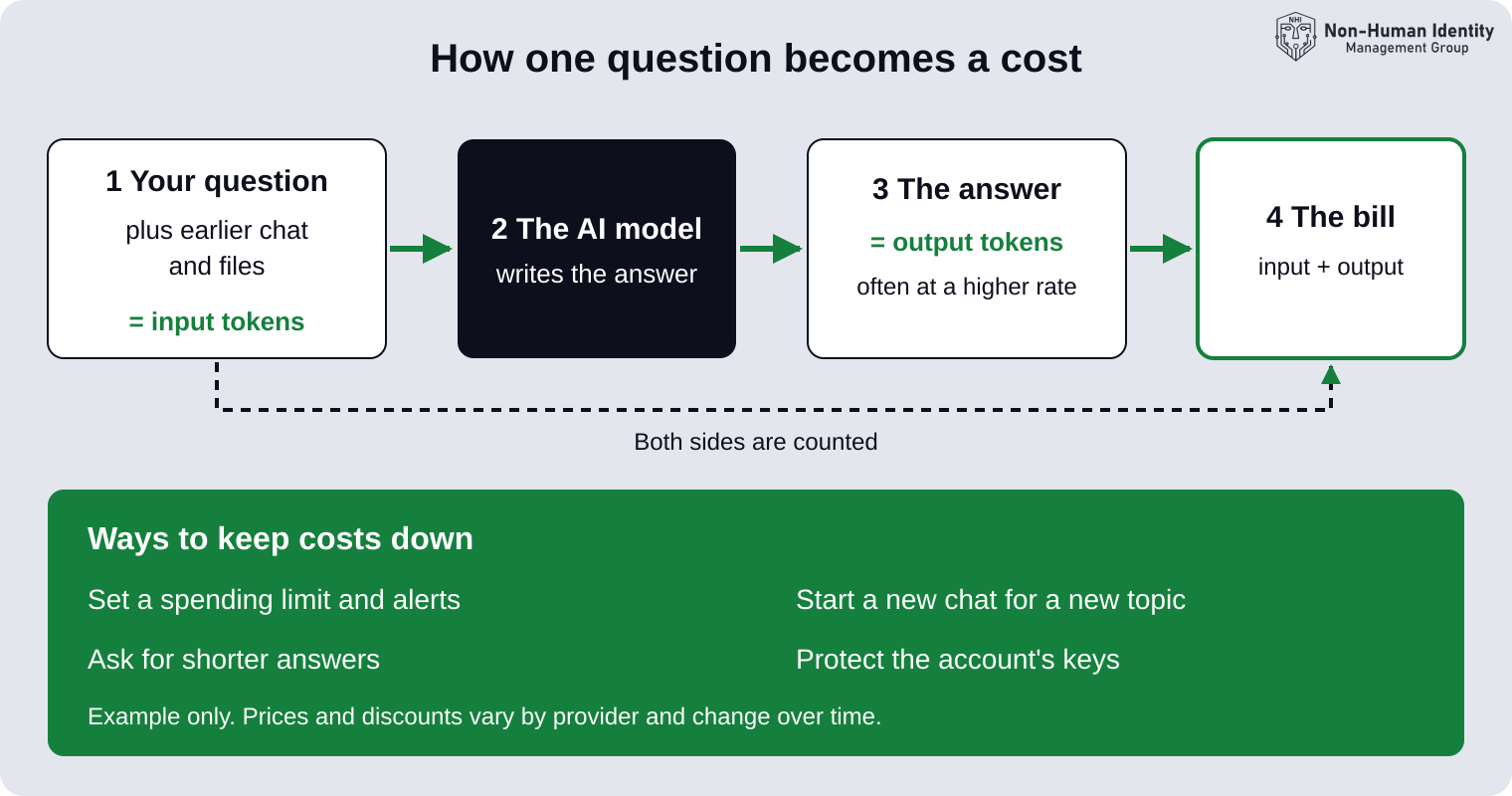
Costs can also come from misuse. A security project that lists risks for AI apps warns that attackers may run up huge numbers of requests to drain a victim's money. It suggests limits on how many requests one user can make.[3]
A worked example
Chiara Bianchi runs the office at Porto Azul Travel, a fictional travel agency with twenty staff. Last spring, the agency added an AI chat helper to its website.
In the first month the bill was small. In the third month it was nearly four times higher, and Chiara wanted to know why before the next one arrived.
She thinks of a taxi meter. A bigger fare usually means longer trips, or more of them. So she asks the developer, Leilani Kahale, to open the usage page with her.
They find three causes. First, the helper sends the whole chat history with every new question, so long chats cost more and more. Second, it pastes the full holiday brochure into each request. Third, it writes long, chatty replies.
Leilani makes some changes. The helper now keeps only recent messages and sends just the brochure pages that match the question. Replies are asked to stay short. The brochure text, which never changes, is set up for prompt caching where the provider supports it.
Chiara then sets a monthly spending limit with an alert at half the budget. She also asks Leilani to move the provider key out of the website code and into the hosting service's secure settings.
The next month, the bill drops back towards the first month's level. Chiara now checks the usage page every Monday.
Myths and mistakes
| What people think | What is true |
|---|---|
| A token is the same as a word. | A token is often part of a word. In English, 100 tokens are roughly 75 words.[1] |
| Only my question is counted. | Earlier messages, files and instructions sent with it count as input too. |
| Input and output cost the same. | They often have different prices, and output is usually the more expensive side.[2] |
| The cheapest price per token means the cheapest tool. | Providers count tokens differently, and a tool that writes longer answers can still cost more. |
| A flat monthly plan and a pay-per-token account work the same way. | Many chat apps sell flat plans with usage limits. Building on a provider's API is usually billed per token. |
What can I do this week?
- Open your AI account's billing page and find this month's token use.
- Set a spending limit and an alert, if your provider offers them.
- Check where your AI provider keys are stored, and move any found in code.
- Ask your supplier or developer how long chats and big files are handled.
Checklist
- I know which AI accounts my business pays for.
- Each account has a spending limit or an alert.
- Someone checks token use at least once a month.
- Provider keys are kept out of code and shared files.
- Long chats and large files are trimmed before they are sent.
- Jobs that can wait use cheaper batch options where offered.
- Automated AI tasks have a limit that stops runaway use.
Common questions
Why do AI tools charge by the token?
Because the work the provider does grows with the amount of text. Longer questions and longer answers take more computing power. Counting tokens lets providers charge for what each customer actually uses, much like a meter for electricity or a taxi.
How many words is a token?
About three quarters of a word in English, on OpenAI's rule of thumb. That makes 100 tokens roughly 75 words. It is only an estimate, and other languages, code and other providers can give quite different counts.[1]
Why does a long chat cost more?
Because earlier messages are often sent again with each new question. The model needs them to keep track of the chat. So the input grows with every turn. Starting a fresh chat for a new topic is a simple way to keep it smaller.
What is prompt caching?
It is a discount for repeated text. Sometimes the start of a request is the same each time, such as fixed instructions. Some providers store that part and charge much less to read it again. Anthropic lists cache reads at a tenth of the normal input price or less, depending on the model.[2]
Can someone else run up my AI bill?
Yes, if they get hold of your provider key or can send unlimited requests to your tool. Keep keys out of code, set spending limits and alerts, and limit how many requests each user can make.[3] See LLM API Key Security.
Where next?
Ready for the detail? Read the practitioner guide: Model Pricing Explained. It goes further into each price line on an AI bill, how caching and batch discounts work across providers, and the extra charges that are easy to miss.
Also useful:
- LLM Pricing Tracker
- AI Agent Pricing Models Explained
- Denial of Wallet and AI Agent Cost Runaway
- How Large Language Models Work
Related NHI Mgmt Group resources: API Keys for Beginners · AI Benchmarks for Beginners · Prompting Basics for Beginners
Key terms
- Token
- A small chunk of text, often part of a word, that an AI model reads or writes and that providers count for billing.
- Tokenizer
- The part of an AI system that splits text into tokens, which differs between providers.
- Context window
- The most text a model can take in and work with in one request.
- Prompt caching
- Storing repeated parts of a request so they can be reused at a lower price.
- API key
- A secret code a program uses to prove it may use a service, and that usage is billed to.
- Denial of wallet
- Misuse that runs up large pay-per-use costs for the victim.
- Rate limiting
- Capping how many requests a user or program can make in a set time.
Sources and further reading
- What are tokens and how to count them? OpenAI Help Center, OpenAI. https://help.openai.com/en/articles/4936856-what-are-tokens-and-how-to-count-them, accessed 28 Nov 2026.
- Pricing. Claude Platform Docs, Anthropic. https://platform.claude.com/docs/en/about-claude/pricing, accessed 28 Nov 2026.
- LLM10:2025 Unbounded Consumption. OWASP Top 10 for LLM Applications, OWASP GenAI Security Project, 2025. https://genai.owasp.org/llmrisk/llm102025-unbounded-consumption/, accessed 28 Nov 2026.