AI regulation means the laws and official rules that control how AI is built, sold and used.
This guide is for anyone who keeps hearing about "AI laws" and wants to know what they are. You do not need to build AI to be affected: if your business uses a chatbot or an AI hiring tool, some rules may already apply to you.
In short
- There is no single world AI law. Each country or region takes its own approach.
- The EU AI Act is the best-known binding law. It sorts AI uses by risk, and the strictest rules go to the riskiest uses.
- Rules often treat the firm that makes an AI tool differently from the firm that uses it.
- Start by listing the AI you use and what it is used for. Then check which rules fit.
What you will learn
- Explain the difference between a law, official guidance and a voluntary framework.
- Describe how a risk-based AI law sorts AI uses into levels.
- Check whether your organisation makes AI, uses AI, or both.
- Ask the first questions about the AI tools your team relies on.
Status: correct as at 28 November 2026, based on the European Commission's AI Act page, EUR-Lex, GOV.UK, the White House, the Council of Europe and NIST. Laws change; check the official text.
This guide explains the topic in general terms and is not legal advice.
- Maker (provider)
- the organisation that builds an AI tool or sells it under its own name.
- User at work (deployer)
- the organisation that uses an AI tool as part of its work.
- Sorting by harm (risk-based approach)
- stricter rules for uses that could do more harm.
What is AI regulation?
Think of road safety. Some rules are laws, like speed limits, with fines. Some are official advice. Some are standards that car makers choose to meet.
AI rules come in the same three kinds. Binding laws must be followed, and breaking them can lead to fines. Official guidance is applied by the regulators that already oversee areas such as data protection. Voluntary frameworks are good-practice guides that nobody is forced to use.
Governments care because AI can shape decisions about people. It might help decide who gets a job interview or a loan. Rules aim to make that safe and fair.
Where the comparison stops working: road rules are much the same in most countries and change slowly. AI rules differ a lot between countries, and the dates are still moving.
Why does it matter?
AI rules can apply even when you only buy an AI tool from a supplier. They can also reach across borders. The EU's law can apply to firms outside the EU when the output of their AI is meant to be used in the EU.[2]
If you run a small business
What could happen: you add a chatbot to your website and do not tell customers they are talking to a machine.
Check this: list the AI features in the tools you use, including ones built into other software.
Next: EU AI Act for Beginners
If you work in HR
What could happen: an AI tool sorts job applications, which some laws treat as a high-risk use with extra duties.
Check this: ask your supplier how the tool works and what records it keeps.
If you are new to compliance work
What could happen: you are asked which AI rules apply, and nobody knows which AI tools the company uses.
Check this: start a simple list of AI tools, owners and uses, and keep it up to date.
Next: Global AI Regulation Map
What does it look like?
Here is a made-up "Am I affected?" checklist for a small firm. It is a starting point, not a legal test.
Example only. All values are made up.
Am I affected? Example Ltd, example.com
[x] We use an AI chatbot on our website        (1)
[x] An AI tool helps us sort job applications  (2)
[ ] We build our own AI tool and sell it       (3)
[x] Some customers are in the EU               (4)
Owner of this list: A. Sample
- A chatbot usually means telling people they are talking to AI.
- Hiring is an area some laws treat as high risk.
- Making and selling AI brings more duties than using it.
- Where your customers are can matter as much as where you are based.
Why this is risky: a firm that never makes this list may miss duties that already apply.
The safer way: keep the list, give it an owner, and check each use against the rules where you work.
How does it work?
Many AI laws, including the EU AI Act, take a risk-based approach. This means the more harm a use could do, the stricter the rules. For an organisation, working with these rules usually goes like this:
- Find your AI. List the AI tools you build, buy or use, including AI features inside other software.
- Find which rules apply. Check where you work, where your customers are and which sector you are in.
- Know your role. Are you the maker, called the provider? Or the user at work, called the deployer? The EU law describes a deployer as anyone using an AI system under its authority, apart from personal, non-work use.[2]
- Sort each use by risk. The EU law has four levels: banned, high risk, transparency (you must tell people) and minimal risk.[1]
- Meet the duties and keep watching. Do what that level needs, such as telling people about a chatbot. Then track changes, because dates move.
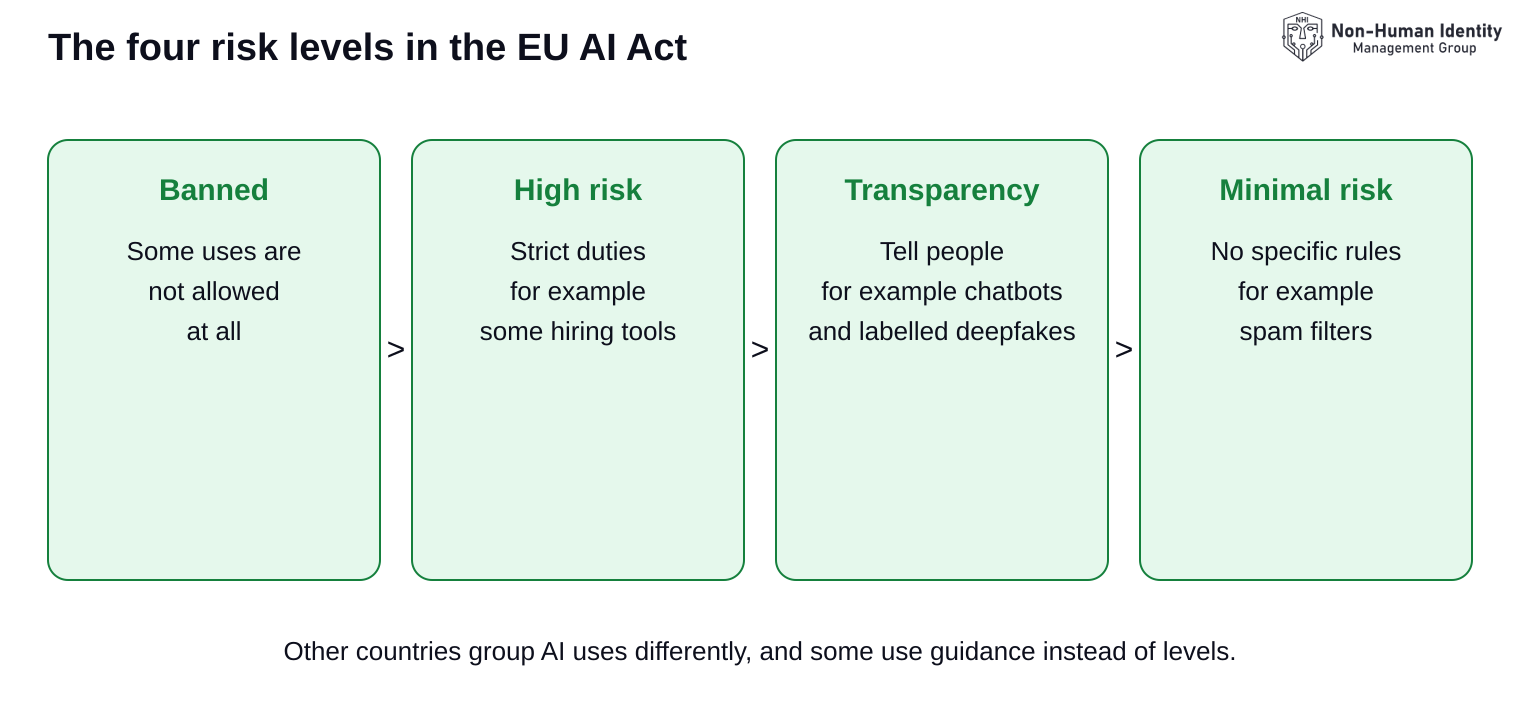
The European Commission gives examples. Chatbots and deepfakes, which are fake videos or images made by AI, fall under transparency rules. Spam filters and AI in video games are minimal risk.[1]
Other places take other paths. The UK government chose in 2024 not to pass a general AI law yet. Instead, it asked existing regulators to apply five principles, such as fairness and transparency.[3] In the US, the main federal step is a presidential order from December 2025, not a law passed by Congress.[4] The Council of Europe, a group of European countries, has a treaty it calls the first binding international treaty on AI.[5] In the US, the NIST AI Risk Management Framework is meant for voluntary use.[6]
The EU law came into force on 1 August 2024, but its rules start in stages. Bans started in February 2025. The high-risk rules were pushed back by a 2026 change. Rules for uses such as hiring now start on 2 December 2027.[1]
A worked example
Abigail Fofana manages the office at Willow Clinic, a small made-up private clinic in the UK. Some of its patients live in Ireland, so it books appointments for people in the EU.
The clinic's owner asks her a simple question: "Do these AI laws affect us?" Abigail does not know, so she starts with a list.
She finds three AI tools. A chatbot on the website answers booking questions. The staff email program suggests replies. And a new recruitment service ranks job applicants for a nurse post.
Next, she works out the clinic's role. It did not build any of these tools. It uses them, so it is a deployer, not a provider.
Then she sorts each use. The chatbot talks to patients, some in Ireland, so the clinic should make clear they are talking to AI. The email helper looks low risk. The ranking tool is different. Hiring is an area the EU law treats as high risk, and those rules start in December 2027.[1]
Abigail adds a line to the chatbot window saying it is an AI assistant. She asks the recruitment supplier how its tool ranks people and what records it keeps. She also asks a data protection adviser, Alastair Schmidt, to check her notes.
She does not try to become a lawyer. She knows what AI the clinic uses, what role it plays and where to ask for help. She sets a reminder to review the list every six months.
Myths and mistakes
| What people think | What is true |
|---|---|
| If we are not in the EU, the EU law cannot apply to us. | It can apply when the output of an AI system is meant to be used in the EU.[2] |
| All AI is treated as high risk. | Most everyday AI, such as spam filters, is minimal risk with no specific rules under the EU law.[1] |
| We only buy AI, so the rules are the supplier's problem. | Users at work have duties too, such as telling people about a chatbot. |
| Following a voluntary framework means we obey the law. | Frameworks help you manage risk and keep evidence. They do not replace legal duties. |
| The dates are fixed, so we can plan once. | Dates have already moved. The EU's high-risk deadlines were pushed back in 2026.[1] |
What can I do this week?
- List the AI tools you use, including AI features inside email, office and HR software.
- Write down your role for each one: did you build it, or do you use it?
- Note where your customers are, because that can decide which rules apply.
- Ask your suppliers what they say about the rules for their AI tools.
- Pick an owner who keeps the list up to date and follows rule changes.
Checklist
- I can explain the difference between a law, guidance and a voluntary framework.
- We have a list of the AI tools we build, buy or use.
- We know whether we are the maker or the user of each tool.
- We know which countries our customers and staff are in.
- People are told when they are talking to an AI chatbot.
- Any AI used in hiring or similar decisions has been flagged for a closer look.
- Someone owns the list and checks official sources for changes.
Common questions
Is there a global AI law?
No. Countries take different approaches. The closest thing to a worldwide rule is the Council of Europe treaty on AI. It binds only the countries that join it.[5] Most firms need to check the rules in each place where they work or have customers.
Does the UK have an AI Act?
Not in its 2024 plan, the latest official response this guide is based on. The UK government said it would pass a law when it was sure that was right. Meanwhile, it asked existing regulators to apply five principles.[3] Check the UK AI Regulation Guide for later changes.
Does the US have a federal AI law?
Not yet, at the date of this guide. The main federal step is a December 2025 presidential order. It calls for a national framework and for a task force to challenge some state AI laws.[4] Several states have their own laws; see the US State AI Laws Tracker.
We only use chat assistants. Do the rules affect us?
Possibly, but usually lightly. Using a chat assistant for drafting is often a lower-risk use. Duties grow if you put a chatbot in front of customers or use AI in decisions about people, such as hiring. Under the EU law, staff using AI may also need suitable AI training.[1]
Who enforces AI laws?
Each law names its own enforcers. Under the EU AI Act, national authorities in each EU country share the job with an EU body called the AI Office. The AI Office oversees general-purpose AI models, which are built to do many tasks.[1] In the UK approach, existing regulators apply the principles in their own areas.[3]
Where next?
Ready for the detail? Read the practitioner guide: AI Regulation Glossary. It goes further into the exact legal terms, the roles each law names and how the main laws define them.
Also useful:
- Global AI Regulation Map
- EU AI Act for Beginners
- EU AI Act Compliance Guide
- NIST AI RMF Guide
- AI Governance Guide
Related NHI Mgmt Group resources: EU AI Act Provider vs Deployer Obligations Guide · UK AI Regulation Guide · US State AI Laws Tracker
Key terms
- EU AI Act
- The European Union's binding law that sets rules for AI according to how much harm a use could do.
- AI system
- Software that works out outputs such as predictions, content or decisions from the inputs it gets.
- AI Provider
- The organisation that builds an AI system or puts it on the market under its own name.
- Deployer
- An organisation that uses an AI system under its own authority as part of its work.
- Risk-Based Approach
- Matching how strict the rules are to how much harm a use could do.
- High-Risk AI System
- An AI use, such as some hiring tools, that carries the strictest duties under the EU law.
- AI Literacy
- Enough understanding of what AI can and cannot do to use it sensibly.
- NIST AI RMF
- A voluntary US framework that helps organisations manage AI risk.
Sources and further reading
- AI Act: Shaping Europe's digital future. European Commission, last updated 25 Nov 2026. https://digital-strategy.ec.europa.eu/en/policies/regulatory-framework-ai, accessed 28 Nov 2026.
- Regulation (EU) 2024/1689 laying down harmonised rules on artificial intelligence (Artificial Intelligence Act), recitals 13 and 22. Official Journal of the European Union, 12 July 2024. EUR-Lex. https://eur-lex.europa.eu/legal-content/EN/TXT/HTML/?uri=OJ:L_202401689, accessed 28 Nov 2026.
- A pro-innovation approach to AI regulation: government response, 6 February 2024. Department for Science, Innovation and Technology, GOV.UK. https://www.gov.uk/government/consultations/ai-regulation-a-pro-innovation-approach-policy-proposals/outcome/a-pro-innovation-approach-to-ai-regulation-government-response, accessed 28 Nov 2026.
- Ensuring a National Policy Framework for Artificial Intelligence (Executive Order 14365), 11 December 2025. The White House. https://www.whitehouse.gov/presidential-actions/2025/12/eliminating-state-law-obstruction-of-national-artificial-intelligence-policy/, accessed 28 Nov 2026.
- The Framework Convention on Artificial Intelligence. Council of Europe. https://www.coe.int/en/web/artificial-intelligence/the-framework-convention-on-artificial-intelligence, accessed 28 Nov 2026.
- AI Risk Management Framework. National Institute of Standards and Technology (NIST). https://www.nist.gov/itl/ai-risk-management-framework, accessed 28 Nov 2026.