The EU AI Act is a European law that sets rules for AI based on the harm it could cause.
This guide is for anyone who keeps hearing about the AI Act and wants a plain starting point. You do not need to build AI to be affected: if your business uses a chatbot or an AI hiring tool, the Act can give you duties too.
In short
- The Act sorts AI uses into four levels of risk. A few uses are banned, and most everyday AI has no special rules.
- Your duties depend on your role. The firm that builds an AI tool carries more work than the firm that uses it.
- Some rules already apply, including the bans and a duty to help staff understand AI.
- The main deadlines for high-risk AI moved to December 2027 and August 2028, so older articles may show other dates.
What you will learn
- Explain what the AI Act does in one sentence.
- Spot which risk level an AI tool is likely to sit in.
- Check whether your organisation builds AI, uses it, or both.
- Ask suppliers the right questions about their AI tools.
Status: correct as at 28 November 2026, based on the AI Act on EUR-Lex and the European Commission's AI Act pages (last updated 25 November 2026). Laws change; check the official text.
This guide explains the topic in general terms and is not legal advice.
- Builder (provider)
- the organisation that makes an AI tool, or has it made, and offers it under its own name.
- User firm (deployer)
- an organisation that uses an AI tool in its own work.
- Risk level (risk tier)
- one of four groups the Act uses to decide how strict the rules are.
What is the EU AI Act?
Think of food safety rules. A stall selling sealed biscuits has few rules, a restaurant kitchen has many, and some foods cannot be sold at all. The AI Act works the same way for AI.
The rules follow the risk of how AI is used, not the technology itself. A spam filter faces no special rules. A tool that ranks job applicants faces strict ones, because a mistake could cost someone a job.
The Act is a European Union law. It applies directly in every EU country, so each country does not need to write its own version. It can also reach firms outside the EU when their AI is sold in the EU or its results are used there.
Where the comparison stops working: a biscuit is always a biscuit. The same AI model can sit in a low-risk use one day and a high-risk use the next. So each use is judged on its own.
Why does it matter?
Customers, auditors and partners are starting to ask which AI a business uses and how it is controlled. The Act also allows large fines, so knowing where you stand is worth an afternoon's work.
If you run a small business
What could happen: you use an AI tool to sort job applications without knowing it counts as high-risk.
Check this: list every AI tool you use and what decisions it helps with.
If you are new to compliance or security work
What could happen: you are asked to show that an AI tool keeps records and has human checks. You may not know where to start.
Check this: find out who owns each AI tool and where its records are kept.
If you manage a team
What could happen: staff use AI tools at work without the basic understanding the Act asks for.
Check this: plan a short session on what AI can and cannot do, and keep a note of who attended.
What does it look like?
Here is a made-up "Am I affected?" card that a small firm might fill in for one tool.
Example only. All values are made up.
AI tool check card: EXAMPLE-TOOL-0000
Tool:        HireRank (made-up CV sorting app)
Used for:    ranking job applicants             (1)
Our role:    we use it; the supplier built it   (2)
Risk level:  likely high-risk (hiring)          (3)
Owner:       Jo Sample, HR lead
Next step:   ask supplier for instructions;
             a person reviews every ranking     (4)
- What the tool does. In a real file, this line would contain the decision the tool supports.
- Your role. Here the firm is the user firm, and the supplier is the builder.
- The likely risk level. Hiring is one of the areas the Act treats as high-risk.
- The action. A user firm of a high-risk tool must follow the instructions and put a person in charge of checking it.
Why this is risky: without a card, nobody may notice the extra duties. A hiring tool brings more work than a spam filter.
The safer way: keep one short card per AI tool, with an owner. Review the cards when you add a tool or the law changes.
How does it work?
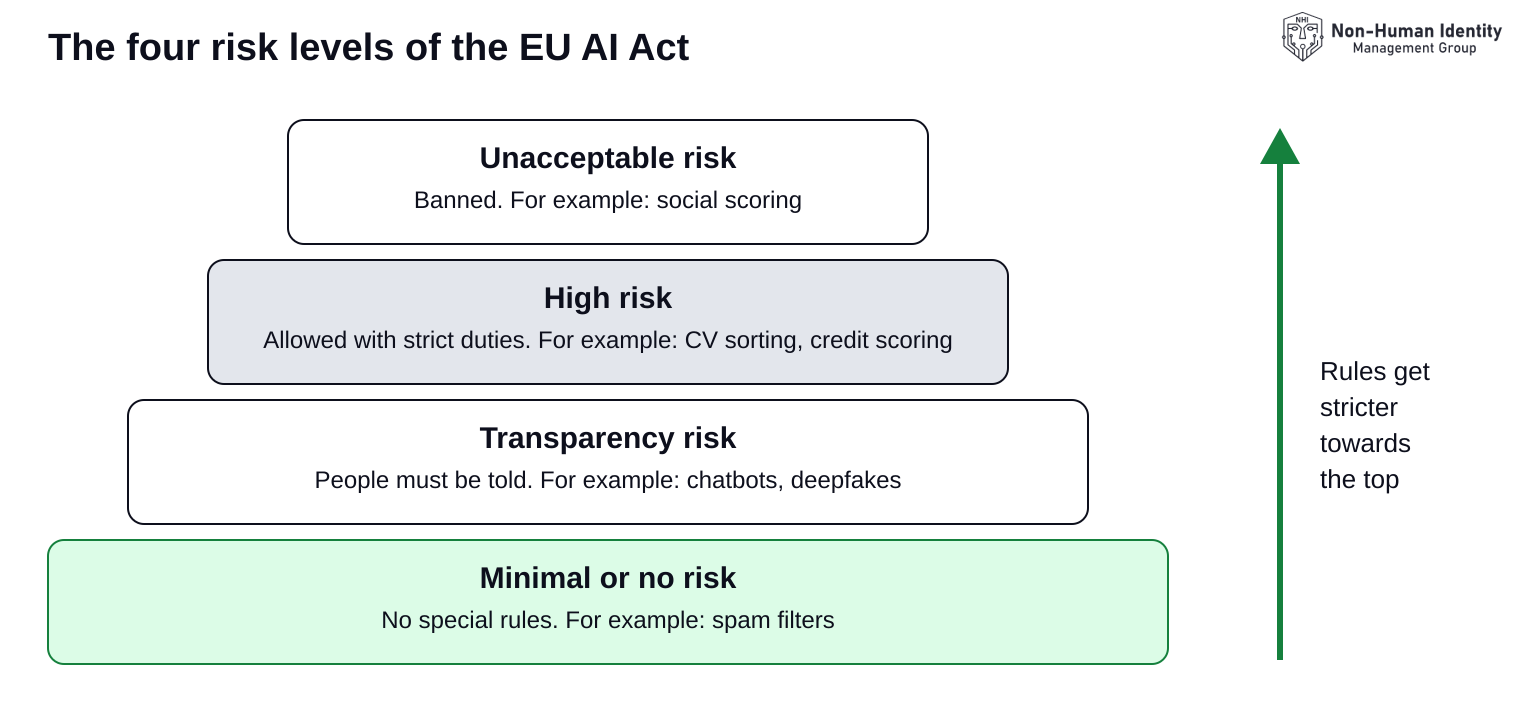
The Commission groups AI uses into four risk levels.[2]
- Unacceptable risk: banned. Examples include social scoring and harmful manipulation.
- High risk: allowed, with strict duties such as risk checks, records, documents and human oversight. CV sorting and credit scoring are examples.
- Transparency risk: people must be told about the AI. A chatbot should make clear it is a machine.
- Minimal or no risk: no special rules. Most AI in use today, such as spam filters, sits here.
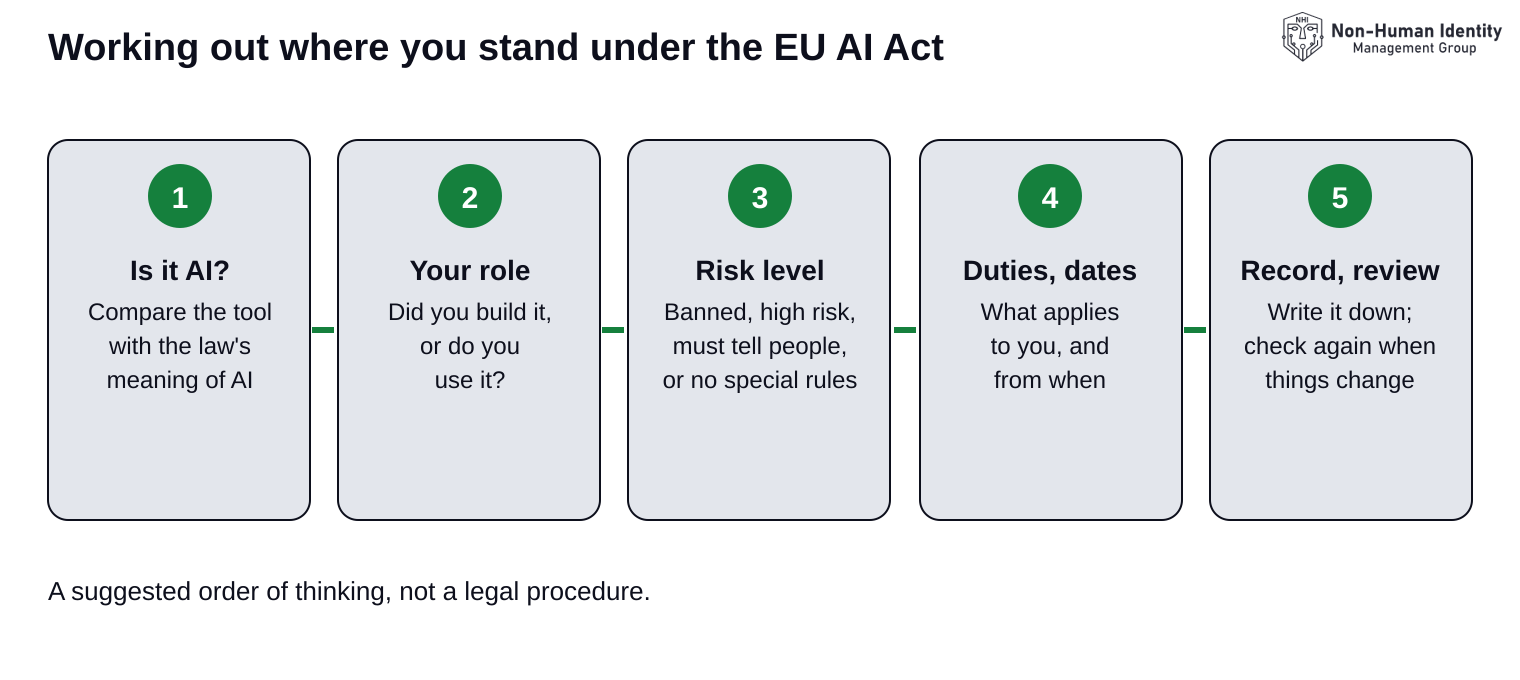
A simple way to work out where you stand is to answer five questions in order. This is our suggested approach, not a procedure set by the law.
- Is it AI? The law covers software that works out from its input how to produce things like predictions, content or decisions.[1] A simple spreadsheet formula is usually not AI. A chatbot usually is.
- What is your role? Decide whether you built the tool, or had it built, and offer it under your name (builder). Or decide whether you only use it (user firm). One firm can be both, for different tools.
- Which risk level? Check the banned list first, then whether the use is in a high-risk area such as hiring or education. Then check whether people must be told about the AI.
- Which duties and when? Match your role to the risk level, and note the date each duty starts.
- Record and review. Write down each decision, and look again when you add a tool or the law changes.
The key dates, as shown on the Commission's pages after a later amending law called the AI Omnibus:[2][3]
| Date | What applies |
|---|---|
| 1 August 2024 | The Act comes into force |
| 2 February 2025 | The bans, and the duty to build AI understanding among staff |
| 2 August 2025 | Rules for the makers of large general-purpose AI models |
| 2 August 2026 | Most rules apply and enforcement begins, including the duty to tell people about chatbots |
| 2 December 2026 | A new ban on AI that creates non-consensual sexual images or child abuse material |
| 2 December 2027 | High-risk rules for listed uses, such as hiring and education |
| 2 August 2028 | High-risk rules for AI built into regulated products, such as lifts or toys |
The Commission says the AI Omnibus came into force on 27 July 2026. It delayed the high-risk dates and added the new ban.[2] That is why older articles often show different dates.
A worked example
Anouk Keane is the office manager at Ember Media, a made-up marketing agency with 40 staff in London and a small office in Dublin. Her director asks her to check where the firm stands on the AI Act.
Anouk starts with a list. She asks each team which AI tools they use, and finds three.
The first is a chatbot on the agency's website that answers client questions. Ember Media set it up on a large AI model and runs it under its own name. So Anouk notes the agency as the builder. People must be told they are talking to AI, so she asks the web team to add a clear notice.
The second is a CV sorting tool that the agency bought to help with hiring. Hiring is a high-risk area, so Anouk marks it as likely high-risk. Ember Media is the user firm, and the supplier is the builder. She asks the supplier for its instructions for use and its plans for the December 2027 deadline. She also names a recruiter who must review every ranking before anyone is turned down.
The third is the spam filter on the agency's email. It sits in the lowest risk level, so she simply notes it.
Finally, Anouk books a one-hour session on AI basics for staff and keeps a list of who attended. She writes each decision on a one-page card per tool and sets a reminder to review them in six months.
This does not make Ember Media fully compliant in one step. It gives the agency a clear picture, a short action list and a record it can show if asked. Anouk also asks the firm's lawyer to confirm how the CV tool is classed.
Myths and mistakes
| What people think | What is true |
|---|---|
| The AI Act only matters to big tech firms. | It can apply to any firm that builds or uses AI covered by the Act. Smaller firms get lower fine limits, not an exemption.[1] |
| Nothing applies until the high-risk dates. | The bans and the staff understanding duty have applied since 2 February 2025, and most rules since 2 August 2026.[3] |
| If we buy AI from a supplier, all the duties are theirs. | The builder carries most duties, but a user firm of a high-risk tool must follow the instructions and assign a person to oversee it. |
| It only applies to EU companies. | It can apply to firms outside the EU when their AI is sold in the EU or its results are used there. |
| Every AI tool is high-risk. | The Commission says most AI in use today, such as spam filters, has no special rules.[2] |
What can I do this week?
- List your AI tools. Include AI features switched on inside software you already use, and name an owner for each.
- Mark your role and a first guess at the risk level for each tool. Flag anything used for hiring, education, credit or safety.
- Check your chatbots tell people they are talking to AI.
- Plan a short AI basics session for staff who use AI, and record who attended.
- Ask suppliers of any likely high-risk tool how they will meet their deadlines.
Checklist
- We have a list of the AI tools we build or use, with an owner for each.
- For each tool, we know whether we are the builder or the user firm.
- We have checked that none of our uses is on the banned list.
- We have flagged any use that may be high-risk.
- Our chatbots and AI-made content are clearly labelled where the rules ask for it.
- Staff who use AI have had basic AI training, and we keep a record.
- We have asked suppliers of likely high-risk tools about their plans.
- We review the list when we add a tool, change a use or the law changes.
Common questions
Does the AI Act apply to my small business?
It can. If staff use AI tools at work, you are probably a user firm, so the staff understanding duty applies. Some uses, such as hiring, can bring high-risk duties. Many everyday tools, such as spam filters, have no special rules at all.
What does the duty to understand AI mean in practice?
The law asks builders and user firms to take steps, as far as they can, so their staff understand AI well enough for their work.[1] A sensible start is short training matched to each role, and a record of who took part.
Who enforces the AI Act?
National authorities in each EU country and the Commission's AI Office share the job, from 2 August 2026. The AI Office has its own powers over the makers of large general-purpose AI models, including fines.[2]
How big can the fines be?
For banned uses, the top fine is 35 million euros or 7% of worldwide yearly turnover, whichever is higher. Other breaches have lower limits. For smaller firms, the lower of the two figures applies instead.[1]
Is the AI Act the same as GDPR?
No. GDPR protects personal data, while the AI Act sets rules for AI based on risk. They often apply side by side, for example when an AI tool handles people's personal details. Each law has its own duties, so check both.
Why do different articles give different deadlines?
Because the AI Omnibus changed them in 2026. Material written before then often shows the original dates, such as August 2027 for AI in regulated products. Use the Commission's timeline as the reference, because it reflects the changes.[3]
Where next?
Ready for the detail? Read the practitioner guide: EU AI Act Compliance Guide. It goes further into how high-risk tools are classed, the duties of each role and the evidence auditors expect.
Also useful:
- EU AI Act Provider vs Deployer Obligations Guide
- EU AI Act Implementation Timeline Tracker
- GDPR for Beginners
- AI Governance for Beginners
Related NHI Mgmt Group resources: EU AI Act High-Risk AI Systems Guide · EU AI Act Prohibited Practices Guide · AI Literacy for Beginners
Key terms
- EU AI Act
- A European law that sets rules for AI according to how much harm a use could cause.
- AI system
- Software that works out from its input how to produce outputs such as predictions, content or decisions.
- AI provider
- The organisation that makes an AI tool, or has it made, and offers it under its own name.
- AI deployer
- An organisation that uses an AI tool in its own work.
- High-risk AI system
- An AI tool used in an area where mistakes could seriously affect people, such as hiring, so strict duties apply.
- General-purpose AI model
- A large AI model that can do many different tasks and is built into many products.
- AI literacy
- Enough understanding of what AI can do, and where it creates risk, for people to use it sensibly in their role.
- AI Office
- The European Commission body that supervises the makers of general-purpose AI models.
Sources and further reading
- Regulation (EU) 2024/1689 of the European Parliament and of the Council of 13 June 2024 laying down harmonised rules on artificial intelligence (Artificial Intelligence Act), including Article 3 (definitions), Article 4 (AI literacy) and Article 99 (penalties). Official Journal of the European Union, 12 July 2024. EUR-Lex. https://eur-lex.europa.eu/eli/reg/2024/1689/oj, accessed 28 Nov 2026.
- AI Act (Regulatory framework for AI). Shaping Europe's digital future, European Commission, last updated 25 November 2026. https://digital-strategy.ec.europa.eu/en/policies/regulatory-framework-ai, accessed 28 Nov 2026.
- Timeline for the implementation of the EU AI Act. AI Act Service Desk, European Commission. https://ai-act-service-desk.ec.europa.eu/en/ai-act/timeline/timeline-implementation-eu-ai-act, accessed 28 Nov 2026.