Payment fraud is when a criminal steals money, goods or card details by tricking a person or a system into making, approving or redirecting a payment that the rightful owner did not intend.
This guide is for newcomers, students, career changers and managers who are not security specialists. It explains, in plain English, the main kinds of card and transfer fraud, how a typical fraud unfolds, and the security controls businesses use to make it harder. It stays on the security side: how the fraud works at a high level, the warning signs, the checks an organisation can put in place and where to report it. For legal or financial matters, speak to a qualified professional.
By the end of this guide you will be able to:
- Explain the difference between card fraud and transfer fraud.
- Understand why "authorised" payments can still be fraud.
- Describe the stages of a typical payment fraud.
- Identify simple controls a small business can add this week.
Key takeaways
- There are two big families. Card fraud misuses card details; transfer fraud moves money by bank payment, often after a convincing lie.
- Many frauds use a real person's approval. In authorised push payment fraud, the payer sends the money themselves because they have been deceived.
- The lie usually arrives through a trusted channel. Fake invoices, changed bank details and messages that look like the boss or a supplier are common routes.
- Process beats instinct. Checking any change of bank details by calling a number you already hold is one of the most useful single controls.
- Speed matters after a fraud. Contact your bank straight away and report it, because stolen money is moved on quickly.
What it is, in plain English
Every payment has someone who pays, someone who receives, and a set of checks in between. Payment fraud happens when a criminal gets round those checks to steal funds, card details or goods. Criminals do this through account takeover, social engineering, card theft and payment redirection.
It helps to split payment fraud into two families:
- Card fraud: someone uses a card, or its details, without the cardholder's permission. A common type is card-not-present fraud, where stolen card details are used online, by phone or by mail order, so the physical card is never seen.
- Transfer fraud: money is moved by bank transfer to a criminal. Sometimes the criminal breaks into an online bank account and sends the money (unauthorised). Often, the real account holder is tricked into sending it themselves. That second kind is called authorised push payment (APP) fraud: the transfer is technically authorised, but the decision behind it was based on a lie.
A useful comparison is a forged delivery note at a warehouse. If someone steals the warehouse key, that is like card fraud or an account break-in. If someone hands the staff a convincing but fake note saying "send the next lorry to this new address", the staff load the lorry themselves. That is like APP fraud. Where the analogy breaks down: a lorry can often be tracked and stopped, while money sent by fast bank payment can be moved on within minutes, so the chance to stop it is short.
Two common business versions of APP fraud are invoice fraud, where criminals redirect a supplier payment to their own account, and mandate fraud. Action Fraud, the UK's former national fraud reporting centre (replaced by Report Fraud in December 2025), described mandate fraud as a criminal tricking you into changing a direct debit, standing order or bank transfer mandate by pretending to be an organisation you already pay.[3] Many of these start with business email compromise (BEC), where the criminal impersonates a trusted person or email address. See Business Email Compromise for Beginners for that part of the story.
Why it matters to you
- If you run a small business: one paid fake invoice can wipe out a month's profit. Small finance teams often have one person who can both change bank details and send payments, which is exactly the gap criminals look for.
- If you are new to a security job: payment fraud sits where security, finance and customer service meet. You will be asked how email security, sign-in controls and payment approval steps fit together.
- If you are a manager: fraud is a process problem as much as a technical one. Clear payment rules, and permission for staff to slow down and check, are decisions only managers can make.
The sums involved are large. UK Finance, the trade body for UK banking, reported over £1.1 billion of fraud losses in the UK in 2024.[1] In the US, the FBI's Internet Crime Complaint Center (IC3) reported $55,499,915,582 in exposed losses from business email compromise between October 2013 and December 2023, across domestic and international incidents.[2] Exposed losses include attempted as well as actual losses, so treat the figure as a measure of scale, not money actually taken.
How it works, step by step
Payment frauds vary, but most follow a similar path. The steps below are at a high level so you can recognise them, not a recipe.
- Research. The criminal learns about the target: who approves payments, which suppliers are paid, when invoices are due. Company websites, social media and earlier data leaks all help.
- Impersonate. They pose as someone trusted: a supplier, a senior manager, the bank or a customer. This may use a look-alike email address, a hacked real mailbox, a phone call or a text.
- Pressure. They ask for something urgent: pay this invoice today, update our bank details, keep this confidential. Urgency is designed to stop people checking.
- Payment. A member of staff pays the new account, or stolen card details are used to buy goods online.
- Move money. The funds are passed quickly through other accounts, often belonging to money mules (people whose accounts are used to receive and move criminal funds), which makes tracing and recovery harder.
- Discover. The fraud comes to light, often when the real supplier asks why they have not been paid. Action Fraud guidance notes that the genuine organisation may then report missed payments or undelivered goods.[3]
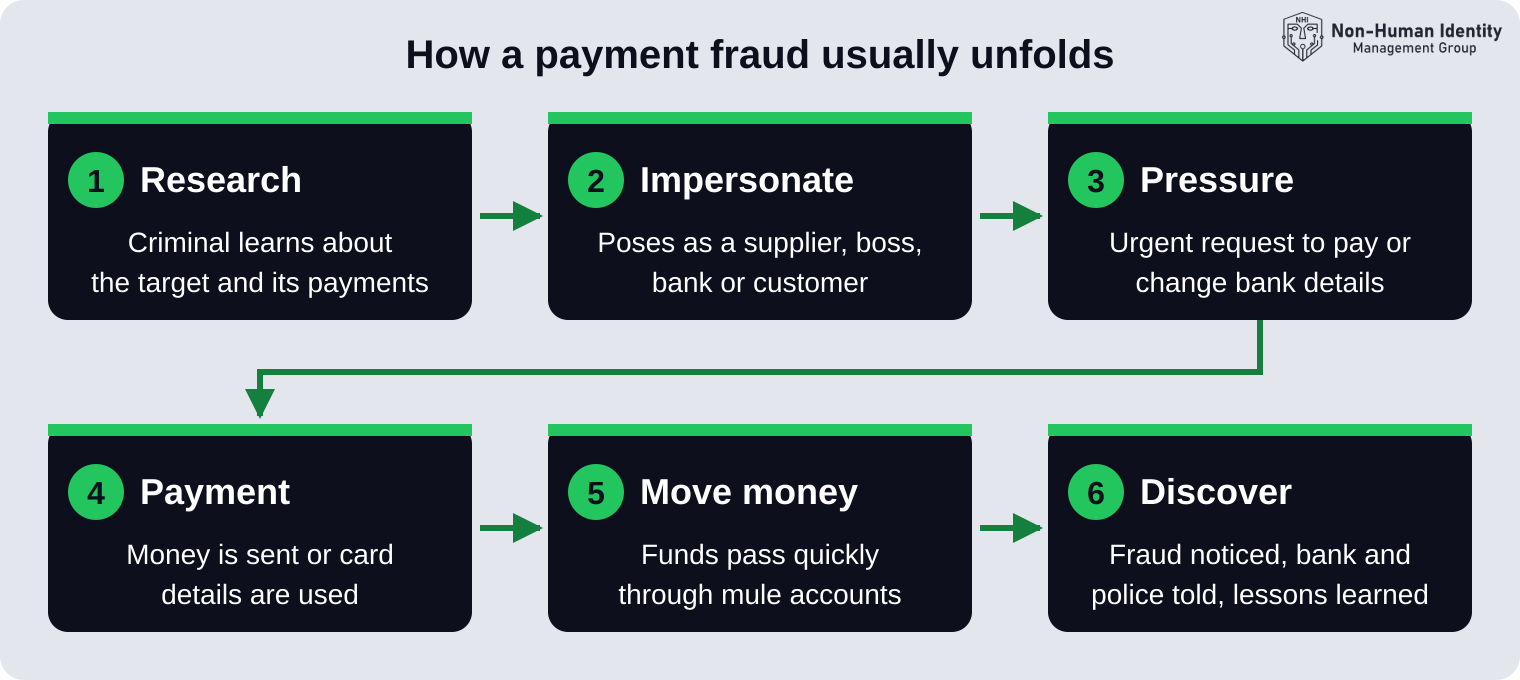
The table below shows the main controls and where each one fits. They reduce risk; none of them is a complete answer on its own.
| Control | What it does | Stage it helps |
|---|---|---|
| Call-back check on bank detail changes | Confirms any new bank details using contact details you already hold, not those in the request. Both Action Fraud guidance and the FBI recommend this kind of independent check.[2][3] | Impersonate, Pressure |
| Two-person approval for payments | One person sets up a payment, a second approves it, so one deceived person cannot send money alone. | Payment |
| Multi-factor sign-in on email and banking | Makes it harder for a criminal to take over a real mailbox or online bank account with a stolen password. | Impersonate |
| 3-D Secure for online card payments | EMVCo describes EMV 3-D Secure as a protocol that lets the card issuer authenticate the shopper for card-not-present purchases, either from data alone or with an extra challenge such as a one-time passcode or biometrics.[5] | Payment |
| Strong customer authentication | In the UK, the FCA says these rules apply when a payer starts an electronic payment, accesses an account online or carries out a risky remote action, unless an exemption applies.[6] | Payment |
| PCI DSS for card data | A security standard for organisations that store, process or transmit card data, so stolen card details are harder to obtain in the first place.[7] | Research |
Useful distinctions
- Unauthorised versus authorised. If a criminal makes the payment, it is unauthorised. If they persuade the account holder to make it, it is authorised push payment fraud. Banks and rules often treat the two differently, which is one reason to report quickly and accurately.
- Payment fraud versus account takeover. Account takeover is the break-in; payment fraud is often what happens next. See Account Takeover for Beginners.
- Merchant side versus payer side. A shop worries about stolen cards being used to buy from it (and the resulting chargebacks, where the cardholder's bank reverses the payment). A business paying suppliers worries about being tricked into paying the wrong account. The controls differ.
A worked example
Harbour Print is a fictional printing firm with 25 staff. Lena runs accounts and can both add suppliers and send payments. One Thursday she receives an email that appears to come from their paper supplier. It says the supplier has changed banks and attaches a letter with new account details. The email address is one letter different from the real one, which Lena does not notice.
The previous month, Harbour Print's manager, Tom, had introduced two rules after reading about invoice fraud: any change of bank details must be confirmed by phone using the number already on the supplier record, and any payment over a set amount needs a second person to approve it.
Lena calls the supplier on the number in the accounts system. The supplier says they have not changed banks. Lena does not reply to the email, forwards it to Tom and their IT provider, and marks the supplier record as "bank details confirmed, no change". The IT provider blocks the look-alike domain and checks whether anyone else received similar messages.
The rules did not stop the email arriving, and a busy day could still have led to a mistake. What they did was give Lena a clear, expected step that caught the lie before money moved. Tom also reminds staff that if a payment does go wrong, the first call is to the bank, straight away.
Myths and misunderstandings
| What people think | What is true |
|---|---|
| Only careless people fall for payment fraud. | Criminals research their targets and copy real suppliers, real invoices and real writing styles. Good processes protect careful people on busy days. |
| If the email came from the supplier's real address, it is safe. | A supplier's real mailbox can be taken over. Check bank detail changes by phone on a number you already hold, whatever the sender address. |
| The bank will always spot and stop a fraudulent transfer. | Banks run checks, but an authorised payment sent by the account holder can look normal. Your own checks come first. |
| Card fraud is only a problem for shoppers. | Businesses that take card payments face chargebacks and must protect the card data they handle. |
| Payment fraud is a finance problem, not a security one. | Most cases rely on email, phone or account security weaknesses, so finance and security teams need to work together. |
Key terms
- Payment fraud
- The unauthorised manipulation of payment transactions to steal funds, credentials or goods, for example through account takeover, social engineering, card theft or payment redirection.
- Card-not-present fraud
- Card fraud where the card is used without the physical card being present, such as online, by phone or by mail order.
- A scam in which the payer is persuaded to authorise the transfer themselves, so the payment is technically authorised but based on deception.
- Invoice fraud
- Redirecting payments, altering supplier details or requesting exceptions using convincing impersonation.
- Business email compromise (BEC)
- Social engineering where an attacker impersonates a trusted person or domain to manipulate payments, change bank details or extract sensitive information.
- Using deception, urgency and authority to persuade a person to reveal information or take a risky action.
- Money mule
- An account holder or intermediary used to receive and move fraudulent funds for a criminal.
- 3-D Secure (3DS)
- An authentication protocol for card-not-present payments that adds issuer verification before a transaction is approved.
- Strong customer authentication (SCA)
- A regulated requirement for more than a single password or code when paying or accessing a payment account, with the approval tied to the specific payment.
- Chargeback
- A reversal of a card payment started by the cardholder's bank after the cardholder disputes it.
- PCI DSS
- The Payment Card Industry Data Security Standard, a security baseline for organisations that store, process or transmit payment card data.
Common questions
What is the most common sign of a fraudulent payment request?
Pressure combined with a change: new bank details, an unusual way of paying, or a request to skip normal steps or keep it secret. Take Five, a UK Finance campaign, puts it simply: stop, challenge, protect.[4]
Is invoice fraud the same as business email compromise?
They overlap. BEC describes the impersonation, usually by email. Invoice fraud describes one outcome, a redirected supplier payment. Invoice fraud can also start with a letter or phone call.
Does 3-D Secure mean online card payments are safe?
It adds a check by the card issuer, which makes stolen card details harder to use online.[5] It does not help if a customer is talked into approving a payment themselves, so other checks are still needed.
Does a small business need PCI DSS?
PCI DSS applies to organisations that store, process or transmit cardholder data, and whether a given business must show compliance is decided by the payment brands or its acquirer.[7] Ask your card payment provider what applies to you.
What should we do first if we think we have paid a fraudster?
Contact your bank immediately, then report it. In the UK, report it to Report Fraud, the national reporting service for fraud and cyber crime run by City of London Police at reportfraud.police.uk (in Scotland, contact Police Scotland on 101).[8] Keep the emails, invoices and payment records. For legal or financial matters, speak to a qualified professional.
Can technology alone stop payment fraud?
No. Email filtering, sign-in security and payment checks all help, but many frauds rely on persuading a person, so clear processes and confident staff matter just as much.
First steps
Three things you can do this week:
- Write a one-line bank details rule. For example: "Any change of supplier bank details is confirmed by phone, using the number already on file, before any payment." Tell everyone who handles payments.
- Split the payment job. Where your bank allows it, set up a second approver for new payees and for payments above an agreed amount. Any exception should be approved, recorded and time-limited.
- Protect the accounts criminals want. Turn on multi-factor authentication for email and online banking for everyone who handles payments. See Multi-Factor Authentication for Beginners.
Checklist
- Bank detail changes are always confirmed through a known contact, never through the request itself.
- No single person can both add a new payee and send a large payment alone.
- Finance staff know they will be supported, not blamed, for delaying a payment to check it.
- Email and online banking accounts used for payments have multi-factor authentication switched on.
- Staff know the warning signs: urgency, secrecy, changed bank details and unusual payment methods.
- Online card payments use the security checks offered by your payment provider, such as 3-D Secure.
- Card data is handled only through your provider's approved systems, never kept in spreadsheets or emails.
- Everyone knows the first step after a suspected fraud: call the bank, then report it.
Simple measures that show progress: the share of bank detail changes with a recorded call-back check, the number of payments approved by two people, suspicious requests reported by staff each month, and how quickly a suspected fraud reaches the bank.
Check your understanding
1. What makes authorised push payment fraud different from a hacked bank account?
Answer: in APP fraud the real account holder sends the money themselves after being deceived; with a hacked account the criminal sends it.
2. An email from a supplier's real address asks you to update their bank details. What should you do?
Answer: confirm the change by phone using a number you already hold, because a real mailbox can be taken over.
3. Why does two-person approval help?
Answer: one deceived or pressured person cannot send money alone, so a second person gets the chance to spot the problem.
4. Why should you contact the bank straight away after a suspected fraud?
Answer: criminals move stolen money on quickly through other accounts, so the window to act is short.
Suggested learning pathway
- Start with how criminals manipulate people in Social Engineering for Beginners.
- Then read Phishing for Beginners, the most common way frauds start.
- For the email impersonation behind many invoice frauds, see Business Email Compromise for Beginners.
- For how accounts are broken into before money is moved, see Account Takeover for Beginners.
- For the full practitioner view of controls and monitoring, see the Payment Fraud Guide.
- For persuaded transfers in depth, see the Authorised Push Payment (APP) Fraud Guide.
- For supplier payment controls, see the Invoice Redirection and Supplier Bank Detail Fraud Guide.
Standards and references
- Annual Fraud Report 2025. UK Finance. https://www.ukfinance.org.uk/policy-and-guidance/reports-and-publications/annual-fraud-report-2025, accessed 27 Nov 2026.
- Business Email Compromise: The $55 Billion Scam (PSA). Federal Bureau of Investigation, Internet Crime Complaint Center (IC3), 11 September 2024. https://www.ic3.gov/PSA/2024/PSA240911, accessed 27 Nov 2026.
- Mandate fraud. Action Fraud (former national fraud reporting centre, replaced by Report Fraud in December 2025). https://www.actionfraud.police.uk/a-z-of-fraud/mandate-fraud, accessed 27 Nov 2026.
- Take Five to Stop Fraud. UK Finance. https://www.takefive-stopfraud.org.uk/, accessed 27 Nov 2026.
- EMV 3-D Secure. EMVCo. https://www.emvco.com/emv-technologies/3-d-secure/, accessed 27 Nov 2026.
- Strong customer authentication. Financial Conduct Authority (FCA). https://www.fca.org.uk/firms/strong-customer-authentication, accessed 27 Nov 2026.
- PCI Data Security Standard (PCI DSS). PCI Security Standards Council. https://www.pcisecuritystandards.org/standards/pci-dss/, accessed 27 Nov 2026.
- Report Fraud: New service from City of London Police. GOV.UK, 4 December 2025. https://www.gov.uk/government/news/report-fraud-new-service-from-city-of-london-police, accessed 27 Nov 2026.
Related NHI Mgmt Group resources: Fraud Prevention Guide for Digital Businesses · Money Mule Detection Guide · Business Email Compromise Response Playbook