CISA is a certification for people who check that an organisation's computer systems are well run and protected.
This guide is for students, IT staff and people in finance or risk who keep seeing "CISA" in job adverts. It explains what the title covers, who it suits and why it is not a first-day certification. You do not need to be an auditor to find it useful: if your team is ever audited, this is the kind of person who will visit.
In short
- CISA stands for Certified Information Systems Auditor. ISACA, a global body for IT audit and governance, runs it.
- It is about checking IT, not only securing it. Audit process and IT management make up a large part of the exam.
- You can pass the exam first, but you need five years of related work experience to hold the title.
- It is a different thing from CISA the US government security agency, which shares the same letters.
What you will learn
- Explain what an IT auditor does in plain words.
- Spot what the CISA exam covers and who it is written for.
- Check the experience rules before you plan your study.
- Ask the right questions if CISA appears in a job advert.
- Independent check (audit)
- a careful review by someone outside the work, to see if rules are followed and things work as claimed.
- Proof the auditor collects (audit evidence)
- records, reports and screenshots that show a control really works.
- Keeping up to date (CPE)
- short courses and learning you log each year to keep the title active.
What is the CISA certification?
Think of a building inspector. They do not build the house. They visit, check the wiring and the fire doors against the rules, and write a report on what needs fixing.
An IT auditor does the same for computer systems. They check things like who can log in, how changes are approved and whether backups work. Then they report what they found.
The CISA title shows you know how to do this work. ISACA calls it the standard for people who audit and assess an organisation's IT.[1]
Where the comparison stops working: a building inspector checks against fixed building rules. An IT auditor often checks against the organisation's own policies and chosen standards, which differ from place to place.
Why does it matter?
Banks, public bodies and large firms are audited often. They need people who can test their IT controls, and ISACA says many organisations and government agencies require CISA.[1]
If you are a student
What could happen: you plan to take CISA as your first title and then find you cannot hold it without years of work.
Check this: read ISACA's experience rules before you set a goal.
If you work in finance or risk
What could happen: you miss a move into IT audit because you think it needs deep coding skills.
Check this: read the five exam topics and see how many you already touch at work.
If your team is being audited
What could happen: you cannot show proof that a control works, and it is reported as a finding.
Check this: ask the auditor early what evidence they will want to see.
What does it look like?
Here is a made-up "Am I ready?" check for someone thinking about CISA.
Example only. All values are made up.
Goal:        CISA (EXAMPLE planning card)
Exam:        150 questions, 5 topics            (1)
My work:     0 years in IT audit, control or security (2)
Needed:      5 years, within the last 10        (3)
Plan:        pass exam now, apply later?        (4)
Deadline:    apply within 5 years of passing
After:       yearly learning hours              (5)
- ISACA lists 150 questions across five topics.
- In a real file, this line would contain your own checked years of work.
- The work must fall within the ten years before you apply.
- You can pass the exam first, then apply once you meet the experience rule.
- Holders log learning hours each year to keep the title.
Why this is risky: without this check, you may pass the exam and then run out of time to gain the experience.
The safer way: count your years honestly and note the five-year deadline before you book.
How does it work?
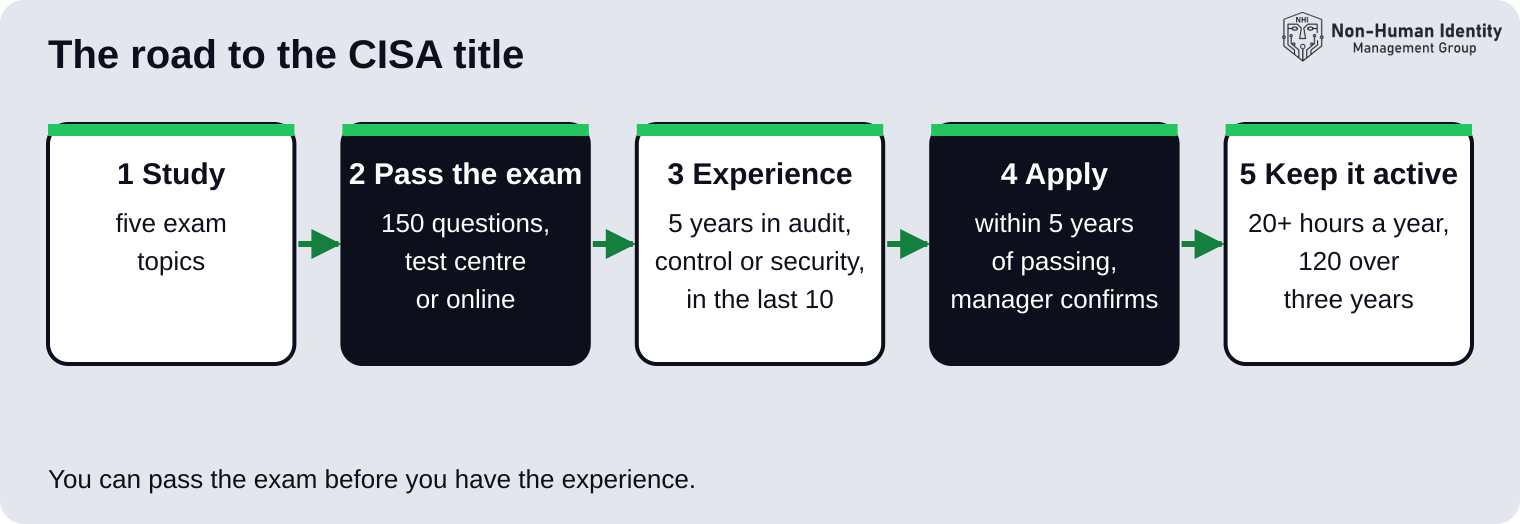
Getting the title takes a few steps. They do not all happen at once.
- Study the five topics. They are the audit process, IT governance and management, building and buying systems, IT operations and resilience, and protecting information.[2]
- Pass the exam. It has 150 questions. You take it on a computer at a test centre or online with a remote supervisor.[1][2]
- Build experience. You need at least five years of work in IT audit, control or security, within the ten years before you apply. A manager must confirm it.[3]
- Apply. You must apply within five years of passing the exam, and pay a one-time application fee.[3]
- Keep it active. Holders log at least 20 hours of learning a year, and 120 hours over three years. They also agree to ISACA's code of ethics.[3]
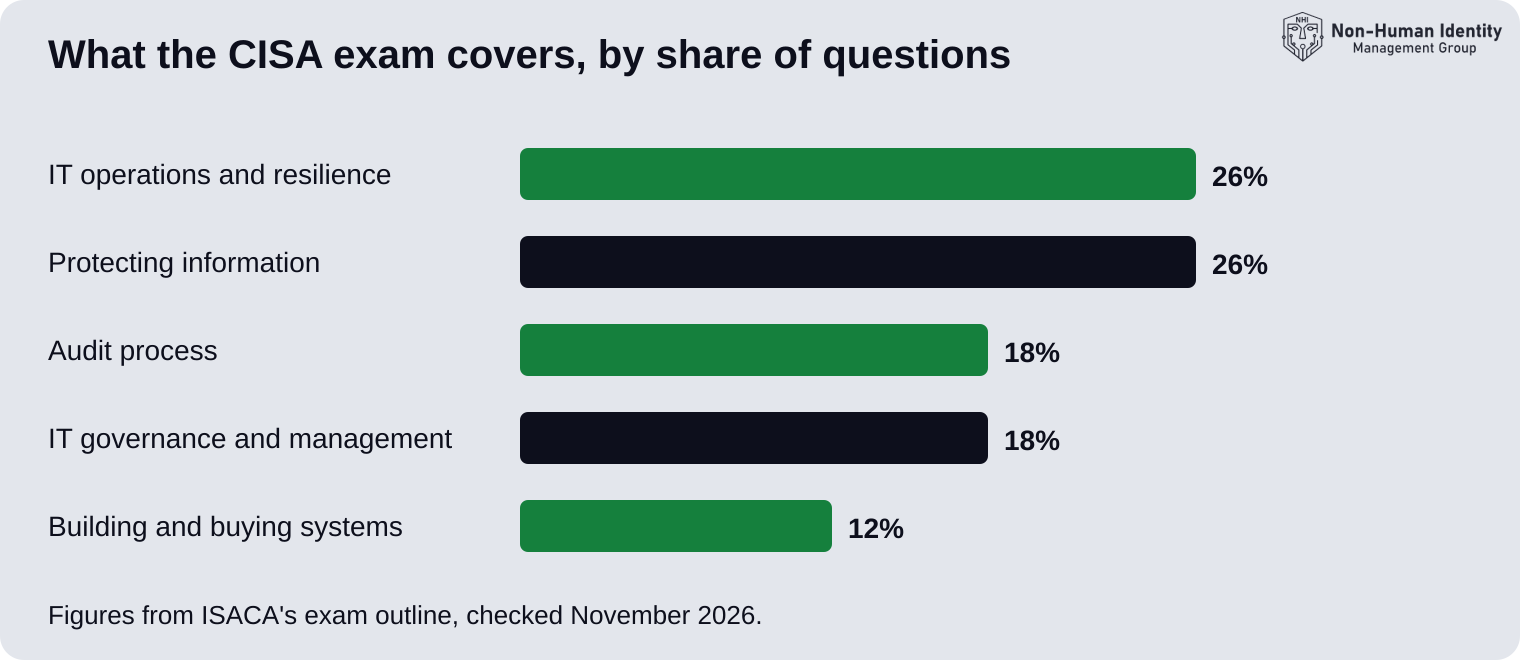
The exam covers more than security. In ISACA's outline, operations and resilience and protecting information make up just over half. The audit process and IT governance together make up over a third.[2]
A worked example
This story is made up to show how the choice can work.
Celia Kowal is 31 and works in the finance team of a regional bank. Each year, auditors visit to check the bank's IT. Celia helps them find records, such as lists of who can approve payments.
She enjoys the work and asks one auditor how he got into it. He mentions CISA. Celia looks it up and nearly books the exam that week.
First, she reads ISACA's rules. She sees that she needs five years of work in IT audit, control or security to hold the title.[3] Her finance work may not count in full, so she makes a card like the one above.
Celia talks to her manager. The bank agrees to move her into the internal audit team, where she will test IT controls. She will gain the right kind of experience there.
She decides to study and pass the exam in her first year. She knows she then has five years to apply.[3] She keeps a simple log of her audit work, with dates, so her manager can confirm it later.
What made the difference: Celia checked the experience rules first and found a job that builds the right experience.
Myths and mistakes
| What people think | What is true |
|---|---|
| CISA is a security hacking certification. | It is an audit title. It tests how to check IT controls, plan audits and report findings.[2] |
| Passing the exam makes me CISA certified. | You also need five years of related experience and an approved application.[3] |
| CISA is linked to the US cyber agency. | No. The agency shares the letters but is a separate US government body. |
| Once certified, I am done. | Holders log learning hours every year and follow ISACA's code of ethics.[3] |
| Auditors need to be expert coders. | Coding can help, but the core skills are checking evidence, asking good questions and writing clear reports. |
What can I do this week?
- Read the CISA pages on ISACA's website, including the experience rules.
- Write down how many years of IT audit, control or security work you have.
- Read the five exam topics and mark the ones you already know a little.
- Ask someone in audit or risk at your workplace what their day involves.
- If you are new to security, pick an entry-level title to start with first.
Checklist
- I know CISA is an audit title, not a hacking title.
- I have read the experience rules on ISACA's own website.
- I know I must apply within five years of passing the exam.
- I know the five exam topics.
- I have a way to build audit, control or security experience.
- I know about the yearly learning hours needed after I qualify.
Common questions
Is CISA good for beginners?
Not as a first step for most people. You can sit the exam at any stage, but the title needs five years of related work experience. Beginners often start with an entry-level security title, gain work in audit or IT, and take CISA later.
What does CISA stand for?
Certified Information Systems Auditor. ISACA, a global professional body for IT audit, governance and risk, runs it. The same letters are also used by a US government cyber security agency, which is a separate organisation with no link to the certification.
Can I take the exam before I have the experience?
Yes. ISACA lets you pass the exam first. You then have five years to apply for the title, and your experience must be from the ten years before you apply. Plan your work so you have the right experience in time.
How is CISA different from a security certification?
CISA focuses on checking IT, not running it. Security titles test how to protect systems. CISA tests how to plan an audit, collect evidence and judge whether controls work. About half the exam is still on IT operations and protecting information.
How much does the exam cost?
The price depends on whether you are an ISACA member, and it can change. Check the current fees on ISACA's website before you book. There is also a one-time application fee once you pass.
Where next?
Ready for the detail? Read the practitioner guide: CISA Certification Guide. It goes further into exam fees, the detailed topic outline and a study plan.
Also useful:
- IT Auditor for Beginners
- Internal Audit for Beginners
- Audit Evidence for Beginners
- Certification Renewal for Beginners
Related NHI Mgmt Group resources: Security Auditor for Beginners · Cybersecurity Certifications Guide · The CISA KEV Catalogue for Beginners
Key terms
- IT audit
- An independent review of technology controls, systems and processes.
- Audit evidence
- The records, reports and observations an auditor uses to reach a conclusion.
- ISACA
- A global professional body for IT audit, governance and risk, which runs the CISA title.
- IT governance
- The rules and decision rights that make sure technology supports the organisation's goals.
- IT general controls
- Basic controls over access, changes and operations that keep business systems reliable.
- Continuing professional education
- Learning you log after you qualify, to keep a certification active.
Sources and further reading
- CISA: Certified Information Systems Auditor. ISACA. https://www.isaca.org/credentialing/cisa, accessed 28 Nov 2026.
- CISA Exam Content Outline. ISACA. https://www.isaca.org/credentialing/cisa/cisa-exam-content-outline, accessed 28 Nov 2026.
- Get CISA Certified. ISACA. https://www.isaca.org/credentialing/cisa/get-cisa-certified, accessed 28 Nov 2026.