A security auditor checks, with evidence, whether an organisation's security safeguards really work.
This guide is for anyone curious about security audit as a job, including people from accounting, IT or compliance work. You do not need to be a hacker to do it. If you run a business, it also explains what an auditor will ask you for.
In short
- A security auditor tests whether safeguards work as the rules say they should, and writes down what they find.
- The auditor must be independent: they do not check work they designed or run themselves.
- The job is built on evidence, such as records, settings and samples, not on opinions.
- Common routes in are IT, security operations, compliance work and accounting, often with an audit certification.
What you will learn
- Explain what a security auditor does in one sentence.
- Describe the steps of a typical audit.
- Spot the skills you already have that fit the job.
- Choose a first step if you want to try it.
- Safeguard (control)
- a rule, process or tool that lowers a security risk, such as removing a leaver's access.
- Proof (audit evidence)
- the records, settings and documents an auditor uses to decide if a safeguard works.
- Something to fix (finding)
- a gap the auditor found, written up with its risk and what should change.
What is a security auditor?
Think of a car's yearly roadworthiness test, such as the MOT in the UK. The tester did not build the car. They check it against a fixed list and record what passes and what fails. A security auditor does the same for an organisation's security.
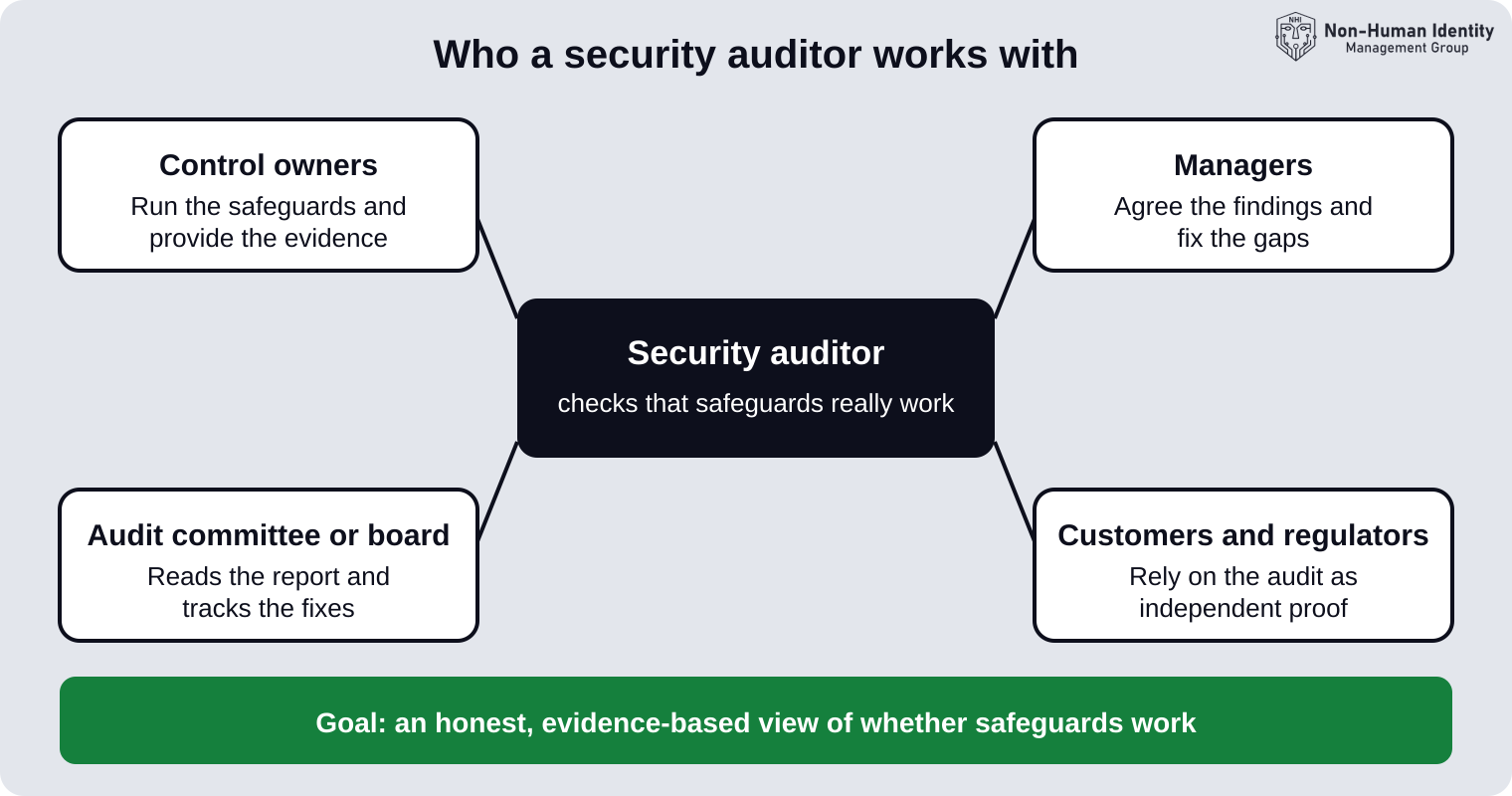
Organisations set rules for keeping their systems safe. The safeguards that carry out those rules are called controls. A control might be "access is removed within a day of someone leaving". The auditor checks whether that really happens.
To do this, the auditor collects evidence. They might ask for a list of leavers, then check a sample of them in the account system. If the proof matches the rule, the control passes. If not, they write a finding.
Some auditors work inside the organisation, in an internal audit team. Others work for outside firms that check many organisations. Others work for bodies that award certificates against a security standard.[1]
Where the comparison stops working: a car test follows the same list for every car. A security audit is planned around each organisation's own risks and rules, so the list changes every time.
Why does it matter?
Boards, customers and regulators want proof that safeguards work, not just a promise. An auditor who is independent gives them that proof. It also shows managers what to fix first.
If you work in accounting or finance
What could happen: you rule out security work because you are not technical, and miss a role built on audit skills you already use.
Check this: list the ways you already test records, take samples and write up exceptions.
If you work in IT
What could happen: you see audits only as extra work, and miss that your system knowledge is in demand on the audit side.
Check this: next time there is an audit, ask to sit in on a walkthrough.
If you run a business
What could happen: a customer asks for audit proof of your security, and nobody knows where the evidence is.
Check this: ask who owns each key safeguard and where its records are kept.
Next: SOC 2 for Beginners
What does it look like?
An auditor's main output is a report of findings. Here is a made-up finding, written the way many audit teams set them out.
Example only. All values are made up.
Finding:   EXAMPLE-0000
Control:   Leavers lose access within 1 working day   (1)
Test:      25 leavers picked from the HR list         (2)
Result:    3 of 25 still had access after 10 days     (3)
Risk:      Medium                                      (4)
Action:    Link HR system to account removal           (5)
Owner:     IT manager (example.com), due 31 March
- The rule the organisation set for itself.
- A sample. The auditor checks some cases, not every one.
- In a real file, this line would contain what the evidence showed.
- How serious the gap is, so managers know what to fix first.
- The agreed fix, with a named owner and a date.
Why this is risky: without an audit, the gap can stay hidden. Former staff could keep access to systems for weeks.
The safer way: the finding gives the gap an owner and a deadline. The auditor later checks the fix worked, so the problem does not quietly return.
How does it work?
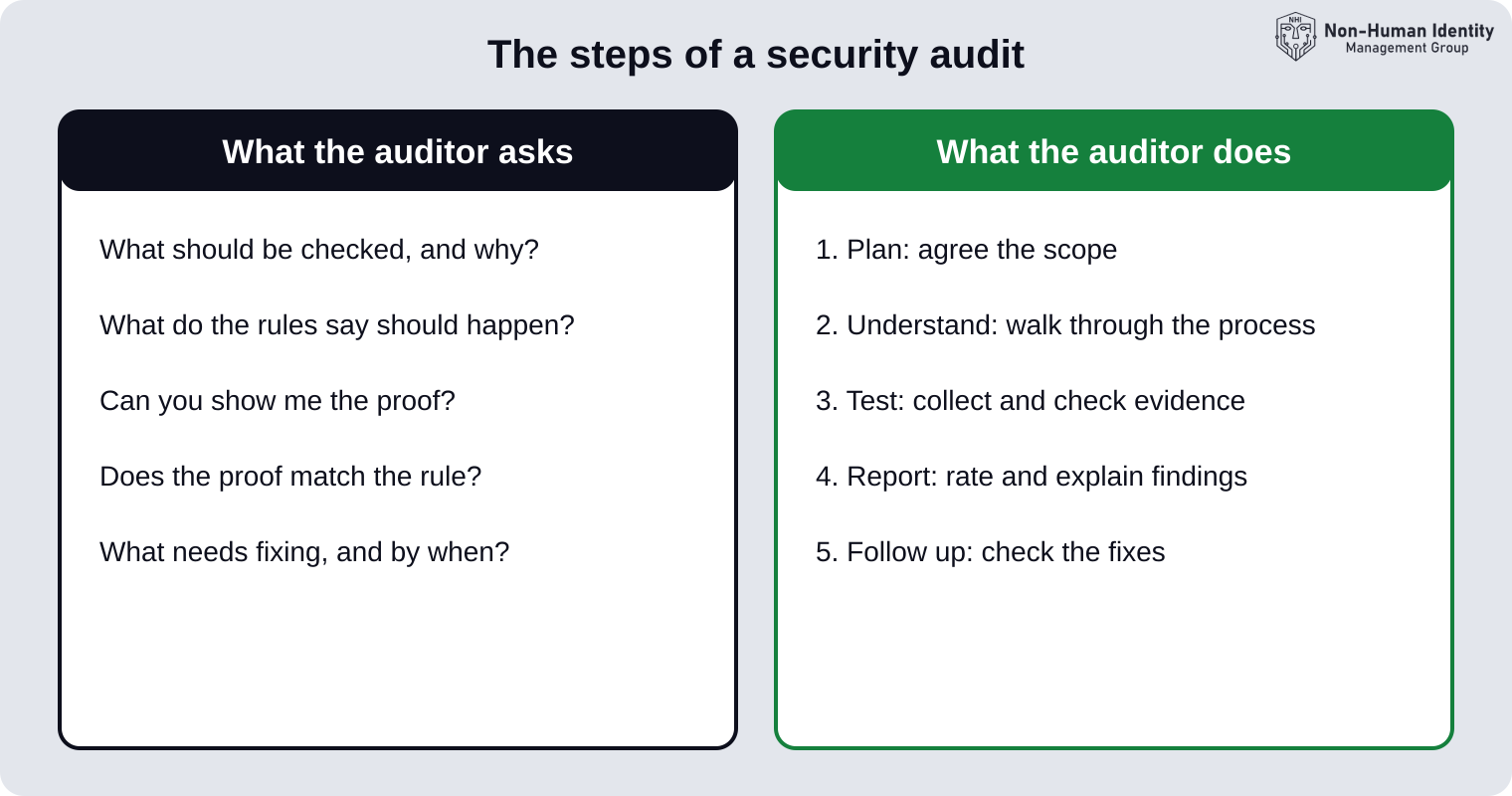
Most security audits follow the same broad steps.
- Plan. The auditor agrees what will be checked, called the scope, and which rules or standard to check against.[1]
- Understand. They talk to the people who run each control. A walkthrough is when someone shows the auditor how a process works, step by step.
- Test. They collect evidence and check it against the rule. Often they test a sample, such as 25 cases out of 500.
- Report. They write findings, rate each one and agree fixes with managers.
- Follow up. They check later that the agreed fixes were made and work.
Skills and tools
You do not need all of these on day one. Most auditors build them up over time.
- Careful, fair thinking. Deciding from evidence, and keeping an open mind until the evidence is in.
- Clear writing. A finding must make sense to a busy manager who was not there.
- Enough technical knowledge. Knowing how accounts, cloud services and logs work helps you ask the right questions.
- Spreadsheets and data. Sorting lists, picking samples and comparing records.
- Calm conversations. People can feel judged. Good auditors stay polite and stick to facts.
Independence is central to the role. An auditor should not check controls they designed or run, or their view carries less weight.[2] Internal auditors follow professional standards that set out how to stay objective.[3]
A worked example
Ruben Jansen is an internal IT auditor at Ashby Building Society, a fictional savings and mortgage provider. This month he is auditing who can reach customer accounts.
On Monday he agrees the scope with the head of IT. He will check three controls. New staff should get only the access they need. Leavers should lose access within a day. Managers should review access every three months.
On Tuesday the identity team walks him through the leaver process. HR sends a list, and the team removes accounts. Ruben asks how they know nothing was missed. Nobody checks, they say.
On Wednesday he picks 25 leavers from the HR list at random. He checks each one in the account system. Three still had access more than a week after leaving. None of the three signed in after their last day, based on the records available to him.
He remembers the car test: a fault found is not a crash, but it still has to be fixed. He writes the finding with the facts, the risk and a suggested fix. The head of IT agrees to link the HR system to account removal by the end of March.
The other two controls pass. Ruben's report goes to the audit committee, the group of board members that oversees audit. In April he will test a fresh sample to confirm the fix works.
Myths and mistakes
| What people think | What is true |
|---|---|
| Auditors are there to catch people out. | The aim is to find gaps before attackers do, and to help fix them. Good audits are fair and factual. |
| Passing an audit means you are secure. | An audit checks chosen controls at a point in time. Gaps outside the scope can remain. |
| Auditors must be expert hackers. | Auditing is about testing evidence against rules. Technical knowledge helps, but many auditors come from accounting or compliance. |
| A screenshot is enough proof. | Auditors often need records over a period, or to check the settings directly, to be confident a control works. |
| Auditors fix the problems they find. | Managers own the fixes. Auditors stay independent, so they recommend and then check. |
What can I do this week?
- Read our beginner guides on compliance and on access reviews.
- Pick one rule at work or college, such as a password rule, and ask how anyone would prove it is followed.
- Look at the page for the best-known IT audit certification, to see what it covers.[4]
- Ask someone who has been through an audit what the auditor asked for.
Checklist
- I can explain what a security auditor does in plain words.
- I know what a control is, with one example.
- I know why auditors need evidence, not opinions.
- I know why auditors test a sample rather than every case.
- I understand why independence matters.
- I have picked one beginner guide or study resource to start with.
Common questions
Is a security auditor the same as a penetration tester?
No. A penetration tester tries to break in to find weak spots. An auditor checks that agreed safeguards are in place and work. They do this mostly by testing proof. The two jobs help each other. An auditor may check that break-in tests happen and that their results are fixed.
Do I need an accounting background?
No, though it helps. Many auditors come from IT, security or compliance work instead. What matters most is fair thinking, clear writing and enough know-how to follow the systems you check. You can learn the audit methods through training and practice on the job.
Which certification should I look at first?
Start with CISA from ISACA, a well-known exam for IT and security auditors.[4] If you want to check firms against the main international security standard, lead auditor training for it is another option.[5] The practitioner guide compares the options.
How much does a security auditor earn?
It varies by country, sector and experience, so we do not quote figures here. Check official sources for your country. In the US, the Bureau of Labor Statistics publishes pay data for the wider information security group of jobs.[6]
What is the difference between internal and external audit?
An internal auditor works for the organisation and reports to its board. An external auditor works for an outside firm. They give an independent view, often for customers or for a certificate. See Internal Audit vs External Audit for a fuller comparison.
Where next?
Ready for the detail? Read the practitioner guide: Cybersecurity Auditor Career Guide. It goes further into the official role profile, the different audit employers, certifications and how auditors progress.
Also useful:
- GRC Analyst for Beginners
- ISO 27001 for Beginners
- SOC 2 for Beginners
- IT and Security Auditor Interview Questions
- Cybersecurity Careers Guide
Related NHI Mgmt Group resources: Internal Audit for Cybersecurity Guide · CISA Certification Guide · Audit, Assurance and Compliance Guide
Key terms
- Control
- A rule, process or tool that lowers a security risk.
- Audit evidence
- The records, settings and documents an auditor uses to decide if a control works.
- Audit finding
- A gap found during an audit, with its risk and the change needed.
- Audit scope
- The systems, controls and time period an audit covers.
- Sampling
- Checking a chosen set of cases to judge how well a control works overall.
- Auditor independence
- Being free from the work under review, so the auditor's view can be trusted.
- Internal audit
- An in-house team that checks the organisation's controls and reports to its board.
Sources and further reading
- European Cybersecurity Skills Framework (ECSF), Cybersecurity Auditor role profile. European Union Agency for Cybersecurity (ENISA). https://www.enisa.europa.eu/topics/skills-and-competences/skills-development/european-cybersecurity-skills-framework-ecsf, accessed 28 Nov 2026.
- European Cybersecurity Skills Framework Role Profiles. ENISA, September 2022. https://www.enisa.europa.eu/sites/default/files/publications/European%20Cybersecurity%20Skills%20Framework%20Role%20Profiles.pdf, accessed 28 Nov 2026.
- Global Internal Audit Standards. The Institute of Internal Auditors (IIA), 2024. https://www.theiia.org/en/standards/2024-standards/global-internal-audit-standards/, accessed 28 Nov 2026.
- CISA, Certified Information Systems Auditor. ISACA. https://www.isaca.org/credentialing/cisa, accessed 28 Nov 2026.
- ISO/IEC 27001, Information security management systems. International Organization for Standardization (ISO). https://www.iso.org/standard/27001, accessed 28 Nov 2026.
- Information Security Analysts, Occupational Outlook Handbook. US Bureau of Labor Statistics. https://www.bls.gov/ooh/computer-and-information-technology/information-security-analysts.htm, accessed 28 Nov 2026.