CISSP is a senior security certification showing that someone understands security across many areas, not just one.
This guide is for students, career changers and anyone who has seen "CISSP" on a job advert and wondered what it means. You do not need a technical background to read it. If you hire security staff, it also explains what the letters do and do not tell you.
In short
- CISSP stands for Certified Information Systems Security Professional. It is run by ISC2, a professional body for security people.
- It covers eight broad areas of security, from risk and networks to software and day to day operations.
- Full certification needs a passed exam, five years of relevant paid work and someone to vouch for you.
- You can pass the exam early and become an Associate of ISC2 while you build up the experience.
What you will learn
- Explain what CISSP is in one sentence.
- Spot the eight areas the exam covers.
- Check whether you have the experience it needs, or should take the Associate route.
- Ask the right questions before you pay for the exam.
- Proof of skill (certification)
- a title you earn by passing an exam and meeting set rules.
- Someone who vouches for you (endorser)
- a certified person who confirms your work history is true.
- Ongoing learning (CPE)
- hours of training you log to keep a certification.
What is CISSP?
Think of a family doctor. They are not a heart surgeon or a skin specialist. But they know enough about every part of the body to spot problems and decide what to do next.
CISSP is a bit like a family doctor's licence for cyber security. It is awarded by ISC2, a professional body. ISC2 says earning it shows you can design, put in place and manage a security programme.[1] A security programme is the whole plan an organisation uses to protect its information.
The exam asks questions across many topics. It covers how to judge risk, how to protect data, how networks are kept safe and how to control who gets in. It tests judgement more than button pressing.
Where the comparison stops working: a doctor needs a licence by law to practise. Nobody needs CISSP by law to work in security. It is a respected badge, not a permit, although some employers and contracts ask for it.
Why does it matter?
CISSP is one of the certifications most often named in senior security job adverts. Knowing what it means helps you plan a career or read a CV fairly.
If you are a student or career changer
What could happen: you study hard for CISSP, pass, and then find you are not fully certified without years of work.
Check this: start with an entry level certificate and treat CISSP as a later goal.
If you already work in IT
What could happen: you have years of useful work but do not know if it counts.
Check this: list your jobs against the eight areas in Figure 2 before you book.
If you hire security staff
What could happen: you ask for CISSP for a junior hands-on job and put off strong candidates.
Check this: ask for it where the job needs broad judgement, such as a lead or architect role.
What does it look like?
Here is a made-up "Am I ready?" card. A person might fill one in before booking the exam.
Example only. All values are made up.
AM I READY FOR CISSP?        Name: A. EXAMPLE
Paid security work so far:     3 years of 5    (1)
Areas my work has covered:
  [x] Networks   [x] Access   [ ] Software    (2)
Someone certified to vouch:    Not yet         (3)
Plan if I pass early:          Associate route (4)
- ISC2 asks for five years of paid work. Three is not enough yet.
- Work must fit the eight exam areas. In a real file, this line would list the jobs behind each tick.
- After you pass, a certified person checks your work. ISC2 can do it if you know nobody.
- If you pass early, you become an Associate of ISC2.
Why this is risky: people often book the exam first. Only later do they read the rules on work and deadlines.
The safer way: read ISC2's own pages first. Then plan the exam, the work and the forms together.
How does it work?
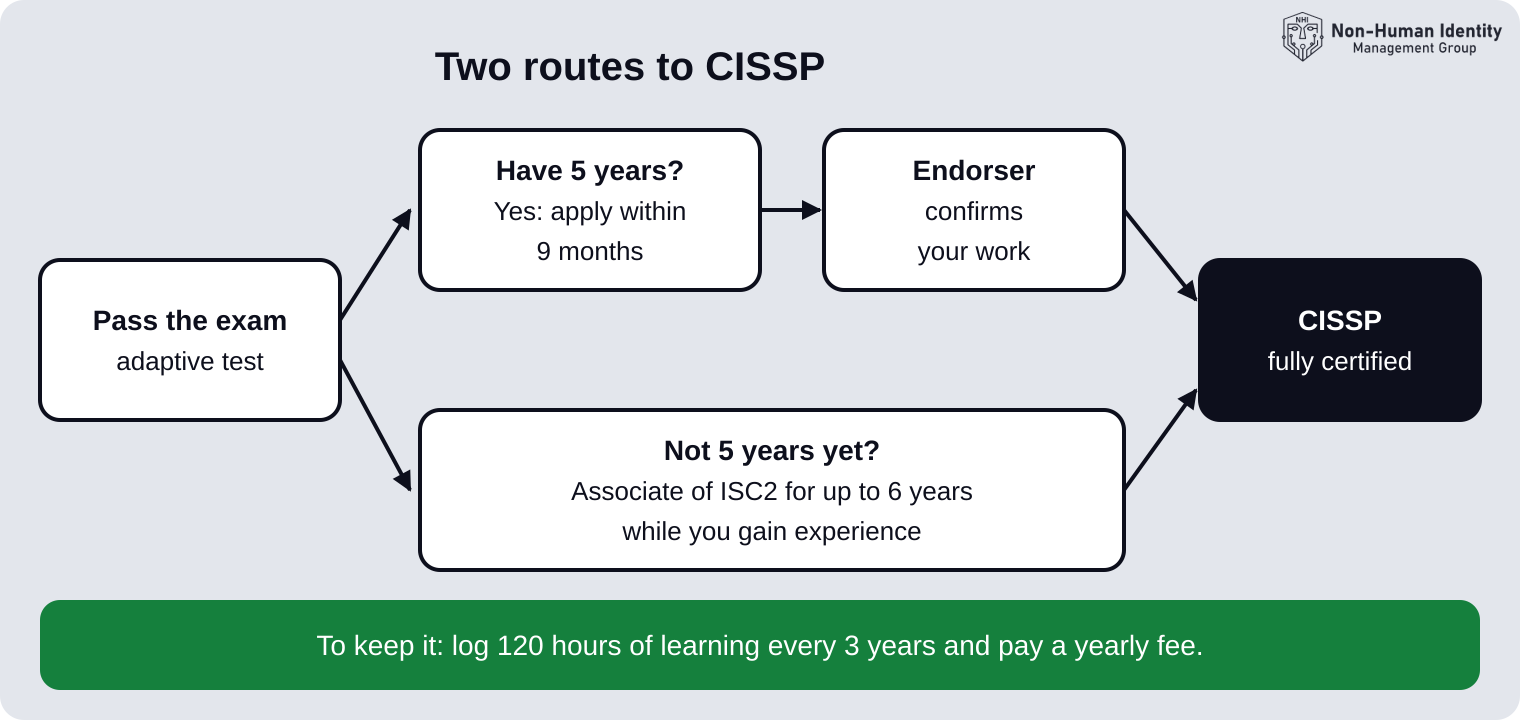
Getting and keeping CISSP follows five steps.
- Build experience. ISC2 asks for five years of relevant work.[1] Its experience page explains how part-time work, internships and one-year waivers count.[3]
- Pass the exam. It is a computer adaptive test, which means each question is picked based on your earlier answers.[6] You take it at a Pearson VUE test centre.[7]
- Apply and get endorsed. You have nine months from the exam date to send your application. An ISC2 certified person, or ISC2 itself, confirms your experience.[5]
- Or take the Associate route. If you pass without the experience, you can be an Associate of ISC2 for up to six years while you gain it.[4]
- Keep it up. Holders log 120 hours of learning, called CPE credits, every three years and pay a yearly fee.[8]
The exam covers eight areas, which ISC2 calls domains.[2] Figure 2 puts each one in plain words.
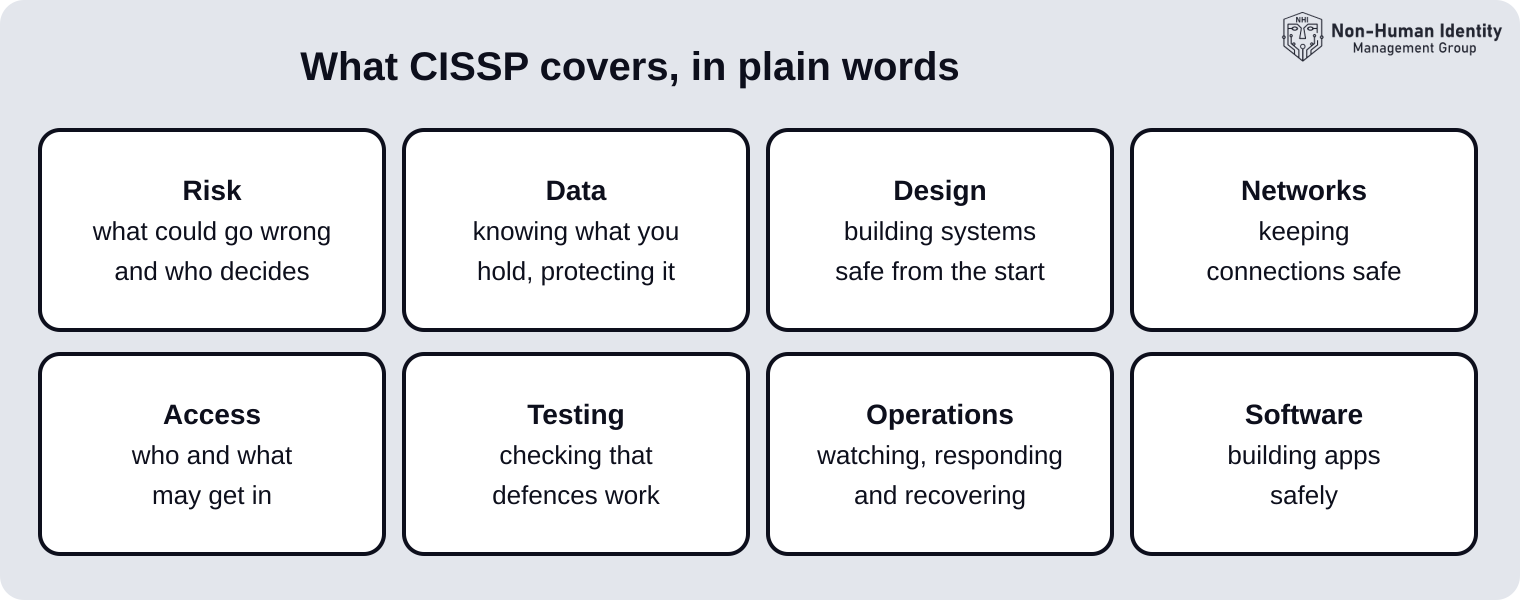
The current exam outline took effect on 15 April 2024.[2] ISC2 has also published notes on outline changes planned for 2027, so check the current version before you study.[1]
A worked example
Nils Thorne looks after the computer network for Linden Kitchens, a fictional company that makes and fits kitchens. He has done this job for three years. Before that, he spent two years on the help desk.
His manager, Yara Jensen, asks him to take on more security work. She mentions CISSP. Nils remembers the family doctor idea. He knows networks well, but CISSP expects him to understand all eight areas.
He reads ISC2's pages first. His network work counts. He is not sure whether the help desk years count, so he checks the experience page instead of guessing.
He decides to study anyway. He uses the plain list in Figure 2 to find his weak spots, which are software and testing. He spends a few hours a week on those for several months.
Nils passes the exam. His experience is still short of five years, so he becomes an Associate of ISC2. He pays the smaller yearly fee and logs his learning hours.
The next year he reaches five years of relevant work. Yara is not certified, so Nils asks ISC2 to confirm his experience. He sends proof of his jobs. Once ISC2 approves it, he becomes a full CISSP. Yara now asks him to help plan the company's security for next year, not just run the network.
Myths and mistakes
| What people think | What is true |
|---|---|
| CISSP is a good first certificate. | It expects years of work. Most newcomers start with an entry level certificate first. |
| Passing the exam makes you a CISSP. | You also need the experience and an endorsement. Without them you are an Associate.[4] |
| CISSP is mainly about technical tools. | It covers risk, management and design as well as technology. It rewards broad judgement. |
| Once you have it, you keep it for life. | You must log learning hours and pay a yearly fee to keep it.[8] |
| Any old study book will do. | The exam outline changes over time. Check the date of any book against ISC2's current outline. |
What can I do this week?
- Read ISC2's official CISSP page and its experience rules.
- List your past jobs against the eight areas in Figure 2.
- Look at three job adverts you would like in five years and see if they ask for CISSP.
- Use our CISSP Study Plan Template if you decide to start.
Checklist
- I can explain what CISSP is in one sentence.
- I can name most of the eight areas it covers.
- I know full certification needs five years of relevant work.
- I know about the Associate route if I pass early.
- I know I have nine months after the exam to apply.
- I know I must log learning hours to keep it.
- I have checked the current exam outline on the ISC2 website.
Common questions
Can I take the CISSP exam with no experience?
Yes. You can sit the exam first. If you pass without the five years of work, you become an Associate of ISC2. You then have up to six years to gain the experience and upgrade to full CISSP.[4]
Is CISSP worth it for a beginner?
Usually not as a first step. CISSP suits people who already work in security and want to move into lead, design or management roles. Newcomers often get more from an entry level certificate first. See Cyber Security Certifications for Beginners.
How much does it cost to keep CISSP?
There is a yearly fee as well as the exam fee. ISC2's handbook lists the yearly fee for certified members as 135 US dollars.[8] Prices change, so check ISC2's own pages before you book. Courses and books are extra and optional.
What is the difference between CISSP and CISM?
Both are senior certificates. CISSP covers a wide range of technical and management topics across eight areas. CISM, from a different body, focuses on running a security programme. Some people hold both. See CISSP vs CISM and CISM for Beginners.
Who can vouch for my experience?
An ISC2 certified person in good standing can endorse you. If you do not know one, ISC2 can endorse you instead, but you will need to show proof of your jobs. Either way, the endorser confirms your claims are true.[5]
Where next?
Ready for the detail? Read the practitioner guide: CISSP Certification Guide. It goes further into the exam format, the domain weightings, a phased study plan and the rules for keeping the certification.
Also useful:
- Cyber Security Certifications for Beginners
- CISM for Beginners
- CISSP vs CISM
- CISSP Study Plan Template
Related NHI Mgmt Group resources: CISSP Domain 5 Identity and Access Management · Certification Renewal and CPE Requirements Guide · CISSP vs CCSP
Key terms
- CISSP
- A senior security certification from ISC2 that covers eight broad areas of security.
- ISC2
- The professional body that runs CISSP and other security certifications.
- Certification
- A title you earn by passing an exam and meeting set rules.
- Endorsement
- A check where a certified person, or ISC2, confirms your work history is true.
- Associate of ISC2
- The status of someone who passed the exam but does not yet have the full experience.
- Computer adaptive test
- A computer exam where each question depends on how you answered the last ones.
- CPE
- Hours of learning you record to keep a certification.
Sources and further reading
- CISSP: Certified Information Systems Security Professional. ISC2. https://www.isc2.org/certifications/cissp, accessed 28 Nov 2026.
- CISSP Certification Exam Outline (effective 15 April 2024). ISC2. https://www.isc2.org/certifications/cissp/cissp-certification-exam-outline, accessed 28 Nov 2026.
- CISSP Experience Requirements. ISC2. https://www.isc2.org/certifications/cissp/cissp-experience-requirements, accessed 28 Nov 2026.
- Associate of ISC2. ISC2. https://www.isc2.org/Certifications/Associate, accessed 28 Nov 2026.
- Endorsement. ISC2. https://www.isc2.org/endorsement, accessed 28 Nov 2026.
- Computerized Adaptive Testing (CAT). ISC2. https://www.isc2.org/certifications/cissp/cissp-cat, accessed 28 Nov 2026.
- After Your Exam. ISC2. https://www.isc2.org/exams/after-your-exam, accessed 28 Nov 2026.
- Certification Maintenance Handbook (01/26). ISC2. ISC2 Certification Maintenance Handbook (PDF), accessed 28 Nov 2026.