CISM is a certification showing that someone can plan and run an organisation's security, not just fix computers.
This guide is for students, newcomers and anyone who has seen "CISM" on a job advert or a CV and wondered what it means. You do not need a technical background to read it. If you hire or work with security managers, it helps to know what the letters do and do not tell you.
In short
- CISM stands for Certified Information Security Manager. It is run by ISACA, a professional body.
- It is about managing security: rules, risk, plans, budgets and handling attacks.
- To hold it, you pass an exam and show about five years of relevant work experience.
- It is not a first step for newcomers. It is a goal for people moving into security management.
What you will learn
- Explain what CISM is in one sentence.
- Spot the four areas the certification covers.
- Check whether CISM fits your stage of career.
- Ask what a CISM holder can do for your team.
- Proof of skill (certification)
- a title you earn by passing an exam and meeting set rules.
- Who decides and how (governance)
- the rules and roles that guide how security is run.
- Ongoing learning (CPE)
- hours of training you log each year to keep a certification.
What is CISM?
Think of a site manager on a building project. They do not lay every brick. They plan the work, manage the budget and make sure the build is safe and on time.
CISM is a certification for the site managers of cyber security. It is awarded by ISACA, a professional body for people who work in IT and security. ISACA says CISM shows you can assess risks, set up good governance (the rules and roles for running security) and respond to incidents.[1]
A security manager decides what to protect first, explains risks to the board and makes sure the team is ready for an attack. CISM tests that kind of thinking. It asks less about how to set up a firewall and more about why, when and who decides.
Where the comparison stops working: a site manager can see the building go up. Security work is often invisible. Success can mean that nothing bad happened, which is harder to show.
Why does it matter?
Many organisations want security run by people who understand both risk and business. CISM is one well-known way to show that. ISACA reports more than 48,000 CISM holders.[1]
If you are new to security
What could happen: you spend months studying for CISM, then find you cannot hold it without years of experience.
Check this: start with an entry level certificate and keep CISM as a later goal.
If you are an IT lead moving into management
What could happen: you are asked to report risk to the board, but nobody has shown you how.
Check this: compare the four CISM areas with the tasks you already do.
If you hire security staff
What could happen: you ask for CISM for a hands-on technical job, and put off good candidates.
Check this: ask for CISM only where the job really is about managing security.
Next: CISO for Beginners
What does it look like?
Here is a made-up "Am I ready?" card, the kind of check a person might fill in before booking the exam.
Example only. All values are made up.
AM I READY FOR CISM?      Name: A. Example
Years in security work:        3 of 5      (1)
Areas I have worked in:
  [x] Governance   [x] Risk
  [ ] Programme    [x] Incidents          (2)
Manager will confirm my work:  Yes        (3)
Study plan booked:             Not yet    (4)
- ISACA asks for five or more years of relevant work. Three years means the person is not ready to apply yet.
- The work must cover at least three of the four areas. In a real file, this line would contain examples for each tick.
- A supervisor or manager has to confirm the experience.
- Many people study for several months. Plans vary a lot.
Why this is risky: people often book the exam first and only later read the experience rules. They can then wait years before the title is theirs.
The safer way: read the official rules on the ISACA website before you pay, and plan around them.
How does it work?
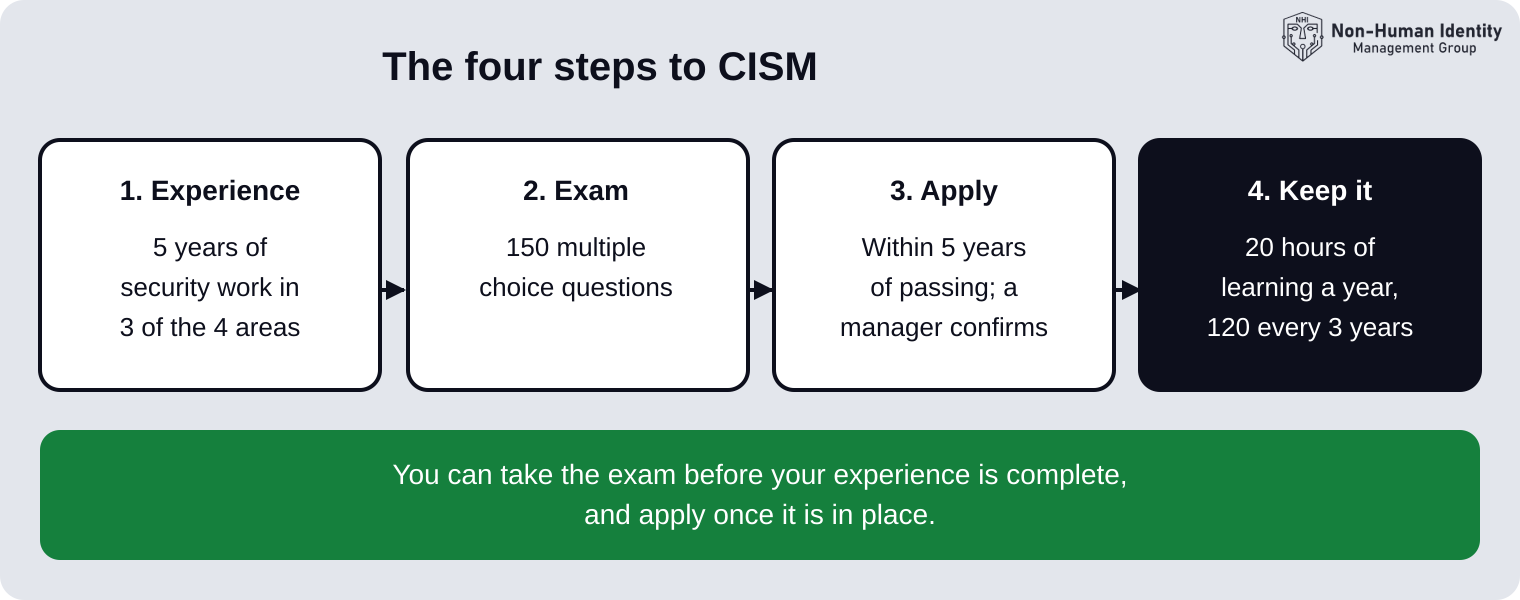
Getting and keeping CISM follows four steps.[2]
- Build experience. You need five or more years of security work across at least three of the four CISM areas. The work must fall within the ten years before you apply.
- Pass the exam. It has 150 multiple choice questions.[3] You can sit it at a test centre or online with a remote supervisor.[1]
- Apply. You have five years after passing to apply. A manager confirms your experience, and you agree to ISACA's code of ethics.
- Keep it up. You log at least 20 hours of learning a year, and 120 hours every three years. These hours are called CPE.
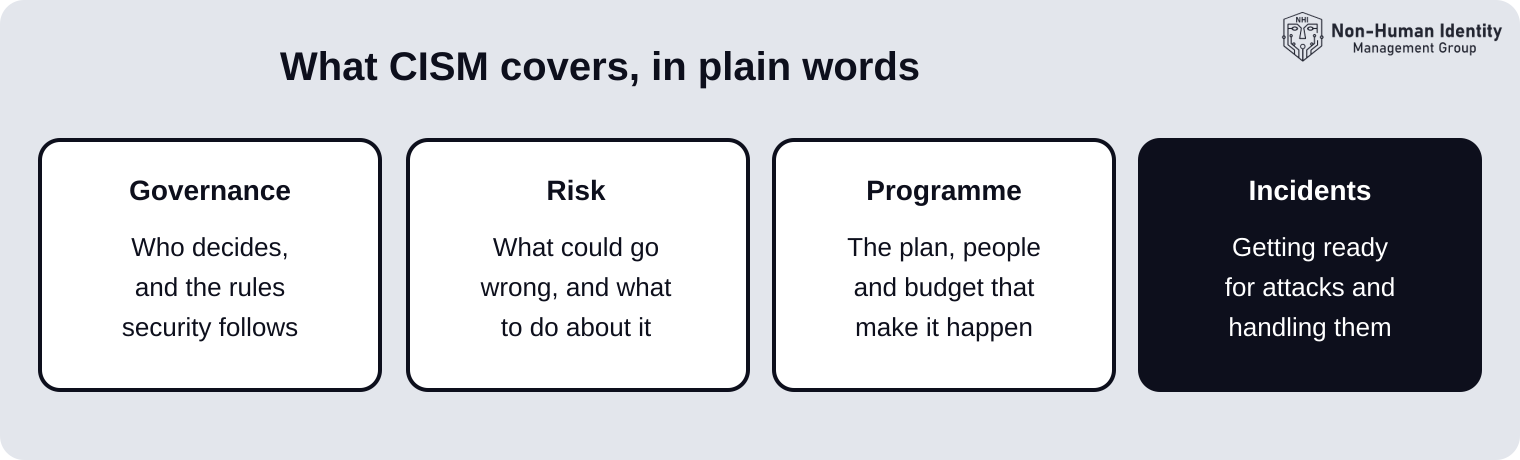
The exam covers four areas. ISACA names them governance, risk management, the security programme and incident management.[1] Figure 2 puts each one in plain words.
ISACA updates the exam outline from time to time. Its outline page says a new version takes effect on 3 November 2026, so check the current one before you study.[3]
A worked example
Sana Iyer runs IT for Cobble Gym, a fictional chain of six gyms. She has worked in IT for nine years. For the last four, security has taken up more and more of her week.
Last month the finance director, Umar Kader, asked her a hard question. "If we were hacked tomorrow, what would it cost us, and are we ready?" Sana knew the technical answer. She found it harder to explain the risk in money and business terms.
A friend suggested CISM. Sana thought of the site manager. She already fixes things. Now she needs to plan, budget and report.
She reads ISACA's rules first. She lists her work against the four areas. She has run the response to a phishing attack, written the gym's security rules and kept a risk list. That covers three areas. Her security work adds up to about five years, so she should qualify.
She sets a study plan of a few hours a week and books the exam for the spring. Meanwhile, she starts a simple monthly risk report for Umar, using what she is learning.
Six months later she passes and applies. Her manager confirms her experience. Umar notices that her reports now talk about cost and priority, not only about tools.
Myths and mistakes
| What people think | What is true |
|---|---|
| CISM is a good first certificate. | It expects years of experience. Most newcomers start with an entry level certificate.[2] |
| Passing the exam makes you certified. | You must also apply, show your experience and agree to the code of ethics.[2] |
| CISM is very technical. | It focuses on managing security: rules, risk, plans and incidents. |
| Once you have it, you keep it for life. | You need to log learning hours each year to keep it.[2] |
| CISM and CISSP are the same thing. | They overlap, but CISSP is broader and more technical. CISM is more focused on management. |
What can I do this week?
- Read ISACA's official CISM page and its experience rules.
- List your security work against the four areas in Figure 2.
- Look at three security manager job adverts and note whether they ask for CISM.
- Read our CISSP vs CISM guide if you are choosing between them.
Checklist
- I can explain what CISM is in one sentence.
- I can name the four areas it covers.
- I know it needs about five years of relevant experience.
- I know a manager must confirm that experience.
- I know I must log learning hours each year to keep it.
- I have checked the current exam outline on the ISACA website.
- I have decided whether CISM fits my career stage now or later.
Common questions
Can I take the CISM exam with no experience?
Yes, you can sit the exam first. But you only become certified once you apply and show five or more years of relevant work. You have five years after passing to do that, so plan the timing carefully.[2]
Is CISM worth it for a beginner?
Usually not yet. CISM suits people who already work in security and want to move into management. Newcomers often get more value from an entry level certificate first. See Cyber Security Certifications for Beginners.
How much does CISM cost?
There is an exam fee, with a lower price for ISACA members, and a separate application fee.[1] Prices change, so check the official ISACA page before you book. Training courses and books are extra and optional.
What is the difference between CISM and CISSP?
Both are senior security certificates. CISSP covers a wide range of technical and management topics. CISM focuses on running a security programme: governance, risk and incidents. Some people hold both. See CISSP vs CISM.
What jobs does CISM help with?
Roles that manage security rather than build it. Examples include security manager, risk lead and, later, head of security or CISO. The certificate supports your experience. It does not replace it. See Information Security Manager Career Guide.
Where next?
Ready for the detail? Read the practitioner guide: CISM Certification Guide. It goes further into what each exam area covers, study approaches and how CISM fits a security management career.
Also useful:
Related NHI Mgmt Group resources: Information Security Manager Career Guide · First Time Security Manager Guide · BCS CISMP Guide
Key terms
- ISACA
- The professional body that runs the CISM certification and its exam.
- Certification
- A title you earn by passing an exam and meeting set rules.
- Security governance
- The rules, roles and decisions that guide how security is run.
- Risk management
- Finding what could go wrong, judging how bad it would be and deciding what to do.
- Incident management
- Getting ready for attacks and handling them when they happen.
- CPE
- Hours of training or learning you record each year to keep a certification.
- CISO
- The senior leader responsible for an organisation's security.
Sources and further reading
- Certified Information Security Manager (CISM). ISACA. https://www.isaca.org/credentialing/cism, accessed 28 Nov 2026.
- How to get CISM certified. ISACA. https://www.isaca.org/credentialing/cism/get-cism-certified, accessed 28 Nov 2026.
- CISM exam content outline. ISACA. https://www.isaca.org/credentialing/cism/cism-exam-content-outline, accessed 28 Nov 2026.