Cyber risk management is the ongoing work of finding what could go wrong with your systems and data, judging how likely and how harmful each problem would be, and deciding what to do about it.
This guide is for newcomers, students, career changers and managers who keep hearing about "risk" and want a plain English starting point. It explains the core ideas, a simple step-by-step method, a worked example with a fictional company, common myths and a few first steps you can take this week. It covers cyber risk in general; risks specific to AI systems have their own page, AI Risk Management for Beginners.
By the end of this guide you will be able to:
- Explain what cyber risk is, using the words threat, vulnerability, likelihood and impact.
- Describe the steps of a basic risk assessment.
- Identify the four ways to respond to a risk.
- Understand what a risk register is and who owns each risk.
Key takeaways
- Risk can be managed, not removed. The UK National Cyber Security Centre (NCSC) puts it simply: risk cannot be abolished, only recognised and managed.[1]
- Risk combines likelihood and impact. How likely is something bad, and how much would it hurt the business?
- There are four responses. Treat it with controls, avoid it, transfer it (for example with insurance) or accept it knowingly.[3]
- Risk decisions are business decisions. The NCSC says cyber risk decisions should not sit with the security team alone.[2]
- It is a cycle, not a one-off. Review risks regularly and whenever something important changes.[3]
What it is, in plain English
A risk is the possibility of something bad happening. The NCSC uses exactly that everyday definition, and also quotes the UK government's Orange Book definition: "the effect of uncertainty on objectives".[1] A cyber risk is that possibility where computers, networks, data or online services are involved.
Four words do most of the work:
- Threat: someone or something that could cause harm, such as a criminal gang, a careless insider or a failing supplier. The NCSC looks at a threat's capability, intent, motivation and opportunity.[1]
- Vulnerability: a weakness a threat could use. It can be technical, like unpatched software, or non-technical, like a weak procedure.[1]
- Likelihood: how probable it is that the threat uses the weakness.
- Impact: the harm to the business if it happens. Beyond lost confidentiality, integrity or availability of data, the NCSC lists outcomes such as unsafe systems, financial loss, reputational damage or business failure.[1]
Cyber risk management is the repeating process of finding these risks, rating them, choosing a response and checking the result. An everyday comparison is looking after a house. You think about what could go wrong (burglary, fire, a burst pipe), how likely each is where you live, and how bad it would be. Then you fit locks, buy a smoke alarm, take out insurance, and simply accept that a few roof tiles may blow off one day. Where the analogy breaks down: house risks change slowly, while cyber threats and your own systems can change from one month to the next, so the review has to happen far more often.
Why it matters to you
- If you run a small business: you cannot afford to protect against everything. A short list of your biggest risks tells you where your limited money and time make the most difference.
- If you are new to a security job: almost every security decision is justified in risk terms. Being able to say "this reduces the likelihood of X, which would cause Y" makes your work easier to approve.
- If you are a manager: you are likely to be a risk owner, the person who decides how a risk is handled. The NCSC says cyber risk decisions are business decisions, and in larger organisations the whole Board should take responsibility rather than leaving it to one person.[2]
Risk management also keeps security honest. The NCSC points out that compliance and security are not the same thing: passing an audit can hide weak practice, while a real risk assessment asks what could actually go wrong.[1] It also notes that protecting against every threat actor is not practical or cost-effective in most cases, which is why choices have to be made.[3]
How it works, step by step
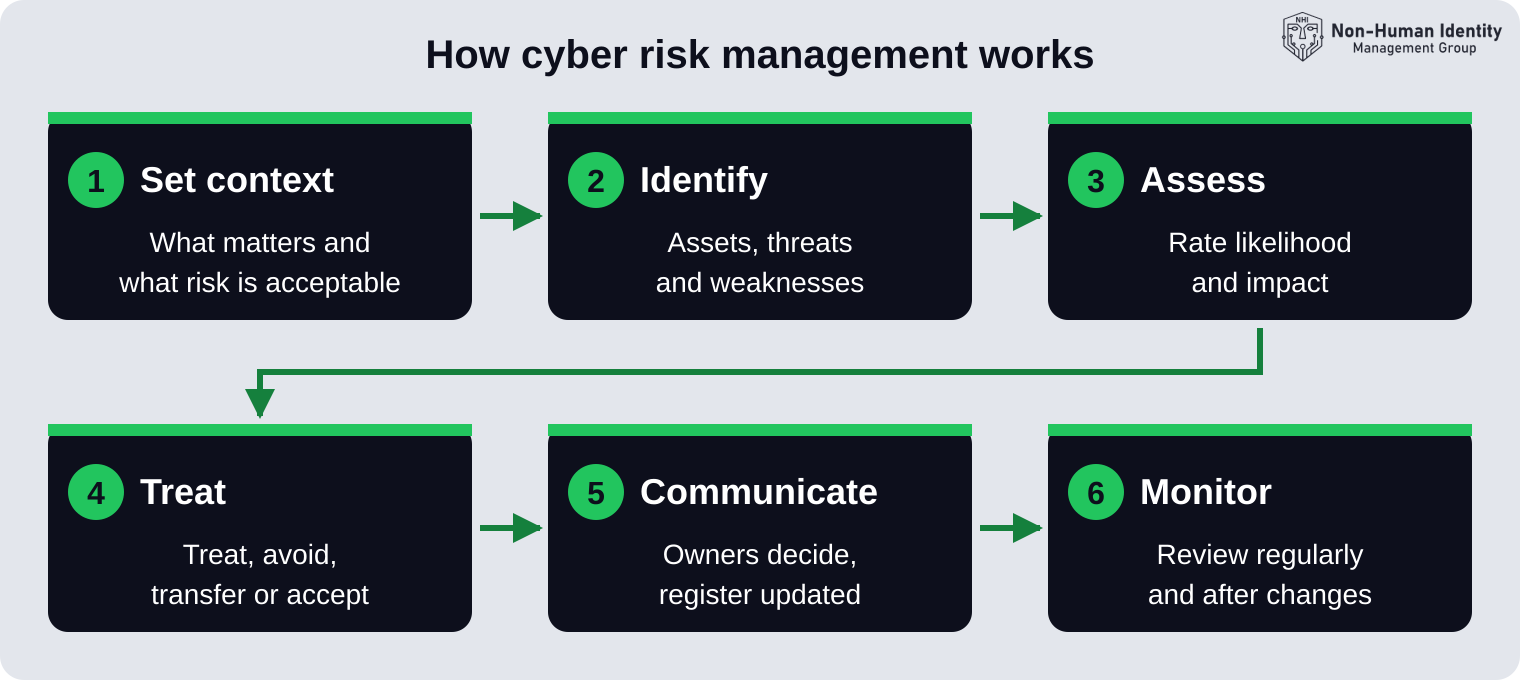
There are many formal methods, such as NIST SP 800-30 in the US and ISO/IEC 27005 internationally.[5][7] The steps below follow the basic method the NCSC publishes as a starting point for organisations new to risk management.[3] The NCSC's wider guidance stresses that improving business outcomes, not ticking compliance boxes, should be the main driver.[4]
- Set the context. Agree what the business cares about most, its legal duties, and how much risk it is willing to take. That last point is called risk appetite.[3]
- Define the scope. Decide which systems, services and suppliers you are looking at, ideally with a simple diagram.[3]
- List your assets and their impact. Write down what matters (customer data, the website, the payroll system), give each an owner and rate how bad its loss would be.[3]
- Look at threats and weaknesses. Who might attack, and where are you weak across people, processes, places and technology?[3]
- Rate likelihood and risk. Combine threat and weakness into a likelihood, then likelihood and impact into a risk rating, often Low, Medium or High.[3]
- Choose a response for each risk. Treat, avoid, transfer or accept, and write it down in a risk register, a list of risks with their ratings, owners and actions. NIST's guidance on linking cyber risk to wider business risk recommends risk registers for exactly this.[6]
- Communicate and get decisions. Explain each risk to its owner in business terms, not jargon.[2]
- Monitor and review. Check controls still work and repeat the assessment regularly and after big changes.[2][3]
The four responses to a risk
| Response | What it means | Everyday example |
|---|---|---|
| Treat (reduce) | Add controls that lower likelihood or impact. | Turn on multi-factor sign-in for email. |
| Avoid | Stop or change the activity that creates the risk. | Stop storing card numbers you do not need. |
| Transfer (share) | Pass part of the impact to someone else, often by insurance or contract. | Buy cyber insurance. The NCSC notes this only covers the financial side, not the disruption itself.[3] |
| Accept | Knowingly take no further action, because the risk is within appetite or fixing it costs more than it saves. | Accept that an old, offline test laptop is not encrypted, and record the decision. |
After you treat a risk, some is always left over. This is called residual risk, and it needs its own decision.[2]
Useful distinctions
- Risk assessment is one part of risk management. Assessment finds and rates risks; management also covers deciding, acting and monitoring.[5]
- Risk appetite and risk tolerance are related but different. NIST's Cybersecurity Framework (CSF) 2.0 lists both as things to agree in outcome GV.RM-02.[8] Appetite is the overall amount of risk you are willing to take; tolerance is how far a specific measure may move before you act.
- Simple ratings versus numbers. Low, Medium and High are quick, but the NCSC warns that matrices can lead to errors and miscommunication if used carelessly.[3] Larger organisations sometimes move to quantification, estimating losses in money; see the Cyber Risk Quantification Guide.
A worked example
Greenleaf Dental is a fictional practice with three surgeries and 25 staff. The practice manager, Aisha, has been asked by the partners to "do something about cyber". She spends a morning with Leon, the part-time IT contractor.
They list four assets: the patient records system, email, the online booking page and the card payment terminal. They agree patient records matter most, because losing them would stop appointments and could harm patients.
For the patient records system they note two weaknesses: staff share one login on the reception PCs, and backups are copied to a drive that stays plugged in. The threat they worry about most is ransomware, a type of malicious software that locks files and demands payment. They rate the likelihood as Medium and the impact as High, which gives a High risk.
Their register entry reads: "Risk: ransomware locks patient records. Owner: Aisha. Response: treat. Actions: individual logins with multi-factor sign-in, offline backup copy tested monthly. Review: in three months." For the booking page, they rate the risk as Low and accept it, with a note explaining why.
Three months later the new logins are in place but a backup test has failed once. The risk is now rated lower than before but not Low, so Aisha keeps it open, fixes the backup job and reports the position to the partners. Nothing about this makes the practice immune to attack; it means the biggest known risk now has an owner, a plan and a date to check again.
Myths and misunderstandings
| What people think | What is true |
|---|---|
| Good security means zero risk. | Risk cannot be abolished. The aim is to understand it and keep it within what the business accepts. |
| Risk management is the IT team's job. | The security team advises, but the business owns the decision, especially to accept a risk. |
| Passing an audit means we are low risk. | Compliance and security overlap but are not the same; an audit checks set requirements, not every real-world risk. |
| Cyber insurance means the risk is dealt with. | Insurance can transfer some financial impact, but not the disruption, the lost data or the harm to customers. |
| Accepting a risk means ignoring it. | Acceptance is a recorded decision by the right person, reviewed on a set date, and any exception should be time-limited. |
| A risk assessment is done once a year. | Review on a schedule and also when something important changes, such as a new system, supplier or threat. |
Key terms
- Cyber risk management
- The ongoing process of identifying, assessing, treating and monitoring threats that could disrupt systems, data or operations.
- Risk assessment
- Identifying what could go wrong, how likely it is and how much damage it could cause, so that action can be prioritised.
- Threat
- Anything that could cause harm to an organisation's systems, data or operations, from external attackers to honest mistakes.
- Vulnerability
- A weakness in code, settings, design or process that could be abused.
- Likelihood
- The estimated chance that a threat uses a weakness and causes harm; combined with impact to rate risk.
- Risk appetite
- The amount and type of risk an organisation is prepared to take to pursue its objectives.
- Risk register
- A structured record of risks with their likelihood, impact, owners and response plans.
- Risk owner
- The person accountable for a specific risk and for decisions to reduce, accept, transfer or monitor it.
- Risk treatment
- The planned response to a risk: avoiding, reducing, sharing or accepting it.
- Residual risk
- The risk that remains after controls are applied.
- Risk matrix
- A grid that plots likelihood against impact to show which risks deserve the most attention.
Common questions
What is the difference between a threat and a risk?
A threat is who or what could cause harm. A risk is the chance of that harm actually happening to you, given your weaknesses, and how bad it would be.
Do small businesses really need a risk register?
A simple one, yes. A spreadsheet with ten rows (risk, rating, owner, action, review date) is enough to start and is far better than nothing.
Which framework should we use?
For a first attempt, the NCSC's basic method is designed as a starting point.[3] Organisations building a formal security management system often use ISO/IEC 27005 alongside ISO/IEC 27001, and US organisations often use NIST SP 800-30 and the NIST CSF.[7][5][8]
How often should we review our risks?
We suggest at least every few months for the top risks, and always after a significant change such as a new system, a new supplier or an incident.
Who should approve accepting a risk?
Someone with the authority to live with the consequences, usually the risk owner or senior management, not the person who found the risk.
Is cyber risk management the same as compliance?
No. Compliance checks you meet specific rules. Risk management asks what could actually go wrong for your organisation. They support each other; see Cyber Security Compliance for Beginners.
First steps
- List your five most important assets (systems or data) and name an owner for each.
- Write down your top five risks in a simple register: what could happen, likelihood, impact, owner, response, review date.
- Agree one treatment action for your highest risk and put a date on it.
- Book a review in your calendar for three months from now.
Checklist
- We know what the business cares about most and have written it down.
- We have a list of important assets, each with a named owner.
- We have a risk register, even a simple one.
- Each risk has a likelihood, an impact and an overall rating, with the labels explained.
- Each risk has an owner who has agreed the response.
- Accepted risks are recorded with a reason and a review date.
- Our top risks have treatment actions with deadlines.
- We review the register on a schedule and after major changes.
Simple measures of progress: the number of high risks without an owner (aim for none), the percentage of treatment actions completed on time, and how many accepted risks are past their review date.
Check your understanding
1. What two things combine to give a risk rating?
Answer: likelihood (how probable) and impact (how harmful).
2. Name the four ways to respond to a risk.
Answer: treat (reduce), avoid, transfer (share) and accept.
3. Why is cyber insurance not a complete answer?
Answer: it can cover some of the financial impact, but not the disruption, lost data or harm to customers.
4. Who should decide to accept a risk?
Answer: the risk owner or a manager with authority, recorded in the register with a review date.
Suggested learning pathway
- Cyber Security for Beginners: the basics behind every risk.
- Governance, Risk and Compliance for Beginners: where risk management sits in the wider picture.
- Threat Modelling for Beginners: a structured way to find risks in a system.
- Third-Party Risk Management for Beginners: risks that come from suppliers.
- AI Risk Management for Beginners: the same ideas applied to AI systems.
- For the practitioner view, see the Risk Management Guide.
- For setting how much risk you will take, see the Risk Appetite and Tolerance for Cyber Guide.
- For putting money values on risk, see the Cyber Risk Quantification Guide.
Standards and references
- The fundamentals and basics of cyber risk. National Cyber Security Centre (NCSC). https://www.ncsc.gov.uk/collection/risk-management/the-fundamentals-and-basics-of-cyber-risk, accessed 27 Nov 2026.
- Cyber security risk management framework. National Cyber Security Centre (NCSC). https://www.ncsc.gov.uk/collection/risk-management/cyber-security-risk-management-framework, accessed 27 Nov 2026.
- A basic risk assessment and management method. National Cyber Security Centre (NCSC). https://www.ncsc.gov.uk/collection/risk-management/a-basic-risk-assessment-and-management-method, accessed 27 Nov 2026.
- Risk management (guidance collection). National Cyber Security Centre (NCSC). https://www.ncsc.gov.uk/collection/risk-management, accessed 27 Nov 2026.
- SP 800-30 Rev. 1, Guide for Conducting Risk Assessments. National Institute of Standards and Technology (NIST), September 2012. https://csrc.nist.gov/pubs/sp/800/30/r1/final.
- IR 8286 Rev. 1, Integrating Cybersecurity and Enterprise Risk Management (ERM). National Institute of Standards and Technology (NIST), December 2025. https://csrc.nist.gov/pubs/ir/8286/r1/final, accessed 27 Nov 2026.
- ISO/IEC 27005:2022, Information security, cybersecurity and privacy protection: Guidance on managing information security risks. International Organization for Standardization (ISO), October 2022. https://www.iso.org/standard/80585.html.
- The NIST Cybersecurity Framework (CSF) 2.0, CSWP 29. National Institute of Standards and Technology (NIST), 26 February 2024. https://csrc.nist.gov/pubs/cswp/29/the-nist-cybersecurity-framework-csf-20/final.
Related NHI Mgmt Group resources: Risk Management Guide · Cyber Risk Ownership Guide · Cyber Risk Scenario Library Guide