Third party risk management (TPRM) is the work of finding out which outside suppliers your organisation depends on, checking how much harm each one could cause you, and keeping that risk under control from the day you sign up until the day you leave.
Every organisation buys in services: a cloud email provider, a payroll firm, an IT support company, a marketing app, a cleaning contractor with a door code. Each one is a third party, and a problem at any of them can become your problem. This guide is for newcomers, students, career changers and managers who are not security specialists. It explains the supplier vetting process in plain English: listing suppliers, ranking them, checking them, writing security into contracts, watching them and leaving cleanly.
It is about deciding which suppliers to trust and how far. Controlling the actual logins and connections you give suppliers is a separate topic, covered in Third-Party Access for Beginners.
By the end of this guide you will be able to:
- Explain what third party risk management is and why it matters.
- Understand why suppliers are ranked so that checks match the risk.
- Describe the six stages of a supplier relationship, from listing to offboarding.
- Identify three first steps a small team can take this week.
Key takeaways
- Your suppliers are part of your security. If a supplier holds your data or connects to your systems, a breach at the supplier can expose you.
- You cannot check everyone equally. Rank suppliers by how much harm they could do, and spend most effort on the few that matter most.
- Checks happen before and during the relationship. Vetting at the start is not enough; suppliers change, get bought and get breached.
- Contracts carry the promises. Security duties, breach notice and the right to ask for evidence belong in the agreement.
- Leaving is a stage too. When a contract ends, access must be removed and your data returned or deleted.
What it is, in plain English
A third party is any outside organisation you have a relationship with: suppliers, service providers, contractors and partners. Third party risk is the chance that one of them causes you harm, through a data leak, an outage, a cyber attack that spreads to you, or a failure to follow the law on your behalf.
Third party risk management is the repeatable process for dealing with that risk. A common description is a lifecycle: identify suppliers, assess them, contract with them, monitor them and offboard them, with effort matched to the risk each brings. You will also hear vendor risk management, which means much the same thing, and supply chain risk management, which is broader and also covers the products and software you buy and the suppliers' own suppliers. The US standards body NIST covers the broader version in SP 800-161, its guidance on cybersecurity supply chain risk management.[2]
An everyday comparison is choosing a childminder. You would not pick one at random. You check references, you ask more questions of someone who will have your house keys than of someone who will only do the school run, you agree rules in writing, you keep an eye on how things go, and when the arrangement ends you get your keys back. Where the analogy breaks down: a business may have hundreds of suppliers, and most of their work happens out of sight, so you rely far more on documents, evidence and contract terms than on watching.
Why it matters to you
- If you run a small business: you probably rely on a handful of online services for email, payments and accounts. Knowing which of them hold your most important data tells you where a supplier breach would hurt.
- If you are new to a security job: supplier reviews, security questionnaires and contract checks are common early tasks, and customers will often send you their questionnaires too.
- If you are a manager: you can outsource a service, but you still answer to customers and regulators if your supplier loses their data.
The problem is common. Verizon's 2025 Data Breach Investigations Report found third-party involvement in 30% of the breaches it studied, double the previous year.[5]
A real incident shows how it happens. In the Salesloft Drift Breach 2025, attackers obtained the credentials that a chat tool used to connect to its customers' Salesforce accounts. Cloudflare, one affected customer, reported that the attacker used a stolen credential from that integration to get into its Salesforce tenant in August 2025 and copy support case data, and that it found 104 of its own API tokens in that data, which it then rotated.[6] Cloudflare had not been breached directly. A supplier it had connected was.
Frameworks treat this as a core part of security governance. NIST's Cybersecurity Framework (CSF) 2.0 has a whole category for it, GV.SC Cybersecurity Supply Chain Risk Management, which includes knowing suppliers and ranking them by criticality (GV.SC-04), doing due diligence before a relationship starts (GV.SC-06) and planning for what happens after it ends (GV.SC-10).[1]
How it works, step by step
The names vary between organisations, but most programmes follow these stages.
- List your suppliers. Build an inventory: every supplier, what service they provide, what data of yours they hold, what systems they connect to and who in your organisation owns the relationship. Finance records and single sign-on app lists are good places to start.
- Tier them. Put each supplier in a tier based on how much harm they could do: how sensitive the data is, how connected they are to your systems and how much the business would suffer if they stopped working. A simple model has three tiers: high, medium and low.
- Assess in proportion. Carry out due diligence, the checks done before you approve a supplier. Low-tier suppliers might get a short set of questions. High-tier suppliers might get a full security questionnaire, a request for independent evidence such as an ISO/IEC 27001 certificate or a SOC 2 report, and a conversation with their security team. NIST SP 800-53 describes this as control SR-6, Supplier Assessments and Reviews.[3]
- Contract. Write the important promises into the agreement: what security the supplier must keep, how quickly they must tell you about a breach, whether they can use other companies to handle your data, your right to audit or request evidence, and what happens to your data at the end.
- Monitor. Recheck high-tier suppliers on a schedule, for example every year, and also when something changes: a new service, a merger, a news report of a breach. Keep track of open issues the supplier promised to fix.
- Offboard. When the relationship ends, remove every account, connection and key the supplier had, get your data back or confirmation it was deleted, and update the inventory.
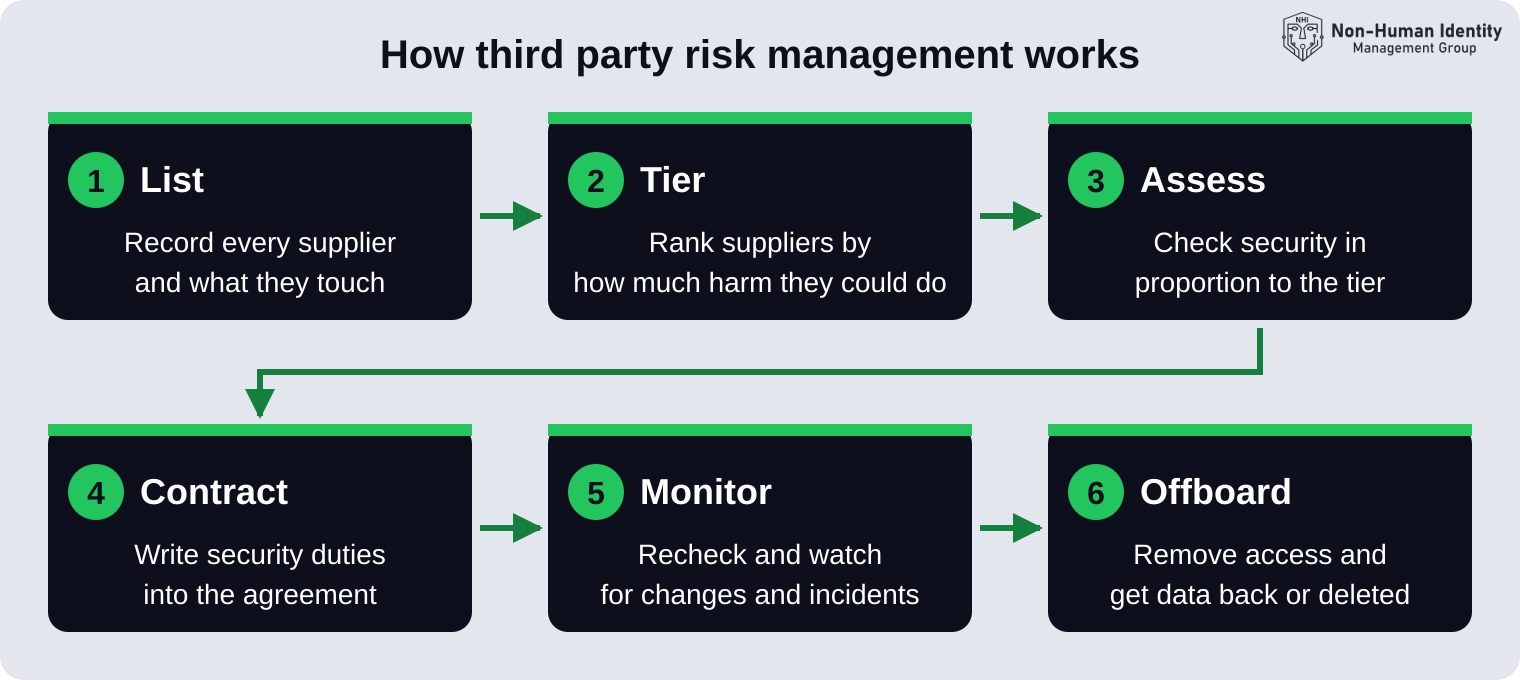
The UK National Cyber Security Centre (NCSC) groups its supply chain security principles into four similar stages: understand the risks, establish control, check your arrangements, and continuous improvement.[4]
The table shows one way to match effort to tier. It is an example, not a standard; set your own thresholds.
| Tier | Typical supplier | Checks before signing | How often to recheck |
|---|---|---|---|
| High | Holds sensitive data or has admin access to your systems, such as a cloud email provider or managed IT firm | Full questionnaire, independent evidence, contract security clauses | At least yearly and on any major change |
| Medium | Holds some business data or connects to one system, such as a marketing tool | Short questionnaire and evidence review | Every two years or on change |
| Low | No data and no system access, such as a stationery supplier | Basic checks only | At renewal |
A worked example
Meadow Vets is a fictional chain of four veterinary practices with 60 staff. Amira, the practice manager, is asked to "sort out supplier risk" after a customer asks how the practice protects pet owners' details.
Amira exports a year of supplier payments and finds 48 suppliers. She marks which ones hold customer data or connect to practice systems. Three stand out as high tier: the online booking system, the practice management software provider, and the IT support firm that has remote access to every computer. Nine are medium, such as the text reminder service. The rest are low.
For the three high-tier suppliers she sends a short security questionnaire and asks for any certificate or audit report they hold. The software provider sends an ISO/IEC 27001 certificate. The booking system has no certificate, but answers the questions well and agrees to add a 72-hour breach notice clause at renewal. The IT support firm admits all its engineers share one login to Meadow Vets' remote access tool. Amira does not cancel the contract; she asks for named accounts with multi-factor sign-in within three months, and puts a review date in the diary.
Six months later the text reminder service is replaced. Amira's offboarding checklist reminds her to remove its connection to the booking system and ask for the customer list to be deleted. The process has not made Meadow Vets immune to a supplier breach, but the practice now knows where its data sits, has fixed one clear weakness and can answer customer questions honestly.
Myths and misunderstandings
| What people think | What is true |
|---|---|
| If we outsource it, the risk is the supplier's problem. | You can hand over the work, but customers and regulators still hold you responsible for your data. |
| A completed questionnaire means the supplier is secure. | Answers are a supplier's own description. Treat them as a starting point and ask for evidence for high-tier suppliers. |
| Every supplier needs the same full review. | That wastes effort and slows the business. Tiering lets you focus on the suppliers that could do the most harm. |
| Vetting is done once, at signing. | Suppliers change. Recheck high-tier suppliers regularly and when something significant happens. |
| Big, well-known suppliers do not need checking. | Size is not the same as safety. Large suppliers are attractive targets because one breach reaches many customers. |
| Only IT suppliers matter. | A payroll firm, a law firm or a building contractor with door codes can all hold sensitive data or access. |
Key terms
- Third party risk management (TPRM)
- The lifecycle of identifying, assessing, contracting, monitoring and offboarding suppliers according to the risk they bring.
- Third party risk
- The chance that an outside organisation, supplier or contractor will cause harm to your business, including security, privacy, operational and legal harm.
- Vendor tiering
- Grouping suppliers by criticality and exposure so that review effort matches business impact.
- Due diligence
- The checks completed before a supplier is approved, such as questionnaires, certificates and contract review.
- Security questionnaire
- A set of questions a buyer sends to assess a supplier's security, privacy and risk posture.
- Right to audit
- A contract term that lets a customer inspect a supplier's records, controls or evidence.
- Fourth-party risk
- The exposure created by your suppliers' own suppliers and sub-processors, which you usually do not contract with directly.
- Vendor offboarding
- The controlled removal of a supplier's access, data and dependencies when the relationship ends or changes.
- Supply chain risk
- The chance that a weakness or compromise in a supplier, partner or upstream dependency, including software, will affect your organisation.
Common questions
What is the difference between third party risk and supply chain risk?
Third party risk focuses on the organisations you deal with directly. Supply chain risk is wider: it includes the products and software you buy and the suppliers behind your suppliers. See Third-Party Risk vs Supply Chain Risk for more.
How many suppliers should get a full review?
Usually only a small share: the ones that hold your most sensitive data, have powerful access or would stop the business if they failed. Your tiering rules decide this.
What evidence should I ask a high-tier supplier for?
We suggest asking for independent evidence where it exists, such as an ISO/IEC 27001 certificate or a SOC 2 report, and checking that it covers the service you actually buy.
What if a supplier gives a poor answer?
You can accept the risk for now, ask for a fix by a set date, add a contract clause, limit what data or access the supplier gets, or choose another supplier. Record the decision and who made it.
Do small businesses need a TPRM programme?
Not a heavy one. A list of suppliers, a simple tier for each and a few questions for the most important ones already covers the basics.
What should I do if a supplier is breached?
Find out what data and access the supplier had, change any credentials they held, and follow your incident plan. See Your vendor was breached for a step-by-step response.
First steps
Three things you can do this week:
- Build a first supplier list. Export a year of supplier payments and add any online apps staff sign in to. Note what data and systems each one touches.
- Mark your top tier. Pick the five or so suppliers whose failure or breach would hurt most, and name an owner for each.
- Ask your top suppliers three questions: how they protect your data, how fast they will tell you about a breach, and what independent evidence they can share.
Checklist
- We have a list of suppliers with the data and systems each one touches.
- Every supplier has a tier and a named owner.
- High-tier suppliers are assessed before signing, with evidence, not just answers.
- Contracts with high-tier suppliers include breach notice and security duties.
- We know whether key suppliers pass our data to other companies.
- High-tier suppliers are rechecked at least yearly and after major changes.
- Agreed fixes from suppliers have due dates and are followed up.
- When a supplier leaves, access is removed and our data is returned or deleted.
Simple measures that show progress: the share of suppliers with a tier, the share of high-tier suppliers assessed in the last year, the number of overdue supplier fixes, and the number of departed suppliers whose access was removed on time.
Check your understanding
1. Why do organisations put suppliers into tiers?
Answer: so that the effort spent checking each supplier matches how much harm that supplier could do.
2. Is a completed security questionnaire proof that a supplier is secure?
Answer: no. It is the supplier's own description. For important suppliers, ask for independent evidence as well.
3. Name two things that belong in a high-tier supplier contract.
Answer: for example, a deadline for telling you about a breach and the right to request security evidence. What happens to your data at the end is another.
4. What must happen when a supplier relationship ends?
Answer: remove all of the supplier's accounts, connections and keys, get your data returned or deleted, and update the supplier list.
Suggested learning pathway
- Next, control the logins you give suppliers: Third-Party Access for Beginners.
- For connected apps and integrations: OAuth Apps and Integrations for Beginners.
- For how attackers use suppliers: Supply Chain Attacks for Beginners.
- For the wider risk process: Cyber Risk Management for Beginners.
- For a common form of supplier evidence: SOC 2 for Beginners.
- For the full practitioner programme, see the Third-Party Risk Management Guide.
- For the NIST framework in depth, see the NIST SP 800-161 Cyber Supply Chain Risk Management Guide.
- If you are the supplier being asked: Answering Security Questionnaires as a Small Supplier.
Standards and references
- The NIST Cybersecurity Framework (CSF) 2.0, NIST CSWP 29. National Institute of Standards and Technology (NIST), February 2024. https://nvlpubs.nist.gov/nistpubs/CSWP/NIST.CSWP.29.pdf.
- SP 800-161 Rev. 1 (Update 1), Cybersecurity Supply Chain Risk Management Practices for Systems and Organizations. National Institute of Standards and Technology (NIST), May 2022, updated 1 November 2024. https://csrc.nist.gov/pubs/sp/800/161/r1/upd1/final, accessed 27 Nov 2026.
- SP 800-53 Rev. 5, Security and Privacy Controls for Information Systems and Organizations (SR-6 Supplier Assessments and Reviews). National Institute of Standards and Technology (NIST). https://csrc.nist.gov/pubs/sp/800/53/r5/upd1/final.
- Supply chain security guidance. National Cyber Security Centre (NCSC), published 28 January 2018, reviewed 22 October 2025. https://www.ncsc.gov.uk/collection/supply-chain-security, accessed 27 Nov 2026.
- 2025 Data Breach Investigations Report (news release). Verizon, 23 April 2025. https://www.verizon.com/about/news/2025-data-breach-investigations-report, accessed 27 Nov 2026.
- The impact of the Salesloft Drift breach on Cloudflare and our customers. Cloudflare blog, Cloudflare, 2 September 2025. https://blog.cloudflare.com/response-to-salesloft-drift-incident/, accessed 27 Nov 2026.
Related NHI Mgmt Group resources: Third-Party and Supply Chain Risk Executive Briefing · ISO/IEC 27036 Supplier Relationships Guide · TPRM Programme Health Check