A deepfake is a fake voice, video or image made with artificial intelligence (AI) so that a real person appears to say or do something they never did, and AI fraud is the use of these fakes and AI-written messages to trick people into sending money, data or access.
This guide is for newcomers, students, career changers and managers who want to understand how deepfakes and AI tools are used against organisations, and what a business can do about it. It covers how these frauds work at a concept level, a worked example, common myths and practical first steps. It is about protecting an organisation's processes; for personal and family advice, see the Spotting Deepfake Scams Guide.
By the end of this guide you will be able to:
- Explain what deepfakes and AI-enabled fraud are.
- Describe the main ways criminals use fake voices, videos and messages against organisations.
- Understand why verification processes matter more than spotting a fake by eye or ear.
- Identify practical steps a team can take this week.
Key takeaways
- AI makes impersonation cheaper and more convincing. Criminals use AI to write fluent messages, clone voices and fake video calls with executives or colleagues.[1]
- The request is the real warning sign. Urgency, secrecy, a new bank account or a request to bypass normal steps matter more than how real the voice or face seems.
- Process beats detection. A rule to call back on a number you already hold, and to have a second person approve large payments, works however good the fake is.[2]
- It is not just about payments. Fakes are also used to get network access, for example through fake job candidates or help desk calls, and to damage a brand.[2]
- Plan, practise and report. Agree in advance what staff should do, rehearse it, and report attempts to your bank and the authorities.[2]
What it is, in plain English
Generative AI is AI that creates new content, such as text, images, audio or video, in response to a request. The same tools that help people write emails or make videos can be misused to create convincing fakes.
A deepfake is one kind of synthetic media: AI-made or AI-altered content that imitates a real person. Voice cloning is the audio version, where AI imitates a particular person's voice. AI fraud is a broader term for any scam where criminals use AI to deceive people, including fake profiles, AI-written phishing messages, fake documents and deepfakes.
The US Federal Bureau of Investigation (FBI) has warned that criminals use generative AI for text, images, audio and video, for example to remove the spelling mistakes that used to give away scam messages, to create fake identity documents, to clone voices and to pose as company executives in live video chats.[1]
A helpful comparison is a forged signature. For years, organisations have known that a signature on a letter can be faked, so they check large payments in other ways. A deepfake is a forged face or voice. Where the analogy breaks down: a forged signature sits still on paper and can be studied, while a deepfake can talk back in real time on a call, under pressure, which makes it much harder to judge in the moment.
How deepfakes and AI are used against organisations
The US National Security Agency (NSA), FBI and Cybersecurity and Infrastructure Security Agency (CISA) group the threats to organisations into three kinds.[2] The examples in the right-hand column come from the agencies' guidance and FBI warnings.
| Threat | What it means | Examples |
|---|---|---|
| Impersonation for financial gain | Faking a trusted person to get money moved[2] | A cloned "finance director" voice asking for an urgent transfer; a fake video call with "executives"[1] |
| Impersonation to gain access | Faking a person to get into networks, systems or sensitive information[2] | Manipulated video in remote job interviews[2]; AI voice messages used to move targets to a malicious link and take over accounts[3] |
| Executive impersonation for brand manipulation | Fake audio or video of leaders to damage reputation or share price[2] | A fake clip of a chief executive making false statements |
| Fake identity documents | AI-made images used to get past identity checks when opening accounts[4] | Fake driving licences or ID photos[1] |
Why it matters to you
- If you run a small business: you may have only one or two people who can move money, and they probably know the boss's voice well. That familiarity is exactly what a voice clone exploits. A simple call-back rule protects you.
- If you are new to a security job: deepfakes are a social engineering problem first. Expect questions about payment controls, help desk identity checks and hiring checks, not just detection tools.
- If you are a manager: your voice and face may be the ones being copied. Your support for "always verify, even if it sounds like me" makes it safe for staff to slow down.
A real case shows the scale. In the Arup Deepfake Fraud 2024, CNN reported that a finance worker in Hong Kong paid out HK$200 million (about US$25.6 million) after a video call in which, according to Hong Kong police, every other participant was a deepfake recreation of colleagues. The worker had first suspected the request was phishing, and the fraud came to light when he checked with head office.[5] The lesson is not that the worker was careless: the fake meeting was designed to overcome his doubts. Independent checks before the money moved would have given a better chance of catching it.
Financial regulators have noticed too. In November 2024 the US Financial Crimes Enforcement Network (FinCEN) issued an alert on fraud schemes using deepfake media, reporting an increase in suspicious activity reports that describe suspected deepfake use, particularly fake identity documents used to get around identity checks.[4]
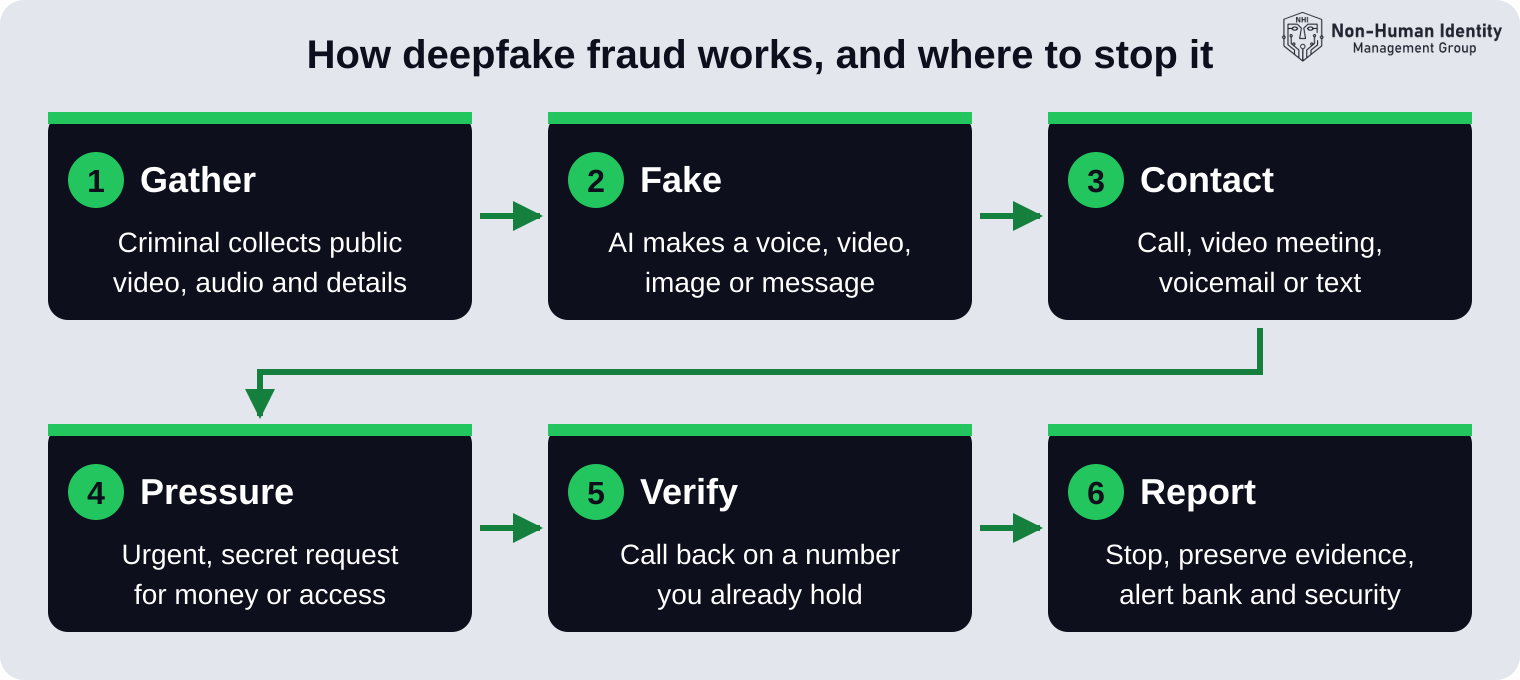
How it works, step by step
This is a concept-level view to help you recognise an attempt and know where to stop it. It is not a description of how to make a fake.
- Gather. Criminals collect public material about the person they want to copy and the target organisation: videos, interviews, voice clips, job titles, who approves payments. The FBI advises limiting public photos and voice recordings for this reason.[1]
- Fake. They use AI tools to produce a convincing voice, video, image or message in that person's style.[1]
- Contact. They reach the target by phone, voicemail, text, email, messaging app or video meeting, often moving the conversation to a channel they control.[3]
- Pressure. They make an urgent or secret request: pay a supplier now, change bank details, reset a password, share a file, click a link. The pressure is meant to stop the target checking.
- Verify (where you stop it). The target pauses and confirms the request through a different, trusted channel, such as calling back on a number they already hold. Both the FBI and the joint NSA, FBI and CISA guidance recommend this kind of independent check.[1][2]
- Report. If it is a fake, the target stops, keeps the evidence, tells the security team and, if money moved, contacts the bank at once. In the US, the FBI asks victims to report to its Internet Crime Complaint Center (IC3).[1]
Which defences help where
| Defence | What it does | Good for |
|---|---|---|
| Callback verification | Confirm the request by contacting the person through a number or channel you already trust | Payment requests, bank detail changes, help desk resets |
| Dual authorisation | A second, independent person must approve a sensitive action | Large or unusual payments |
| Real-time identity checks | Checks during live communication, such as multi-factor authentication or liveness testing[2] | High-value approvals, remote hiring, account recovery |
| Training and rehearsal | Teach staff the tactics and practise the response with tabletop exercises, including executives[2] | Every team that handles money, access or sensitive data |
| Detection tools | Check media for signs of manipulation, its source and its metadata[2] | Investigating suspicious recordings; a support to process, not a replacement |
A worked example
Northgate Logistics is a fictional haulage company with 300 staff. On a Friday afternoon, Amira in accounts receives a voicemail that sounds exactly like Chris, the finance director. "Amira, I'm about to board a flight. We need to pay a new supplier today to close a deal, the details are coming by message. Keep it quiet until Monday." A message follows from an unknown number with bank details and a signed-looking invoice.
- The request triggers the rule: a new payee, urgency and secrecy together match the warning signs in Northgate's payment policy.
- Call back, not reply: Amira does not reply to the message. She calls Chris on the mobile number in the company directory. He does not answer, so she calls his assistant, who confirms Chris is in a meeting in the building, not at the airport.
- Second approval: Northgate's policy says any new payee needs approval from a second named person through the finance system. The request never reaches that stage.
- Report: Amira forwards the voicemail and message to the security team without deleting them. The team warns other finance staff and logs the attempt.
No money was lost, but the outcome was not certain. Amira only acted because the policy gave her clear steps and the managers had said "verify, even if it sounds like me". The security team also notes that the criminals knew Chris's role and travel habits from public posts, and reviews what the company publishes about its finance staff.
Myths and misunderstandings
| What people think | What is true |
|---|---|
| I would always spot a fake. | Fakes can be very convincing, especially on a short call or under pressure. The FBI notes AI voice clones can be nearly identical to a known contact.[3] Rely on verification, not on your ear. |
| A video call proves it is really them. | Criminals have used AI video in live calls posing as executives.[1] A video call is one channel; confirm through a different one. |
| Deepfakes only target big companies. | Voice cloning and AI messages are cheap to produce, so smaller firms and individual staff are targets too. |
| A detection tool solves the problem. | Detection helps investigate, but the NSA, FBI and CISA guidance also stresses real-time verification, planning, training and reporting.[2] |
| It is only about money. | Fakes are also used to gain access, for example in remote job interviews or to take over accounts.[2][3] |
Key terms
- Deepfake
- Synthetic or altered media created with AI so that a person appears to say or do something they never did. Deepfakes are trust attacks on identity checks and approvals.
- Synthetic media
- Audio, video or images generated or altered by AI to imitate a real person or event.
- Voice cloning
- Using generative AI to create speech that imitates a real person's voice.
- Generative AI
- AI designed to create text, code, images or other content in response to a prompt.
- Using deception, urgency and authority to persuade a person to reveal information or take a risky action.
- Vishing
- Voice phishing: using phone calls or voice messages to persuade someone to reveal information or approve access.
- CEO fraud
- Impersonating a senior executive to convince staff to approve transfers, share information or change account details.
- Business email compromise
- Impersonating a trusted person or domain by email to manipulate payments, change bank details or extract information.
- Callback verification
- Confirming a sensitive request by contacting the person through a channel you already trust, rather than replying to the request.
- Out-of-band verification
- A confirmation step that uses a different channel from the original request, so one faked call or message cannot approve an action alone.
- Requiring two separate, independent people to approve a sensitive action before it goes ahead.
- Liveness detection
- A check that a face or voice sample comes from a real person who is present, not a recording, photo or fake.
Common questions
How is deepfake fraud different from business email compromise?
They overlap. Business email compromise uses email to impersonate someone; deepfake fraud adds fake voices or video. The NSA, FBI and CISA guidance notes that deepfakes can be part of business email compromise schemes.[2] See Business Email Compromise for Beginners.
Can I tell a deepfake by looking for glitches?
Sometimes. The FBI suggests looking for subtle imperfections such as distorted hands, odd teeth or eyes and inconsistent shadows or movement.[1] But fakes keep improving, so treat glitches as a bonus clue, not your main defence.
What should staff do if they think a call is fake?
End the call politely, do not act on the request, and confirm through a channel they already trust. Then report it to the security team and keep any recordings or messages.
Should executives stop posting videos online?
Not necessarily, but it helps to be aware that public audio and video can be used to build fakes. The NSA, FBI and CISA guidance suggests protecting public media of high-priority people, for example with watermarking or content authenticity standards.[2]
Does a family-style "secret word" work for businesses?
The FBI recommends a secret word for families.[1] Some teams use a similar idea for urgent requests, but we suggest a call-back rule and second approvals as the main controls, because a code word can be forgotten, shared or overheard.
Where do we report an attempt?
Internally, to your security team. If money moved, contact your bank immediately. In the US, report to the FBI's IC3; the NSA, FBI and CISA guidance also encourages reporting malicious deepfakes to government partners.[1][2] Elsewhere, use your national fraud or cyber reporting service.
First steps
Three things you can do this week:
- Write down the call-back rule. Any request to pay a new payee, change bank details or reset access is confirmed by contacting the person on a number from your own records, never the one in the request.
- Add a second approver. Make sure large or unusual payments need approval from a second, independent person in the finance system.
- Brief the people most at risk. Spend fifteen minutes with finance, help desk and executive assistants: show them the warning signs and tell them managers will always support them for checking.
Checklist
- Payment and bank-detail changes are always confirmed by calling back on a known number.
- Large or unusual payments need a second, independent approver.
- The help desk verifies identity before resetting passwords or multi-factor authentication, without relying on voice alone.
- Remote hiring includes identity checks beyond a single video interview.
- Finance, help desk and executive assistant teams have had deepfake awareness training.
- Senior leaders have said publicly, inside the company, that staff should verify requests even if they appear to come from them.
- Staff know how to report a suspected fake and that they should keep the evidence.
- We have rehearsed a deepfake fraud scenario at least once.
Check your understanding
1. What is the main warning sign in most deepfake frauds?
Answer: the request itself: urgency, secrecy, a new bank account or pressure to skip normal checks.
2. Why is calling back on a known number better than trying to spot a fake?
Answer: because it works however convincing the fake is. The criminal controls the original call or message, but not your trusted number.
3. Name one way deepfakes are used other than to steal money.
Answer: to gain access to networks, for example through fake job interviews or account takeovers, or to damage a brand with fake clips of executives.
4. Is a video call enough to confirm who someone is?
Answer: no. Criminals have used AI video in live calls, so confirm through a different, trusted channel.
Suggested learning pathway
- Start with Social Engineering for Beginners.
- Then read Business Email Compromise for Beginners.
- For fake and stolen identities, read Identity Fraud for Beginners.
- For personal and family advice, see the Spotting Deepfake Scams Guide.
- For the practitioner view, see the Deepfake and AI Impersonation Guide.
- For executive impersonation in depth, see the Executive Deepfake and CEO Fraud Guide.
- For training staff, see Deepfake Awareness Training for Staff.
- For responding to an incident, see the Deepfake CEO Fraud Response Playbook.
Standards and references
- Criminals Use Generative Artificial Intelligence to Facilitate Financial Fraud (Alert I-120324-PSA). Federal Bureau of Investigation, Internet Crime Complaint Center (IC3), 3 December 2024. https://www.ic3.gov/PSA/2024/PSA241203, accessed 27 Nov 2026.
- Contextualizing Deepfake Threats to Organizations (Cybersecurity Information Sheet, version 1.0). National Security Agency, Federal Bureau of Investigation and Cybersecurity and Infrastructure Security Agency, September 2023. https://media.defense.gov/2023/Sep/12/2003298925/-1/-1/0/CSI-DEEPFAKE-THREATS.PDF, accessed 27 Nov 2026.
- Senior US Officials Impersonated in Malicious Messaging Campaign (Alert I-051525-PSA). Federal Bureau of Investigation, Internet Crime Complaint Center (IC3), 15 May 2025. https://www.ic3.gov/PSA/2025/PSA250515, accessed 27 Nov 2026.
- FinCEN Issues Alert on Fraud Schemes Involving Deepfake Media Targeting Financial Institutions (FIN-2024-Alert004). Financial Crimes Enforcement Network, US Department of the Treasury, 13 November 2024. https://www.fincen.gov/news/news-releases/fincen-issues-alert-fraud-schemes-involving-deepfake-media-targeting-financial, accessed 27 Nov 2026.
- Finance worker pays out $25 million after video call with deepfake 'chief financial officer'. CNN, 4 February 2024. https://edition.cnn.com/2024/02/04/asia/deepfake-cfo-scam-hong-kong-intl-hnk, accessed 27 Nov 2026.
Related NHI Mgmt Group resources: Deepfake-Resistant Identity Verification Guide · Deepfake and Payment Fraud Executive Briefing · Authorised Push Payment (APP) Fraud Guide