Identity fraud is when someone uses another person's identity details, or a made-up identity, to deceive an organisation into giving them an account, credit, goods, services or access they are not entitled to.
This guide is for newcomers, students, career changers and managers who are not security specialists. It explains the main kinds of identity fraud, how organisations check identities when someone signs up or asks for a change, the warning signs, and simple controls a team can put in place. It is written from the organisation's side: how to spot and stop stolen and fake identities. For legal or financial matters, speak to a qualified professional.
By the end of this guide you will be able to:
- Explain the difference between identity theft, identity fraud and synthetic identities.
- Understand how organisations check that a person is real and is who they claim to be.
- Describe the warning signs that an identity may be stolen or fake.
- Identify first steps an organisation can take this week.
Key takeaways
- Theft and fraud are different stages. Identity theft is getting someone's details; identity fraud is using them to deceive an organisation.
- Some identities are not stolen but invented. Synthetic identities mix real and made-up details, so there may be no single victim to notice.
- Checking an identity has several parts. Is this a real person, is the evidence genuine, and is the applicant the person the evidence belongs to?
- The riskiest moments are sign-up and change. New accounts, password resets and changes to contact details are where fraudsters push hardest.
- No single check is enough. Organisations combine evidence checks with risk signals and give staff a safe way to say no or ask for more.
What it is, in plain English
Action Fraud, the UK's former national fraud reporting centre (replaced by Report Fraud in December 2025), separated two ideas. Identity theft is when criminals gather enough information about someone, such as name, date of birth and addresses, to pretend to be them. Identity fraud is using that stolen identity to obtain goods or services by deception.[1] Action Fraud guidance lists uses such as opening bank accounts, getting credit cards and loans, taking over existing accounts, taking out mobile phone contracts and applying for passports or driving licences.[1]
From an organisation's point of view, identity fraud usually takes one of three forms:
- Impersonation: a criminal applies for something in a real person's name, using stolen details. This is often called account opening fraud when the aim is a new account.
- Account takeover: a criminal gets into an existing account that belongs to someone else. Cifas, the UK fraud prevention service, records this as "account (facility) takeover".[2]
- Synthetic identity fraud: a criminal builds a fake identity from a mix of real and made-up details, then uses it to open accounts and build a history.
A helpful comparison is a nightclub door. Impersonation is someone arriving with a friend's real ID card. A synthetic identity is someone arriving with a convincing ID card for a person who does not exist. Account takeover is someone who slipped past the door earlier and is now inside wearing a regular's wristband. Where the analogy breaks down: a door supervisor sees a face, while most organisations check identities online, at scale, from photos and data, which gives fraudsters more room to hide.
Why it matters to you
- If you run a small business: a fraudster who opens an account or takes over a customer's account can leave you with unpaid goods, chargebacks and unhappy customers.
- If you are new to a security job: identity fraud links sign-in security, customer onboarding and fraud teams. You will often be asked how a fraudster got past a check, and which data showed it.
- If you are a manager: how strict to make sign-up and account change checks is a business decision about risk, cost and customer experience. It should be made deliberately, not by default.
Identity fraud is the largest category of cases that UK organisations share through Cifas's National Fraud Database. In the twelve months to December 2025, Cifas recorded 242,003 identity fraud cases, 54% of all filings, and 78,387 account (facility) takeover cases, 18% of filings, out of a record 444,993 cases in total.[2] In the US, the Federal Trade Commission received more than 1.1 million identity theft reports through IdentityTheft.gov in 2024.[3] Cifas also warns that synthetic identities are "becoming industrialised".[2]
How it works, step by step
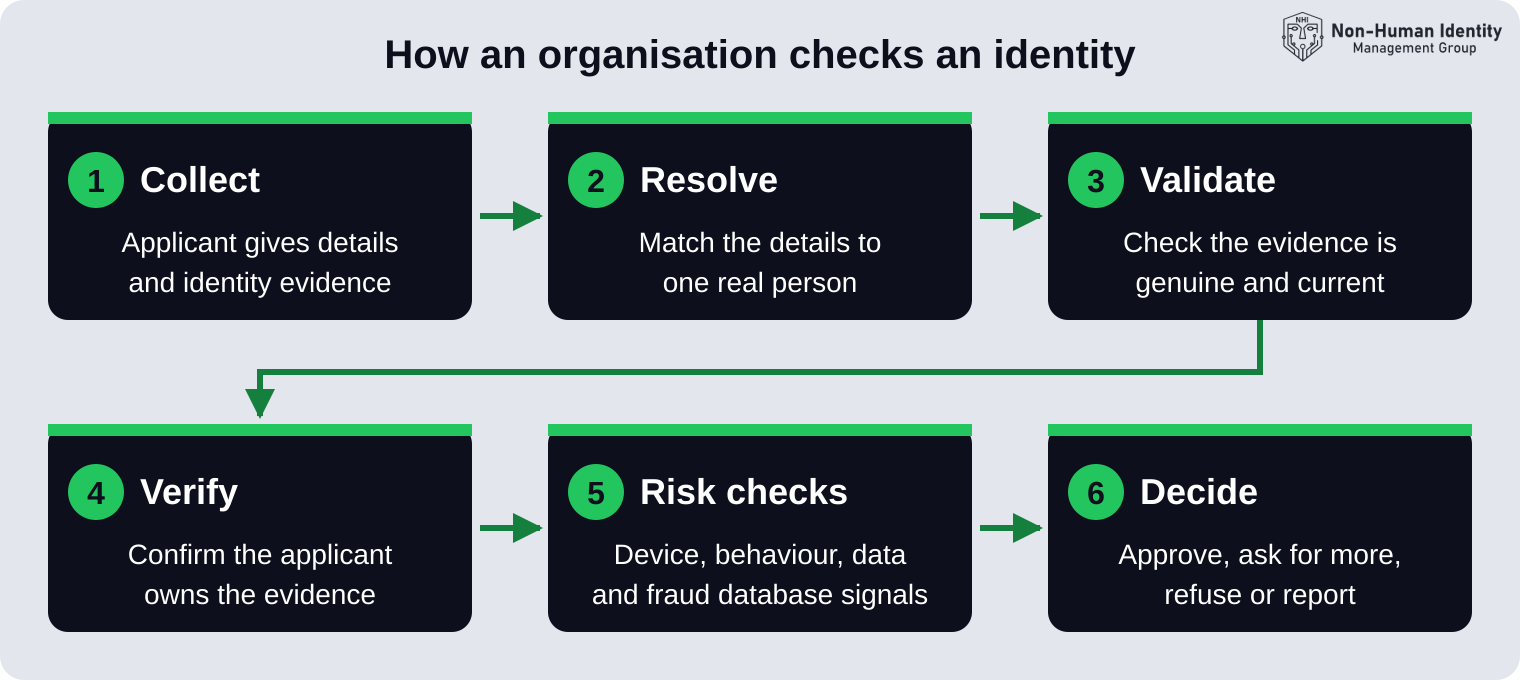
Most organisations do not see the theft itself. They see an application or a request, and must decide whether to trust it. NIST, the US standards body, describes identity checking in SP 800-63A as three core steps: resolution, validation and verification.[4] The steps below combine those with the fraud checks around them.
- Collect. The applicant gives their details and, where needed, identity evidence such as a passport or driving licence photo.
- Resolve. The organisation checks that the details point to one real, unique person.[4] Details that match nobody, or that match someone who is unlikely to be applying, are warning signs of a synthetic or stolen identity.
- Validate. The organisation checks that the evidence is genuine, accurate and current, against trusted sources.[4]
- Verify. The organisation confirms that the applicant really owns that evidence, for example by comparing a live selfie with the document photo or by sending a code to a confirmed contact. NIST does not allow knowledge-based questions (such as "what was your first car?") for this step.[4]
- Risk checks. Alongside the evidence, the organisation looks at risk signals. NIST recommends fraud checks such as SIM swap detection, device fingerprinting and transaction analytics.[4] Many organisations also check shared fraud databases.
- Decide. The application is approved, asked for more evidence, refused or reported. A refusal or a request for more evidence is a normal outcome, not a failure.
The table below shows common warning signs and the checks that help with each. It is a starting point, not a complete list.
| Warning sign | What it may mean | Checks that help |
|---|---|---|
| Details that do not fit together (age, address history, contact details) | A synthetic identity or stolen details used carelessly | Resolution against trusted data sources; fraud database checks |
| Many applications from one device or address | Organised fraud using several identities | Device and velocity checks |
| Document photo that looks edited or is a photo of a screen | Forged or altered evidence | Document validation and liveness checks |
| Request to change email, phone or address, then a quick password reset | Account takeover in progress | Step-up checks and alerts to the old contact details |
| Customer reports bills or letters for things they never ordered | Their identity has been used elsewhere; Action Fraud guidance lists this as a sign[1] | Investigation, account review and reporting |
Useful distinctions
- Identity proofing versus authentication. Proofing checks who someone is when they first join. Authentication checks that the same person is returning, each time they sign in. Fraudsters attack both. See Identity Proofing for Beginners.
- Stolen versus synthetic. With a stolen identity, a real person may eventually notice and complain. With a synthetic identity, there may be nobody to complain, so the organisation has to spot it from the data.
- Stronger checks versus more friction. NIST describes three identity assurance levels, from IAL1 up to IAL3, which needs an in-person session with a trained agent.[4] Higher levels resist more attacks but ask more of the applicant, so choose the level by risk.
- New threats to remote checks. NIST warns that digital injection attacks, often combined with AI-generated deepfakes, can defeat remote document and selfie checks.[4]
A worked example
Brightwater Energy is a fictional small energy supplier. New customers sign up online and can switch to monthly payments after a basic check.
Over two weeks, Kofi in the customer operations team notices something odd. Fourteen new accounts have been opened from the same device, each with a different name, all asking for an expensive smart heating bundle delivered to a handful of addresses. Several applicants are listed as over 80 but signed up at 3am using new email addresses.
Kofi raises it with Grace, who looks after security. Together they pause deliveries for the flagged accounts, ask each applicant to complete a document and selfie check, and add a simple rule: more than two applications from one device in a week sends the next one for manual review. Most of the applicants never complete the check. Two are genuine customers who do, and their orders go ahead.
Grace also reviews account changes and finds that one existing customer's email address was changed the day before a large order. She contacts the customer through the phone number held before the change; the customer did not make it, so the account is secured and the order cancelled. The new rules will not catch every fraud, and they create some extra work, but they give the team a clear, repeatable way to spot patterns like this earlier.
Myths and misunderstandings
| What people think | What is true |
|---|---|
| Identity fraud only affects banks. | Action Fraud guidance lists phone contracts, goods and government documents among its uses, so any organisation that gives credit, goods or accounts can be a target.[1] |
| A photo of a passport proves who someone is. | It shows that a document image exists. You still need to check that it is genuine and that the applicant is its owner. |
| Security questions are a good way to check identity. | Answers are often findable or leaked. NIST does not allow knowledge-based questions to verify that an applicant owns their evidence.[4] |
| If nobody complains, there was no fraud. | Synthetic identities have no real victim to complain, so the losses can appear later as unpaid debts. |
| Checks only matter at sign-up. | Changes to email, phone or address, and account recovery, are common routes for account takeover. |
Key terms
- Identity theft
- Obtaining and misusing another person's identity data to impersonate them, open accounts or pass checks.
- Identity fraud
- Misusing personal or account identity evidence to gain unauthorised access, financial benefit or trusted status.
- Synthetic identity fraud
- Creating a fake identity from a mix of real and made-up personal data to open accounts, build credit and avoid standard checks.
- Account opening fraud
- Creating a new account using stolen, synthetic or altered identity data.
- Account takeover
- Unauthorised use of a real account after an attacker gets valid access, for example through stolen passwords.
- Identity proofing
- Checking that a person is who they claim to be before giving or restoring access.
- Document verification
- Checking that an identity document is genuine, valid and right for the person claiming it.
- Liveness detection
- Checking that a face or other biometric comes from a real, present person, not a photo, screen or mask.
- Know Your Customer (KYC)
- The process of checking a customer's identity and deciding whether the relationship is acceptable, including ongoing review, not just a one-time sign-up step.
- Step-up authentication
- An extra check triggered when a session becomes higher risk or a user tries a sensitive action, such as changing contact details.
Common questions
What is the difference between identity theft and identity fraud?
Identity theft is getting hold of someone's details. Identity fraud is using them to deceive an organisation, for example to open an account.[1]
What is a synthetic identity?
An invented identity built from a mix of real and made-up details. Because the person does not fully exist, nobody may notice it being used until losses appear.
Do small organisations need identity checks?
If you give credit, ship goods before payment or hold valuable accounts, some checking is sensible. The level should match the risk: a newsletter sign-up needs far less than a credit account.
Are selfie and document checks enough on their own?
They help, but NIST warns that injection attacks and deepfakes can defeat remote checks, so combine them with risk signals and review.[4]
How is identity fraud connected to account takeover?
Account takeover is one form of identity fraud: the criminal uses a real person's existing account instead of opening a new one. See Account Takeover for Beginners.
What should an organisation do when it finds identity fraud?
Stop the activity, secure any affected genuine customer accounts, keep the evidence and report it through the proper channels, such as Report Fraud, the national reporting service for fraud and cyber crime run by City of London Police at reportfraud.police.uk (in Scotland, contact Police Scotland on 101) in the UK.[5] For legal or financial matters, speak to a qualified professional.
First steps
Three things you can do this week:
- Map your trust moments. List where you decide to trust a person: sign-up, credit decisions, password resets, changes of email, phone or address.
- Protect contact detail changes. When someone changes their email or phone number, notify the old contact details and add an extra check before any high-value action that follows.
- Set one simple pattern rule. For example, send applications for manual review when one device or address appears on several applications in a short time. Any rule you relax for a busy period should be approved, recorded and time-limited.
Checklist
- We know every point where we decide to trust a new or returning person.
- Our identity checks are matched to the risk of what the person can get.
- We do not rely on security questions alone to confirm identity.
- Changes to email, phone or address trigger an alert to the old details.
- Staff can pause or refuse a suspicious application without being penalised.
- We watch for repeated devices, addresses or details across applications.
- Customer complaints about unknown accounts or bills are routed to someone who investigates.
- We know how to report identity fraud and what evidence to keep.
Simple measures that show progress: the number of applications sent for manual review and how many turned out to be fraud, account changes followed by a high-value action within a day, the time from a customer complaint to investigation, and fraud losses per thousand new accounts.
Check your understanding
1. What is the difference between identity theft and identity fraud?
Answer: theft is obtaining someone's details; fraud is using them to deceive an organisation.
2. Why can synthetic identities be harder to spot than stolen ones?
Answer: there is often no real victim to notice and complain, so the organisation must spot it from the data.
3. What are NIST's three core identity proofing steps?
Answer: resolution (is this one real person), validation (is the evidence genuine) and verification (does the applicant own the evidence).
4. Why should a change of email address trigger an alert to the old address?
Answer: changing contact details is a common step in account takeover, and the alert gives the real owner a chance to spot it.
Suggested learning pathway
- Start with how identities are checked in Identity Proofing for Beginners.
- Then read Account Takeover for Beginners for attacks on existing accounts.
- For the human tricks behind many frauds, see Social Engineering for Beginners.
- For how stolen identities are turned into money, see Payment Fraud for Beginners.
- For the full practitioner view, see the Identity Fraud Prevention Guide.
- For invented identities in depth, see the Synthetic Identity Fraud Guide.
- For sign-up fraud controls, see the Account Opening and Application Fraud Guide.
Standards and references
- Identity fraud and identity theft. Action Fraud (former national fraud reporting centre, replaced by Report Fraud in December 2025). https://www.actionfraud.police.uk/a-z-of-fraud/identity-fraud-and-identity-theft, accessed 27 Nov 2026.
- Fraudscape 2026 (National Fraud Database, twelve months to December 2025). Cifas. https://www.fraudscape.co.uk, accessed 27 Nov 2026.
- New FTC Data Show a Big Jump in Reported Losses to Fraud to $12.5 Billion in 2024. Federal Trade Commission (FTC), 10 March 2025. https://www.ftc.gov/news-events/news/press-releases/2025/03/new-ftc-data-show-big-jump-reported-losses-fraud-125-billion-2024, accessed 27 Nov 2026.
- SP 800-63A-4, Digital Identity Guidelines: Identity Proofing and Enrollment. National Institute of Standards and Technology (NIST). https://pages.nist.gov/800-63-4/sp800-63a.html, accessed 27 Nov 2026.
- Report Fraud: New service from City of London Police. GOV.UK, 4 December 2025. https://www.gov.uk/government/news/report-fraud-new-service-from-city-of-london-police, accessed 27 Nov 2026.
Related NHI Mgmt Group resources: Synthetic Identity Fraud vs Identity Theft · Document Verification vs Liveness Detection · Deepfake-Resistant Identity Verification Guide