The EU Cyber Resilience Act is a law that makes connected products sold in the EU meet security rules.
This guide is for anyone who has heard of the Cyber Resilience Act, or CRA, and wants a plain picture of it. You do not need to write code to be affected: if your firm makes or sells an app, a device or software in the EU, it may apply to you.
In short
- The CRA covers hardware and software that connect to a device or a network, from smart watches to apps.
- Makers must build products with security in mind and fix flaws for a set time, usually at least five years.
- Since 11 September 2026, makers must report flaws that attackers are using, with a first warning within 24 hours.
- Most other duties apply from 11 December 2027. Products that meet the rules carry the CE mark.
What you will learn
- Explain what the CRA is and which products it covers.
- Spot the main duties it gives to product makers.
- Check the key dates, including the reporting duty that already applies.
- Ask the right questions of a supplier or your own product team.
Status: correct as at 28 November 2026, based on the text of the regulation on EUR-Lex and the European Commission's Cyber Resilience Act page. Laws change; check the official text.
This guide explains the topic in general terms and is not legal advice.
- Connected product (product with digital elements)
- hardware or software that can link to a device or a network.
- Maker (manufacturer)
- the firm that makes a product and sells it under its own name.
- Flaw attackers are using (actively exploited vulnerability)
- a weakness that there is proof criminals are already using.
What is the Cyber Resilience Act?
Think of the safety rules for toys. A toy must pass safety checks before it reaches a shop. The CRA brings the same idea to products with software inside.
Many everyday things now run software and connect to the internet. Think of a baby monitor, a smart watch, a game or a phone app.[1] If one ships with weak security, every buyer takes on the risk.
The CRA puts that job on the people who make and sell these products. Makers must think about security when they design a product. They must also keep fixing problems after it is sold.
The law is an EU regulation, known officially by its number, 2024/2847.[2] That means the same text applies in every EU country, without each country writing its own version.
Where the comparison stops working: a toy is checked once and then it is done. A connected product keeps changing through updates, and new flaws turn up for years, so the maker's job goes on after the sale.
Why does it matter?
Weak products put whole networks at risk, not only the buyer. The CRA turns secure design into a legal duty. The most serious breaches can bring large fines, based on a firm's yearly turnover.[3]
If you make an app or a device
What could happen: you sell in the EU without knowing the rules apply, and miss the 24-hour warning when a flaw is attacked.
Check this: list each product you sell in the EU and name who would send a report.
If you buy products for a business
What could happen: you buy a device that stops getting security fixes after a year or two.
Check this: ask suppliers how long they will ship security updates for each product.
If you are new to security work
What could happen: you are asked about product security, parts lists or flaw reports, and the terms are new.
Check this: learn how flaws are found, tracked and fixed, because the CRA leans on that work.
What does it look like?
Here is a made-up "Am I affected?" checklist that a small product team might fill in.
Example only. All values are made up.
Product: ExampleTherm smart oven thermometer
Sold in the EU?                      Yes        (1)
Connects to a phone or network?      Yes        (2)
Covered by medical or car rules?     No         (3)
On the important or critical lists?  Check      (4)
Support period promised:             EXAMPLE    (5)
Who sends flaw reports?              Not named  (6)
- The CRA covers products made available on the EU market.
- A product that connects to a device or network is likely in scope.
- Some products, such as medical devices and cars, have their own rules and are left out.[3]
- Products on these lists need stricter checks before sale.
- In a real file, this line would give the number of years of security fixes.
- A gap here matters, because reporting duties already apply.
Why this is risky: nobody is named to send a report. A 24-hour deadline could pass while people work out whose job it is.
The safer way: name a person and a backup, write down the steps, and check the product against the official lists.
How does it work?
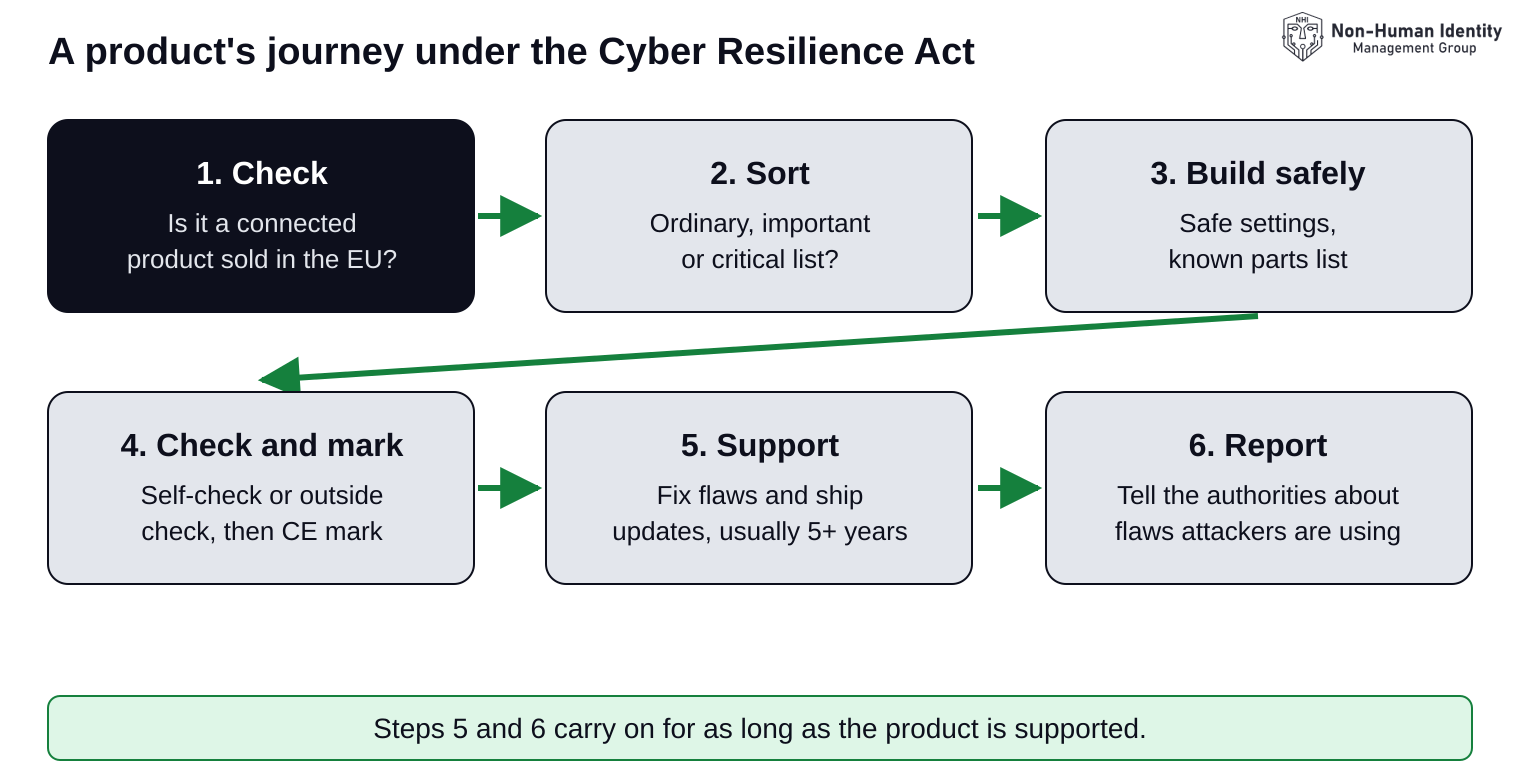
The CRA follows the life of a product, from design to the end of its support.
- Check scope. Is it hardware or software that connects to a device or network, and is it sold in the EU? Some products, such as medical devices, cars and products made only for national defence, are left out.[3]
- Sort the product. Most products are in the ordinary group. Some are listed as important or critical, and those face stricter checks.[3]
- Build it safely. The product must meet a set of basic security needs. These include safe settings out of the box and a way to get security updates. Makers also keep a list of the software parts inside, called an SBOM (software bill of materials).[3]
- Check and mark. Most makers can check their own product. Important and critical products may need an outside body to check them. The maker then signs a statement that the product meets the rules and adds the CE mark.[3]
- Support it. The maker must handle flaws for a support period of at least five years, unless the product is expected to be used for less time.[3]
- Report. The maker reports flaws that attackers are using, and serious security incidents, through one EU reporting platform run by ENISA, the EU cyber security agency.[3]
The dates are staged. The law came into force on 10 December 2024. The reporting duty has applied since 11 September 2026, and most other duties apply from 11 December 2027.[1] Rules for the outside bodies that check products applied earlier, from 11 June 2026.[3]
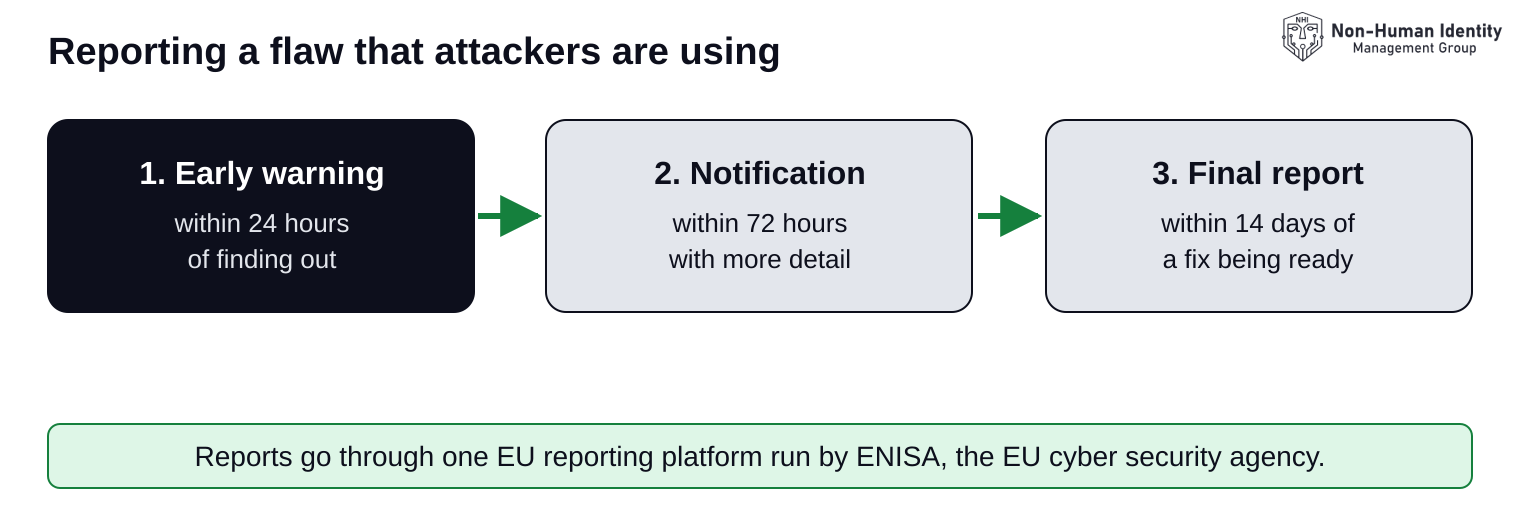
Reporting has three stages. Each clock starts when the maker becomes aware of the problem, and the last stage runs from when a fix is ready.[3]
A worked example
Esra Olsen leads a small made-up firm that makes a smart oven thermometer and its phone app. Restaurants and caterers across the EU buy it, including a made-up firm called Dune Catering.
Esra starts a CRA project. Her team agrees the thermometer and app are connected products sold in the EU. They check the important and critical lists. The product does not seem to be on them. So they plan to check it themselves, and note that the lists need a second look.
They pick a support period of seven years, because kitchens keep equipment a long time. They put that promise on the product page.
Next they look at the product. Every unit shipped with the same default admin password. They change the design so each owner sets their own at set-up. They also start making a parts list at every build, and set up a web page where outside researchers can report flaws.
In October 2026, a researcher writes in. Attackers are using a flaw in a free software part inside the app. Esra's team checks the evidence and sends an early warning through the EU platform within 24 hours. They send a fuller notice within 72 hours and release a fix.
Dune Catering gets a message asking it to update the app. Esra's team sends the final report within 14 days of the fix. The law did not stop the flaw from existing. But because the team had prepared, it could act and report on time.
Myths and mistakes
| What people think | What is true |
|---|---|
| Nothing starts until 2027. | Most duties apply from 11 December 2027, but the reporting duty has applied since 11 September 2026.[3] |
| It only covers smart gadgets. | It covers hardware and software, including apps and computer programs.[1] |
| Every product needs an outside check. | Most products can be checked by the maker. Important and critical products face stricter routes.[3] |
| Once a product is sold, the maker's job is done. | Makers must handle flaws for the support period, usually at least five years.[3] |
| Open-source volunteers face the same fines as companies. | Groups that look after open-source software for others, called stewards, have lighter duties and are not fined under the law.[3] |
What can I do this week?
- List your products sold in the EU, and note which ones connect to a device or network.
- Name who sends reports about flaws that attackers are using, plus a backup, and write down how.
- Start a parts list for your main product, so you can tell quickly whether a new flaw affects you.
- Ask your suppliers how long each product will get security updates.
- Read the Commission's guidance for makers, published on 27 July 2026.[1]
Checklist
- We know which of our products are connected products sold in the EU.
- We have checked each product against the important and critical lists.
- Each product has a stated support period, usually at least five years.
- We keep a software parts list for each release.
- Outside researchers have a clear way to report flaws to us.
- We know how to report through the EU platform, and who does it.
- We have a plan to tell users about fixes and what to do.
- Products ship without a shared default password and can receive security updates.
Common questions
When does the Cyber Resilience Act apply?
In stages. It came into force on 10 December 2024. The duty to report flaws that attackers are using has applied since 11 September 2026. Most other duties, including the CE mark rules for security, apply from 11 December 2027.[1]
Does it apply to firms outside the EU?
Yes, if they sell in the EU. The law is about products made available on the EU market, so where the maker is based does not decide it. Check the official text and the Commission's guidance for your own case, or ask a lawyer.
Does it cover online services?
Partly, and it depends on the details. The law includes a product's own remote data processing, such as the online service a smart device relies on. Whether a separate online service is covered depends on the case, so check the Commission's guidance rather than assume.[3]
Who enforces the CRA?
National market surveillance authorities do. These are bodies in each EU country that check products on sale meet the rules, and they can act when a product does not.[1] Small makers are not fined for missing the 24-hour early warning deadline.[3]
How is the CRA different from NIS2?
The CRA is about products, and NIS2 is about organisations. The CRA sets duties for things being sold, such as apps and devices. NIS2 sets duties for organisations that run important services, such as energy or health. A firm can fall under both laws at once.
Where next?
Ready for the detail? Read the practitioner guide: EU Cyber Resilience Act Guide. It goes further into the product lists, the checking routes and the reporting rules, with links to the official articles.
Also useful:
- EU Cyber Resilience Act Readiness Checklist for Manufacturers
- EU Cyber Resilience Act Vulnerability and Incident Reporting Guide
- SBOMs for Beginners
- NIS2 for Beginners
Related NHI Mgmt Group resources: EU Cyber Resilience Act Executive Briefing · EU CRA Product Classes Guide · PSIRT Guide
Key terms
- Cyber Resilience Act (CRA)
- An EU law that sets security rules for hardware and software products sold in the EU.
- Product with digital elements
- Hardware or software that can connect to a device or network, which is what decides whether the CRA applies.
- Manufacturer
- The firm that makes a product and sells it under its own name, and so carries most CRA duties.
- Actively exploited vulnerability
- A known flaw that attackers are using in real attacks.
- Software bill of materials (SBOM)
- A list of the software parts inside a product.
- Single reporting platform
- The EU system, run by ENISA, that makers use to send CRA reports.
- CE marking
- A mark showing a product meets the EU rules that apply to it.
- Secure by default
- A design approach where the safest settings are the ones a product ships with.
Sources and further reading
- Cyber Resilience Act. Shaping Europe's digital future, European Commission, last updated 23 November 2026. https://digital-strategy.ec.europa.eu/en/policies/cyber-resilience-act, accessed 28 Nov 2026.
- Regulation (EU) 2024/2847 (Cyber Resilience Act), document information. EUR-Lex, Publications Office of the European Union. https://eur-lex.europa.eu/eli/reg/2024/2847/oj/eng, accessed 28 Nov 2026.
- Regulation (EU) 2024/2847 of the European Parliament and of the Council of 23 October 2024 on horizontal cybersecurity requirements for products with digital elements (Cyber Resilience Act), full text, Articles 2, 13, 14, 16, 64 and 71. Official Journal of the European Union, via EUR-Lex. https://eur-lex.europa.eu/legal-content/EN/TXT/HTML/?uri=CELEX:32024R2847, accessed 28 Nov 2026.