NIS2 is the European Union's main cyber security law for important services, requiring covered organisations to manage cyber risk with a set of minimum security measures, report significant incidents quickly and make their management bodies accountable.
This guide is for newcomers, students, career changers and managers who need to understand NIS2 without reading the legal text. It explains who the law covers, the difference between essential and important entities, what the ten minimum measures mean in plain English, how incident reporting works and where to go next. It links to deeper guides on each measure and on national laws rather than repeating them.
By the end of this guide you will be able to:
- Explain what NIS2 is and why the EU introduced it.
- Describe how an organisation can fall within its scope.
- Understand the ten minimum security measures in plain English.
- Identify the three stages of NIS2 incident reporting.
Status: correct as at 27 November 2026, based on Directive (EU) 2022/2555 on EUR-Lex and the European Commission's NIS2 policy page. Laws change; check the official text.
This guide explains the topic in general terms and is not legal advice.
Key takeaways
- NIS2 is an EU directive, applied through national laws. Each EU country writes it into its own law, so details such as registration and the named authority vary by country.
- Scope depends on sector and size. Mainly medium-sized and larger organisations in the sectors listed in the directive's two annexes, plus some named services regardless of size.
- There are two categories. Essential entities face stricter supervision and higher maximum fines than important entities, but both follow the same core duties.
- Ten minimum measures set the baseline. Article 21(2) lists areas such as incident handling, supply chain security, backups, training and multi-factor authentication.
- Leaders are accountable. Management bodies must approve the measures, oversee them and take training.
What it is, in plain English
NIS2's official name is Directive (EU) 2022/2555 on measures for a high common level of cybersecurity across the Union. It was adopted on 14 December 2022, published on 27 December 2022 and entered into force on 16 January 2023.[1] It replaced the earlier NIS Directive of 2016, which is why it is called "NIS2".[1]
A directive is a type of EU law that sets goals each member state must achieve through its own national law. NIS2 required member states to adopt and publish their national measures by 17 October 2024 and to apply them from 18 October 2024.[2] In practice, an organisation follows its country's NIS2 law and deals with its national authority.
The core idea is simple. If your organisation provides a service that society or the economy relies on, you must manage your cyber risks in a sensible, proportionate way, tell the authorities quickly when something serious happens, and make sure your leadership takes responsibility.
A helpful comparison is food hygiene rules. A restaurant does not get a list of exact recipes, but it must meet basic standards (clean kitchen, safe storage, trained staff), report outbreaks and accept inspections. NIS2 does the same for cyber security. Where the analogy breaks down: NIS2 covers much larger and more varied organisations, from hospitals to cloud providers, and the measures are risk-based, so what is "appropriate" depends on the organisation.
Why it matters to you
- If you run a small business: most small and micro businesses are outside direct scope, but you may be a supplier to a covered organisation. NIS2 requires covered entities to address supply chain security, so customers may ask you about your security.[2]
- If you are new to a security job: in the EU, NIS2 shapes security programmes, audits and job descriptions. Knowing the ten measures helps you understand why work is prioritised.
- If you are a manager: NIS2 makes management bodies responsible for approving and overseeing cyber risk measures, and they can be held liable for infringements under national law.[2]
The penalties are significant. For essential entities, member states must allow maximum fines of at least 10 million euros or at least 2 percent of total worldwide annual turnover, whichever is higher. For important entities the figures are at least 7 million euros or at least 1.4 percent.[2] These are the minimum caps the directive sets; each national law sets the actual amounts.
How it works, step by step
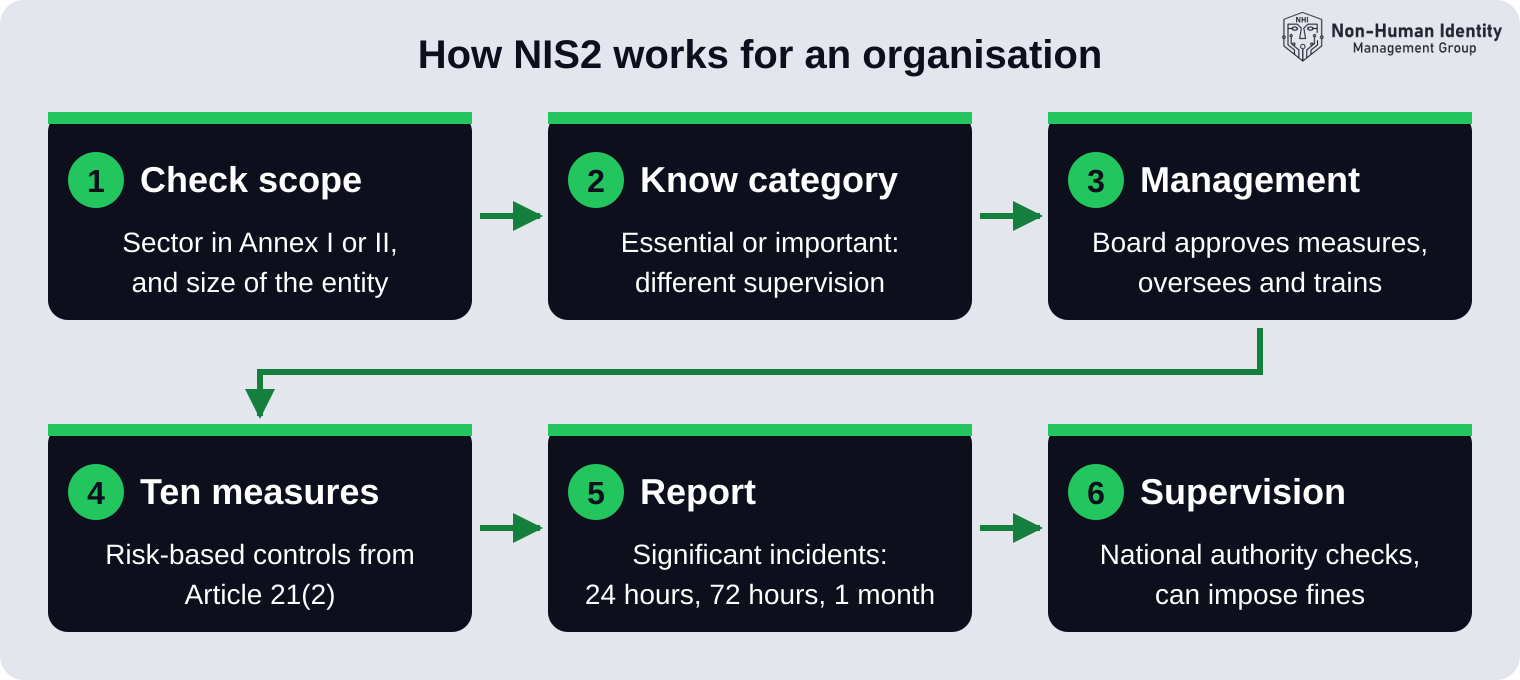
This is how NIS2 applies to an organisation, in general terms. National laws add their own details.
- Check whether you are in scope. NIS2 applies to public or private entities of a type listed in Annex I or Annex II that are medium-sized or larger and provide services or carry out activities in the EU.[3] Some entities, such as DNS service providers and top-level domain name registries, are covered regardless of size.[3]
- Work out your category. Article 3 sets out who is an essential entity, for example large organisations in Annex I sectors, qualified trust service providers and entities identified as critical under the separate Critical Entities Resilience Directive. Other in-scope entities are important entities.[3]
- Put governance in place. The management body (for example the board) approves the cyber security risk-management measures, oversees how they are put in place and must follow training.[2]
- Take the ten minimum measures. Article 21 requires appropriate and proportionate technical, operational and organisational measures, covering at least the ten areas in the table below.[2]
- Report significant incidents. Entities notify their national CSIRT (computer security incident response team) or competent authority without undue delay, in stages: an early warning within 24 hours of becoming aware, an incident notification within 72 hours and a final report no later than one month after the notification.[2]
- Expect supervision. National competent authorities supervise and can impose fines. The directive provides for different supervision of the two categories.[3]
The two annexes
| Annex I: sectors of high criticality | Annex II: other critical sectors |
|---|---|
| Energy; transport; banking; financial market infrastructures; health; drinking water; waste water; digital infrastructure; ICT service management (business-to-business); public administration; space | Postal and courier services; waste management; chemicals; food production, processing and distribution; manufacturing; digital providers; research |
Source: Annexes I and II of the directive.[3] Each sector has sub-sectors and entity types listed in the annexes; check the official text and your national law.
The ten minimum measures in plain English
| Article 21(2) | What the directive covers | In plain English |
|---|---|---|
| (a) | Policies on risk analysis and information system security | Understand your risks and write down how you secure your systems. |
| (b) | Incident handling | Know how to spot, deal with and recover from incidents. See NIS2 Article 21(2)(b) Incident Handling. |
| (c) | Business continuity, such as backup management and disaster recovery, and crisis management | Keep running, or recover quickly, when something goes wrong. See NIS2 Article 21(2)(c) Business Continuity and Crisis Management. |
| (d) | Supply chain security, including relationships with direct suppliers and service providers | Check the security of the suppliers you depend on. See the NIS2 Supply Chain Security Guide. |
| (e) | Security in acquisition, development and maintenance, including vulnerability handling and disclosure | Buy and build securely, and fix weaknesses. See NIS2 Article 21(2)(e) Secure Development and Vulnerability Handling. |
| (f) | Policies and procedures to assess the effectiveness of the measures | Check that your controls actually work. |
| (g) | Basic cyber hygiene practices and cyber security training | Do the basics well and train your people. |
| (h) | Policies and procedures on cryptography and, where appropriate, encryption | Protect data with encryption where it makes sense. |
| (i) | Human resources security, access control policies and asset management | Know your people, systems and accounts, and control who can access what. See NIS2 Article 21(2)(i) HR Security, Access Control and Asset Management. |
| (j) | Multi-factor or continuous authentication, secured voice, video and text communications and secured emergency communications, where appropriate | Use strong sign-in and secure ways to talk, including in a crisis. See NIS2 Article 21(2)(j) MFA and Secured Communications. |
The wording in the middle column is summarised from Article 21(2).[2] For certain digital service providers, such as cloud and managed service providers, Commission Implementing Regulation (EU) 2024/2690 sets out more detailed technical requirements; see the NIS2 Implementing Regulation 2024/2690 Guide.
Useful distinctions
- Access control covers software accounts too. Measure (i) is about controlling who and what can access systems. That includes service accounts, API keys and other non-human identities, which often hold powerful access and are easy to overlook.
- Proportionate does not mean optional. Article 21 asks for appropriate and proportionate measures, which leaves room to scale them to the organisation, but the ten areas are the minimum the measures must cover.[2]
- NIS2 is not a certification. Unlike ISO 27001, there is no certificate that proves NIS2 compliance in general. Standards such as ISO 27001 can help; see the ISO 27001 to NIS2 and DORA Mapping Guide.
- Changes are proposed. On 20 January 2026 the European Commission proposed targeted amendments to NIS2 to increase legal clarity and simplify compliance. As at the date checked, the Commission page describes this as a proposal.[4] See NIS2 Amending Directive Proposal 2026.
A worked example
Valley Foods is a fictional food processing company with 220 staff, operating in one EU country. Its operations director, Marta, hears that NIS2 might apply.
- Scope: food production, processing and distribution is listed in Annex II, and Valley Foods is above the medium-sized thresholds. Marta checks her country's NIS2 law and the national authority's website and concludes, with legal advice, that the company is likely an important entity.
- Governance: she briefs the board. The board agrees to approve a cyber risk plan, receive a quarterly update and attend training.
- Gap check: the IT manager, Jonas, compares current practice with the ten measures. He finds good backups but no tested recovery plan, MFA on email but not on remote access to the factory systems, no list of service accounts, and no checks on the company's two main IT suppliers.
- Plan: Jonas proposes a prioritised plan: MFA for all remote access, a service account inventory, a recovery test, supplier security questions and an incident reporting procedure that names who contacts the national CSIRT.
Six months later, a ransomware attack hits one office laptop. The team isolates it quickly, follows its new procedure and, with advice, decides whether the incident is significant under the national rules. NIS2 did not stop the attack, and the company is not "NIS2 compliant" because of one plan. But the work gave Valley Foods a clearer picture of its risks, a tested process and evidence that management was involved.
Myths and misunderstandings
| What people think | What is true |
|---|---|
| NIS2 only applies to big critical infrastructure. | It covers 18 sectors across two annexes, including manufacturing, food, postal services and digital providers, mostly for medium-sized and larger entities. |
| Small companies can ignore NIS2. | Most small firms are outside direct scope, but some services are covered regardless of size, and suppliers may be asked about security by covered customers. |
| NIS2 is one law that reads the same everywhere. | It is a directive. Each EU country has its own national law, authority and procedures. See the NIS2 Transposition Tracker. |
| Security is the IT team's problem. | Management bodies must approve and oversee the measures and take training, and can be held liable. |
| We have 72 hours before telling anyone. | An early warning is due within 24 hours of becoming aware of a significant incident; the 72-hour deadline is for the fuller incident notification. |
| Buying a tool makes us compliant. | NIS2 asks for risk-based measures across people, process and technology, plus governance and reporting. No single product covers that. |
Sources for the table: the directive's articles on scope, governance and reporting.[2][3]
Key terms
- NIS2 Directive
- The European Union's cyber security law for risk management, incident reporting and governance across critical sectors.
- Essential entity
- An organisation classed as highly critical under NIS2 and therefore subject to stricter oversight.
- Important entity
- An organisation in NIS2 scope with generally less intensive oversight than essential entities, but similar core duties.
- Cyber security risk-management measures
- The policies, controls and processes used to reduce the chance and impact of cyber attacks; NIS2 lists ten minimum areas.
- Significant incident
- An incident serious enough to cross a regulatory reporting threshold, for example by causing severe disruption or financial loss.
- Early warning
- The first notice of a significant incident, due under NIS2 within 24 hours of becoming aware of it.
- CSIRT
- A computer security incident response team; under NIS2, each country has CSIRTs that receive incident reports.
- The national authority that supervises whether organisations meet their cyber security duties.
- Supply chain security
- Protecting the suppliers, software, services and data an organisation depends on from compromise.
- Multi-factor authentication (MFA)
- Signing in with two or more independent kinds of proof, such as a password plus an app prompt or security key.
Common questions
What does NIS2 stand for?
NIS stands for network and information systems. NIS2 is the second EU directive on the security of network and information systems, replacing the first one from 2016.[1]
When did NIS2 start to apply?
Member states had to apply their national NIS2 measures from 18 October 2024.[2] Some countries were late, so national start dates differ. Check your country's law.
How do I know if my organisation is covered?
Check whether your activity appears in Annex I or II and whether you are medium-sized or larger, then check your national law and authority's guidance. We suggest getting legal advice where it is unclear. The NIS2 Entity Self-Classification Checklist can help you prepare questions.
What is a significant incident?
Under Article 23, an incident is significant if it has caused or could cause severe operational disruption or financial loss, or has affected or could affect others by causing considerable material or non-material damage.[2]
Does NIS2 apply in the UK?
No. NIS2 is EU law. The UK has its own NIS Regulations and is working on new legislation; see NIS2 vs UK Cyber Security and Resilience Bill. UK firms serving EU customers may still be affected.
How does NIS2 relate to DORA?
DORA is a separate EU regulation for the financial sector's digital operational resilience. Where both could apply, see DORA for Beginners and the DORA and NIS2 Overlap Mapping Guide.
First steps
Three things you can do this week:
- Find your national law and authority. Look up how your country has written NIS2 into law and which authority supervises your sector.
- Compare your activities with the annexes. Write down which of your services might fall under Annex I or II, and your organisation's size. Take this to legal or compliance colleagues.
- Do a quick ten-measure check. For each Article 21(2) area, note whether you have something in place, something partial or nothing. We suggest starting with incident reporting, MFA and backups, which are common gaps.
Checklist
- We know whether we are likely in scope, and in which category, with the reasoning written down.
- We know our national NIS2 law and our competent authority.
- Our management body has approved our cyber risk measures and receives regular updates.
- Management body members have attended cyber security training.
- Each of the ten Article 21(2) areas has an owner and a current status.
- We have an incident procedure that covers the 24-hour, 72-hour and one-month reporting stages.
- We know our key suppliers and have asked about their security.
- Remote access and admin accounts use multi-factor authentication.
Check your understanding
1. What two things decide whether an organisation is usually in NIS2 scope?
Answer: whether its activity is a type listed in Annex I or II, and whether it is medium-sized or larger (with some entity types covered regardless of size).
2. What is the difference between essential and important entities?
Answer: essential entities are the most critical and face stricter supervision and higher maximum fines; important entities have generally less intensive oversight but similar core duties.
3. What are the three main NIS2 reporting stages?
Answer: an early warning within 24 hours, an incident notification within 72 hours and a final report within one month of the notification.
4. Who must approve the cyber security risk-management measures?
Answer: the organisation's management body, which must also oversee them and follow training.
Suggested learning pathway
- Start with the basics of compliance in Cyber Security Compliance for Beginners.
- For a widely used security standard that supports NIS2 work, read ISO 27001 for Beginners.
- For the incident side, read Incident Response for Beginners.
- For the full practitioner view of the directive, see the NIS2 Directive Guide.
- For the reporting rules in depth, see NIS2 Article 23 Incident Reporting.
- For leadership duties, see the NIS2 Management Liability Executive Briefing.
- To plan your gap check, use the NIS2 Readiness Checklist.
Standards and references
- Directive (EU) 2022/2555 (NIS 2 Directive), document information page. EUR-Lex, Publications Office of the European Union; act dated 14 December 2022. https://eur-lex.europa.eu/eli/dir/2022/2555/oj/eng, accessed 27 Nov 2026.
- Directive (EU) 2022/2555, full text: Articles 20, 21, 23, 34 and 41. EUR-Lex, Official Journal of the European Union L 333, 27 December 2022. https://eur-lex.europa.eu/legal-content/EN/TXT/HTML/?uri=CELEX:32022L2555, accessed 27 Nov 2026.
- Directive (EU) 2022/2555, full text: Articles 2 and 3, recitals and Annexes I and II. EUR-Lex, Official Journal of the European Union L 333, 27 December 2022. https://eur-lex.europa.eu/legal-content/EN/TXT/HTML/?uri=CELEX:32022L2555, accessed 27 Nov 2026.
- NIS2 Directive: securing network and information systems. European Commission, Shaping Europe's digital future. https://digital-strategy.ec.europa.eu/en/policies/nis2-directive, accessed 27 Nov 2026.
Related NHI Mgmt Group resources: Top 10 NIS2 and DORA Readiness Gaps Found in Assessments · NIS2 vs Cyber Resilience Act · EU AI Act vs NIS2