Keyless car theft is when thieves trick a car into unlocking by stretching the signal from its key.
This guide is for drivers, car buyers and anyone who has heard of "relay attacks" and wants to know what they are. You do not need to know anything about car electronics: if your car opens when you walk up with the key in your pocket, this is about you.
In short
- Many keyless cars unlock and start when they sense the key is close by.
- In a relay attack, thieves use two devices to pass the key's signal from your house to your car.
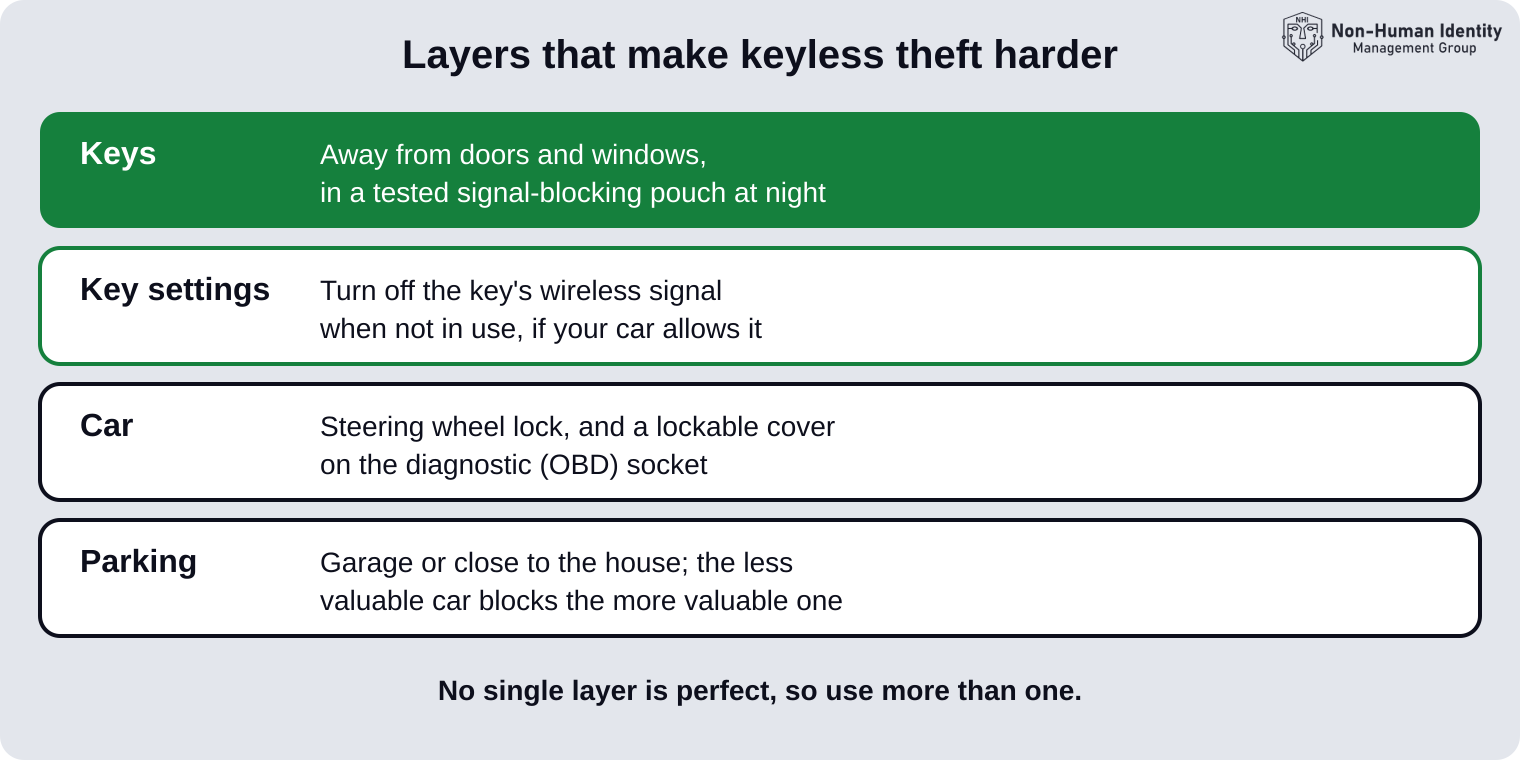
- Keep keys away from doors and windows, and in a signal-blocking pouch at night.
- A steering wheel lock, a lockable cover for the car's diagnostic socket and turning off the key's signal add extra layers.
What you will learn
- Explain how a relay attack works in two sentences.
- Spot the habits that make a keyless car easier to steal.
- Check whether your key's wireless signal can be turned off.
- Choose simple, layered protection for your car.
- Walk-up unlocking (keyless entry)
- a car that unlocks and starts when its key is nearby, with no button press.
- Signal stretching (relay attack)
- using two devices to pass a key's signal over a longer distance than it should reach.
- Signal-blocking pouch (Faraday pouch)
- a lined bag that stops radio signals getting in or out.
What is keyless car theft?
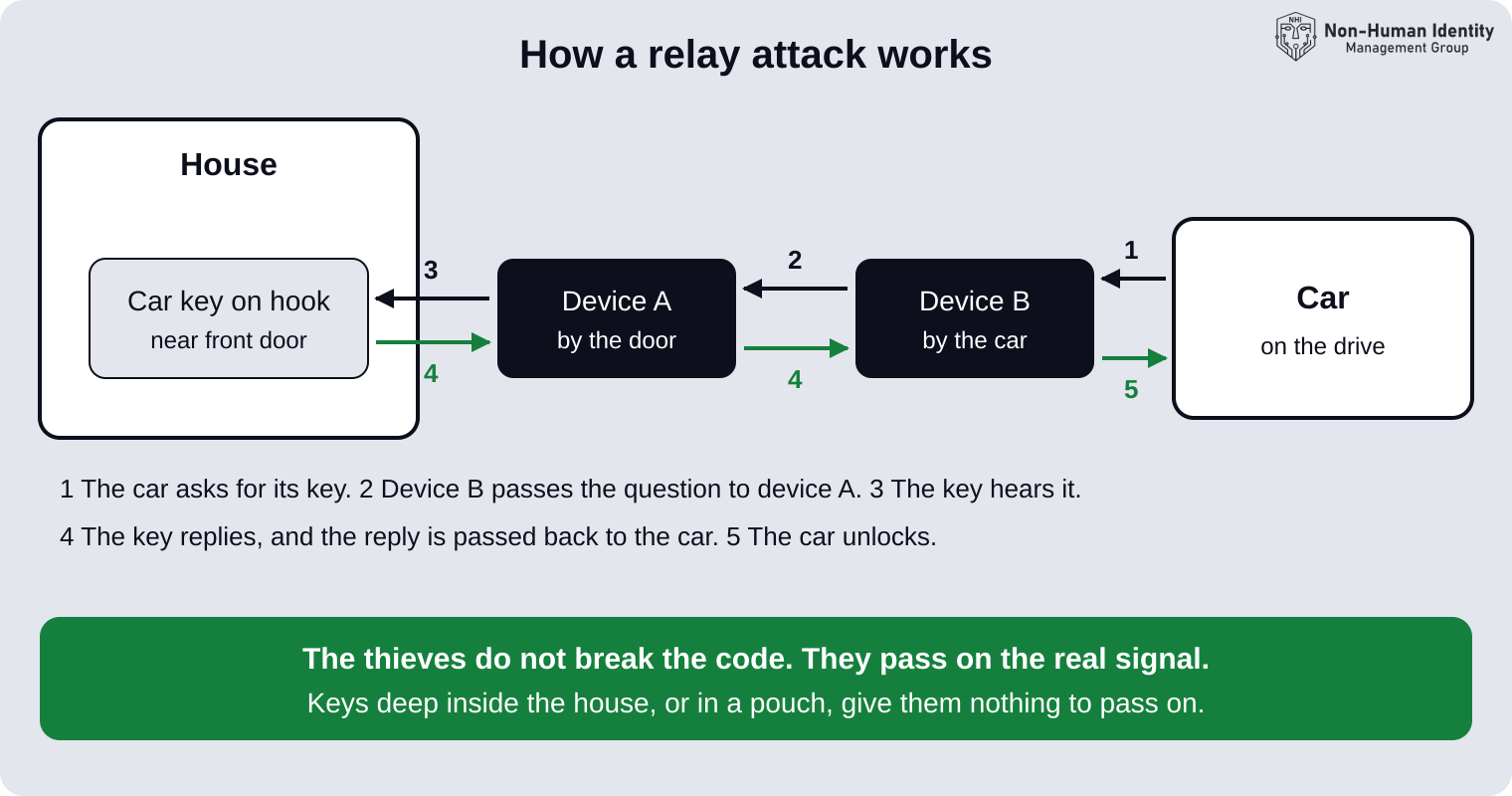
Think of two people holding walkie-talkies. One stands by your front door, the other stands by your car. Whatever is said at the door is heard at the car, as if the two were next to each other.
That is a relay attack. A keyless car regularly calls out, "Is my key here?" Normally only a key a short distance away can hear and reply. In a relay attack, one thief holds a device near your house to pick up the key's signal. A second device by the car passes it on. The car hears a correct reply and believes the key is right beside it.
The thieves do not crack any code. Researchers showed in 2010 that relays can beat even strong encryption (the scrambling of messages). The relay simply passes on the real signal.[3]
Where the comparison stops working: you would notice a stranger with a walkie-talkie at your door. Relay devices can be small, and they can pick up a key's signal through house walls.[2]
Why does it matter?
This is a common way cars are stolen. The UK Home Office cites a police estimate that electronic devices are used in about 60% of vehicle thefts in London.[1]
If you drive a keyless car
What could happen: your car is driven away at night with no broken glass and no noise.
Check this: where do your keys sit overnight? Hooks by the front door are the easiest to reach.
If you are buying a used car
What could happen: an extra key you were never given still works with the car.
Check this: ask how many keys were made, and consider having the keys reprogrammed.
If your business runs vans or company cars
What could happen: vans parked outside drivers' homes are taken overnight, with tools and stock inside.
Check this: give drivers signal-blocking pouches and a short written key routine.
What does it look like?
Here is a made-up note from a home doorbell camera. It shows the signs that police and insurers often describe.
Example only. All values are made up.
Doorbell camera, EXAMPLE Close, 02:14
02:14  Person walks close to front door, holding a bag   (1)
02:14  Second person waits beside the car               (2)
02:15  Car indicators flash once, car unlocks           (3)
02:16  Car drives away. No alarm, no broken glass       (4)
Keys found next morning on hook inside front door      (5)
- In a real screen, this would show the first device, held near the house to pick up the key's signal.
- In a real screen, this would show the second device, passing the signal to the car.
- The car believes its key is nearby, so it unlocks.
- Because the car thinks its key is present, it may also start.
- The key never left the house. It was close enough to the door to be reached.
Why this is risky: keys kept near a front door or window are within easy reach of a relay device outside.[2]
The safer way: keep keys deeper inside the house and in a signal-blocking pouch, so there is no signal to pass on.[4]
How does it work?
Here is a relay attack in five plain steps. The point is to show where you can break the chain.
- The car calls out. When someone tries the door, a keyless car typically sends a short-range signal asking for its key.
- The relay picks it up. A device by the car catches that signal and sends it to a second device near the house.
- The key answers. The key hears the car's question, as if the car were close, and replies.
- The reply travels back. The devices carry the real reply back to the car. Researchers found this can work with the key many metres away.[3]
- The car opens. The car accepts the reply, unlocks and can be started.[4]
Some thieves skip the key altogether. Police warn that the car's diagnostic socket can be used to start some vehicles. This socket, the OBD port, is the plug mechanics use to read the car's computer.[4] That is why layers matter.
A worked example
Ivo Varga drives a two-year-old keyless hatchback and parks it on his drive. One morning his neighbour, Umar Jensen, knocks on the door. Umar's car was taken from outside his house overnight. His doorbell camera shows two people, one by his front door and one by the car.
Ivo pictures the two walkie-talkies. His own keys hang on a hook just inside the front door, about a metre from the street.
That evening he makes a plan. First, he moves the key hook to the kitchen at the back of the house. He buys a signal-blocking pouch and tests it: with the key inside, he stands next to the car and tries the handle. The car stays locked.
Next, he reads the car manual. It explains how to put the key into a sleep mode that turns off its wireless signal until a button is pressed. He sets this up on the spare key, which he rarely uses.
He also orders a steering wheel lock, because police describe it as a barrier that technology alone cannot get past.[4] He asks his garage about a lockable cover for the diagnostic socket.
Finally, he checks the car is locked each night by trying the handle, rather than trusting the beep. Umar reports his theft to the police and his insurer, and shares the camera clip with them.
Ivo knows no single step is perfect. Together, they make his car a slower, noisier and less tempting target than the one next door.
Myths and mistakes
| What people think | What is true |
|---|---|
| My key is inside a locked house, so the car is safe. | A relay device can pick up the signal from a few metres away, even through walls.[2] |
| Thieves must have hacked the car's code. | Relay attacks pass on the real signal. No code is broken.[3] |
| Any pouch will block the signal. | Some pouches work poorly or wear out. Test yours: with the key inside, try the door handle. |
| Steering locks are old-fashioned and pointless. | They are a visible, physical barrier that works however the car was opened.[4] |
| A second-hand car comes with all its keys. | Extra keys may exist. Reprogramming the keys removes old ones from the car.[2] |
What can I do this week?
- Move your keys, and the spare, away from doors and windows.
- Buy a signal-blocking pouch and test it at the car.
- Check the car manual for a way to turn off the key's wireless signal.
- Fit a steering wheel lock and ask your garage about a diagnostic socket cover.
- Try the handle each time you lock up, rather than trusting the beep.
Checklist
- Keys and spares are kept away from doors and windows.
- Keys go in a tested signal-blocking pouch at night.
- The key's wireless signal is turned off when not in use, if the car allows it.
- A steering wheel lock is used when the car is parked.
- The diagnostic socket has a lockable cover, or you have asked a garage about one.
- The car is parked in a garage or as close to the house as possible.
- Keys were reprogrammed after buying a used car.
- You check the car is locked before walking away.
Common questions
Do signal-blocking pouches really work?
A good pouch can stop the key's signal getting out, which leaves nothing to relay. Quality varies, and linings may wear with use. Test yours by putting the key inside, standing at the car and trying the door. If the car opens, replace the pouch.
Can I turn off keyless entry on my car?
On some cars, yes. Some keys can switch off their wireless signal, often with a button sequence in the manual. If the manual does not say, ask the dealer or maker. You can still unlock with the key's button when the walk-up feature is off.
Is it illegal to own a relay device?
The UK's Crime and Policing Act 2026 creates offences of having, making or supplying an electronic device for use in vehicle theft. The maximum penalty is five years in prison, an unlimited fine or both.[1] Check official sources for when the offences take effect.
Are phone car keys safer?
They can be, depending on the car and the technology used, but no key type is free of risk. The phone and the car maker's app account also become part of your car's security. Protect them with a screen lock and a strong, unique password.
What should I do if my car is stolen?
Report it to the police straight away, then tell your insurer. Share any camera footage and your car's tracker details if it has one. Do not try to recover the car yourself if you find it. Tell the police where it is.
Where next?
Ready for the detail? Read the practitioner guide: Digital Car Key and Keyless Entry Security Guide. It goes further into how distance-measuring radio and phone keys resist relays, how keys are shared and revoked, and attacks that bypass the key through the car's wiring.
Also useful:
- Connected Car Security for Beginners
- Access Card Cloning for Beginners
- Connected Car Privacy Guide
- CAN Bus and AUTOSAR SecOC Guide
Related NHI Mgmt Group resources: Automotive Cybersecurity Guide · Connected Fleet and Telematics Security Guide · Automotive Identity Security Guide
Key terms
- Relay attack
- Passing a key's real signal between the car and the key so the car thinks the key is nearby.
- Passive keyless entry
- A system that unlocks and often starts a car when its key is close, with no button press.
- Faraday cage
- A metal enclosure that blocks radio signals. Signal-blocking pouches work on the same idea.
- Jamming attack
- Drowning out a radio signal so a device, such as a car lock, does not receive it.
- CAN bus
- The network inside a car that lets its electronic parts talk to each other.
- Digital car key
- A car key stored on a phone or watch instead of a physical fob.
Sources and further reading
- Crime and Policing Act 2026: serious crime factsheet. Home Office, GOV.UK, updated 30 September 2026. https://www.gov.uk/government/publications/crime-and-policing-act-2026-factsheets/crime-and-policing-act-2026-serious-crime-factsheet, accessed 28 Nov 2026.
- Preventing keyless car theft. Police Service of Northern Ireland. https://www.psni.police.uk/preventing-keyless-car-theft, accessed 28 Nov 2026.
- Relay Attacks on Passive Keyless Entry and Start Systems in Modern Cars. Aurelien Francillon, Boris Danev and Srdjan Capkun, IACR Cryptology ePrint Archive, Paper 2010/332. https://eprint.iacr.org/2010/332, accessed 28 Nov 2026.
- Keyless theft. West Yorkshire Police. https://westyorkshire.police.uk/advice/vehicle-crime/vehicle-crime/keyless-theft, accessed 28 Nov 2026.