A security programme manager runs a group of related security projects so they deliver one shared goal.
This guide is for project managers, people who coordinate work and anyone curious about the role. You do not need to be a security expert to see why it matters: big security changes touch many teams, and someone has to keep them pulling in the same direction.
In short
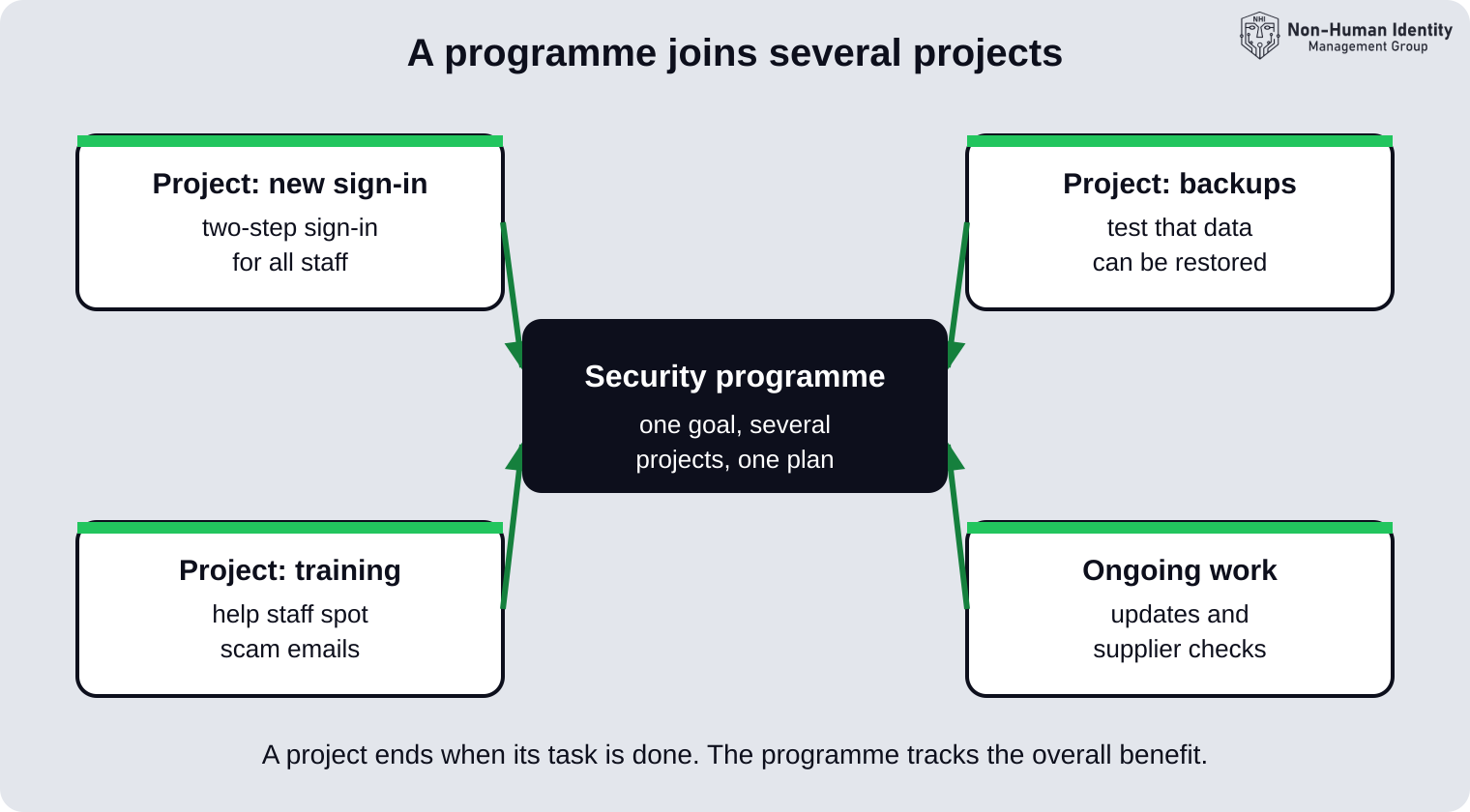
- A security programme manager looks after several linked projects, such as new sign-in, backups and staff training, as one plan.
- They track progress, money and risks, and report to leaders in plain words.
- A project ends when its task is done. A programme keeps going until the overall benefit is delivered.
- Many people move in from project management, IT or security work.
What you will learn
- Explain what a security programme manager does in one sentence.
- Spot the difference between a project and a programme.
- Describe the cycle a programme manager follows.
- Choose a first step if you want to move into the role.
- One piece of work (project)
- a task with a clear start, finish and result, such as setting up new backups.
- A group of linked work (programme)
- several projects and ongoing tasks run together to reach one bigger goal.
- What could go wrong (risk)
- how likely a problem is, and how much it would hurt.
What is a security programme manager?
Think of an orchestra conductor. Each section plays its own part, but the conductor keeps them in time so the whole piece works. A security programme manager does the same for a group of security projects.
In plain words, they run a programme, a set of linked projects and ongoing work aimed at one goal. The goal might be to make the firm much harder to break into this year. That could mean a sign-in project, a backup project and a training project, all at once.
A UK body for project workers says a programme joins projects and everyday work to bring about a useful change. It says the plan is led by the benefits wanted.[1] A security programme manager applies that to security.
Where the comparison stops working: an orchestra plays a piece that is already written. A security programme changes as threats, budgets and teams change. So the programme manager keeps adjusting the plan as they go.
Why does it matter?
Security changes often depend on each other. Training staff on a new sign-in tool is hard if the tool is late. A programme manager spots those links early.
If you are a project manager
What could happen: you run one project well, but it clashes with another team's work.
Check this: list the other projects your work depends on, and who leads them.
If you are a business leader
What could happen: you fund many security projects but cannot tell if the firm is safer.
Check this: ask for one short report that shows progress against the overall goal.
If you are new to security work
What could happen: you see many projects but not how they fit together.
Check this: ask what the security team's main goal is for this year.
What does it look like?
Programme managers often send a short status report to leaders each month. Here is a made-up one.
Example only. All values are made up.
PROGRAMME STATUS  PS-0000 (EXAMPLE)
Goal:     safer sign-in and backups for all sites  (1)
Sign-in:  ON TRACK   8 of 12 sites done            (2)
Backups:  AT RISK    supplier delay, 2 weeks       (3)
Training: ON TRACK   70% of staff finished         (4)
Decision: agree extra budget for backup supplier   (5)
Owner:    FAKE-PROGRAMME-MANAGER
- The shared goal, in plain words, at the top.
- Each project gets one line, with a simple status.
- Problems are shown early, with the reason. In a real file, this line would also name the backup plan.
- Progress is shown with a number leaders can follow.
- A clear ask, so leaders know what they need to decide.
Why this is risky: without a shared report, each project can look fine on its own while the overall goal slips.
The safer way: one regular report shows every project against the same goal, with risks and decisions made clear.
How does it work?
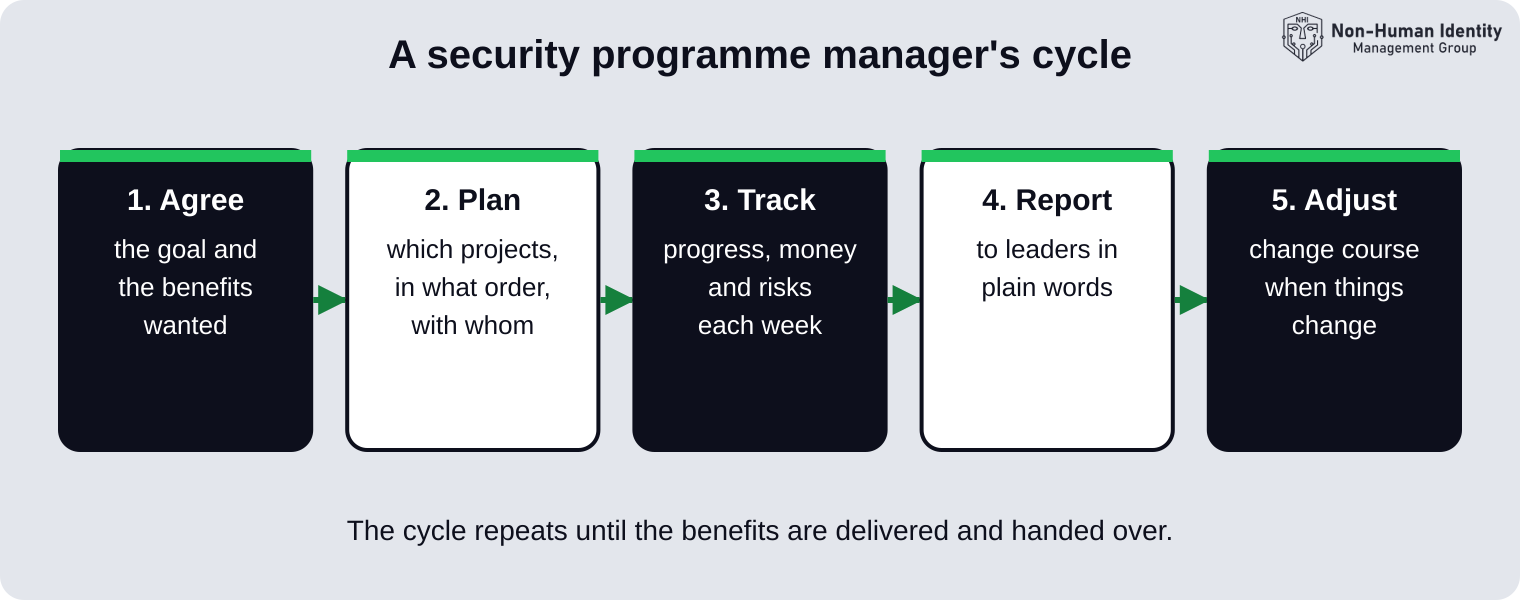
A security programme manager works in a cycle that repeats until the goal is met.
- Agree. Settle the goal and the benefits wanted with leaders and the security team.
- Plan. Choose the projects, put them in order and agree who leads each one.
- Track. Follow progress, money and risks, the things that could go wrong, often in a shared list called a risk register.
- Report. Tell leaders how things stand, in plain words, and ask for decisions.
- Adjust. Change the plan when budgets, people or threats change.
Programme managers often use a published framework to shape the goal. A widely used US framework helps organisations understand and improve how they manage cyber risk.[2] To show progress, they choose measures. A US guide explains how to pick measures that show whether security controls are working.[3]
Skills and tools
Many of these skills come from project management or coordination jobs.
- Planning. Putting work in order and spotting where one task depends on another.
- Tracking risks. Keeping a clear list of what could go wrong, with an owner for each.
- Money and time. Following the budget and the timeline across several teams.
- Security basics. Enough to understand what each project does and why it matters.
- Plain reporting. Short updates that leaders can read in a few minutes.
A worked example
This is a made-up day in the life. Celia Rinaldi is a security programme manager at Alder Dental, a group of twelve dental practices.
Celia's programme has one goal this year: safer sign-in and reliable backups at every practice. It has three projects and some ongoing supplier checks.
She starts by reading weekly updates from the three project leads. Sign-in is going well. The backup project has hit a snag: the supplier will deliver two weeks late. Celia adds this to her risk register and notes who owns it.
Mid-morning, she spots a knock-on effect. Staff training on the new sign-in was planned for the same week as the backup work. The practice managers cannot handle both at once. Celia moves the training back by a week and tells everyone.
After lunch, she meets Bea Marlow, the operations director who sponsors the programme. Celia shows a one-page status report. She asks Bea to agree a small extra budget so the backup supplier can add staff. Bea agrees.
Late afternoon, Celia updates the plan and sends a short note to all project leads. She checked no systems herself today. Her work was keeping three projects in step so the whole goal stays on track.
Myths and mistakes
| What people think | What is true |
|---|---|
| A programme is just a big project. | A programme joins several projects and ongoing work around one goal and its benefits. |
| Programme managers must be technical experts. | They need enough security knowledge to follow the work. Experts lead the detail. |
| Finishing every project means the goal is met. | The programme checks the benefit, such as fewer risky sign-ins, not just tasks done. |
| Bad news should wait until there is a fix. | Raising problems early gives leaders time to decide. |
| Once the plan is agreed, it stays the same. | Plans change as budgets, people and threats change. |
What can I do this week?
- Read three security programme manager job adverts and list what they ask for.
- Draw how two projects you know depend on each other.
- Read the UK definition of programme management listed in the sources below.
- Write a five-line status report for something you are working on.
- Ask someone in a security team what their main goal is this year.
Checklist
- I can explain what a security programme manager does in one sentence.
- I can explain the difference between a project and a programme.
- I can name the five steps of the programme cycle.
- I know what a risk register is for.
- I know why reports should show progress against the overall goal.
- I know the role is about coordination more than technical work.
- I know where to find the practitioner career guide for more detail.
Common questions
How do people become security programme managers?
Many start as project managers and take on larger, linked pieces of work. Others come from IT or security jobs and learn programme skills. Experience of running several teams at once, and of reporting to leaders, tends to matter most.
How is it different from a security project manager?
A project manager runs one piece of work to a finish line. A programme manager runs several linked projects and ongoing work towards one bigger goal. They also check that the goal's benefits are really delivered, not just the tasks.
Do I need a security background?
It helps, but strong coordination skills matter more at first. You need to understand what each project does and why. Many people learn the security side on the job, by working closely with engineers and analysts.
Is it the same as an information security manager?
Not quite. An information security manager usually looks after day-to-day security across a firm. A programme manager runs a set of change projects for a time, until the goal is met. In some smaller firms one person does both.
Is this a good first job?
It is rarely a first job. Most adverts look for experience of running projects. A good first step is a project coordinator or project manager role, ideally on IT or security work.
Where next?
Ready for the detail? Read the practitioner guide: Cybersecurity Programme Manager Career Guide. It goes further into the core skills and tools, certifications and how the career progresses.
Also useful:
- Security Programme Building Guide
- Information Security Manager for Beginners
- NIST Cybersecurity Framework for Beginners
- Cyber Risk Management for Beginners
Related NHI Mgmt Group resources: Cybersecurity Careers Guide · Career Change into Cyber Security Guide · Risk Register Template
Key terms
- Security programme
- A planned set of security projects and ongoing work aimed at one overall goal.
- Risk register
- A shared list of what could go wrong, how likely and serious it is, and who owns it.
- Risk management
- Finding, judging and dealing with risks, so leaders can decide which to reduce or accept.
- Security metrics
- Measures that show whether security work is making a difference.
- Stakeholder alignment
- Getting the people affected by the work to agree on the goal and the plan.
Sources and further reading
- What is programme management? Association for Project Management. https://www.apm.org.uk/resources/what-is-project-management/what-is-programme-management/, accessed 28 Nov 2026.
- Cybersecurity Framework. National Institute of Standards and Technology. https://www.nist.gov/cyberframework, accessed 28 Nov 2026.
- NIST SP 800-55 Vol. 1, Measurement Guide for Information Security: Volume 1, Identifying and Selecting Measures. National Institute of Standards and Technology, December 2024. https://csrc.nist.gov/pubs/sp/800/55/v1/final, accessed 28 Nov 2026.