Connected car security means protecting cars that link to the internet, phones and the maker's servers.
This guide is for drivers, students and anyone buying, selling or renting a modern car. You do not need to know how cars work: if your car has an app, a built-in map or over-the-air updates, it is a connected car.
In short
- Many new cars carry a built-in mobile connection and talk to the maker's servers and your phone.
- Weak points can be in the car, the phone app, the maker's servers or short-range links like Bluetooth.
- Makers fix flaws with software updates, sometimes sent over the air, so install them.
- When you sell or buy a car, remove old app links, reset the screen and set up your own account.
What you will learn
- Explain what makes a car "connected" in one sentence.
- Spot the main ways a connected car can be attacked.
- Check that only you can use your car's app.
- Explain in plain words what EU and US rules ask of car makers.
Status: correct as at 28 November 2026, based on the EU vehicle safety regulation and the US connected vehicles rule. Laws change; check the official text.
This guide explains the topic in general terms and is not legal advice.
- Car's phone line (telematics)
- a built-in box with a SIM card that lets the car send and receive data.
- Update by air (over-the-air update)
- new software sent to the car through its internet link, with no garage visit.
What is connected car security?
Think of a modern car as a smartphone on wheels. It has apps, a mobile data link, a screen and regular software updates.
A connected car has a built-in telematics unit. This is a small box with a SIM card that links the car to the maker's servers. It lets you use a phone app to find, lock or warm up the car. It also lets the maker send updates and collect data about the car.
Inside, the car has many small computers called ECUs (electronic control units). Each one runs a job, such as the brakes, doors or screen. They talk to each other over an internal network.
Connected car security means keeping all of this safe: the car, the app, the servers and the links between them.
Where the comparison stops working: if a phone fails, you lose a call. If a car's systems are misused, it can affect safety, so makers try to keep key driving systems apart from the entertainment screen.
Why does it matter?
A flaw in a car's software can let someone in without permission. In 2015, Fiat Chrysler recalled several Jeep, Dodge, Chrysler and Ram models because their electronic systems might be accessed without permission. The fix was a free radio software update.[4]
If you drive a connected car
What could happen: someone who gets into your car app account may be able to locate or unlock your car.
Check this: use a strong, unique password and extra sign-in checks on the car app.
If you are buying or selling a used car
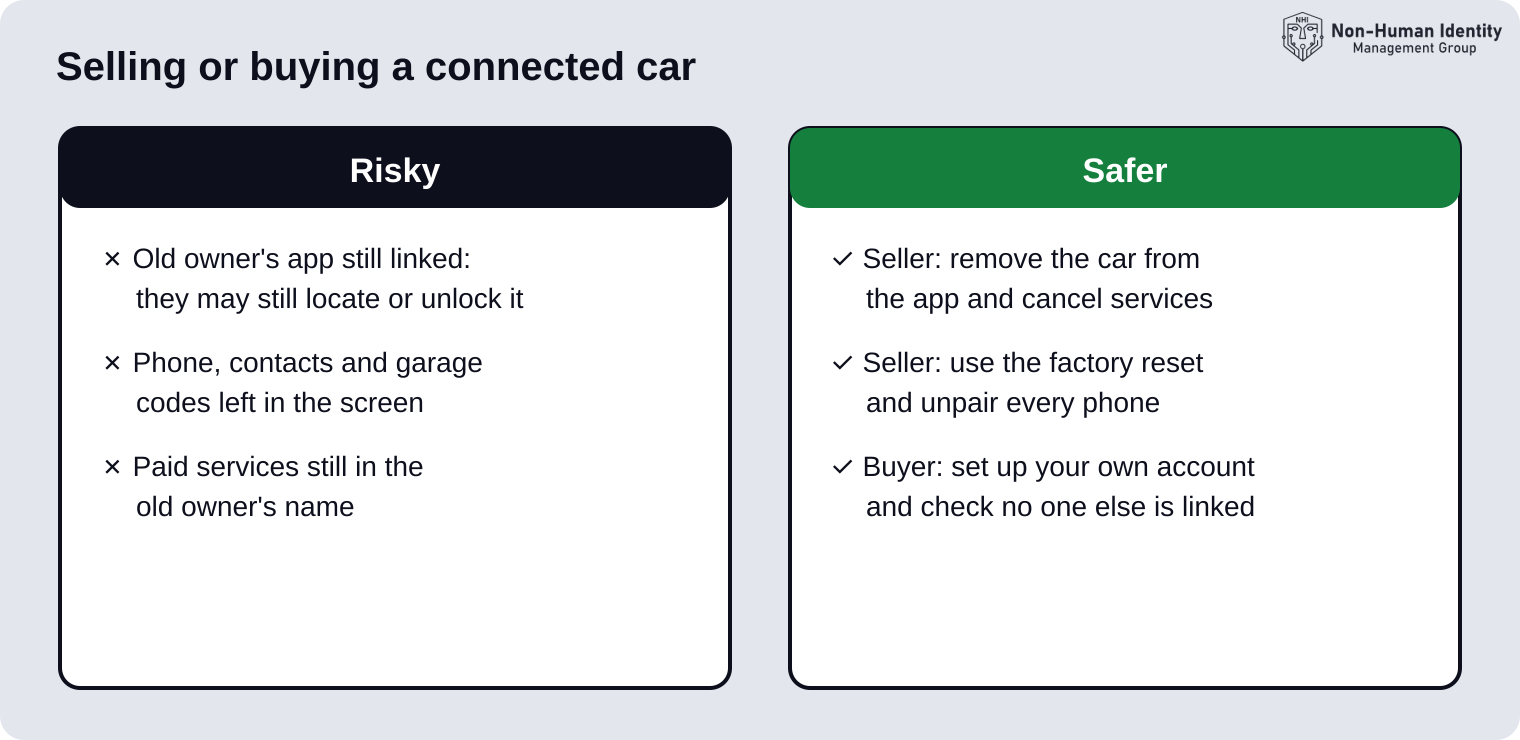
What could happen: the old owner's app is still linked, or your contacts and home address stay in the car.
Check this: remove app links and use the factory reset before handing over the keys.
If you are a student or new to the field
What could happen: you study the car alone and miss that the servers and apps are part of the attack surface.
Check this: draw the whole system, from phone to servers to car, before you look for weak spots.
What does it look like?
Many car apps have a screen showing who can use the car. Here is a made-up one that a new owner might see after buying a used car.
Example only. All values are made up.
My car: Example Motors Model F (FAKE-VIN-0000)
People with access:
  You (primary driver)         added today
  [email protected]        added 2023   (1)
  Guest key: EXAMPLE-0000      no end date  (2)
Paired phones: "Phone 0000"                 (3)
- In a real screen, this line would show the previous owner's account, which may still be able to locate or unlock the car.
- A digital guest key shared with someone in the past, with no end date.
- A phone still paired by Bluetooth that does not belong to you.
Why this is risky: anyone still on this list may keep some control of the car, and the old owner may see where you drive.
The safer way: remove every account, guest key and phone you do not know. If you cannot, ask the dealer or the maker's support team to reset the car's ownership.
How does it work?
Here is how a connected car talks to the outside world, and where things can go wrong.
- You tap a button. Your phone app sends a request, such as "unlock", to the maker's servers over the internet.
- The servers check it. The servers check that your account is allowed to control that car.
- The car gets the command. The servers send the command to the car's telematics unit over the mobile network.
- The car acts. The telematics unit passes the command to the right ECU, which unlocks the doors.
- Updates arrive the same way. The maker can send new software to fix flaws. The car should check that it is genuine before installing it.
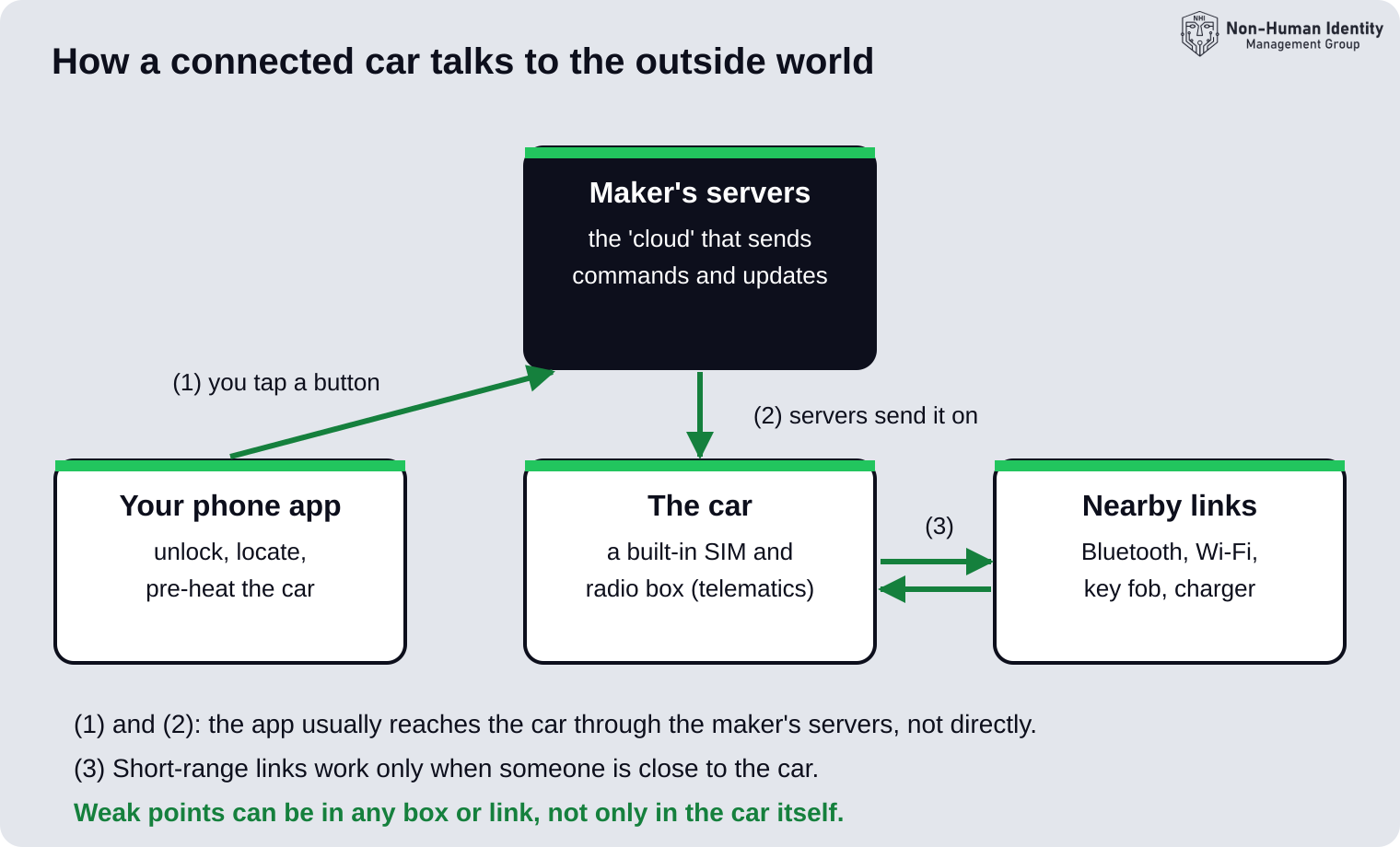
Attackers look for the weakest part. That might be a stolen app password or a flaw in the maker's website. It might be a radio link near the car, or a cable plugged into the car's repair port. Safety agencies look at all the ways in, both wireless and wired.[6] Keyless entry is a separate risk; see our page on keyless car theft.
Rules now ask makers to plan for this. In the EU, new vehicle types must be protected against cyberattacks, a rule that has applied to new type approvals since 6 July 2022.[1] In the US, a rule in force since 17 March 2025 bans some car connection hardware and software linked to China or Russia. The software ban starts with model year 2027 and the hardware ban with model year 2030.[2][3] The US government's stated worry is that such links could be used to take car data or to control cars from afar.[2]
A worked example
Nils Fairweather is buying a used family car from Anil Pajari, a fictional private seller. The car is three years old and has a phone app for locking and finding it.
Before they meet, Nils reads that a car can store a lot of personal data, and that sellers should clear it.[5] He thinks of the car as a second-hand smartphone. You would not buy a phone still signed in to someone else's account.
At the handover, Nils asks Anil to open his car app. Anil removes the car from his account and cancels the paid connection plan. Then they use the factory reset on the car's screen together. Anil's phone, contacts and home address disappear from the screen.
That evening, Nils downloads the app and adds the car. The app shows one extra guest key that Anil had shared with his sister years ago. Nils removes it, and the access list now shows only him.
He sets a strong, unique password and turns on the app's extra sign-in check. He also checks the car's settings and sees that automatic software updates are switched on.
A month later, the car offers an update overnight. Nils lets it install. The notes say it fixes a security flaw in the screen's software.
Myths and mistakes
| What people think | What is true |
|---|---|
| Car hacking is only something from films. | Real flaws have led to recalls that were fixed with software updates.[4] |
| Only the car itself can be attacked. | The phone app, the maker's servers and nearby links are all part of the system. |
| Software updates on a car are optional extras. | Some updates fix security flaws. Install them, or ask a dealer to. |
| Selling the car ends the old owner's access. | App links and guest keys can stay until someone removes them. |
| A factory reset clears everything. | It helps, but you may also need to remove app links and cancel services.[5] |
What can I do this week?
- Open your car app and check who has access, including guest keys.
- Set a strong, unique password and extra sign-in checks on the app.
- Check that automatic software updates are on, or ask your dealer.
- Look for any open recalls on your car on your official recall site.
- Before you sell, plan to reset the car and remove it from your app.
Checklist
- The car app has a strong, unique password and extra sign-in checks.
- Only people you know appear in the app's access list.
- Guest keys have end dates or are removed when no longer needed.
- Software updates are installed when offered.
- Recalls for your car are checked and done.
- Before selling: app removed, services cancelled, factory reset done, phones unpaired.
- After buying: your own account set up and old access removed.
Common questions
Can my car be hacked remotely?
It is possible. Makers have recalled cars over the risk of access without permission and fixed them with software updates. For most drivers, we suggest focusing on two things: protect the car app account well, and install updates when they are offered.
What data does a connected car collect?
It can store a lot about you, such as phone contacts and garage door codes.[5] Many cars can also record where they go and how they are driven. What is collected depends on the maker and model. The maker's privacy notice should say what is shared.
What should I do before selling my car?
Remove the car from your app, cancel or transfer paid services, and use the factory reset on the screen. Unpair your phones and delete garage codes. Then check the screen shows none of your details before you hand over the keys.
Are there laws on car cyber security?
Yes, in some places. The EU requires new vehicle types to be protected against cyberattacks. The US bans some car connection software and hardware linked to China or Russia, from model years 2027 and 2030. This is general information, not legal advice.
Is it safe to plug my phone into a rental car?
It is usually fine to charge, but syncing can copy your contacts and messages into the car. If you sync, delete your phone from the car's screen before you return it. A plain charger or charge-only cable avoids sharing data at all.
Where next?
Ready for the detail? Read the practitioner guide: US Connected Vehicles ICTS Rule Guide. It goes further into who the US rule covers, the declarations car makers must file and the dates and penalties.
Also useful:
- Connected and Autonomous Vehicle Security Guide
- Keyless Car Theft for Beginners
- Connected Car Privacy Guide
- IoT Security for Beginners
Related NHI Mgmt Group resources: Automotive Cybersecurity Guide · Automotive Cybersecurity Regulations Compared · Uptane and Vehicle OTA Security Guide
Key terms
- Telematics
- The system that lets a vehicle send and receive data over a mobile network.
- Electronic control unit (ECU)
- A small computer in a vehicle that controls one job, such as the engine, brakes or doors.
- CAN bus
- The internal network that lets a car's small computers talk to each other.
- Over-the-air update
- New software sent to a device or vehicle through its internet link.
- Relay attack
- A trick where thieves pass a key's signal along so the car thinks the key is nearby.
- Firmware
- Software built into a device's hardware that controls how it works.
Sources and further reading
- Regulation (EU) 2019/2144 on type-approval requirements for motor vehicles (General Safety Regulation), Article 4(5)(d) and Annex II, row D4 "Protection of vehicle against cyberattacks". Official Journal of the European Union, 16 December 2019. https://eur-lex.europa.eu/legal-content/EN/TXT/HTML/?uri=CELEX:32019R2144, accessed 28 Nov 2026.
- Securing the Information and Communications Technology and Services Supply Chain: Connected Vehicles, final rule, 90 FR 5360. Bureau of Industry and Security, US Department of Commerce, Federal Register, 16 January 2025. https://www.federalregister.gov/documents/2025/01/16/2025-00592/securing-the-information-and-communications-technology-and-services-supply-chain-connected-vehicles, accessed 28 Nov 2026.
- 15 CFR part 791 subpart D, Connected Vehicles, section 791.308 Exemptions. Electronic Code of Federal Regulations. https://www.ecfr.gov/current/title-15/subtitle-B/chapter-VII/subchapter-E/part-791/subpart-D, accessed 28 Nov 2026.
- Recall 15V-461, owner notification letter: radio software update. FCA US LLC, filed with the National Highway Traffic Safety Administration, 2015. https://static.nhtsa.gov/odi/rcl/2015/RIONL-15V461-0202.pdf, accessed 28 Nov 2026.
- Selling your car? Clear your personal data first. Consumer Advice, US Federal Trade Commission, August 2018. https://consumer.ftc.gov/blog/2018/08/selling-your-car-clear-your-personal-data-first, accessed 28 Nov 2026.
- Vehicle Cybersecurity. National Highway Traffic Safety Administration. https://www.nhtsa.gov/research/vehicle-cybersecurity, accessed 28 Nov 2026.