MITRE CAPEC is a free public catalogue that describes the common ways attackers exploit weaknesses in software.
This guide is for students, new developers and testers who have seen CAPEC mentioned and want to know what it is for. You do not need to be an expert to use it: if your team builds or tests software, CAPEC can help you think like an attacker before one finds the gap.
In short
- CAPEC lists attack patterns: the repeatable methods attackers use, such as tricking a database with crafted input.
- Each entry explains how the attack works, what it needs, the harm it can cause and how to defend against it.
- Entries link to CWE, MITRE's list of the software weaknesses those attacks exploit.
- Teams use CAPEC when planning defences, training developers and planning security tests.
What you will learn
- Explain what an attack pattern is in one sentence.
- Read the main parts of a CAPEC entry.
- Explain how CAPEC differs from CWE, CVE and ATT&CK.
- Use CAPEC to ask better questions about your own software.
- Known attacker method (attack pattern)
- a description of a repeatable way attackers exploit a type of weakness.
- Weak spot in software (weakness)
- a kind of mistake in design or code that could let an attack work.
What is MITRE CAPEC?
Think of a police leaflet on how burglars get into homes. It does not describe one break-in. It lists the usual tricks, such as climbing through an open window, and how to stop each one.
CAPEC does this for software. The name stands for Common Attack Pattern Enumeration and Classification. It is run by MITRE, a not-for-profit organisation, and was first released in 2007 with backing from the US Department of Homeland Security.[1] Each entry is an attack pattern: a common method attackers use to exploit a type of weakness. The catalogue lists 559 patterns in its current version.[2]
Where the comparison stops working: a burglary leaflet is short and fixed. CAPEC is large, linked to other catalogues and updated over time. You use it as a reference you dip into, not a leaflet you read once.
Why does it matter?
Most attacks reuse a small number of methods. If you know the methods, you can check your software for them before it goes live. CAPEC gives teams a shared name and description for each method.
If you are studying security
What could happen: you learn attacks one by one and miss the patterns that connect them.
Check this: pick one attack you know and read its CAPEC entry end to end.
If you build software
What could happen: a feature ships with an input box that an attacker can abuse in a well-known way.
Check this: during design, ask which attack patterns apply to each new feature.
If you plan security tests
What could happen: tests cover only the attacks the tester happens to remember.
Check this: use CAPEC as a menu of methods to try against the parts that matter most.
What does it look like?
Here is a short, made-up entry in the CAPEC style. Real entries have more sections, but these are the main ones.
Example only. All values are made up.
CAPEC-0000 (EXAMPLE): Tricking a search box     (1)
Level:          Standard                         (2)
Likelihood:     High   Severity: High
Prerequisites:  the app passes typed text
                straight to its database          (3)
Mitigations:    check input, use safe queries     (4)
Related weakness: a CWE entry (EXAMPLE)           (5)
- Each pattern has a number and a plain name. In a real file, this line would carry an official CAPEC number.
- The level shows how general the pattern is, from broad to very specific.
- Prerequisites say what must be true for the attack to work.
- Mitigations are the defences that make the attack fail or harder.
- Each pattern links to the weaknesses it exploits in CWE.
Why this is risky: if your app matches the prerequisites, the attack may work against it. Teams that never check often find out only after an attack.
The safer way: match each feature to its likely patterns, then check the listed defences are in place. Look up patterns during design and testing, not only after an incident. A real entry, such as the one for SQL injection, has the same main parts.[3]
How does it work?
CAPEC sorts patterns in a few simple ways, so you can find what you need.
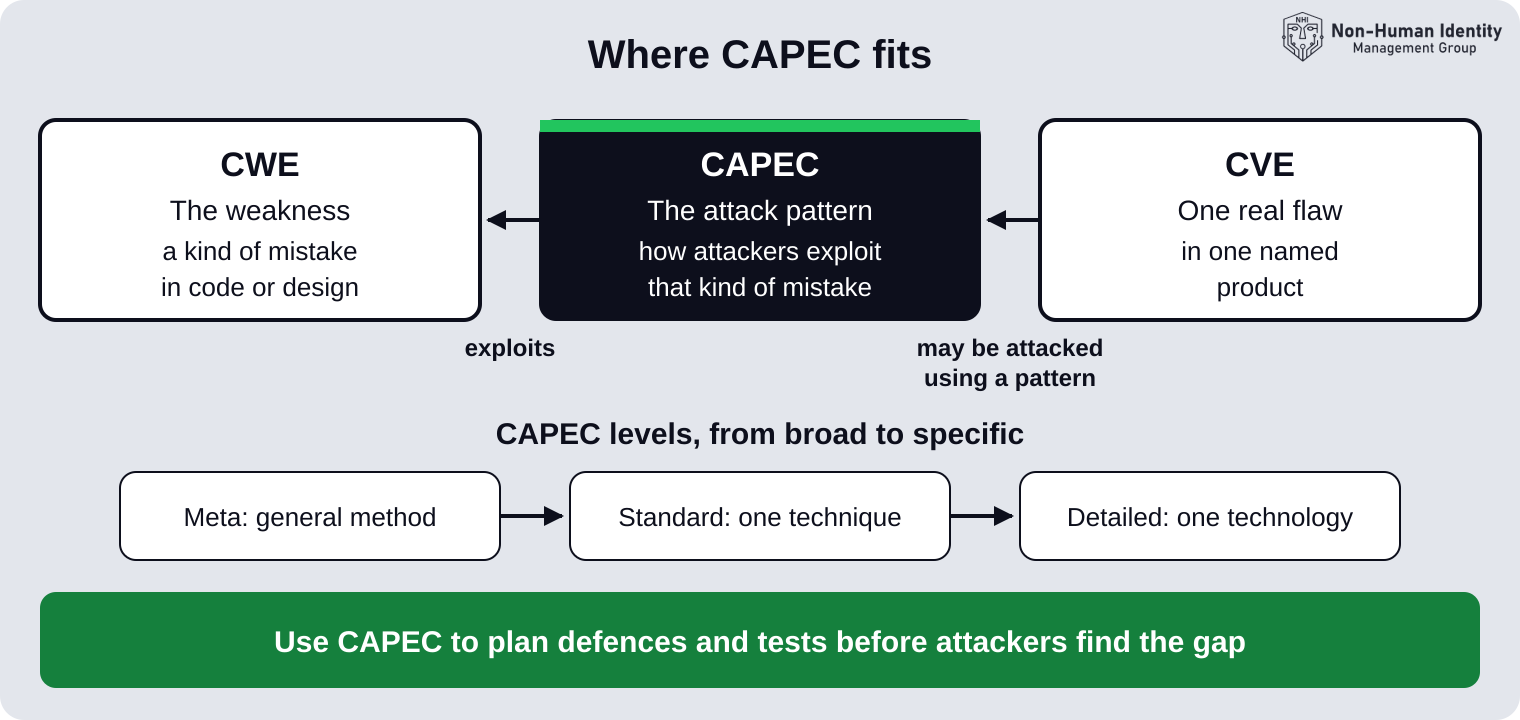
- Levels. Broad patterns, called meta patterns, describe a general method. Standard patterns describe one technique. Detailed patterns describe a technique against a specific technology.[4]
- Views. A view groups patterns by one angle. One view sorts them by how the attack works. Another sorts them by what is attacked, such as software or people.[2]
- Links to weaknesses. Each pattern points to the CWE weaknesses it exploits, so you can go from "how they attack" to "what mistake to fix".[3]
- Links to ATT&CK. Some patterns point to MITRE ATT&CK, which tracks what attackers do inside a network. CAPEC focuses more on applications.[5]
A worked example
Lina Zamora is a computing student on a placement at Sorrel Accountants. The firm is adding a page where clients can upload documents and search their files. Amara Jovanovic, the developer leading the work, asks Lina to help plan the security tests.
Lina starts with the features, not the tools. The page has a search box, a file upload and a login. For each one she looks up CAPEC patterns that fit. For the search box she finds the pattern for tricking a database with crafted input. For the login she finds patterns for guessing passwords. For the upload she finds patterns about sending harmful files.
For each pattern she reads the prerequisites. The search box sends text to the database, so the first pattern may apply. She notes the suggested defences, such as checking input and using safe database queries.
She then follows the links to CWE. This gives Amara a short list of mistakes to check in the code review.
Lina writes a one-page test plan. Each line names the feature, the attack pattern, what to test and the defence that should stop it. Amara adds two items Lina missed and keeps the plan for the next release.
Lina notices one limit. CAPEC told her what to look for. It did not tell her whether this app is safe. Only the tests and the review can do that.
Myths and mistakes
| What people think | What is true |
|---|---|
| CAPEC is a list of known bugs in products. | That is CVE. CAPEC describes attack methods, not specific bugs.[1] |
| CAPEC and ATT&CK are the same thing. | They overlap. CAPEC focuses on how applications are attacked. ATT&CK focuses on what attackers do in a network.[5] |
| CAPEC is a how-to for attackers. | Entries describe methods at a level that helps defenders, with defences for each one.[3] |
| You need to read all of CAPEC. | Start from your own features and look up only the patterns that fit them. |
| If no pattern fits, the feature is safe. | CAPEC is a guide, not a full list of every possible attack. Testing is still needed. |
What can I do this week?
- Open the CAPEC website and read the entry for one attack you already know.
- List the inputs in one app you work on, such as forms, uploads and logins.
- Find one attack pattern for each input.
- Follow each pattern's link to CWE and note the mistake it exploits.
- Share the list with your team as a starting point for tests.
Checklist
- I can explain what an attack pattern is.
- I know how CAPEC differs from CVE and CWE.
- I know how CAPEC differs from ATT&CK.
- Our main features have been matched to likely attack patterns.
- Each matched pattern has a defence we have checked.
- Our security tests cover the patterns that matter most.
Common questions
Is CAPEC free to use?
Yes. CAPEC is a free, public catalogue published by MITRE on its own website. Anyone can read the entries online or download the full list. Many security tools and other catalogues refer to CAPEC numbers, so learning to read an entry is a useful skill.
What is the difference between CAPEC, CWE and CVE?
CWE lists kinds of mistakes in software. CAPEC lists the methods attackers use to exploit those mistakes. CVE lists specific flaws found in named products. Put simply: the mistake, the method and the real case.
Who uses CAPEC?
Developers, testers and security teams. MITRE names three common uses: planning defences during design (threat modelling), training developers and planning penetration tests.[5] Students also use it to learn how attacks are grouped.
Do I need to remember CAPEC numbers?
No. The numbers help tools and reports refer to the same pattern, but the names and descriptions matter more. Look up the number when you need it, and talk about the attack in plain words with your team.
Where next?
Ready for the detail? Read the practitioner guide: CVE vs CWE vs CAPEC. It goes further into how the three catalogues chain together, when to reach for each one and how to use CAPEC in threat modelling.
Also useful:
- CAPEC-90 Reflection Attack in Authentication Protocol
- CWE for Beginners
- CVE and CVSS for Beginners
- MITRE ATT&CK for Beginners
Related NHI Mgmt Group resources: Threat Modelling Guide · CWE Top 25 Guide · CAPEC-151 Identity Spoofing
Key terms
- Attack pattern
- A description of a common approach attackers use to exploit a type of weakness.
- CAPEC
- MITRE's free public catalogue of attack patterns, short for Common Attack Pattern Enumeration and Classification.
- CWE
- MITRE's public list of kinds of weaknesses in software and hardware.
- CVE
- A public ID for one specific, known security flaw in a named product.
- MITRE ATT&CK
- A public knowledge base of attacker tactics and techniques seen in real attacks.
- Threat modelling
- Thinking through how a system could be attacked, so defences can be planned early.
Sources and further reading
- About CAPEC. The MITRE Corporation. https://capec.mitre.org/about/index.html, accessed 28 Nov 2026.
- CAPEC List (version 3.9). The MITRE Corporation. https://capec.mitre.org/data/index.html, accessed 28 Nov 2026.
- CAPEC-66: SQL Injection. The MITRE Corporation. https://capec.mitre.org/data/definitions/66.html, accessed 28 Nov 2026.
- CAPEC Glossary. The MITRE Corporation. https://capec.mitre.org/about/glossary.html, accessed 28 Nov 2026.
- ATT&CK Comparison. CAPEC, The MITRE Corporation. https://capec.mitre.org/about/attack_comparison.html, accessed 28 Nov 2026.