The Cyber Assessment Framework (CAF) is a UK guide for judging how well vital services resist cyber attacks.
This guide is for staff, managers and students who have heard "we are doing a CAF assessment" and want to know what it means. It is written for people in the NHS, government, energy, water and transport, and anyone curious. You do not need a technical background: a CAF assessment looks at people and processes as well as computers.
In short
- The CAF is made by the UK's National Cyber Security Centre (NCSC). It helps check how well important services are protected.
- It describes good results to reach, not a list of tools to buy.
- Each result is judged as Achieved, Partially achieved or Not achieved, based on evidence.
- Regulators, government and the NHS each set their own target levels, called profiles.
What you will learn
- Explain what the CAF is and who uses it.
- Describe the four big areas it looks at.
- Spot the difference between a rating and a target profile.
- Check what part you might play in an assessment at work.
Status: correct as at 28 November 2026, based on the NCSC Cyber Assessment Framework version 4.0 and the NCSC CAF collection page. Frameworks and rules change; check the official text.
This guide explains the topic in general terms and is not legal advice.
- Wanted result (outcome)
- a good state the organisation should reach, such as "only the right people can get in".
- Target level (profile)
- the grade an organisation is expected to reach for each wanted result.
- Vital service (essential function)
- a service people rely on, such as power, water, health care or transport.
What is the Cyber Assessment Framework?
Think of a school report. Each subject gets a grade, and the teacher bases it on the work the pupil has shown. Different schools may set different target grades.
The CAF works in a similar way for cyber security. It is a structured way to judge how well an organisation protects the services people depend on. It looks at results, not shopping lists. It does not say "buy this tool". It asks whether the organisation has reached a good result, and what evidence shows it.[1]
The CAF was first built to support regulators who oversee vital services. Any organisation that wants a clear, results-based way to look at its cyber risk can use it too.[1] It is not a certificate you can pass and hang on the wall.
Where the comparison stops working: a school report covers one pupil. A CAF assessment usually covers the systems behind one or more vital services, and many people help gather the evidence.
Why does it matter?
A cyber attack on a hospital, water works or rail network can affect thousands of people. The CAF gives these services and their regulators one shared way to check their protections.
If you work in the NHS
What could happen: your trust's yearly security return uses CAF-style results. Gaps in your area can hold back the whole return.
Check this: ask who leads the security return and what proof they need from your team.
If you manage a team in an essential service
What could happen: an assessor asks how your team controls access, and nobody can show the records.
Check this: know where your team's access lists, training records and incident plans are kept.
If you are new to a security or audit job
What could happen: you treat the CAF as a tick-box list and miss whether the result is really met.
Check this: for each result, ask "what evidence shows this is true today?"
What does it look like?
Here is a made-up scenario card. It is in the style of one CAF result about who can get into systems. It is simplified for learning.
Example only. All values are made up.
Wanted result: only the right people and devices get in   (1)
System: EXAMPLE-WATER-CONTROL (made-up)

Good sign:  second login check used for all staff,
            including remote access                        (2)
Warning:    two old accounts of staff who left in 2020     (3)
Evidence:   access list dated 01/01/0000, sign-in report   (4)
Rating:     Partially achieved                             (5)
Target:     Achieved (set by the profile)                  (6)
- The result the organisation is trying to reach.
- A sign of good practice. The CAF lists signs like this for each result.[2]
- A sign that something is wrong. In a real file, this line would contain the findings from the access check.
- The proof the assessor looked at.
- The judgement, made by a person weighing the evidence.
- The level this system is expected to reach.
Why this is risky: old accounts that still work are a way in. A former worker could use one. So could anyone who has the password.
The safer way: remove the old accounts and record the fix. Then check regularly, so the next assessment can show the result is met.
How does it work?
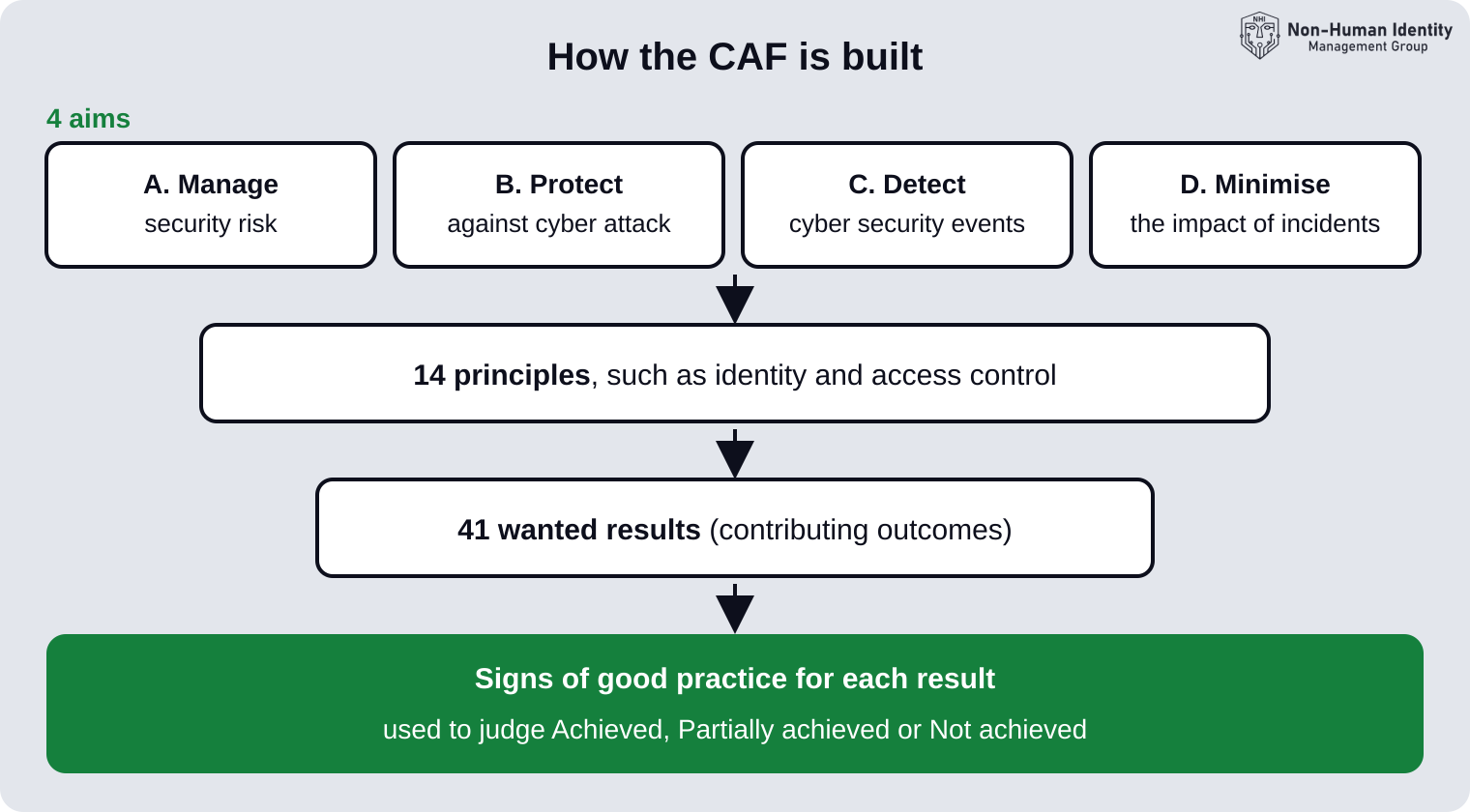
The CAF is built in layers, a bit like chapters, sections and questions in a workbook.
- Four big aims. Managing security risk, protecting against cyber attack, detecting cyber security events and keeping the damage from incidents small.[1]
- Fourteen principles. Each aim is split into principles, such as identity and access control or staff awareness and training. Version 4.0 has 14 principles.[2]
- Wanted results. The principles are split into 41 wanted results, called contributing outcomes in the official text.[2]
- Signs of good practice. Each result has lists of signs for each rating. They help the assessor's judgement. The NCSC says they are not a checklist to apply rigidly.[2]
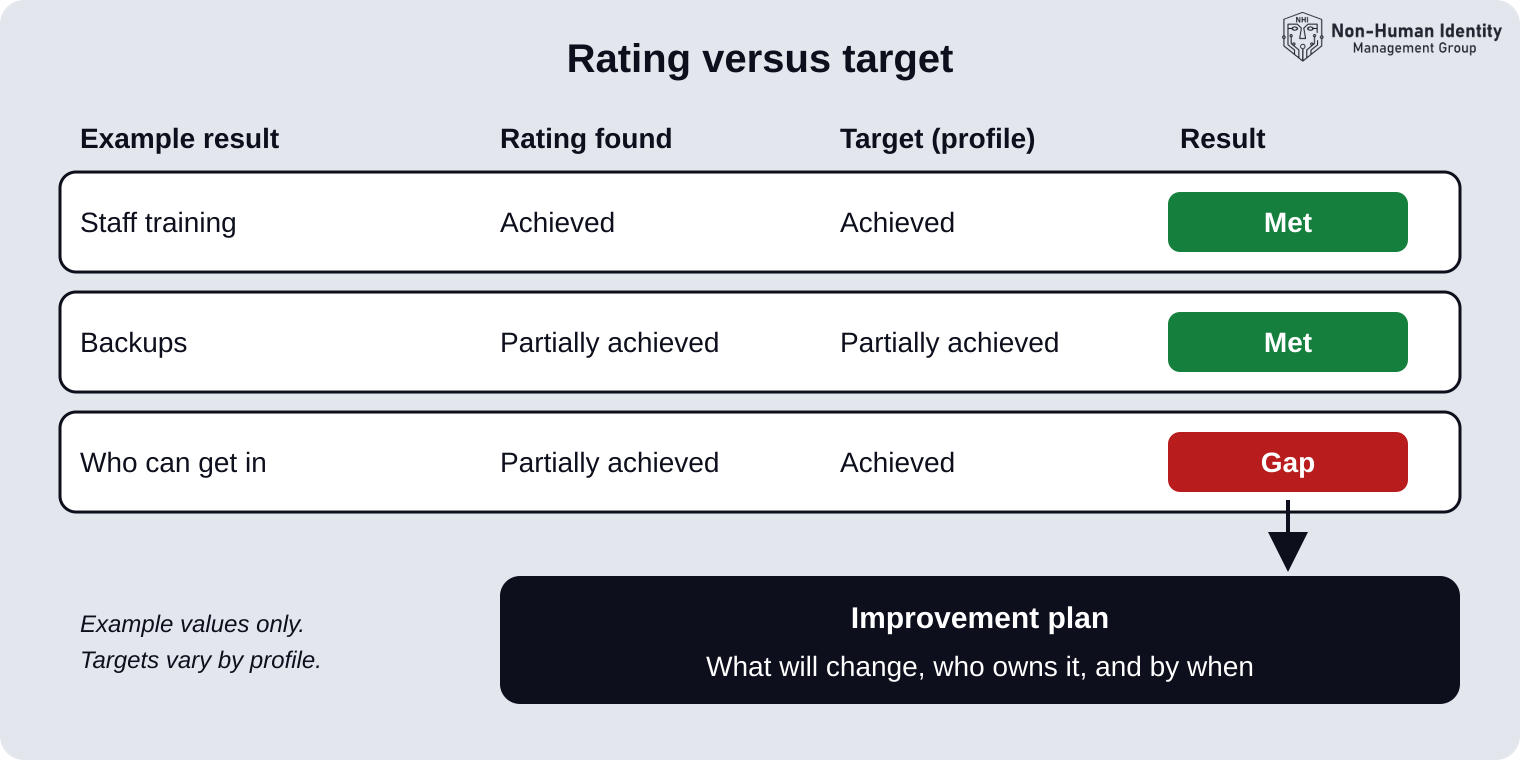
- A rating. Each result is judged Achieved, Partially achieved or Not achieved, based on evidence and expert judgement.[2]
- A target. A profile sets the minimum level expected for each result. Profiles are linked to the threat the organisation faces.[1]
Different groups use the CAF with their own targets. UK government uses it in a process called GovAssure. There, critical systems get a Baseline profile, and systems facing more skilled attackers get an Enhanced one.[3] The NHS security return for large NHS bodies moved to a CAF-based approach for 2024-25, with its own set of results and target levels.[4] It is also used in sectors covered by the UK's 2018 rules for vital services. These include energy, water, transport, health care and digital services.[1][5]
A worked example
Talia Falk has just joined a fictional regional water company as an IT officer. Her manager, Dario Strand, tells her the company's yearly CAF self-assessment starts next month.
Talia expected a long checklist. Instead, Dario shows her a list of wanted results. Next to each one is a column for evidence and a column for the rating.
She remembers the school report. A grade means little without the work behind it. So for her part, identity and access control, she starts with evidence. She gathers the list of who can log in to the system that controls the pumps. She also pulls the latest sign-in report.
The list holds a surprise. Two accounts belong to engineers who left some years ago. Both accounts still work. Talia shows Dario. They agree the honest rating for this result is Partially achieved, because a second login check is in place, but old accounts remain.
Dario checks the target profile. For this system, the target is Achieved, so there is a gap. Talia switches off the two accounts that week. Then they write a short plan: an owner, a date and a monthly check of leavers against the access list.
At the review, the assessor asks to see the monthly check working. Talia shows the first two months of records. The assessor notes the improvement, and the company's plan for the next year starts from a clearer picture.
Myths and mistakes
| What people think | What is true |
|---|---|
| The CAF is a checklist of tools to buy. | It describes results to reach. It does not name products or technologies.[1] |
| Passing the CAF gives you a certificate. | The CAF is not a certification scheme. It is a way to assess and improve.[1] |
| Everyone has to reach Achieved on every result. | The profile sets the target for each result, and it differs between groups and systems.[3] |
| It is only about IT. | It also covers risk management, staff training, supply chains and recovery plans.[2] |
| A high rating means we cannot be hacked. | Meeting a target lowers risk. Government guidance says even the higher profile does not make a system impenetrable to advanced state attackers.[3] |
What can I do this week?
- Ask whether your organisation uses the CAF, and which profile applies to your systems.
- Find out who leads the assessment and what evidence they may need from you.
- Read the four aims and 14 principles on the NCSC website.
- Pick one result linked to your job and ask "what proof shows this is true today?"
Checklist
- We know whether the CAF applies to us, and through which regulator or programme.
- We know which systems support our vital services.
- We know which profile, or target level, applies to each of those systems.
- Each wanted result has an owner.
- Evidence is stored where the assessment team can find it.
- Ratings are honest, and backed by evidence rather than hope.
- Each gap has an improvement plan with an owner and a date.
- We check which CAF version our regulator or programme uses.
Common questions
Who has to use the CAF?
Mainly organisations that run vital services. Many of their regulators use it. UK government uses it for critical systems. Large NHS bodies use a CAF-based security return. Other organisations can choose to use it. Ask your regulator or security lead which applies to you.
Is the CAF the same as Cyber Essentials?
No. Cyber Essentials is a short certification covering a set of basic technical controls. The CAF is a much broader, results-based way to assess the protection of vital services. It has no certificate. See Cyber Essentials for Beginners for the other scheme.
What does Partially achieved mean?
It means some good practice is in place. It gives real security benefit, but the full result is not yet met. Not every result has this middle rating. Some can only be Achieved or Not achieved.
What is a CAF profile?
A profile is the set of target levels for each result. It shows what "good enough" means for a system. It is based on the threats the system faces. Government, the NHS and regulators each set their own profiles, so targets can differ between organisations.
Which version of the CAF is current?
Version 4.0, published by the NCSC in April 2024, is the latest version as at November 2026. Regulators and programmes may move to a new version at different times. Always check which version your assessment uses.
Where next?
Ready for the detail? Read the practitioner guide: NCSC Cyber Assessment Framework (CAF) Guide. It goes further into the full list of principles, what changed in version 4.0, how each UK regime applies profiles and how to run an assessment.
Also useful:
- NCSC CAF Self-Assessment Workbook
- UK NIS Regulations 2018 Guide
- NHS Data Security and Protection Toolkit
- NIS2 for Beginners
- Cyber Essentials for Beginners
Related NHI Mgmt Group resources: UK Cyber Security and Resilience Bill Guide · Cyber Resilience Guide · Healthcare Identity Security Guide
Key terms
- Cyber Assessment Framework (CAF)
- The NCSC's results-based way to judge how well vital services resist and recover from cyber attacks.
- Contributing outcome
- One of the 41 wanted results in CAF version 4.0 that an organisation is judged against.
- Indicators of good practice
- Signs listed under each result that help an assessor decide the rating.
- CAF profile
- The target level set for each result, based on the threats a system faces.
- Essential function
- A service people rely on, such as health care, power or water, whose loss would cause serious harm.
- NIS Regulations
- The UK's 2018 rules on the security of network and information systems behind vital services.
- The regulator that oversees cyber security for a sector under the NIS Regulations.
Sources and further reading
- Cyber Assessment Framework. National Cyber Security Centre (NCSC), version 4.0, 18 April 2024. https://www.ncsc.gov.uk/collection/cyber-assessment-framework, accessed 28 Nov 2026.
- Cyber Assessment Framework 4.0 (PDF). National Cyber Security Centre (NCSC), 2024. https://www.ncsc.gov.uk/files/NCSC-Cyber-Assessment-Framework-4.0.pdf, accessed 28 Nov 2026.
- GovAssure stage 2: in-scope systems and assigning a target CAF profile. GOV.UK Security, Cabinet Office. https://www.security.gov.uk/policy-and-guidance/stage-2-in-scope-systems-and-assigning-target-caf-profile, accessed 28 Nov 2026.
- Data Security and Protection Toolkit news: move to the Cyber Assessment Framework for 2024-25. NHS England. https://www.dsptoolkit.nhs.uk/News/154, accessed 28 Nov 2026.
- The Network and Information Systems Regulations 2018 (SI 2018/506). legislation.gov.uk. https://www.legislation.gov.uk/uksi/2018/506/contents, accessed 28 Nov 2026.