NERC CIP is a set of mandatory cyber security rules for the companies that run North America's power grid.
This guide is for anyone new to the power sector or working with a utility. Suppliers and IT staff at power companies often have to follow these rules too.
In short
- NERC CIP is a family of security rules for the big power system that moves electricity across most of the US and Canada.
- In the US the rules are mandatory, and companies can be fined for breaking them.
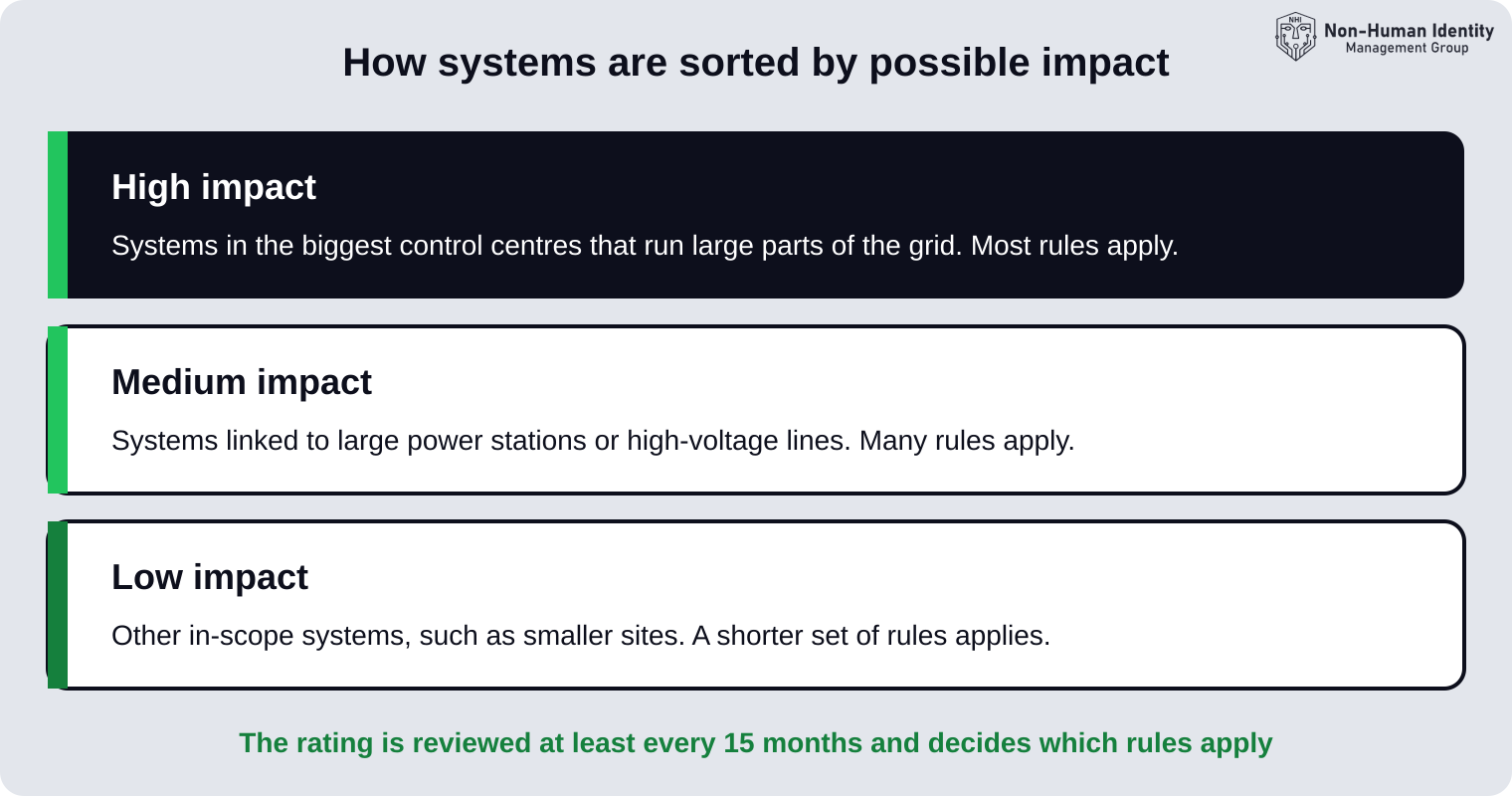
- Each company sorts its computer systems into high, medium or low impact, and that decides which rules apply.
- Much of the work is about proof: who has access, what changed and when, written down so an auditor can check it.
What you will learn
- Explain what NERC CIP is and who has to follow it.
- Spot whether your job or company is likely to be in scope.
- Explain the high, medium and low impact sorting.
- Ask the right first questions if you start working with a utility.
Status: correct as at 28 November 2026, from NERC and FERC sources. Rules change, so check the official text. This guide is general and is not legal advice.
- The main power network (bulk electric system)
- the large power stations and high-voltage lines that move electricity over long distances.
- Grid rule writer (NERC)
- the North American Electric Reliability Corporation, the body that writes reliability rules for the power grid.
- Grid security rules (CIP)
- short for Critical Infrastructure Protection, the part of NERC's rules that covers cyber and physical security.
What is NERC CIP?
Think of the safety rulebook that every airline must follow. Inspectors check it, and an airline that breaks it can be fined. NERC CIP plays a similar part for the computers that keep the lights on.
A body called NERC writes rules to keep the power grid running. Its full name is the North American Electric Reliability Corporation. One group of its rules is called CIP, short for Critical Infrastructure Protection. CIP covers the security of the computers that run the grid.
The rules apply to the main power network, called the bulk electric system. That means firms that own or run big power stations, high-voltage lines and the control rooms that keep supply and demand in balance.[2]
NERC covers most of the US. It also has duties in Canada and in part of northern Mexico.[1]
Where the comparison stops working: an airline rulebook is checked one firm at a time. The grid is joined up, so one firm's weak spot can hurt its neighbours too.
Why does it matter?
When the grid fails, homes, hospitals and businesses lose power. In the US, NERC's rules became mandatory after a large blackout in 2003, and penalties can be over $1 million per day for each violation.[1]
If you are new to a power company
What could happen: you share a login or skip a training step, and your company has to report a rule breach.
Check this: ask which systems you can reach and which security training you must finish first.
If you supply a utility
What could happen: your remote access into a plant becomes a way in for attackers.
Check this: expect the utility to control, record and be able to cut off your remote sessions.
Next: NERC CIP-013
If you work in IT at a utility
What could happen: a quick change to a firewall or server is not recorded, and an auditor finds the gap.
Check this: find out which systems are in scope before you touch them.
What does it look like?
Here is a made-up "Am I affected?" card that a new starter might fill in.
Example only. All values are made up.
Company:  EXAMPLE Power Co-op (fictional)
[x] Owns or runs power stations or high-voltage lines  (1)
[x] Registered with NERC for one or more roles          (2)
[x] Has computer systems that control the grid         (3)
[ ] Rating of each system: high / medium / low          (4)
[ ] Remote access by suppliers: who, how, can we stop it (5)
Next review due: 0000-00-00                              (6)
- The rules are for firms that run parts of the main power network.
- NERC keeps a register of these companies and the roles they play.
- The rules cover the computers that run or watch the grid.
- Each system gets a rating. The rating decides which rules apply.
- The rules look closely at how suppliers log in from outside.
- The ratings must be reviewed on a regular cycle.
Why this is risky: a company that does not know which systems are in scope cannot show that it follows the right rules.
The safer way: keep an up-to-date list of systems and their ratings. Give each one an owner. Check the list whenever something changes.
How does it work?
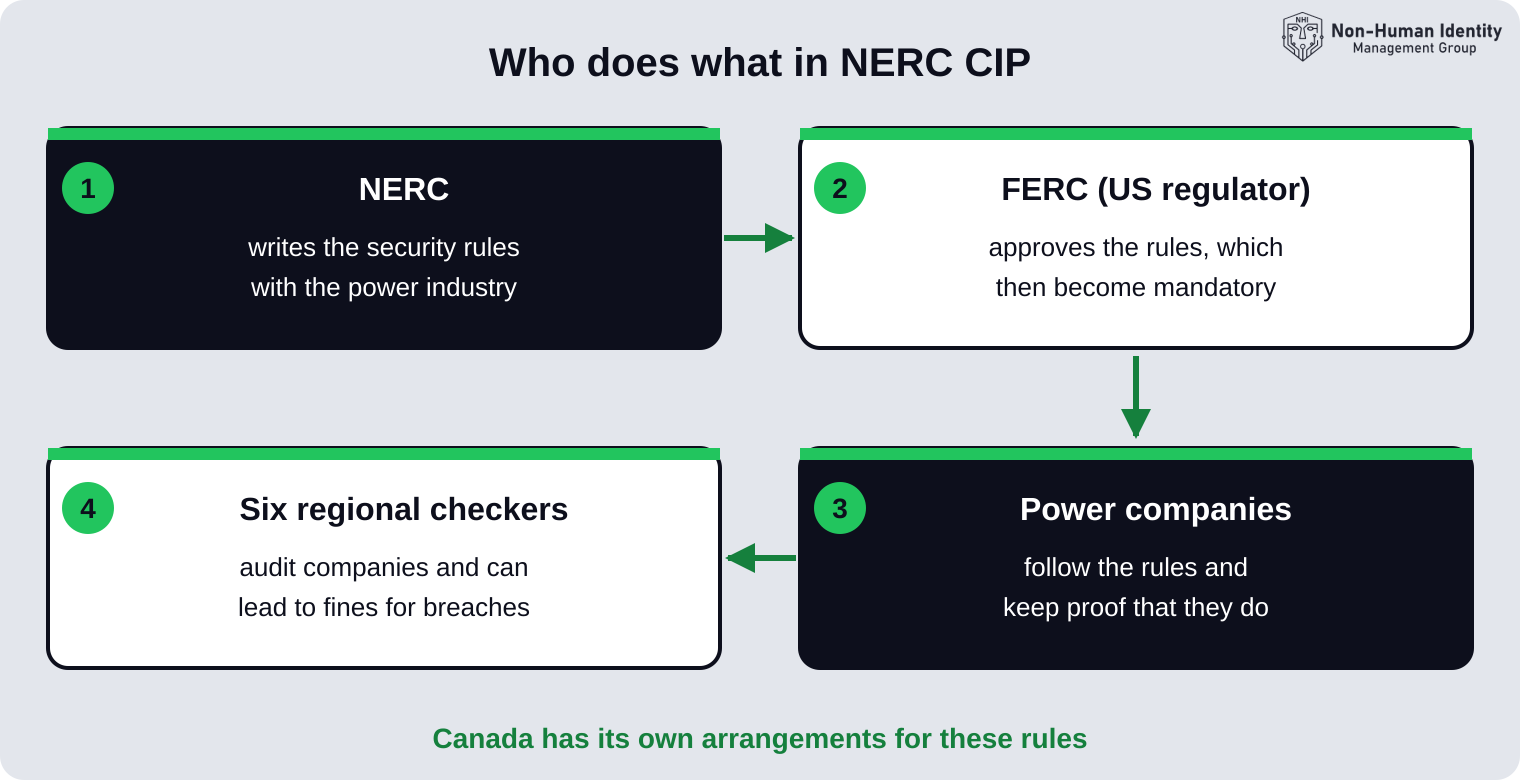
- NERC writes the rules. It works with the power industry to draft each rule. In the US, a rule only takes effect after the federal energy regulator, FERC, approves it.[1]
- Companies sort their systems. Each company lists the computer systems that could quickly harm the grid if they failed or were misused. It rates each one high, medium or low impact.[2]
- The rating decides the rules. High impact systems carry the most rules. Low impact systems carry a shorter set.[2]
- Companies run the controls and keep proof. Even the shorter low impact list is broad. It covers staff awareness, locks and doors, network access and incident plans. It also covers USB drives, visiting laptops and supplier remote access.[3]
- Checkers audit them. Six regional bodies check compliance for NERC. Breaches can lead to fines.[1][5]
The sorting step matters most. A system counts if losing it, or someone misusing it, could harm the grid within 15 minutes.[2] Companies must review their ratings at least every 15 calendar months.[2]
The rules keep changing. Newer ones add checks on supplier remote access at smaller sites and ask for closer watching of traffic inside protected networks.[3][4]
A worked example
This story is made up to show how it can happen.
Leilani Kahale has just joined a small electricity co-operative in the US Midwest as a compliance coordinator. The co-op runs a control room and several substations, the sites where power lines meet and voltages change.
In her first week, an engineer asks her to approve remote access for a supplier. The supplier wants to update software on equipment at one substation.
Leilani does not say yes straight away. First she checks the system list. The substation's control equipment is rated low impact. She reads the co-op's plan for supplier remote access at low impact sites.
The plan says three things. The co-op must be able to see when the supplier is connected. It must be able to cut the session off. It must also watch for signs of harmful traffic.[3]
She checks with the network team. The supplier will connect through a gateway that records each session and can end it at once. Leilani approves the access for a set time window and saves the approval with the date.
Six months later, the regional checker audits the co-op. The auditor asks how supplier access is controlled at low impact sites. Leilani shows the plan, the approval and the session records.
What made the difference: Leilani treated the request as a rule question, not just a technical one, and she kept dated proof as she went.
Myths and mistakes
| What people think | What is true |
|---|---|
| NERC CIP covers every power company. | It covers the main power network. Small local distribution networks are mostly out of scope, apart from some protection equipment.[3] |
| Low impact means no rules. | Low impact systems have a shorter list, but it still covers plans, training, access and supplier remote access.[3] |
| If our controls work, we are compliant. | Auditors also need proof. Dated records of who did what are a big part of the work. |
| NERC CIP is the same as a general security standard. | It is written for the grid and is often more specific, with fixed review cycles and named roles. |
| Ratings are done once. | They must be reviewed at least every 15 calendar months, and changes to a site can move a system up a level.[2] |
What can I do this week?
- Ask whether your company or client is registered with NERC, and for which roles.
- Find out which systems you work on are in scope, and at which impact level.
- Finish any required security training before you ask for access.
- If you are a supplier, ask how your remote access will be approved, recorded and ended.
Checklist
- I know whether my company or client must follow NERC CIP.
- I know which systems I touch are in scope.
- I know the impact level of those systems.
- I have finished the security training my role needs.
- I do not share logins for in-scope systems.
- I record changes and approvals with dates.
- I know who to tell if I spot a possible security problem.
Common questions
Is NERC a government body?
No. FERC calls NERC a not-for-profit body that sets and checks rules across borders. In the US, the federal energy regulator FERC certified it in 2006 and approves its rules before they take effect.[1]
Does NERC CIP apply in Canada?
Yes, in part. NERC has reliability responsibilities in Canada as well as the US.[1] The way the rules become law there is not the same as in the US. If you work with a Canadian utility, ask its compliance team or the local regulator.
How many CIP rules are there?
About a dozen, and new ones get added over time. FERC lists 13 rules that deal with cyber security. Each one covers a topic, such as training, access, networks, incidents, recovery or suppliers.[1]
Where next?
Ready for the detail? Read the practitioner guide: NERC CIP Guide. It goes further into what each standard requires, how to build and evidence a programme, and the dated changes that are phasing in.
Also useful:
- Industrial Control Systems and SCADA for Beginners
- NERC CIP-002 BES Cyber System Categorisation Guide
- NERC CIP-013
- Electric Utility Cybersecurity Programme Guide
Related NHI Mgmt Group resources: Energy Sector Cyber Regulation Map · Energy Sector Identity and OT Access Guide · Critical Infrastructure Regulation Map
Key terms
- NERC CIP
- The Critical Infrastructure Protection rules from NERC, covering the cyber and physical security of the North American power grid.
- Bulk electric system
- The large power stations and high-voltage lines that move electricity over long distances.
- Critical infrastructure
- Services a country depends on, such as power, water and transport, whose loss would cause serious harm.
- Operational technology
- The hardware and software that monitor or control physical processes, such as power stations and substations.
- Industrial control systems
- The computers and controllers that run and supervise industrial processes, including parts of the grid.
- Impact rating
- The high, medium or low label a power company gives each in-scope system, which decides which rules apply.
Sources and further reading
- Reliability Explainer (Energy Policy Act of 2005, NERC certified as the Electric Reliability Organization in 2006, six regional entities, 13 cyber security reliability standards, penalties, geographic coverage). Federal Energy Regulatory Commission (FERC). https://www.ferc.gov/reliability-explainer, accessed 28 Nov 2026.
- CIP-002-5.1a, Cyber Security: BES Cyber System Categorization (purpose, high, medium and low impact criteria, 15-minute definition, review at least every 15 calendar months). North American Electric Reliability Corporation (NERC). https://www.nerc.com/pa/Stand/Reliability%20Standards/CIP-002-5.1a.pdf, accessed 28 Nov 2026.
- CIP-003-9, Cyber Security: Security Management Controls (applicable entities, low impact plan including vendor electronic remote access). North American Electric Reliability Corporation (NERC). https://www.nerc.com/pa/Stand/Reliability%20Standards/CIP-003-9.pdf, accessed 28 Nov 2026.
- CIP-015-1, Cyber Security: Internal Network Security Monitoring. North American Electric Reliability Corporation (NERC). https://www.nerc.com/pa/Stand/Reliability%20Standards/CIP-015-1.pdf, accessed 28 Nov 2026.
- About NERC (mission, ERO Enterprise with six Regional Entities). North American Electric Reliability Corporation (NERC). https://www.nerc.com/AboutNERC/Pages/default.aspx, accessed 28 Nov 2026.
- CIP-014-3, Physical Security (purpose: identify and protect transmission stations, substations and their primary control centres). North American Electric Reliability Corporation (NERC). https://www.nerc.com/pa/Stand/Reliability%20Standards/CIP-014-3.pdf, accessed 28 Nov 2026.