New Industry Analysis Outlines Essential Security Frameworks for Protecting Enterprise AI Stacks and Automated Credentials


TL;DR
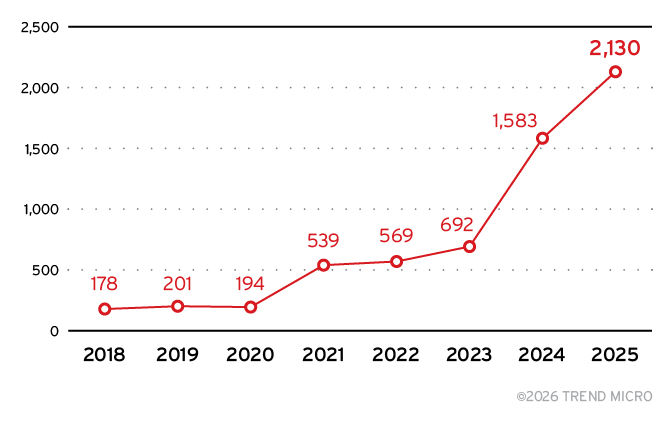
- AI-specific vulnerabilities surged 34.6% in 2025, reaching over 2,100 reported cases.
- 51.4% of AI security flaws are now located within GPU and hardware layers.
- AI breaches cost an average of $4.88M and take 38% longer to remediate.
- Modern frameworks must address prompt injection and non-deterministic model risks.
- Organizations must prioritize workload identity management to secure automated AI agents.
The AI Security Reckoning: Why Your Enterprise Stack is More Vulnerable Than You Think
The honeymoon phase with enterprise AI is officially over. As companies scramble to bolt LLMs and automated agents onto their legacy infrastructure, they’re inadvertently rolling out a red carpet for threat actors. The numbers don’t lie: between 2018 and 2025, we saw 6,086 vulnerabilities tied directly to AI infrastructure. And 2025? It was a banner year for hackers, with 2,130 reported vulnerabilities—a staggering 34.6% jump from the previous year. According to the Trend Micro State of AI Security Report, these AI-specific flaws now account for over 4% of all disclosed CVEs.
We aren't just talking about buggy software anymore. The attack surface has mutated. It’s no longer just about the application layer; it’s the GPU hardware, the tangled web of data pipelines, and the machine learning frameworks themselves. If you’re still relying on a 2020-era security playbook, you’re already behind.
The Anatomy of an AI Breach
Why are attackers pivoting so hard toward AI? Because that’s where the keys to the kingdom are moving. Over a quarter of all AI-related vulnerabilities documented since 2018 are classified as high or critical. Hackers aren't just poking around; they’re hunting for the core of the stack.
The breakdown of where these vulnerabilities live is a wake-up call for any CTO:
- GPU/AI Hardware: 51.4% of vulnerabilities.
- ML Frameworks: 26.7% of vulnerabilities.
- LLM Tools/Applications: 20.4% of vulnerabilities.
The financial fallout is just as brutal. An AI-related breach now costs an average of $4.88 million. To make matters worse, recovery isn't a simple "restore from backup" job. Because AI models are essentially black boxes—non-deterministic and heavy with complex weights—cleaning up after a breach takes 38% longer than a standard cyberattack. You’re essentially trying to debug a ghost.
Hardening the Perimeter: New Controls for a New Era
If the old ways of securing data don't work, what does? The Cloud Security Alliance has been pushing for a total re-engineering of the standard CIA triad (confidentiality, integrity, availability) to account for the weird, wild world of adversarial AI. Think prompt injections and model inversion—threats that didn't exist in the traditional enterprise threat model.
The industry is coalescing around a few critical controls to be folded into the existing AI Controls Matrix (AICM):
| Control Category | Objective |
|---|---|
| Prompt Injection Defense | Stop the "jailbreak" attempts designed to trick models into leaking secrets. |
| Model Inversion/Membership Inference | Lock down training data so it can’t be reverse-engineered by bad actors. |
| Federated Learning Governance | Ensure decentralized training doesn't become a weak link. |
| Shadow AI Detection | Hunt down and kill unauthorized AI tools before they leak company IP. |
These aren't just suggestions. They’re meant to play nice with the NIST AI Risk Management Framework and the OWASP Top 10 for LLM Applications. We’re dealing with multi-modal systems now—text, audio, video—and each one introduces a new vector for cross-modal data leakage. If your security team isn't looking at these frameworks, they’re effectively flying blind.
Identity-First: The New Gold Standard
Technical controls are only half the battle. The real vulnerability often sits between the keyboard and the chair—or, more accurately, in the automated credentials we hand out like candy. As highlighted in recent AI security best practices, the sheer volume of service accounts and automated credentials floating around AI pipelines is a disaster waiting to happen.
Then there’s the "Shadow AI" problem. Your employees are likely using unauthorized SaaS AI tools to "get work done faster," and in doing so, they’re feeding your proprietary data into public models. This is how model theft happens—a $2.3 million mistake on average.
To stop the bleeding, you need a data-centric approach that spans the entire lifecycle:
- Continuous Behavioral Monitoring: If your AI agent suddenly starts querying the database at 3:00 AM for data it doesn't usually touch, you need to know now, not next month. Establish a baseline and watch for the anomalies.
- Zero-Trust Architecture: Every single interaction between an AI agent and your backend needs to be authenticated, authorized, and logged. No exceptions.
- Strict SaaS Governance: If it isn't vetted, it shouldn't be on your network. Centralize your AI tooling to prevent data from leaking into the wild.
The reality is grim: 67% of LLM-integrated apps currently have at least one exploitable prompt injection vulnerability. That is a massive surface area for failure.
We are moving into an era where security isn't just a "nice to have" or an IT checkbox; it’s a regulatory mandate. With GDPR and HIPAA tightening their grip on AI-driven data processing, you can’t afford to be reactive. By marrying the NIST guidelines with these specific AI-focused controls, you aren't just protecting your stack—you’re ensuring that your organization can actually survive the AI transition. The tools exist. The frameworks are ready. The only question is whether your team is willing to do the work to implement them before the next big breach hits.