GitGuardian Integrates with AWS Secrets Manager to Automate Credential Lifecycle Governance for Machine Identities


TL;DR
- GitGuardian integrates with AWS Secrets Manager to bridge cloud vaults and code repos.
- The new 'ggscout' tool automates secret cataloging and identifies leaked credentials.
- HMSL protocol ensures security by checking secret fingerprints without exposing actual keys.
- Lean deployment on small EC2 instances enables continuous pipeline monitoring.
Managing secrets at scale is a headache—plain and simple. As cloud environments grow, the gap between where credentials live (like AWS Secrets Manager) and where they accidentally end up (like your source code) is widening. GitGuardian’s latest integration is a direct attempt to fix this "secret sprawl" by finally syncing up your cloud vaults with your repositories.
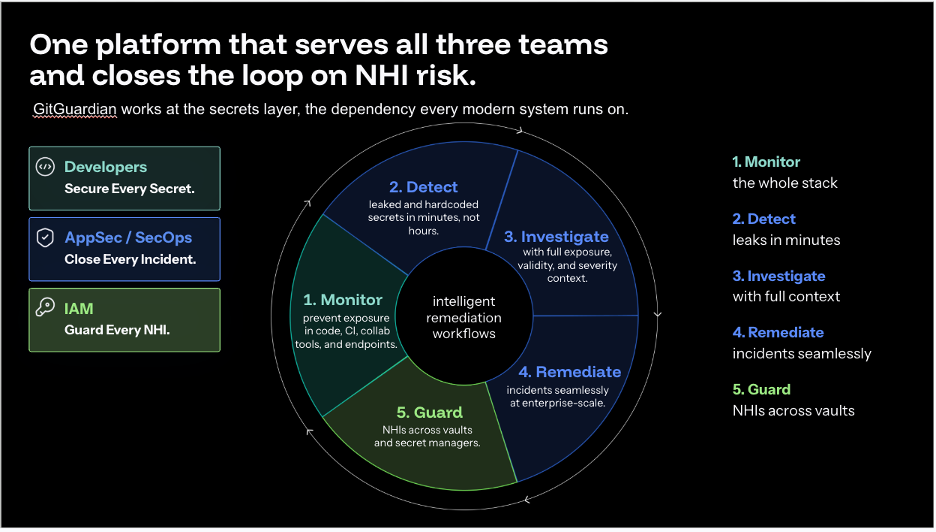
The core of this update is a tool called ggscout. Think of it as a bridge between the vault and the wild west of your development environment. By cataloging secrets directly from AWS and cross-referencing them with what’s lurking in your code, security teams finally get a clear picture of their credential lifecycle. It’s about time we stopped guessing whether a vaulted secret has leaked into a CI/CD log.
The Problem with Modern Velocity
Let’s be honest: the way we write code has changed. With AI coding assistants and Model Context Protocol (MCP) servers churning out configurations at breakneck speed, the risk of a developer accidentally committing a sensitive key to version control has skyrocketed. Manual tracking? That’s a pipe dream. When your infrastructure scales, the speed of development inevitably outpaces your ability to audit every machine identity.
Keeping Secrets Secret
The technical heavy lifting here is handled by the Hashed Message Secret Lookup (HMSL) protocol. This is the clever part: you don't want your actual production credentials floating around in a third-party tool. HMSL ensures that only anonymized fingerprints of those secrets leave your AWS environment. GitGuardian can verify if a secret has been exposed in a repo by checking the hash, without ever seeing the secret itself. It’s a "trust but verify" model that actually respects your data privacy.
Deployment isn't a nightmare, either. The ggscout collector is designed to be lean. According to GitGuardian, you can run this on a tiny Amazon EC2 t3.small instance. It’s a low-overhead way to add continuous monitoring to your pipeline without eating up your compute budget.
What This Actually Solves
The integration hits four major pain points that keep security engineers up at night:
- Credential Exposure: It catches those "oops" moments where a secret from AWS ends up hardcoded or sitting in plain text in your logs.
- Secret Sprawl: It hunts down orphaned or duplicate credentials across multiple AWS accounts that are otherwise impossible to track manually.
- Compliance Gaps: It builds the audit trail you need for regulatory requirements, proving exactly which machine identities are where.
- Remediation Delays: It cuts down the time between finding a leak and actually rotating the credential, which is the difference between a near-miss and a breach.
| Component | Function | Security Mechanism |
|---|---|---|
| AWS Secrets Manager | Centralized vault for credentials | Encryption at rest and in transit |
| ggscout | Cataloging and correlation tool | External collection via API |
| HMSL Protocol | Comparison of secret signatures | Cryptographic hashing (no raw data) |
Closing the Loop
The real value here is the feedback loop. By correlating vaulted secrets with repository data, your team can finally prioritize. If a secret is flagged as both "vaulted" and "exposed," you know exactly where to strike. You can trigger an immediate rotation in AWS Secrets Manager, turning a potential disaster into a routine maintenance task.
If you’re ready to get started, the documentation for ggscout lays out the path. It’s a shift toward automated governance that acknowledges a hard truth: in an era of AI-driven development, manual oversight is dead. We need cryptographic links between our cloud vaults and our codebases to keep the lights on and the data safe. This integration isn't just about better hygiene; it's about keeping pace with a modern, automated stack.