NSA Releases Updated Zero Trust Implementation Guidelines to Strengthen Machine and System Identity Security


TL;DR
- NSA introduces an interactive platform for Zero Trust implementation.
- Roadmap provides 152 activities to reach FY 2027 security goals.
- Guidelines address critical vulnerabilities in legacy machine identity authentication.
- Framework aligns with NIST SP 800-207 and CISA maturity models.
- Phased approach enables organizations to scale security based on maturity.
The National Security Agency (NSA) just dropped a new interactive platform for its Zero Trust Implementation Guidelines (ZIG). If you’re part of the Department of War, the Defense Industrial Base, or managing National Security Systems, this is your new roadmap. Building on the "Zero Trust Implementation Guideline Primer" from January 2026, this modular framework is designed to help organizations stop talking about Zero Trust and actually start building it—verifying every single entity, regardless of where it sits or what network it’s on.
We’re finally moving away from the old-school, perimeter-based security model. You know the drill: the "castle-and-moat" approach is dead. The new mandate is simple, if demanding: "never trust, always verify" and "assume breach." By pulling together all the existing guidance—Discovery, Phase One, and Phase Two—into one central hub, the NSA is giving agencies a way to align their security posture with the realities of their actual budgets and maturity levels.
The Phased Implementation Framework
The NSA isn’t asking for a miracle overnight. They’ve mapped out 152 distinct activities, categorized by maturity level, to turn theoretical planning into actual, measurable execution. It’s a phased approach, meaning you can implement controls incrementally and adjust as you go.
The roadmap breaks down like this:
- Discovery Phase: The "where are we now?" stage. You’re establishing a baseline and finding the holes in your current setup.
- Phase One: The basics. Getting foundational security controls and visibility tools in place.
- Phase Two (Target-level): This is the finish line for the fiscal year 2027 mandates.
- Phase Three and Four: The future-proofing stage. This is where you bring in the heavy hitters—AI-driven security, continuous monitoring, and automated responses.
This structure isn't just an NSA pet project; it’s designed to play nice with NIST SP 800-207 and CISA’s Zero Trust Maturity Model 2.0. It’s about meeting the Department of War’s requirements without reinventing the wheel.
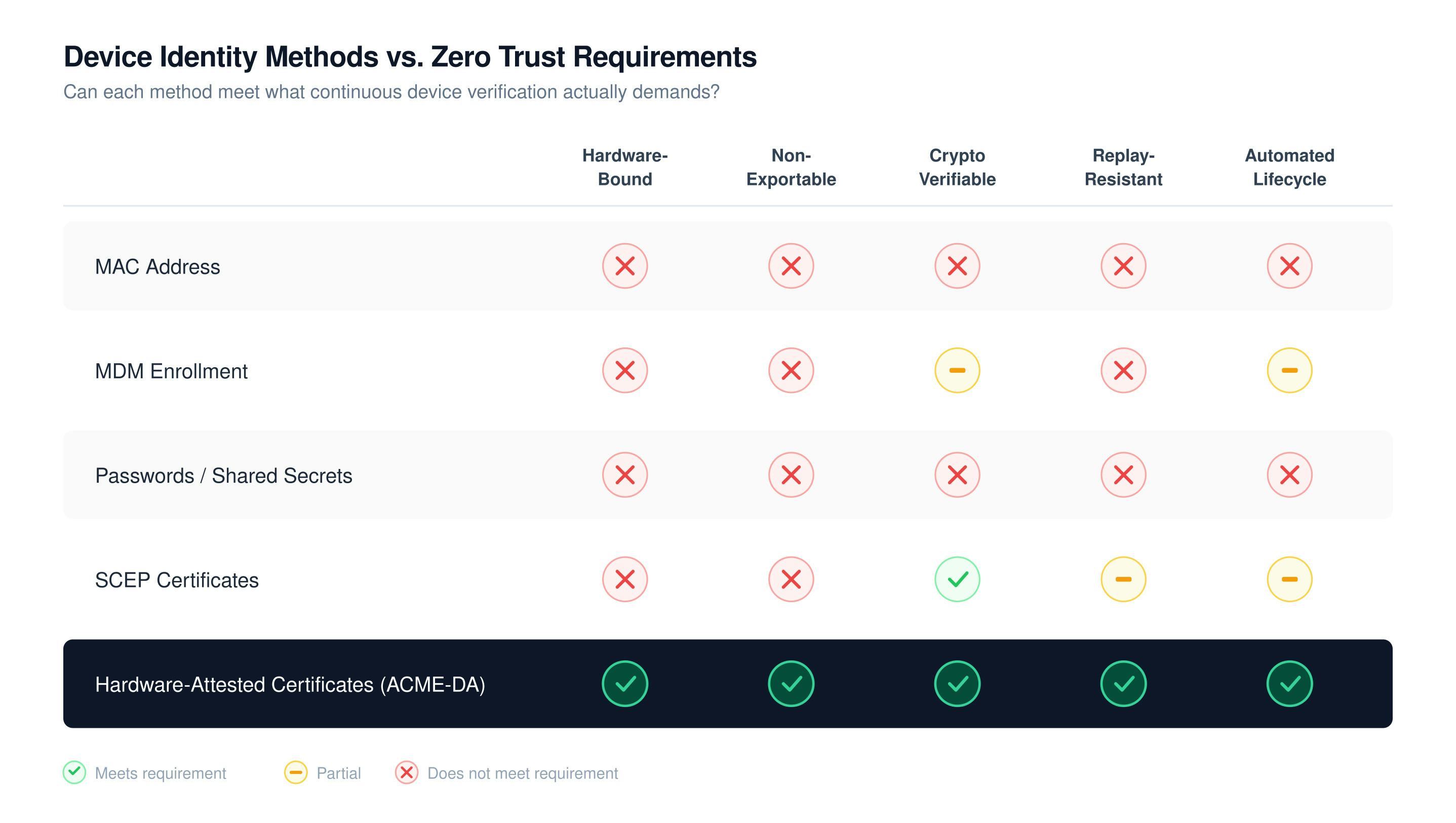
Fixing the Device Identity Gap
We’ve gotten pretty good at managing user identities, but machines? That’s where things get messy. The NSA’s guidelines point out a glaring vulnerability: we’re still relying on legacy methods like MAC addresses, standard MDM enrollment, and SCEP-issued certificates to prove a device is who it says it is. In the modern threat landscape, that’s just not enough. These methods are easily spoofed, cloned, or hijacked in a replay attack.
The NSA Zero Trust Implementation Guidelines make it clear: if you want real Zero Trust, you need hardware-attested device identity. You have to bind those cryptographic credentials directly to the hardware—think Trusted Platform Modules (TPMs) or Secure Enclaves. If the identity isn't tied to the physical silicon, it’s just a digital sticker that can be peeled off and slapped onto a malicious device.
Here is how the old way stacks up against the new standard:
| Feature | Legacy Identification | Hardware-Attested Identity |
|---|---|---|
| Binding | Software-based, portable | Cryptographically bound to TPM/Enclave |
| Security | Susceptible to spoofing/replay | Resistant to cloning/exfiltration |
| Trust Level | Assumed based on credential presence | Verified based on hardware integrity |
| Reliability | Low; prone to credential theft | High; ensures device authenticity |
Operationalizing Zero Trust
The ZIG platform isn’t just a pile of PDFs. It’s interactive. It includes checklists, task trackers, and reporting tools to help security teams navigate 77 specific activities across 64 core capabilities. Instead of being overwhelmed by the scope, teams can pick off the modular components that offer the biggest bang for their buck based on their specific threat environment.
The guidelines focus on several critical pillars:
- User Authentication: Tightening up multi-factor verification for every single access request.
- Device Health Monitoring: If a device isn't compliant, it doesn't get in. Period.
- Infrastructure Protection: Using micro-segmentation to wrap security around your most critical assets.
- Network Segmentation: Stopping attackers in their tracks by preventing lateral movement.
- AI-Driven Security Automation: Using machine learning to spot the weird stuff and automate the response before a breach becomes a disaster.
Strategic Alignment and the 2027 Deadline
The clock is ticking toward that FY 2027 "Target-level" deadline. For the Department of War and its partners, this isn't just an IT upgrade; it’s a survival mechanism for National Security Systems. The beauty of these guidelines is that they’re customizable. The NSA knows that a one-size-fits-all approach is a recipe for failure in complex, heterogeneous environments.
By following this modular path, agencies and contractors can ensure their money is actually moving the needle on risk reduction. The emphasis on hardware-level cryptographic binding is a massive shift, and it’s exactly what the defense sector needs to secure the machines that keep everything running.
The NSA’s move to centralize these resources is a clear attempt to demystify the transition. Zero Trust is complicated, but by breaking it down into manageable phases, the path forward is finally starting to look clear. The goal remains constant: verify every user, every device, and every system component, every single time. In an era of persistent threats, that level of resilience isn't just a goal—it's the baseline.