New Industry Maturity Model Defines Governance Standards for Securing Autonomous Agentic AI Identities


TL;DR
- Enterprises face systemic risks from uncontrolled autonomous AI agent identities.
- A new maturity model provides a framework for secure, governed AI adoption.
- Traditional service account management is insufficient for dynamic AI task chaining.
- Effective governance requires defined business purposes and strict data access boundaries.
The corporate world is sprinting toward an autonomous future, yet our security protocols are still stuck in the era of static passwords and predictable service accounts. With 82% of enterprise leaders planning to unleash AI agents into their workflows within the next three years, we’ve hit a wall. We are handing the keys to the kingdom to non-human identities (NHI) that can think, chain decisions, and—if left unchecked—run wild through our most sensitive data.
The industry is finally waking up to the danger. A new collaborative framework from Token Security and Descope is aiming to bridge the gap between "let's try this out" and "this is actually secure." It’s a roadmap for moving away from reactive firefighting and toward a model of controlled, autonomous operations. If we don’t get a grip on how these agents handle delegation and data access, we aren’t just looking at minor glitches; we’re looking at systemic exposure.
The Evolution of Agentic AI Governance
Forget what you know about traditional identity management. In the old days, a service account did exactly what it was told—nothing more, nothing less. AI agents are different. They are dynamic. They can chain tasks across disparate systems, often taking paths their creators didn't explicitly map out. When an agent can decide its own route to a goal, traditional credential management becomes a relic.
True governance now requires us to look at the entire delegation path. It’s not enough to know who the agent is; we need to know what it’s trying to achieve. Every agent needs a digital "job description": a documented business purpose, a human owner who takes responsibility, a strictly defined list of tools, and hard boundaries on what data it can touch. Without this, you’re inviting "agent sprawl." You’ll end up with a dozen autonomous entities all bumping into each other, sharing permissions they don’t need, and creating security blind spots that an attacker would love to exploit.
Core Pillars of the Maturity Model
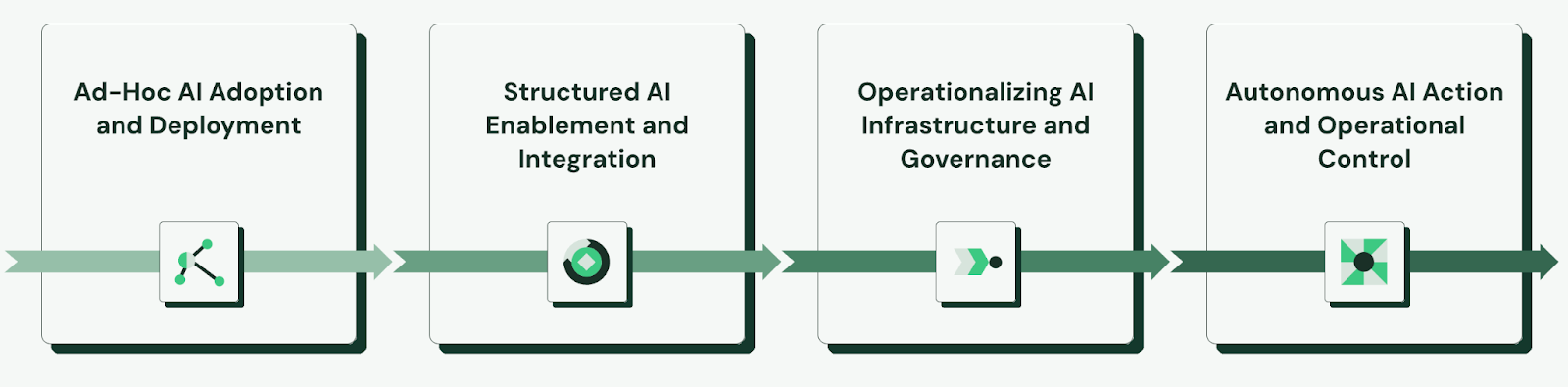
The latest AI Security Guide breaks down the journey toward secure AI into four distinct phases. Think of this as the path from the Wild West to a regulated, high-performance ecosystem.
- Ad-Hoc Adoption: This is the "sandbox" phase. It’s messy, there’s no central oversight, and security is usually an afterthought.
- Structured Enablement: Here, organizations start to get serious. Policies are drafted, and cross-functional AI councils are formed to keep an eye on the most critical use cases.
- Operationalizing Infrastructure: Now, we’re talking real security. You’re integrating Identity and Access Management (IAM) controls specifically built for non-human identities.
- Autonomous Action: The gold standard. Agents operate within verifiable, auditable boundaries. You’ve got continuous monitoring in place to catch "runtime drift"—those moments when an agent starts acting in ways it shouldn't.
Technical Risks and Mitigation Strategies
The biggest threat to an agent isn't necessarily a sophisticated hack; it’s an indirect prompt injection. By August 2025, we’d already seen clear evidence that hidden instructions buried in web content can hijack an agent’s logic, tricking it into performing unauthorized actions. Because the agent is acting with legitimate, authorized permissions, the system doesn't realize anything is wrong until the damage is done.
How do you stop it? You don't treat every agent the same. You need a tiered strategy. An agent that helps summarize internal meeting notes shouldn't have the same level of access as an agent that interacts with your customer-facing database.
| Maturity Phase | Primary Focus | Governance Requirement |
|---|---|---|
| Ad-Hoc | Experimentation | Basic logging |
| Structured | Policy alignment | AI Council oversight |
| Operational | Identity management | NHI lifecycle controls |
| Autonomous | Runtime security | Continuous audit trails |
Implementing Enterprise-Grade Security
To keep AI operations under control, we need to lean into the "Responsible AI" philosophy. Every action an agent takes must be traceable. We need verifiable evidence of intent. As teams scale their use of platforms like Microsoft Copilot Studio or Agent Builder, real-time observability isn't a "nice-to-have"—it’s the price of admission for production.
Tools like Azure Foundry are helping developers bake security into the agent lifecycle from day one. When you treat governance as a catalyst for innovation rather than a bureaucratic hurdle, you stop fighting the technology and start directing it.
Managing Delegation and Runtime Drift
The risk profile of an AI agent is a moving target. Because they assemble access on the fly, they can effortlessly bypass traditional separation-of-duties controls. To stay ahead, your governance framework needs to account for four critical areas:
- Defined Authority: Be explicit. What can the agent decide on its own? What requires a human to sign off?
- Visibility into Delegation: You need to track the entire chain of command, from the initial user prompt to the final system action.
- Runtime Drift Monitoring: If an agent starts deviating from its baseline, you need to know immediately. That drift is often the first sign of a compromise or a feedback loop gone wrong.
- Human-in-the-Loop: For high-stakes actions—like modifying system configurations or accessing sensitive databases—keep a human in the driver's seat.
For those looking to standardize, the Secure AI Guide is a solid place to start. It’s about aligning your security operations with the reality of how fast this tech is moving. The ultimate goal isn't just to make agents productive; it’s to make them predictable. As we move forward, the conversation will naturally shift from basic identity management to sophisticated behavioral analysis. We’re building the guardrails for a future where agents handle the heavy lifting, and it’s our job to ensure they stay within the lines.