New Industry Research Establishes Six Core Governance Principles for Securing Enterprise Non-Human Identities


TL;DR
- Non-human identities (NHIs) now outnumber human users by up to 144 to 1.
- 80% of current machine identities possess high or critical security vulnerabilities.
- Only 15% of organizations are confident in detecting attacks on machine identities.
- Autonomous AI agents are rapidly expanding the unmonitored enterprise attack surface.
- New industry research establishes six governance principles to secure machine access.
The Governance Vacuum: Why Non-Human Identities Are Your Biggest Security Blind Spot
We’ve spent decades obsessing over human identities. We’ve built fortresses around passwords, hammered home the importance of MFA, and perfected the art of Single Sign-On. But while we were busy guarding the front door, a massive, silent army moved in through the back.
New research from the Cloud Security Alliance (CSA) has finally put a name to the problem: the "Non-Human Identity (NHI) Governance Vacuum." As organizations sprint toward agentic AI and cloud-native architectures, we’ve inadvertently created a sprawling, unmonitored attack surface. Service accounts, API keys, and OAuth tokens are multiplying at a rate that traditional security frameworks simply weren't built to handle.
The numbers are staggering. In most enterprise environments, non-human identities now outnumber human users by 45 to 1. In some cloud-heavy setups, that ratio balloons to 144 to 1. Yet, despite this massive footprint, only 15% of organizations feel confident they can actually stop an attack targeting these machine identities. It’s a security gap that threat actors are already exploiting to move laterally and establish persistent, invisible access.
The Scale of the Identity Proliferation Challenge
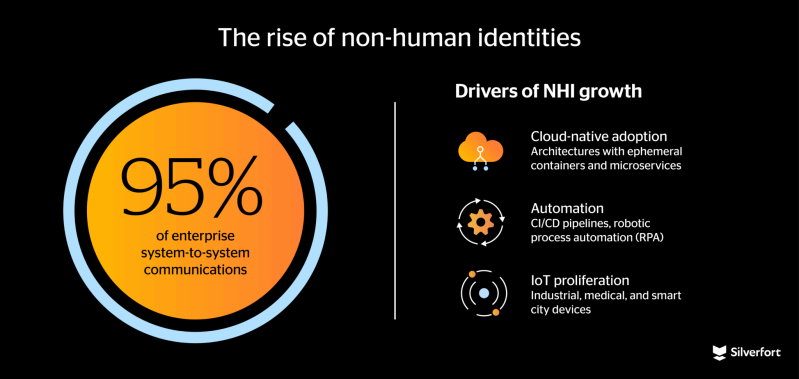
Why is this happening? It’s the cost of doing business in the cloud. Modern workflows rely on constant machine-to-machine communication. But unlike human users, who are tethered to centralized identity providers, NHIs are often left to fend for themselves.
These credentials—static, long-lived, and often hard-coded into configuration files or application logs—are a goldmine for attackers. Because there’s no standard lifecycle management for these identities, they tend to linger long after their usefulness has expired. Industry analysis suggests that 80% of NHIs in the wild currently carry high or critical security vulnerabilities. Perhaps most alarming is that 16% of organizations don’t even track the creation of AI-related identities. They are effectively building their infrastructure in the dark.
The Agentic AI Shift
We are moving past the era of simple, scripted automation. Gartner projects that by 2028, a third of enterprise applications will incorporate agentic AI. Unlike a static script that does exactly what it’s told, these agents are autonomous entities. They reason. They request new permissions at runtime. They orchestrate complex actions across disparate systems.
This changes everything. When an AI agent can dynamically decide it needs more access to finish a job, the traditional "least privilege" model breaks down. If you can’t govern the identity, you can’t govern the agent. Experts are increasingly pointing to guidance on non-human identity governance as the only way to reconcile this operational agility with actual security.
The Identity Risk Landscape
To understand the scale of the problem, we have to look at how these identities differ from the ones we’re used to managing:
| Feature | Human Identity | Non-Human Identity (NHI) |
|---|---|---|
| Primary Credential | Password/Biometric | API Keys/Tokens/Secrets |
| Lifecycle Management | Standardized (HR-driven) | Often Unmanaged/Ad-hoc |
| MFA/SSO Support | Native/Ubiquitous | Frequently Unsupported |
| Behavioral Baseline | Predictable/Consistent | Highly Variable/Dynamic |
| Credential Lifespan | Controlled/Rotated | Often Static/Long-lived |
Closing the Governance Gap
The challenge for security teams isn't just about locking things down; it's about doing so without breaking the high-speed automation that keeps the business running. Because NHIs often operate in the "shadows" of IT infrastructure, the first step is simple visibility. If you can't see it, you can't secure it. Organizations that ignore the insecurity in the shadows created by unmanaged service accounts are essentially leaving the back door wide open.
Mitigation requires a shift in mindset. We need to move from manual, reactive tracking to automated discovery and lifecycle management. We also need to get serious about the shared security model—a concept that has become vital as attackers exploit cross-vendor lateral movement to jump from one compromised service to the next.
As we look toward the future, the industry is coalescing around six core governance principles for non-human identities. These principles aren't just suggestions; they are a blueprint for survival. They prioritize total visibility into machine-to-machine interactions, the strict enforcement of least-privilege access for autonomous agents, and, crucially, the automated rotation of all credentials.
We are currently in a race between the adoption of agentic AI and the hardening of our identity frameworks. If we continue to let the governance vacuum expand, the very tools we use to drive efficiency will become the primary vectors for our next major security breach. It is time to treat the machine with the same rigor we apply to the human.