Red teaming is an authorised exercise in which a group of security specialists acts like a real attacker against your organisation, to find out whether your people, processes and technology can spot and stop a realistic attack.
This guide is for newcomers, students, career changers and managers who keep hearing the term and want to know what it really means. It explains how red teaming differs from a penetration test, how an exercise is planned and kept safe, what a realistic example looks like and how to tell whether your organisation is ready for one. It stays at concept level: it does not describe attack tools or techniques. For the wider family of authorised testing, start with Penetration Testing for Beginners. Red teaming of AI models is a separate topic, covered in AI Red Teaming for Beginners.
By the end of this guide you will be able to:
- Explain what a red team exercise is and what it tests.
- Describe how red teaming differs from penetration testing.
- Understand how an exercise is planned and kept under control.
- Identify signs that an organisation is ready for one.
Key takeaways
- It tests the defenders, not just the systems. The main question is whether your organisation notices and responds to a realistic attack.
- It is goal-based. A red team aims for an agreed objective, such as reaching a sensitive system, rather than listing every weakness.
- It is always authorised and controlled. Written approval, rules of engagement and a small control group who know about the test keep it safe.
- The value is in the fixes. Findings are only useful if detection and response gaps are closed and checked again.
- It is not a first step. Organisations usually get basic hygiene, logging and penetration testing in place before red teaming.
What it is, in plain English
NIST's glossary defines a red team as a group of people authorised and organised to emulate a potential adversary's attack or exploitation capabilities against an enterprise's security posture. Its objective is to improve security by demonstrating the impact of successful attacks and what works for the defenders.[1] The defenders are usually called the blue team: the people and tools that detect and respond to attacks, often a security operations centre.
A red team exercise is different from a penetration test. The NCSC describes a penetration test as a way of gaining assurance in a system's security by trying to breach it using techniques an adversary might use.[5] Penetration tests are usually scoped to specific systems and aim to find as many weaknesses as possible. A red team takes a wider view across people, processes and technology, follows a realistic attacker's path towards a goal, and often runs without the defenders knowing.
A useful comparison is a fire drill run by an outside fire safety team without warning staff. It shows whether alarms work, whether people notice and whether the evacuation plan holds up. Where the analogy breaks down: a red team does not only test whether people react; it deliberately tries to stay hidden, as a real attacker would, so a "quiet" exercise can still reveal serious gaps.
| Question | Penetration test | Red team exercise |
|---|---|---|
| Main aim | Find and report weaknesses in agreed systems | Test whether the organisation can detect and respond to a realistic attack |
| Scope | Defined systems, applications or networks | The organisation as a whole, towards an agreed goal |
| Do defenders know? | Usually yes | Usually only a small control group |
| Typical length | Days to weeks | Weeks to months |
| Main output | List of weaknesses to fix | Attack story, detection and response gaps, improvement plan |
Why it matters to you
- If you run a small business: a full red team is often more than you need. Basic controls and a penetration test usually come first, but knowing the term helps you judge what suppliers offer.
- If you are new to a security job: red team reports are a rich source of learning about how real attacks unfold and where detection fails.
- If you are a manager: red teaming gives evidence of whether your security investment works in practice, not just on paper. In financial services, regulators run their own intelligence-led schemes.
Some regulators use red teaming directly. In the UK, CBEST is run by the Bank of England, the Prudential Regulation Authority and the Financial Conduct Authority, and uses threat intelligence to design tests that mimic the actions of cyber attackers against a firm's important business services.[3] In the EU, the European Central Bank's TIBER-EU framework, first published in May 2018, was updated in 2024 to align with the threat-led penetration testing rules under the Digital Operational Resilience Act (DORA).[2] NIST SP 800-53 also includes red team exercises as control enhancement CA-8(2).[7]
A public example shows what red teams can reveal. In advisory AA24-193A, the US Cybersecurity and Infrastructure Security Agency (CISA) described a no-notice red team assessment of a federal agency that lasted about eight months in 2023. The red team stayed undetected through the first phase, and the agency's defenders relied mainly on known-bad indicators, so new techniques slipped past. CISA recommended detection based on behaviour rather than indicator lists, and noted that short log retention limited the investigation.[4]
How it works, step by step
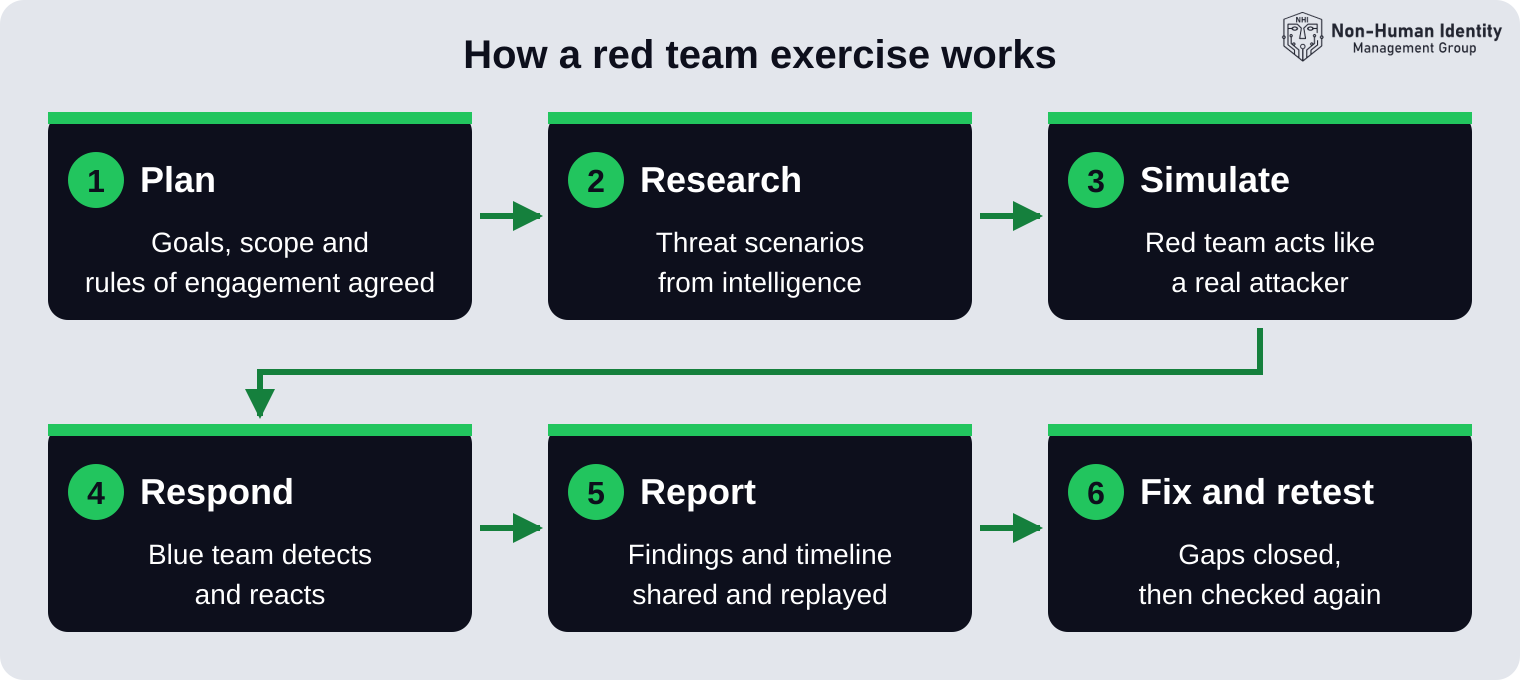
- Plan and authorise. Senior leaders sign off the exercise. A small control group (sometimes called the white team) agrees the goals, scope, timing and rules of engagement: what testers may and may not do, how data is handled, when to stop and who to call in an emergency.[3]
- Research the threat. Threat intelligence is used to build realistic scenarios based on the kinds of attacker likely to target the organisation. Schemes such as TIBER-EU and CBEST use a separate threat intelligence provider for this.[2][3]
- Simulate the attack. The red team works towards the agreed goal, behaving like the chosen attacker. Many teams describe this behaviour using MITRE ATT&CK, a knowledge base of adversary tactics and techniques based on real-world observations.[6]
- Watch the response. The blue team carries on as normal. The control group tracks whether and when activity is detected, and can pause or stop the exercise if something risky happens.[2]
- Report and replay. The red team shares a timeline of what it did. Defenders compare it with what they saw, which shows exactly where detection and response worked or failed. TIBER-EU stresses that the outcome is not a pass or fail.[2]
- Fix and retest. The organisation agrees an improvement plan, closes gaps and checks them again, often in a collaborative purple team session where attackers and defenders work side by side.
The teams involved go by different names in different schemes.
| Role | What they do | Other names |
|---|---|---|
| Red team | Simulates the attacker | Red team testers, penetration test provider (CBEST) |
| Blue team | Detects and responds, usually without warning | Security operations, defenders |
| Control group | Authorises, oversees, keeps the test secret and safe | White team, control team (TIBER-EU) |
| Threat intelligence provider | Builds realistic attack scenarios | TISP (CBEST) |
| Purple team | Brings red and blue together to improve detection | Purple teaming session |
A worked example
Meridian Insurance is a fictional insurer with 1,200 staff and its own security operations team. The board asks a simple question: "If a determined criminal group targeted us, would we notice before they reached customer data?"
The chief information security officer, Tom, sets up a control group of four people: himself, the head of IT, a lawyer and the chief operating officer. They hire an outside red team, sign a written authorisation and agree rules of engagement. The goal is to show read access to a test record in the claims system, without touching real customer data. Production outages are out of bounds, and the red team must stop immediately if the control group asks.
Over six weeks the red team tries to get in the way a financially motivated group might. The security operations team spots and blocks one attempt in week two, but misses a later route. In week five the red team reaches the test record and stops.
At the replay session, the defenders see that an alert did fire on the missed route but was closed as a false positive, and that one key system was not sending logs centrally. Meridian fixes the logging, adds a new detection, changes how that alert type is triaged and books a purple team session to test the changes. The exercise did not prove Meridian is secure; it showed where to improve next.
Myths and misunderstandings
| What people think | What is true |
|---|---|
| Red teaming is just a bigger penetration test. | It has a different aim: testing detection and response against a realistic goal, not listing every weakness. |
| If the red team gets in, the defenders failed. | Getting in is expected. The useful findings are how far they got, what was detected and how quickly the team responded. TIBER-EU says the outcome is not a pass or fail.[2] |
| Red teams can do anything to win. | They work within written authorisation and rules of engagement, overseen by a control group who can stop the test. |
| Every organisation should start with a red team. | Without basic controls and logging, a red team will mostly confirm gaps you could find more cheaply. Penetration testing and fixing the basics come first. |
| Red teaming means testing AI chatbots. | That is AI red teaming, a related but separate practice. This page covers testing a whole organisation. |
Key terms
- Red team
- An authorised offensive testing function that simulates adversary behaviour to show how weaknesses combine into a path to business impact.
- Blue team
- The defensive function responsible for detection, response, hardening and recovery.
- Purple team
- A collaborative way of working that blends offensive and defensive security to turn attack knowledge into better detection and response.
- White team
- The neutral group that oversees an exercise, enforces the rules of engagement and keeps it safe.
- Rules of engagement
- The written agreement that sets what testers may and may not do: scope, timing, permitted activity, data handling, stop conditions and emergency contacts.
- Adversary emulation
- A structured method of simulating a specific attacker's behaviour to check whether defences work as intended.
- Red team assessment
- A controlled exercise that simulates a real attacker to test how well an organisation can detect, resist and recover from compromise.
- Threat intelligence
- Contextualised information about attackers and their methods that helps teams decide what matters and what to do next.
Common questions
Is red teaming legal?
Yes, when it is properly authorised in writing by someone with the authority to approve it, and kept within agreed rules of engagement. Without authorisation, the same activity would be an attack.
How long does a red team exercise take?
Usually weeks to months. The Bank of England's CBEST guide says average CBEST projects take roughly 9 to 12 months from start to finish, including planning and remediation.[3]
Should the security team be told in advance?
Usually not, because the point is to see how they respond for real. A small control group knows, so that the exercise can be paused and so that real incidents are not confused with the test.
What is the difference between red teaming and purple teaming?
A red team works covertly and reports afterwards. Purple teaming is open collaboration, with attackers and defenders working together to test and improve detections. See the Red Team vs Blue Team vs Purple Team guide.
Does red teaming include phishing staff?
It can, if the rules of engagement allow it. Many organisations set clear limits, such as no targeting of personal accounts and support for any staff member who is caught out.
Can a small organisation do red teaming?
It can, but it is rarely the best first spend. A smaller, scenario-based test or a penetration test with a detection check often gives more value until the basics are in place.
First steps
Three things you can do this week:
- Check your readiness. Ask whether you have central logging, someone who reviews alerts and an incident response plan. If not, we suggest fixing those before commissioning a red team.
- Write down the question you want answered. For example, "Would we detect an attacker reaching our payment system?" A clear goal shapes the whole exercise.
- Read one public red team report. CISA's advisory AA24-193A shows the kinds of detection and logging lessons an exercise produces.[4]
Checklist
- We have run at least one penetration test and fixed the main findings.
- Our important systems send logs to a central place that someone reviews.
- We have a written incident response plan that has been practised.
- We know the goal we want a red team to test.
- A senior leader is ready to give written authorisation.
- A small control group is named, with an emergency stop process.
- Rules of engagement cover scope, out-of-bounds systems, data handling and staff welfare.
- Time and budget are set aside to fix findings and retest.
Simple measures that show progress: how long it took to detect the red team, how many of its key steps were detected, how quickly the blue team responded once it did, and how many findings were closed and retested.
Check your understanding
1. What is the main difference between a penetration test and a red team exercise?
Answer: a penetration test looks for weaknesses in agreed systems; a red team tests whether the organisation detects and responds to a realistic attack towards a goal.
2. Who is the control group, and why does it matter?
Answer: the small group who know about the exercise and oversee it. They keep it safe and secret and can stop it if needed.
3. If the red team reaches its goal, has the exercise failed?
Answer: no. The useful findings are what was detected, what was missed and how the response could improve.
4. What should usually be in place before a red team exercise?
Answer: basic security controls, central logging, someone reviewing alerts, an incident response plan and earlier penetration testing.
Suggested learning pathway
- Start with the umbrella topic: Penetration Testing for Beginners.
- For the defenders being tested: Security Operations Centres for Beginners.
- For how attackers are chosen as scenarios: Threat Intelligence for Beginners.
- For searching for attackers proactively: Threat Hunting for Beginners.
- For the AI-only version: AI Red Teaming for Beginners.
- For practitioner depth: the Red Teaming Guide.
- For working side by side with defenders: the Purple Teaming Guide.
Standards and references
- Glossary: red team (source CNSSI 4009-2022). NIST Computer Security Resource Center. https://csrc.nist.gov/glossary/term/red_team, accessed 27 Nov 2026.
- TIBER-EU: Threat intelligence-based ethical red teaming. European Central Bank. https://www.ecb.europa.eu/paym/cyber-resilience/tiber-eu/html/index.en.html, accessed 27 Nov 2026.
- CBEST Threat Intelligence-Led Assessments: Implementation Guide, 2024 edition. Bank of England. https://www.bankofengland.co.uk/financial-stability/operational-resilience-of-the-financial-sector/cbest-threat-intelligence-led-assessments-implementation-guide, accessed 27 Nov 2026.
- AA24-193A: CISA Red Team's Operations Against a Federal Civilian Executive Branch Organization Highlights the Necessity of Defense-in-Depth, 11 July 2024. Cybersecurity and Infrastructure Security Agency (CISA). https://www.cisa.gov/news-events/cybersecurity-advisories/aa24-193a, accessed 27 Nov 2026.
- Penetration testing. National Cyber Security Centre (NCSC). https://www.ncsc.gov.uk/guidance/penetration-testing, accessed 27 Nov 2026.
- MITRE ATT&CK. The MITRE Corporation. https://attack.mitre.org/, accessed 27 Nov 2026.
- SP 800-53 Rev. 5, Security and Privacy Controls for Information Systems and Organizations. National Institute of Standards and Technology (NIST). https://csrc.nist.gov/pubs/sp/800/53/r5/upd1/final.
Related NHI Mgmt Group resources: Red Teaming Guide · Red Team vs Blue Team vs Purple Team · Purple Teaming Guide