SOX is a US law that makes listed companies prove their financial reports can be trusted.
This guide is for anyone who keeps hearing "that's a SOX control" and wants to know what it means. You do not need to work in finance to be affected: at a listed company, everyday IT jobs such as granting access or approving changes can be part of SOX.
In short
- SOX is about honest company accounts. It applies to companies that report to the US markets watchdog, the SEC.
- The top bosses sign off each report, and each year the company checks its own controls.
- IT matters because computers make the numbers. Who can get in and who can change systems affects whether the numbers can be trusted.
- A check that leaves no record is hard to prove, so keep the evidence.
What you will learn
- Explain what SOX is and which companies it is aimed at.
- Spot which everyday IT tasks can count as SOX controls.
- Check that a control leaves the records an auditor will ask for.
- Ask your team which SOX controls you own.
Status: correct as at 28 November 2026, based on the Act as published by the US Government Publishing Office, the current US Code and SEC rules. Laws change; check the official text.
This guide explains the topic in general terms and is not legal advice.
- Checks on the numbers (internal controls)
- the steps a company takes so its accounts are right, such as approvals and reviews.
- Basic IT checks (IT general controls)
- controls over who can get into systems, how systems change and how they run.
- Proof (evidence)
- a ticket, approval or log that shows a check really happened.
What is SOX?
Think of a restaurant kitchen. The head chef signs to say the food is safe, and an inspector comes to check. The chef cannot just say "trust me". There must be fridge logs and cleaning rotas that anyone can read.
SOX works the same way for a company's accounts. Its full name is the Sarbanes-Oxley Act. It became law on 30 July 2002, to fight company and accounting fraud.[5] Its aim is to protect investors by making company reports more accurate and reliable.[1]
The bosses must stand behind the numbers. The company must also run checks, called internal controls, that make the numbers likely to be right. Then it must show the proof.
Where the comparison stops working: an inspector looks at one kitchen on one day. SOX auditors look at whether the checks worked all through the year.
Why does it matter?
Company numbers come out of computer systems. If anyone can change those systems or give themselves access, nobody can fully trust the numbers.
If you are new to IT work
What could happen: you grant access or remove a leaver, but keep no record, and the auditor counts it as a failed check.
Check this: ask which of your tasks are SOX controls and where the proof is kept.
If you run a small business
What could happen: SOX probably does not cover you directly, but a listed customer may ask how you control your systems.
Check this: know who can get into the systems you run for that customer.
Next: SOC 2 for Beginners
If you manage a team
What could happen: small habits, such as skipping change approvals, turn into audit findings that your leaders must explain.
Check this: make sure each SOX control your team runs has a named owner and a backup.
What does it look like?
Here is a made-up "Am I affected?" checklist for someone starting an IT job.
Example only. All values are made up.
Am I affected by SOX? (Example Corp, example.com)
[x] My employer's shares trade on a US stock exchange   (1)
[x] I can give people access to the finance system      (2)
[x] I approve or install changes to that system         (3)
[ ] I keep a ticket for each access I grant             (4)
Control owner: FAKE-NAME-0000
- Listed companies that report to the SEC are the main target of SOX.
- Access to a finance system is a classic SOX control.
- Changes to that system are another one.
- This empty box is the problem. With no record, the check is hard to prove.
Why this is risky: the work may be done well. But with no proof, the auditor may treat it as a failure.
The safer way: every access and change goes through a ticket with an approval. The proof then builds up as you work.
How does it work?
Two parts of the law matter most to IT teams.
The first says the chief executive and the finance chief must sign off each yearly and quarterly report. They say they are responsible for the controls and checked them within 90 days before the report. They must also tell the auditors about serious gaps.[1]
The second asks for a yearly report on how well the controls work.[1] For larger companies, an outside audit firm must also give its view. Smaller and newer companies are left out of that extra step.[2] The company must judge its controls against a recognised set of rules, called a control framework.[3]
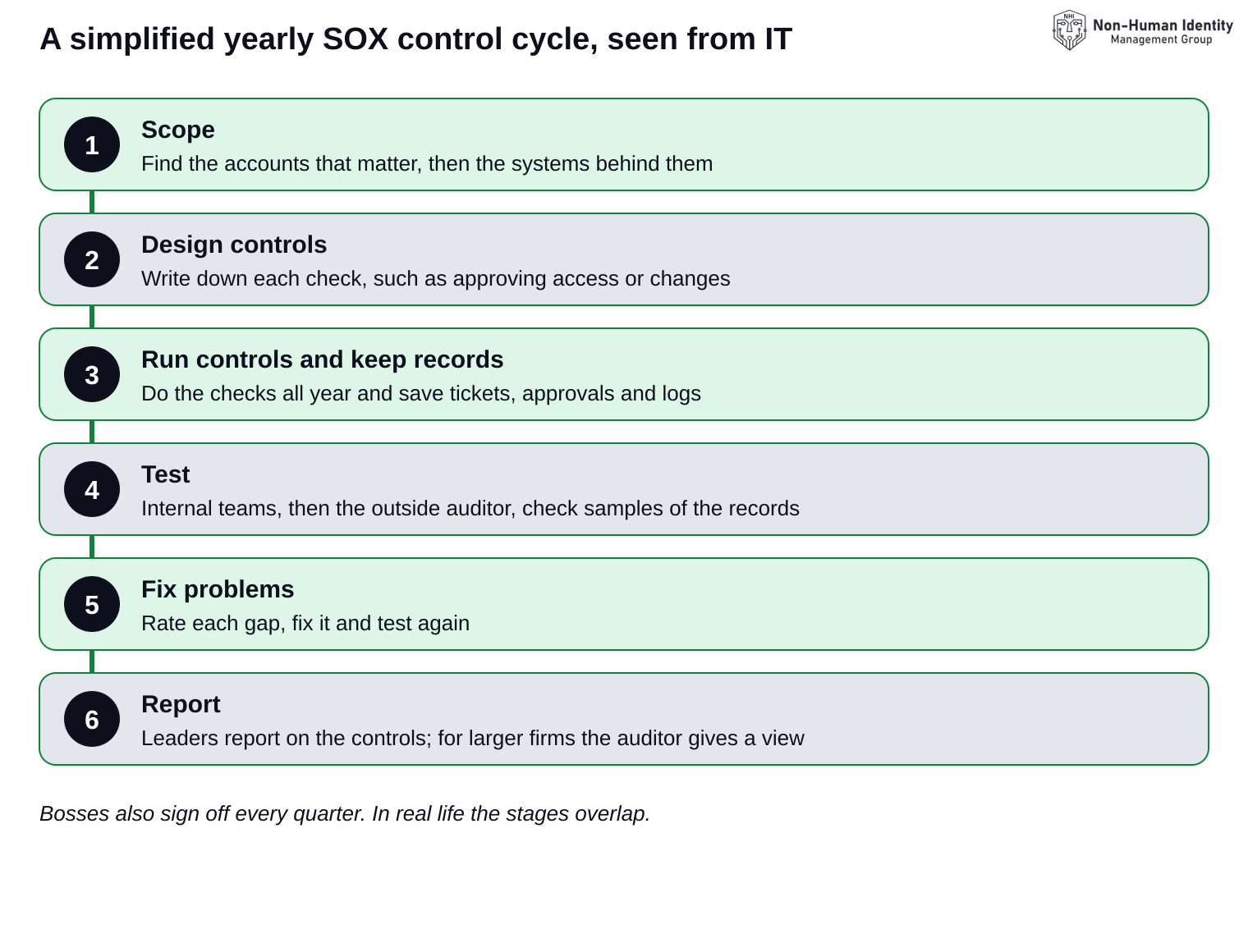
Seen from an IT desk, a typical year runs like this:
- Scope. Finance works out which accounts matter most, then which systems sit behind them. Auditors start at the accounts and work down.[4]
- Design controls. Each risk gets a written check. Some are IT checks, such as approving access or testing changes.
- Run the controls and keep records. People do the checks all year. Each one leaves a ticket, an approval or a log.
- Test. Teams follow one transaction from start to end, called a walkthrough, then check samples of the records.[4]
- Fix and report. Gaps are rated, fixed and tested again. The most serious kind is called a material weakness. Then the yearly report is made.
Why do auditors care about IT? Their rules say checking IT risk is part of the same top-down review, not a separate job.[4] An automated check inside a system is usually lower risk, but only when the basic IT checks around it work well.[4] These basic checks cover who can get into systems, how systems change and how they run.
A worked example
Dune Printers is a made-up printing firm whose shares trade on a US exchange. Dev Navarro has just joined its small IT team.
In his first week, his manager explains that three of his tasks are SOX controls. Nobody gets into the finance system without a ticket approved by the finance manager. Leavers lose access within an agreed time, and Dev notes it on the ticket. Every quarter, finance managers review who has access and sign it off.
In March, a warehouse lead asks Dev for "quick access" to the finance system to check stock values. Dev asks for an approved ticket. The finance manager approves read-only access, not the full access that was asked for.
At year end, the auditor picks 25 access grants and 25 leavers to check. One leaver's account was closed three weeks late, because the list was missed while Dev was on holiday. The auditor records an exception.
The team checks what that account could do and whether it was used after the person left. The records available show no use. So the gap is rated as a smaller problem, not a material weakness. IT adds a named backup for the leavers task.
SOX did not make the systems secure by itself. The checks made it less likely that someone could change the numbers without permission, and the records let Dune Printers show it.
Myths and mistakes
| What people think | What is true |
|---|---|
| SOX is a cyber security law. | SOX is about reliable company reports.[1] Security matters where it protects the systems behind the numbers. |
| SOX tells you which products to buy. | It sets duties and yearly checks, not technology. The company picks its controls and judges them against a recognised framework.[3] |
| Every listed company needs an auditor to check its controls. | Smaller and newer companies are left out of the auditor's extra check.[2] The company's own yearly report still applies. |
| If we did the task, we passed. | Auditors need proof that the check worked all year. No records usually means an exception. |
| Software accounts are not in scope. | Any account that can change finance data or systems is part of access control, whether a person or a program uses it. |
What can I do this week?
- Ask for the list of IT controls from your SOX or audit team, and find the ones your team owns.
- Pick one recent access grant and check the ticket, approval and completion note all exist and match.
- Compare last month's leavers with the accounts on one in-scope system. If you find a gap, fix it, record it and tell the control owner.
- Treat any exception as temporary. If an account must stay open for a handover, get it approved, recorded and time-limited.
Checklist
- I can say in one sentence what SOX is for.
- We know which systems are in SOX scope and who owns each one.
- Access to in-scope systems needs a recorded approval first.
- Leavers lose access within an agreed time, with a record.
- Access is reviewed regularly and the review is signed off.
- Changes are tested and approved before release, with records kept.
- Software accounts and scripts on in-scope systems have named owners.
- Each SOX control my team runs has a backup person.
Common questions
What does SOX stand for?
It is short for the Sarbanes-Oxley Act of 2002, named after the two members of Congress who sponsored it. It became law on 30 July 2002. It aims to make company reports more reliable and to fight accounting fraud.[5]
Does SOX apply to private companies?
Not usually. Its main rules are aimed at companies that file reports with the SEC. A private company may still be asked about its controls by a listed customer, or may need SOX if it plans to list. Ask a qualified adviser about any specific company.
Is SOX the same as SOC 2?
No. SOX is a law. SOC 1 and SOC 2 are reports an independent auditor writes about a supplier's controls. A listed company may use a supplier's SOC 1 report as proof about controls it relies on for its accounts.
Who writes the rules auditors follow?
A board set up by SOX, the Public Company Accounting Oversight Board, writes them.[5] Its standard tells auditors to start from the accounts and work down. It treats IT risk as part of that same review.[4]
Do AI agents and automation change anything?
The ideas stay the same. Anything that can post entries or change finance systems needs controlled access, controlled changes and proof. That is true whether a person, a script or an AI agent does the work. Each software account needs a named owner and regular review.
Where next?
Ready for the detail? Read the practitioner guide: SOX IT General Controls (ITGC) Guide. It goes further into each IT control area, how auditors test them and how gaps are rated.
Also useful:
- Cyber Security Compliance for Beginners
- Access Reviews for Beginners
- SOX ITGCs vs SOC 1
- AI Agents and SOX Controls
Related NHI Mgmt Group resources: Change Management Security · Access Reviews Guide · SOC 1 Guide
Key terms
- Sarbanes-Oxley Act (SOX)
- A US law that makes listed companies keep and check controls over their financial reports.
- IT general controls (ITGC)
- Basic controls over access, changes and running systems that finance checks rely on.
- Material weakness
- The most serious kind of control gap, where a big error in the accounts might not be caught in time.
- Segregation of duties
- Splitting tasks so one person cannot both make and approve a risky change.
- Change management
- The approved, recorded way of making changes to systems.
- User access review
- A regular check that each account still needs the access it has.
- Audit trail
- A time-ordered record showing who did what, and when.
Sources and further reading
- Public Law 107-204, Sarbanes-Oxley Act of 2002 (116 Stat. 745), sections 302 and 404. US Government Publishing Office, govinfo. https://www.govinfo.gov/content/pkg/PLAW-107publ204/html/PLAW-107publ204.htm, accessed 28 Nov 2026.
- 15 U.S. Code § 7262, Management assessment of internal controls. Legal Information Institute, Cornell Law School. https://www.law.cornell.edu/uscode/text/15/7262, accessed 28 Nov 2026.
- 17 CFR § 240.13a-15, Issuer's disclosure controls and procedures. Legal Information Institute, Cornell Law School. https://www.law.cornell.edu/cfr/text/17/240.13a-15, accessed 28 Nov 2026.
- AS 2201: An Audit of Internal Control Over Financial Reporting That Is Integrated with An Audit of Financial Statements. Public Company Accounting Oversight Board (PCAOB). https://pcaobus.org/oversight/standards/auditing-standards/details/AS2201, accessed 28 Nov 2026.
- The Laws That Govern the Securities Industry. Investor.gov, US Securities and Exchange Commission. https://www.investor.gov/introduction-investing/investing-basics/role-sec/laws-govern-securities-industry, accessed 28 Nov 2026.