A SOC 2 report is an independent auditor's report on how well a service provider controls its system for security and, where chosen, availability, processing integrity, confidentiality and privacy.
If your company uses a cloud service, a payroll provider or a software platform, that supplier holds some of your data or runs part of your business. A SOC 2 report is one of the most common ways for a supplier to show customers how it protects that system, checked by an independent certified public accountant (CPA). This guide is for newcomers, students, career changers, buyers and managers. It explains what the report covers, how Type I and Type II differ, how a report is produced, a worked example and simple first steps whether you are reading a report or preparing for one.
By the end of this guide you will be able to:
- Explain what a SOC 2 report is and who it is for.
- Describe the five trust services categories.
- Understand the difference between a Type I and a Type II report.
- Identify what to check first when a supplier sends you a report.
Status: correct as at 27 November 2026, based on the AICPA's SOC 2 guidance and its published exposure drafts. Criteria and guidance change; check the AICPA's current publications.
This guide explains the topic in general terms and is not legal advice.
Key takeaways
- SOC 2 is a report, not a certificate. An independent CPA gives an opinion on a service provider's system description and controls.
- Five categories, chosen by scope. Security, availability, processing integrity, confidentiality and privacy; the security criteria are the shared base for all of them.
- Type I is a snapshot, Type II is a track record. Type I looks at design at a point in time; Type II also tests whether controls worked throughout a period.
- Read beyond the opinion. Scope, exceptions found in testing and the controls customers must run themselves all matter.
- It is for informed readers. A SOC 2 report is restricted to specified parties, such as customers, who understand the system.
What it is, in plain English
SOC stands for System and Organization Controls. The AICPA (the American Institute of Certified Public Accountants) describes SOC as a suite of services that CPAs can provide, producing assurance reports that help users assess the risks of outsourcing services.[1] SOC 2 is the member of that family focused on a service provider's controls over its system.
In a SOC 2 examination, the provider's management writes a system description: what the service is, which parts are in scope and how controls support it. Management also gives a written management assertion that the description is accurate and the controls are suitably designed (and, for Type II, worked). An independent CPA, called the service auditor, then examines the description and controls against two sets of AICPA criteria: the description criteria for the description, and the trust services criteria for the controls.[2][3][4][6]
An everyday comparison is a vehicle inspection carried out by an independent garage. The owner says what the car is and what it has fitted; the inspector checks it against a published list and writes down what passed and what did not. Where the analogy breaks down: a basic car check is a single moment, while a SOC 2 Type II report checks that controls kept working over months, and the provider, not a law, chooses which categories are examined.
Why it matters to you
- If you run a small business: larger customers may ask for a SOC 2 report before signing a contract. If you buy software, asking suppliers for theirs is a quick way to learn how they protect your data.
- If you are new to a security job: you may be asked to collect evidence for an audit, or to review a supplier's report. Knowing the structure saves a lot of time.
- If you are a manager: a SOC 2 report is evidence you can rely on for supplier due diligence, but only if someone reads the scope, exceptions and customer responsibilities, not just the first page.
The AICPA's SOC 2 guide notes that customers and business partners often request a SOC 2 report from service organisations.[3] It is not a law or a government requirement. Whether you need one depends on your customers and contracts, which is why it sits alongside, not instead of, frameworks such as ISO/IEC 27001.
How it works, step by step
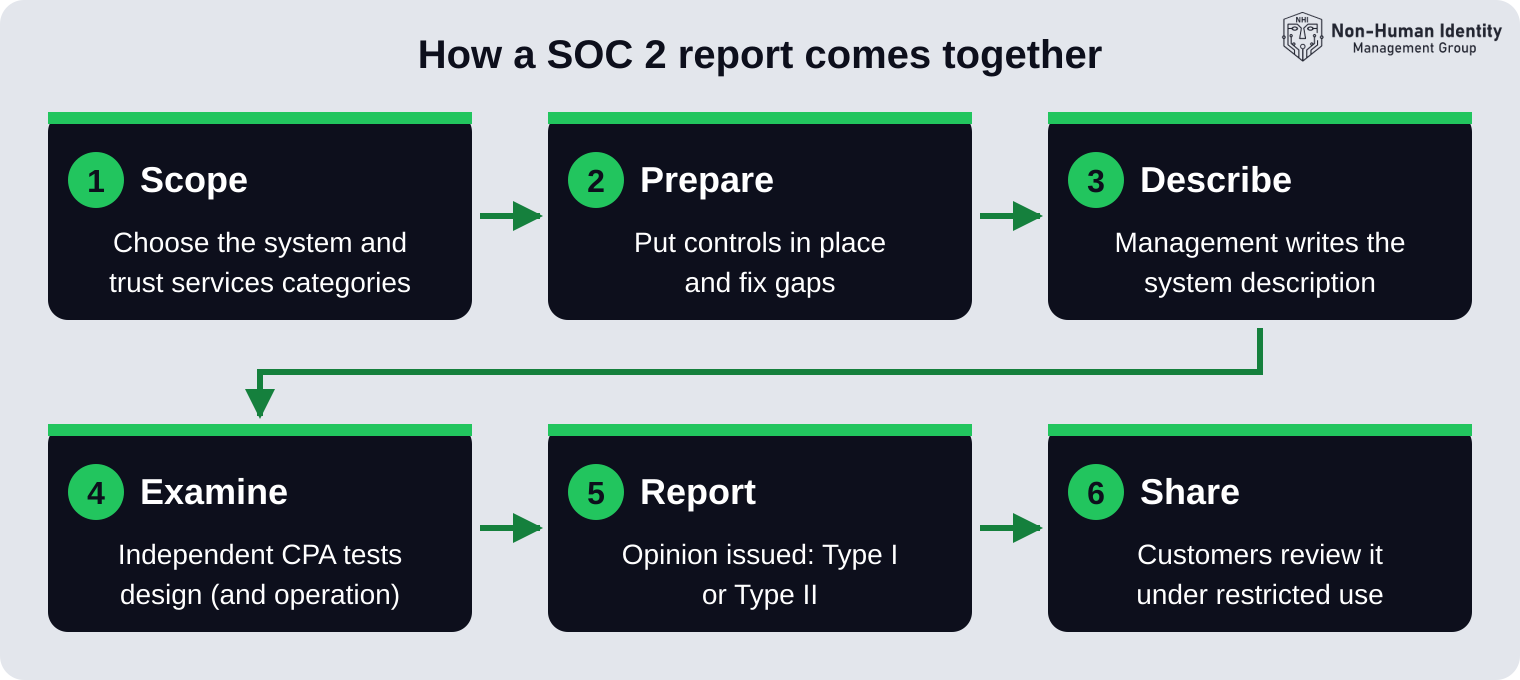
- Decide the scope. The provider chooses which system or service is covered and which of the five trust services categories to include. The AICPA guide says the engaging party may choose to report on one or more categories.[2]
- Prepare. The provider writes down its controls, closes gaps and often runs a readiness check with an adviser before the real examination.
- Choose a report type. Type I or Type II (see the table below), and for Type II, the period the auditor will cover.
- Write the system description and assertion. Management prepares the description of its system and signs a written assertion about it.[2]
- Examination. The service auditor tests the controls by asking questions, inspecting evidence such as tickets and configuration exports, and re-performing some controls. In a Type II, testing covers the whole period.
- Report. The auditor issues the report: their opinion, management's assertion, the system description and, for Type II, the tests performed and their results, including any exceptions (cases where a control did not work as described).
- Share with customers. The report goes to specified parties, such as existing customers, often under a non-disclosure agreement.
- Repeat. Many providers repeat the Type II each year so customers always have a recent report.
The five trust services categories
| Category | AICPA description, in short | Typical example |
|---|---|---|
| Security | Information and systems are protected against unauthorised access, unauthorised disclosure and damage.[2] | Access control, multi-factor sign-in, monitoring |
| Availability | Information and systems are available for operation and use to meet objectives.[2] | Backups, disaster recovery, capacity planning |
| Processing integrity | System processing is complete, valid, accurate, timely and authorised.[2] | Payment or payroll calculations |
| Confidentiality | Information designated as confidential is protected.[2] | Customer contracts, encryption, secure disposal |
| Privacy | Personal information is collected, used, retained, disclosed and disposed of to meet objectives.[2] | Consent, retention and deletion of personal data |
The guide explains that a set of common criteria (numbered CC1.1 to CC9.2) forms the complete set of criteria for security, and that each of the other four categories uses the common criteria plus its own extra criteria.[2] In practice this means security is the foundation of every SOC 2 report. The criteria are based on the COSO 2013 internal control framework.[2]
Type I and Type II compared
| Question | Type I | Type II |
|---|---|---|
| What time does it cover? | A single point in time (a specific date) | A period of time agreed with the auditor |
| What does the auditor conclude on? | Whether the description is fair and controls were suitably designed and implemented[2] | The same, plus whether controls operated effectively throughout the period[2] |
| Does it list tests and results? | No operating effectiveness testing | Yes, including any exceptions |
| When is it useful? | A first report, or a new system, to show the design is sound | Ongoing assurance that controls work in daily practice |
Useful distinctions
- SOC 2 and SOC 3. A SOC 3 report is a general use report for people without detailed knowledge of the system; it leaves out the system description and the auditor's test results.[2] Providers often publish a SOC 3 and share the fuller SOC 2 on request.
- Restricted use. The SOC 2 auditor's report is restricted to specified parties who have enough knowledge of the system, such as the provider's staff, customers, business partners and regulators.[2]
- Customer responsibilities. Reports can list complementary user entity controls: things the customer must do for the provider's controls to work, such as managing their own users. Reports can also include or carve out the provider's own suppliers, called subservice organisations.[2]
- Criteria are being updated. The AICPA has published exposure drafts of proposed 2027 SOC 2 trust services criteria and description criteria, listed on its site on 16 November 2026.[5] Proposals can change before they are final, so check the AICPA's site for the current position.
A worked example
Brightline Rota is a fictional company of 45 people that sells staff scheduling software to care homes. A large care group asks for a SOC 2 Type II report before renewing its contract. Brightline's operations lead, Tomasz, has never been through an audit.
Tomasz scopes the report to the scheduling platform and chooses the security and availability categories, because customers care most about access to staff data and the service staying up. Brightline does not process payments, so processing integrity is left out. With the CPA firm, he agrees to a Type I report first, then a Type II covering the following six months.
Preparation shows gaps. Leavers' accounts are not always removed on their last day, and nobody records the quarterly review of who has admin access. Tomasz writes a short leaver procedure, links it to the HR system and sets up a recorded access review. The Type I report confirms the controls are suitably designed as at its date.
During the Type II period, the auditor samples leavers and finds one whose account stayed active for a week. The report lists this as an exception, with management's response. The report still carries an unmodified opinion, but the care group's security reviewer reads the exception, asks how it was fixed and checks the customer responsibilities section, which says each care home must manage its own staff logins. The report did not make Brightline perfectly secure. It gave the customer reliable, tested evidence to make an informed decision.
Myths and misunderstandings
| What people think | What is true |
|---|---|
| "We are SOC 2 certified." | SOC 2 is an attestation report with an auditor's opinion, not a certificate. The accurate phrase is "we have a SOC 2 Type II report" for a stated period. |
| A SOC 2 report covers the whole company. | It covers the system and categories in scope. Always check the system description to see what is in and out. |
| Type I and Type II give the same assurance. | Type I shows design at a point in time. Type II also tests whether controls worked throughout a period.[2] |
| A clean opinion means nothing went wrong. | A report can carry an unmodified opinion and still list exceptions in testing. Read them. |
| If my supplier has SOC 2, I have nothing to do. | Reports often list complementary user entity controls that the customer must run.[2] |
| Any SOC 2 provider is as good as another. | The AICPA urges service organisations and CPA firms to evaluate SOC services thoroughly.[1] Check that the report is signed by a licensed CPA firm. |
Key terms
- Trust services criteria
- The AICPA control criteria used to evaluate a service organisation's controls over security, availability, processing integrity, confidentiality and privacy.
- SOC 2 Type 1 (Type I)
- A report giving an auditor's opinion on the design of a service organisation's controls at a single point in time.
- SOC 2 Type 2 (Type II)
- A report that also tests whether controls operated effectively over a defined period.
- System description
- Management's narrative of what the service does, what is in scope and how controls support it; the auditor's map of the environment.
- Management assertion
- The service organisation's written statement about its system description and controls, which sets the boundaries of the examination.
- Attestation
- An engagement in which an independent practitioner reports on a subject matter or an assertion about it, such as a SOC 2 examination.
- Control testing
- Checking whether a control is designed effectively and whether it operated as designed over a period.
- Audit evidence
- The records and observations an auditor relies on, such as tickets, system reports, configuration exports and logs.
- Complementary user entity controls
- Controls the customer must have in place for the provider's controls to work as intended.
- Qualified opinion
- An audit outcome showing the provider did not fully meet the criteria in some respect; a signal to look closely at scope and risk.
- Bridge letter
- A short statement from a service organisation covering the gap between the end of its last report period and the next report.
- SOC 3
- A general use summary report for a broad audience, without the detailed system description and test results.
Common questions
Who can perform a SOC 2 examination?
A CPA acting as the service auditor. The AICPA guide notes that the professional code requires the auditor to be independent of the organisation examined.[2]
Is SOC 2 required by law?
No. It is a voluntary attestation that customers and partners often ask for in contracts and due diligence.[3]
Should we start with Type I or Type II?
Many organisations start with a Type I to confirm the design, then move to Type II. If customers have asked specifically for Type II, a sensible plan is to agree a realistic period with your auditor early.
Which categories should we include?
Security forms the base of every report. Add the other categories where your customers depend on them, for example availability for a service they rely on daily.
How is SOC 2 different from ISO 27001?
ISO/IEC 27001 leads to certification of an information security management system against an international standard. SOC 2 is an AICPA attestation report on a specific system's controls. Many organisations hold both.
What should I read first in a supplier's report?
The report type and period, the system description scope, the auditor's opinion, any exceptions, and the complementary user entity controls.
First steps
Three things you can do this week:
- If you buy services: list your three most important suppliers and ask each for its latest SOC 2 report (or SOC 3 if that is all they share), noting the report type and period.
- Read one report properly. Use the "what to read first" list above and write down any exceptions and the customer responsibilities that apply to you.
- If you may need your own report: write a one-page scope: which service, which categories, and who owns access control, change management and monitoring today. We suggest sharing it with a CPA firm or adviser before committing to dates.
Checklist
- We know which suppliers hold our most sensitive data or run critical services.
- We have a current SOC 2 report, or another independent assurance, for each of them.
- We check that the report period is recent and ask for a bridge letter if it has ended.
- We read the scope to confirm the service we use is covered.
- We review exceptions and the provider's responses.
- We carry out the complementary user entity controls that apply to us.
- If we produce our own report, each control has a named owner and keeps evidence as it runs.
- Any temporary exception to a control is approved, recorded and time-limited, with a review date.
Simple measures that show progress: the share of critical suppliers with a current report on file, the number of open exceptions you are tracking with suppliers, and, for your own programme, the number of controls with evidence collected on schedule.
Check your understanding
1. What is the main difference between a Type I and a Type II report?
Answer: Type I looks at control design at a point in time. Type II also tests whether controls operated effectively throughout a period.
2. Which category forms the base of every SOC 2 report?
Answer: security. The common criteria are the complete set for security and are shared by the other four categories.
3. Why should you read the complementary user entity controls?
Answer: they list what you, the customer, must do for the provider's controls to work.
4. Is "SOC 2 certified" accurate wording?
Answer: no. SOC 2 is an attestation report with an auditor's opinion, not a certificate.
Suggested learning pathway
- Start with the bigger picture: Cyber Security Compliance for Beginners.
- See where audits fit: Governance, Risk and Compliance for Beginners.
- Compare with the international standard: ISO 27001 for Beginners.
- Learn how to assess suppliers: Third Party Risk Management for Beginners.
- For the full practitioner view, see the SOC 2 Guide.
- For report types in depth, see SOC 2 Type 1 vs Type 2.
- To prepare your own examination, use the SOC 2 Readiness Checklist.
- For the family of reports, see SOC 1 vs SOC 2 vs SOC 3.
Standards and references
- Audit and assurance: SOC 2. AICPA & CIMA. https://www.aicpa-cima.com/topic/audit-assurance/audit-and-assurance-greater-than-soc-2, accessed 27 Nov 2026.
- SOC 2 Reporting on Controls at a Service Organization: Relevant to Security, Availability, Processing Integrity, Confidentiality, or Privacy, Chapter 1 Introduction and Background (publisher's excerpt). AICPA Guide, 2018. https://catalogimages.wiley.com/images/db/pdf/9781945498602.excerpt.pdf, accessed 27 Nov 2026.
- SOC 2 Reporting on an Examination of Controls at a Service Organization Relevant to Security, Availability, Processing Integrity, Confidentiality, or Privacy. AICPA & CIMA, updated as of 15 October 2022. https://www.aicpa-cima.com/cpe-learning/publication/soc-2-reporting-on-an-examination-of-controls-at-a-service-organization-relevant-to-security-availability-processing-integrity-confidentiality-or-privacy, accessed 27 Nov 2026.
- 2017 Trust Services Criteria (With Revised Points of Focus, 2022). AICPA & CIMA, Assurance Services Executive Committee. https://www.aicpa-cima.com/resources/download/2017-trust-services-criteria-with-revised-points-of-focus-2022, accessed 27 Nov 2026.
- AICPA Exposure Drafts: Proposed 2027 SOC 2 Trust Services Criteria and Description Criteria. AICPA & CIMA, 16 November 2026. https://www.aicpa-cima.com/resources/download/aicpa-exposure-drafts-proposed-2027-soc-2-trust-services-criteria-and-description-criteria, accessed 27 Nov 2026.
- 2018 SOC 2 Description Criteria (With Revised Implementation Guidance, 2022). AICPA & CIMA. https://www.aicpa-cima.com/resources/download/get-description-criteria-for-your-organizations-soc-2-r-report, accessed 27 Nov 2026.
Related NHI Mgmt Group resources: SOC 2 vs ISO 27001 vs PCI DSS · SOC 2 CC6 Logical Access Guide · Audit, Assurance and Compliance Guide