The UK GDPR is the United Kingdom's own version of the EU General Data Protection Regulation: the main law that sets the rules for how organisations collect, use, store and protect information about people in the UK.
This guide is for newcomers, students, career changers and managers who need a plain English picture of UK data protection law after Brexit. It covers the three laws that work together (the UK GDPR, the Data Protection Act 2018 and the Data (Use and Access) Act 2025), who regulates them, and what they mean day to day. It focuses on the UK angle only. For the core GDPR ideas shared with the EU, read GDPR for Beginners first.
By the end of this guide you will be able to:
- Explain what the UK GDPR is and how it relates to the EU GDPR.
- Understand how the UK GDPR, the Data Protection Act 2018 and the Data (Use and Access) Act 2025 fit together.
- Describe the main duties an organisation has when it handles personal data.
- Identify the UK regulator and the recent changes to UK law.
Status: correct as at 27 November 2026, based on legislation.gov.uk, the Information Commissioner's Office (ICO) guidance and GOV.UK. Laws change; check the official text.
This guide explains the topic in general terms and is not legal advice.
Key takeaways
- The UK kept the GDPR, under its own name. The EU regulation was copied into UK law and is now published as the "United Kingdom General Data Protection Regulation".
- Three laws work together. The UK GDPR sets the core rules, the Data Protection Act 2018 adds UK detail, and the Data (Use and Access) Act 2025 updated both.
- The basics are the same as the EU. Seven principles, lawful bases, people's rights, security and breach reporting all still apply.
- The UK is starting to differ. The 2025 Act added a new lawful basis, changed some cookie rules and required a complaints process.
- The regulator has a new form. The Information Commission took over from the Information Commissioner on 30 September 2026, with the same role and powers.
What it is, in plain English
Personal data is any information that can identify a living person, directly or indirectly: a name, an email address, a customer number, a device identifier or a location history. Data protection law sets rules for anyone who handles it.
The EU General Data Protection Regulation (GDPR) applied in the UK while it was an EU member. When the UK left, the regulation was kept and adapted for UK use. Legislation.gov.uk publishes it as Regulation (EU) 2016/679 with the label "United Kingdom General Data Protection Regulation", and notes that it originated from the EU and has been kept up to date with later UK changes.[1]
It does not work alone. The Data Protection Act 2018 (DPA 2018) supplements the UK GDPR with UK-specific detail, such as exemptions and conditions for sensitive data, and has separate parts for law enforcement and the intelligence services. It also sets out the regulator's role and enforcement powers.[2] The Data (Use and Access) Act 2025 (DUAA) received Royal Assent on 19 June 2025 and changed parts of UK data protection law.[3][4]
A helpful comparison is a house the UK and EU once shared. When the UK moved out, it took an exact copy of the house rules with it. Since then it has repainted some rooms and added an extension, while the EU has kept its own copy. Most rules still match, so visitors familiar with one house find their way round the other. Where the analogy breaks down: the two "houses" are still connected, because personal data flows between them, and the EU checks whether the UK's rules remain close enough to allow that.
Why it matters to you
- If you run a small business: almost every business holds personal data, such as customer, staff or supplier contacts. The ICO says organisations that use personal information need to pay a data protection fee unless they are exempt, under the Data Protection (Charges and Information) Regulations 2018.[10]
- If you are new to a security job: the UK GDPR expects appropriate security for personal data and has firm rules on reporting breaches, so security teams are central to meeting it.
- If you are a manager: the organisation must be able to show it complies, not just say so. The highest tier of fines reaches £17.5 million or 4% of total worldwide annual turnover, whichever is higher.[5]
It also matters for trust. People increasingly ask what happens to their data, and a clear, honest answer is part of good customer service, not just legal compliance.
How it works, step by step
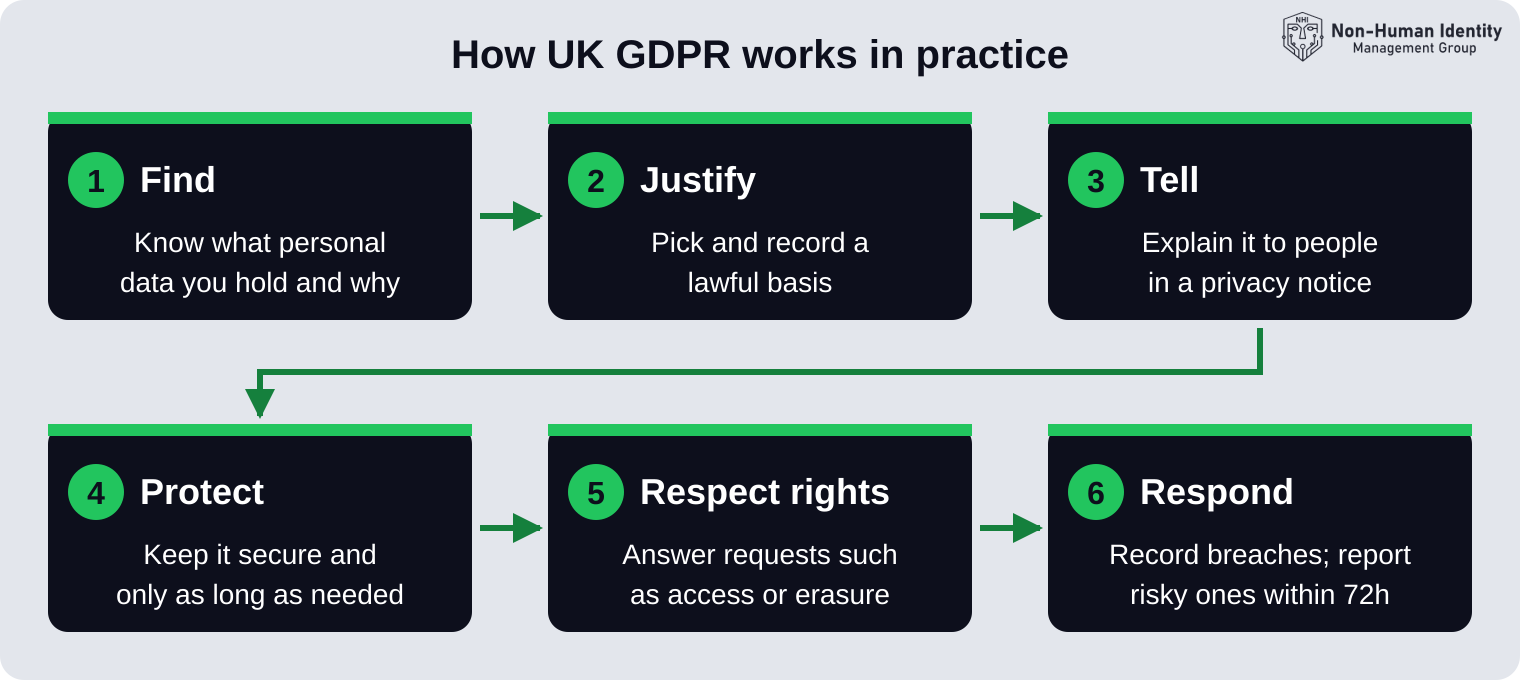
For an organisation deciding how and why personal data is used (the controller), the law works roughly like this in practice.
- Know what you hold. Find the personal data you collect, where it is stored, who can see it and why you have it.
- Follow the seven principles. UK GDPR Article 5 sets out lawfulness, fairness and transparency; purpose limitation; data minimisation; accuracy; storage limitation; integrity and confidentiality (security); and accountability, which means being able to prove you comply.[5]
- Choose a lawful basis. You need at least one legal reason for each use of personal data, decided before you start and written down. The ICO now lists seven: consent, contract, legal obligation, vital interests, public task, recognised legitimate interest and legitimate interests.[6]
- Tell people. Explain what you do with their data, including your lawful basis and purposes, usually in a privacy notice.[6]
- Keep it secure. Protect data with appropriate technical and organisational measures, such as access controls, encryption and staff training, and delete it when it is no longer needed.
- Respect people's rights. The ICO lists eight rights, including the right to be informed, the right of access, the right to erasure and the right to object.[7] Organisations usually have one month to respond to a subject access request.[8]
- Handle breaches and complaints. Record every personal data breach. Report it to the regulator within 72 hours of becoming aware of it, unless it is unlikely to pose a risk to people, and tell affected people without undue delay if the risk to them is high.[9] Since the DUAA, organisations must also have a process to help people make data protection complaints.[3]
The three UK laws at a glance
| Law | What it does | Official source |
|---|---|---|
| UK GDPR | The core rules: principles, lawful bases, rights, security, breaches, transfers | legislation.gov.uk, Regulation (EU) 2016/679 (UK version)[1] |
| Data Protection Act 2018 | UK detail and exemptions, law enforcement and intelligence processing, the regulator and enforcement | legislation.gov.uk, 2018 c. 12[2] |
| Data (Use and Access) Act 2025 | Amends UK data protection law and replaces the Information Commissioner with the Information Commission | legislation.gov.uk, 2025 c. 18[3] |
What the 2025 Act changed
The ICO says the changes were phased in between June 2025 and June 2026 and that all the data protection provisions of the Act are now in force.[4] The main ones for a beginner:
| Area | Change, as the ICO describes it |
|---|---|
| Recognised legitimate interests | A new lawful basis for some set purposes, such as protecting public security, without the usual balancing test[4] |
| Automated decisions | More lawful bases can be used for significant automated decisions, with safeguards; not for special category data[4] |
| Cookies | Some cookies, such as those for statistics or improving website functions, can be set without consent[4] |
| Subject access | Organisations only need to carry out reasonable and proportionate searches[4] |
| Complaints | Organisations must help people complain, acknowledge complaints within 30 days and respond without undue delay[4] |
| International transfers | The test for sending data outside the UK was reworded; the ICO says this does not materially change what you can do[4] |
The regulator changed too. The Information Commission took over from the Information Commissioner's Office on 30 September 2026. GOV.UK says this changes the regulator's structure, from a single commissioner to a board, but not its role, responsibilities or powers.[11]
Data still flows freely from the EU to the UK. The European Commission adopted adequacy decisions for the UK on 28 June 2021 and renewed them on 19 December 2025.[12] For the detail of how UK and EU rules now differ, see UK GDPR vs EU GDPR.
A worked example
Fernside Garden Supplies is a fictional online shop in Leeds with 25 staff. Its owner, Amira, hears that "the GDPR changed after Brexit" and asks Josh, who looks after IT, to check where they stand.
Josh starts with a simple list: customer orders, a newsletter mailing list, staff records and CCTV in the warehouse. For each, he notes why they hold it and the lawful basis: contract for orders, consent for the newsletter, legal obligation and contract for staff records, and legitimate interests for CCTV, with a short written balancing check. He finds an old spreadsheet of customer addresses from 2017 that nobody uses, and they delete it.
He then checks security. Two former employees still have accounts on the order system, so he removes them and turns on multi-factor sign-in for everyone. He updates the website privacy notice and adds a simple online form for data protection complaints, as the 2025 Act now expects. Finally, they agree a one-page plan for breaches: who decides whether to report, and how to record every incident.
None of this makes Fernside "GDPR certified", and Josh says so. But the shop now knows what it holds, can explain why, and has fewer old accounts and files that could cause a breach.
Myths and misunderstandings
| What people think | What is true |
|---|---|
| GDPR stopped applying in the UK after Brexit. | The UK kept it as the UK GDPR, published on legislation.gov.uk.[1] UK firms serving people in the EU may also need to consider the EU GDPR. |
| The UK GDPR is the only UK data protection law. | It works with the Data Protection Act 2018, which adds UK detail and exemptions.[2] |
| You always need consent to use personal data. | Consent is one of seven lawful bases. Many everyday uses rely on contract, legal obligation or legitimate interests.[6] |
| Every breach must be reported to the regulator. | Every breach must be recorded, but only those likely to pose a risk to people must be reported, within 72 hours.[9] |
| The ICO has been abolished, so the rules no longer apply. | The Information Commission replaced the Information Commissioner with the same role and powers.[11] |
| Small businesses are exempt. | Size alone does not exempt you. Some duties scale with risk, but the principles apply to organisations of every size. |
Key terms
- Personal data
- Information that can identify a person directly or indirectly, such as a name, account number, device identifier or location history.
- Data subject
- The identified or identifiable person that personal data relates to.
- Controller
- The person or organisation that decides why and how personal data is processed, and carries primary accountability.
- Processor
- An organisation that handles personal data on behalf of a controller, under its instructions.
- Lawful basis
- The legal reason an organisation is allowed to process personal data, chosen and documented before processing starts.
- Special category data
- Sensitive personal data, such as health or ethnic origin, that receives higher legal protection.
- Personal data breach
- A security incident that leads to accidental or unlawful destruction, loss, alteration, unauthorised disclosure of, or access to, personal data.
- Subject access request
- A request by a person to see the personal data an organisation holds about them.
- Data protection impact assessment (DPIA)
- A structured review of how a system or change could affect people's privacy, used to find and reduce risk.
- Information Commissioner's Office (ICO)
- The UK's independent regulator for data protection and information rights; its functions passed to the Information Commission on 30 September 2026.
- Adequacy decision
- A formal finding by the European Commission that a country outside the EU protects personal data to an adequate level, allowing data to flow there.
Common questions
Is UK GDPR the same as EU GDPR?
Mostly, but not entirely. They started identical and the core ideas still match, but UK changes such as those in the Data (Use and Access) Act 2025 mean the two are drifting apart in places. See UK GDPR vs EU GDPR.
Who enforces UK GDPR?
The Information Commission, which took over from the Information Commissioner's Office on 30 September 2026.[11] In UK law, references to the Information Commissioner are now read as the Information Commission.[13]
What are the maximum fines?
For the most serious breaches, such as of the basic principles, up to £17.5 million or 4% of total worldwide annual turnover, whichever is higher.[5]
Can data still flow between the UK and the EU?
Yes. The European Commission renewed its UK adequacy decisions on 19 December 2025, so personal data can flow from the EU to the UK without extra transfer tools.[12]
Does UK GDPR apply to information about businesses?
Not to company information itself, but it does apply to information about the people in them, such as a named contact's work email address.
Where does security fit in?
Security is one of the seven principles (integrity and confidentiality).[5] In practice that means controlling who and what can access personal data, including software accounts and API keys, logging access and being ready to respond to breaches. See the UK GDPR and Data Protection Act 2018 Guide for the security detail.
First steps
Three things you can do this week:
- Make a simple data list. Write down the main kinds of personal data you hold, where each lives and why you have it.
- Check your lawful bases. For each item on the list, note the lawful basis and whether it is recorded anywhere. We suggest starting with the uses you are least sure about.
- Agree what happens if something goes wrong. Decide who assesses a possible breach, where incidents are recorded and how you would meet the 72-hour reporting window.
Checklist
- We know what personal data we hold, where it is and why.
- Each use of personal data has a recorded lawful basis.
- Our privacy notice is up to date and easy to find.
- We have checked whether we need to pay the data protection fee.
- Access to personal data is limited to the people and systems that need it, and leavers are removed promptly.
- We delete data we no longer need.
- We can recognise and answer a subject access request within the time limit.
- We record every personal data breach and know when to report one.
- We have a simple way for people to make a data protection complaint.
Check your understanding
1. Which three laws make up the core of UK data protection law today?
Answer: the UK GDPR, the Data Protection Act 2018 and the Data (Use and Access) Act 2025, which amended the other two.
2. Name two lawful bases other than consent.
Answer: any two of contract, legal obligation, vital interests, public task, recognised legitimate interest and legitimate interests.
3. Must every personal data breach be reported to the regulator?
Answer: no. Every breach must be recorded, but only those likely to pose a risk to people's rights and freedoms must be reported, within 72 hours of becoming aware.
4. What happened on 30 September 2026?
Answer: the Information Commission took over from the Information Commissioner's Office as the UK data protection regulator, with the same role and powers.
Suggested learning pathway
- Data Privacy for Beginners: why privacy matters and the basic ideas.
- GDPR for Beginners: the core GDPR concepts the UK version shares.
- Cyber Security Compliance for Beginners: how laws and frameworks fit together.
- UK GDPR and Data Protection Act 2018 Guide: the practitioner view, with security obligations.
- UK GDPR vs EU GDPR: where the two laws now differ.
- DPIA Guide: Running a Data Protection Impact Assessment: assessing risky processing.
- International Data Transfers Map: sending data across borders.
- AI and GDPR Guide: personal data in AI systems.
Standards and references
- legislation.gov.uk, "Regulation (EU) 2016/679 (United Kingdom General Data Protection Regulation)". https://www.legislation.gov.uk/eur/2016/679/contents, accessed 27 Nov 2026.
- legislation.gov.uk, "Data Protection Act 2018" (2018 c. 12). https://www.legislation.gov.uk/ukpga/2018/12/contents, accessed 27 Nov 2026.
- ICO, "Data (Use and Access) Act 2025". https://ico.org.uk/about-the-ico/what-we-do/legislation-we-cover/data-use-and-access-act-2025/, accessed 27 Nov 2026; legislation.gov.uk, "Data (Use and Access) Act 2025" (2025 c. 18), https://www.legislation.gov.uk/ukpga/2025/18/contents.
- ICO, "The Data (Use and Access) Act 2025: what does it mean for organisations?", published 19 June 2025, updated 19 June 2026. https://ico.org.uk/about-the-ico/what-we-do/legislation-we-cover/data-use-and-access-act-2025/the-data-use-and-access-act-2025-what-does-it-mean-for-organisations/, accessed 27 Nov 2026.
- ICO, "A guide to the data protection principles". https://ico.org.uk/for-organisations/uk-gdpr-guidance-and-resources/data-protection-principles/a-guide-to-the-data-protection-principles/, accessed 27 Nov 2026.
- ICO, "A guide to lawful basis". https://ico.org.uk/for-organisations/uk-gdpr-guidance-and-resources/lawful-basis/a-guide-to-lawful-basis/, accessed 27 Nov 2026.
- ICO, "Individual rights". https://ico.org.uk/for-organisations/uk-gdpr-guidance-and-resources/individual-rights/individual-rights/, accessed 27 Nov 2026.
- ICO, "Getting copies of your information (subject access request)". https://ico.org.uk/for-the-public/getting-copies-of-your-information-subject-access-request/, accessed 27 Nov 2026.
- ICO, "Personal data breaches: a guide". https://ico.org.uk/for-organisations/report-a-breach/personal-data-breach/personal-data-breaches-a-guide/, accessed 27 Nov 2026.
- ICO, "Data protection fee". https://ico.org.uk/for-organisations/data-protection-fee/, accessed 27 Nov 2026.
- GOV.UK, "Information Commission succeeds the ICO as UK's data protection regulator", 30 September 2026. https://www.gov.uk/government/news/information-commission-succeeds-the-ico-as-uks-data-protection-regulator.
- European Commission, "Adequacy decisions". https://commission.europa.eu/law/law-topic/data-protection/international-dimension-data-protection/adequacy-decisions_en, accessed 27 Nov 2026.
- ICO, "The Information Commission" (DUAA summary of the changes). https://ico.org.uk/about-the-ico/what-we-do/legislation-we-cover/data-use-and-access-act-2025/the-data-use-and-access-act-2025-duaa-summary-of-the-changes/the-information-commission/, accessed 27 Nov 2026.
Related NHI Mgmt Group resources: UK GDPR and Data Protection Act 2018 Guide, UK GDPR vs EU GDPR, Data Breach Notification Checklist. This guide summarises UK data protection law and is not legal advice.