A business continuity manager plans how an organisation keeps its key work going when something breaks.
This guide is for career changers, students and managers who want to know what the job is really like. You do not need a technical background to read it. If your firm has ever lost power, internet or a key supplier for a day, this is the role that plans for it.
In short
- The job is to find the work that matters most and plan how to keep it going, or bring it back fast.
- Most days are spent talking to teams, writing and updating plans, and running practice drills.
- Organising, clear writing and staying calm count as much as technical skill at the start.
- People come in from IT, risk, audit, project work, emergency planning and the armed forces. Entry-level professional certificates exist.
What you will learn
- Explain what a business continuity manager does in one sentence.
- Spot the main steps in planning for a disruption.
- Check which of your skills the job already uses.
- Ask good questions about a continuity job before you apply.
- Most important work (critical activities)
- the tasks a firm must keep doing, or restart quickly, to avoid serious harm.
- Impact check (business impact analysis)
- a study of what would happen if each task stopped, and how fast it must return.
- Practice drill (exercise)
- a planned test of the plan, from a table-top talk to a full switch-over.
What is a business continuity manager?
Think of a spare tyre and a breakdown plan. Nobody wants a flat tyre. But someone has to check the spare is there, the jack works and everyone knows who to call.
A business continuity manager does that for a whole organisation. They ask: what work matters most, what does it depend on, and how long can it stop before real harm is done?
Then they agree plans with each team. The plans cover things like working from another site, using a backup supplier or switching to paper for a day. Finally, they test the plans with drills and fix what the drills show up.
Job titles vary. You may see continuity manager, resilience manager, or business continuity and disaster recovery lead. Disaster recovery is the IT side: getting computer systems and data back. Continuity covers the whole business, including people, buildings and suppliers.
Where the comparison stops working: a car has one spare tyre. An organisation has hundreds of tasks, suppliers and systems, and they depend on each other in ways that are easy to miss.
Why does it matter?
Disruption comes in many forms: a cyber attack, a power cut, a flood or a supplier going bust. Good planning means fewer surprises and a faster return to normal. For many people, it is also a way into security work that uses skills from other jobs.
If you are thinking of a career change
What could happen: you assume the job needs deep IT skills, and miss a role that fits your planning skills.
Check this: read three continuity job adverts and mark the tasks you already do.
If you manage a team
What could happen: your team is asked "how long can you stop?" and nobody has an answer.
Check this: list your team's three most important tasks and what each one depends on.
Next: Business Continuity and Disaster Recovery for Beginners
If you work in IT
What could happen: you restore the systems in the wrong order because nobody agreed what matters most.
Check this: ask your continuity lead for the agreed order of recovery.
What does it look like?
Much of the work starts with a business impact analysis. Here is a made-up entry for one task, as it might appear in a spreadsheet.
Example only. All values are made up.
ACTIVITY: Pay staff (EXAMPLE-0000)
Owner:          Finance lead (FAKE NAME)        (1)
Max stop time:  3 working days                   (2)
Back within:    1 working day                    (3)
Depends on:     payroll app, bank link, 2 staff  (4)
Workaround:     (none written)                   (5)
Last tested:    never                            (6)
- The person who must make sure the plan is kept up to date. In a real file, this line would contain their job title.
- How long the task can stop before the harm becomes serious.
- The goal for getting it running again, set well inside the limit.
- The people, systems and suppliers the task needs.
- What staff would do if the systems were down. Here, nothing is written.
- Nobody has ever tried the plan.
Why this is risky: the entry looks complete, but there is no workaround and no test. On a bad day, staff would be making it up as they go.
The safer way: write a simple workaround, such as a manual payment run with the bank. Then test it in a short drill and record what happened.
How does it work?
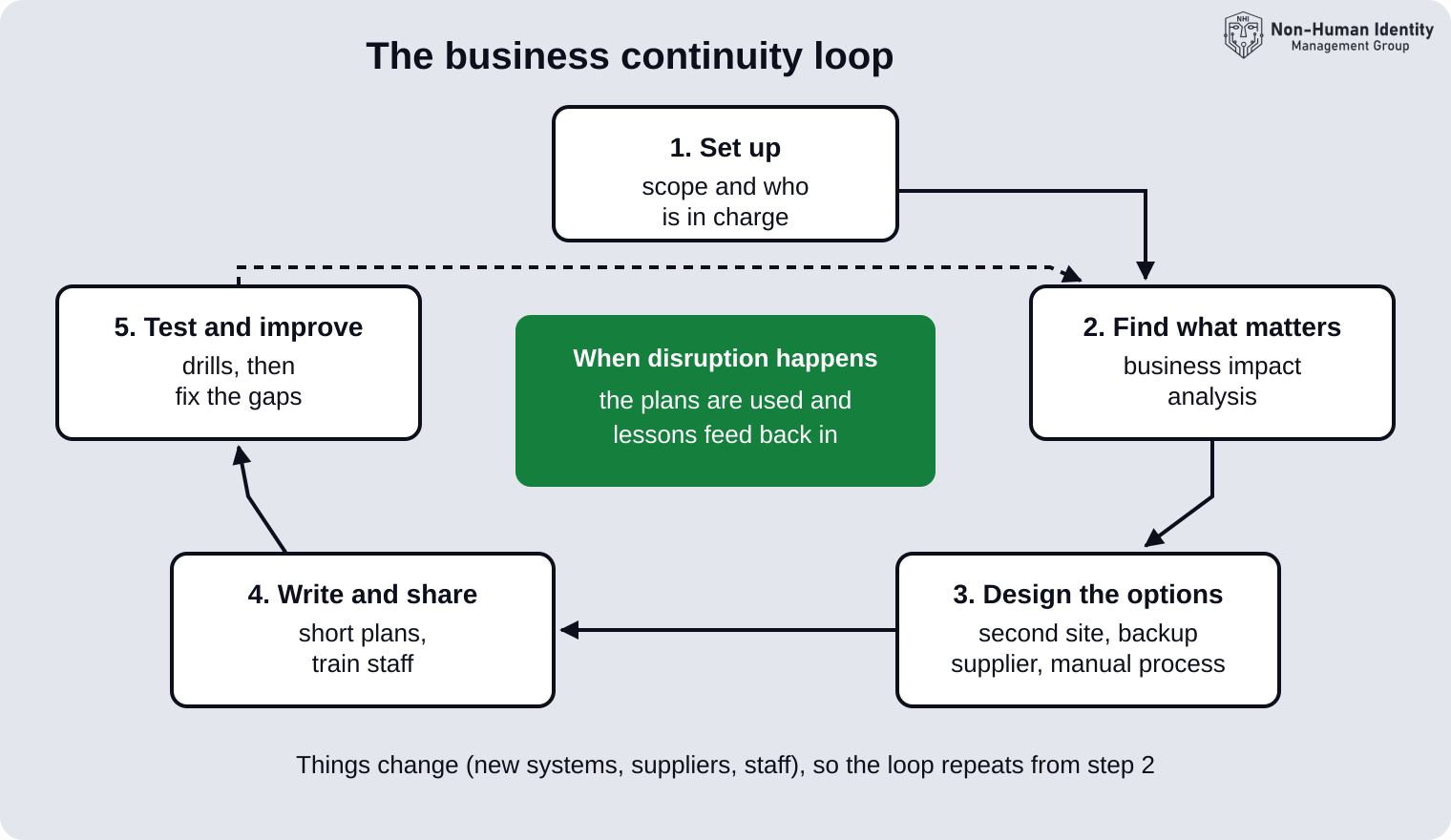
Each organisation works a little differently, but the job often follows a loop like this one. A widely used professional guide splits the work into six practices, from setting up the programme to testing it.[1]
- Set up the programme. Agree with leaders what is in scope, who is in charge and how progress is reported.
- Find what matters. Run the business impact analysis with each team and agree the order of recovery.
- Design the options. Agree ways to keep going, such as a second site, a backup supplier or a manual process.
- Write and share the plans. Turn the options into short plans that staff can use under stress, and train people on them.
- Test and improve. Run drills, from a one-hour talk-through to a real switch-over, then fix the gaps found.
When something really goes wrong, the continuity manager often helps the crisis team. They track what is down, what the plans say and who needs to be told.
Skills and tools
The main professional body for the field says the job needs leadership, ethics, working with others, and technical and management skills.[2] In practice that means:
- People skills. Getting busy teams to give time to "what if" planning.
- Clear writing. Plans must make sense to a stressed reader at 3am.
- Organising. Keeping many plans, owners and test dates up to date.
- Calm under pressure. Helping leaders make decisions during a real incident.
- Tools. Spreadsheets, shared documents and often dedicated continuity software for plans, contact lists and alerts.
Many firms follow an international standard for continuity management. It sets out what a good continuity programme should include.[5] You do not need to know it by heart on day one.
Routes in
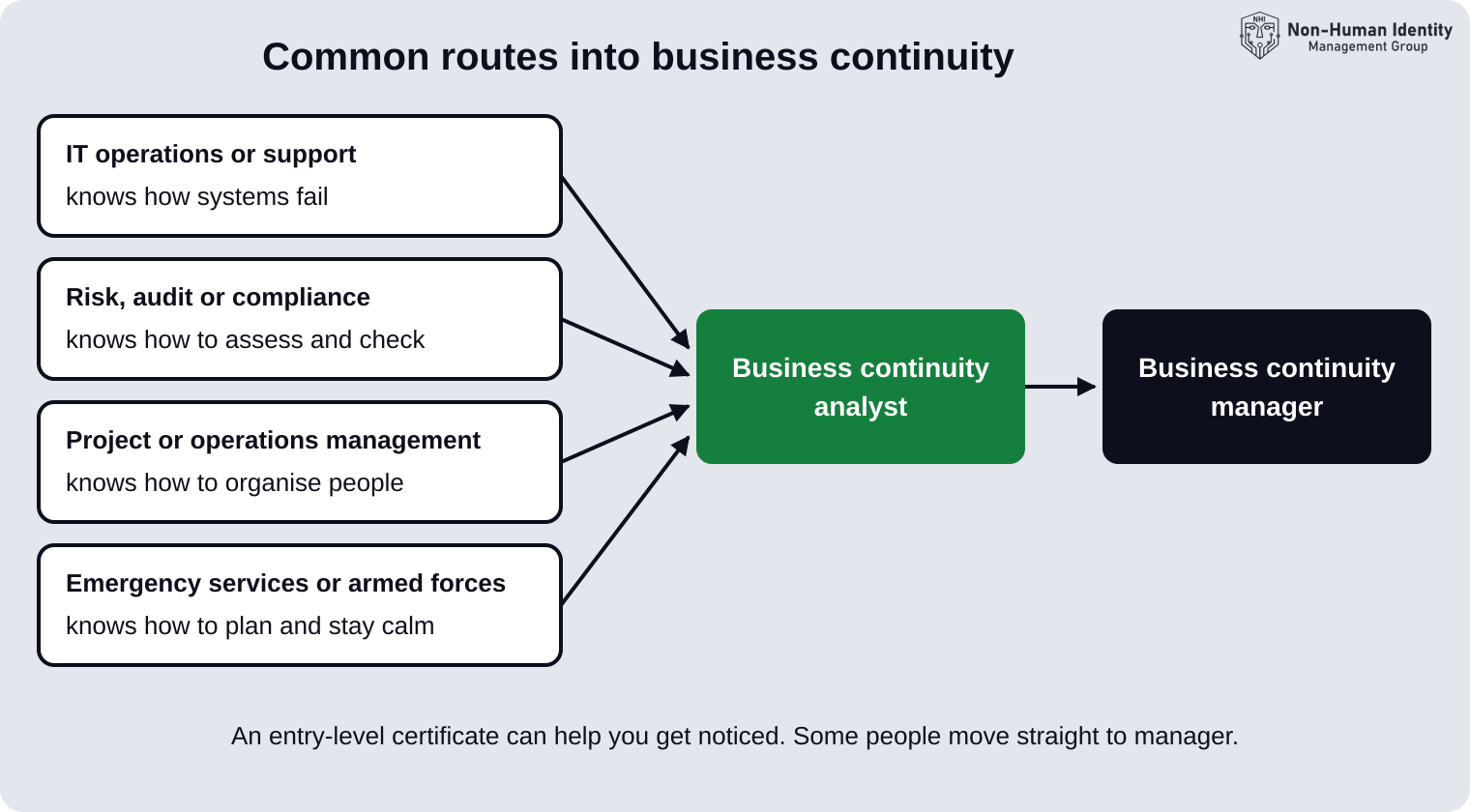
There is no single route. People move across from IT operations, risk, audit, project management, emergency planning and the armed forces. Some start as a continuity analyst or coordinator.
Professional certificates can help. The Business Continuity Institute offers the CBCI exam. It presents the exam as a way to start a career, and states no work experience needed.[3] DRI International offers the ABCP for people with less than two years in the field, and the CBCP for those with more.[4]
For pay, check current job adverts and official careers services in your country, as rates vary widely by sector and region.
A worked example
Lina Bergmann is the business continuity manager at Birch Accountants, a fictional firm with 200 staff. Before this, she ran projects in the IT team.
Her Monday starts with a list. Two plans are due for review this month, and a drill is booked for Thursday.
The first review is payroll. Lina thinks of the spare tyre. Is it really in the boot, and has anyone checked the jack? The plan says staff can pay people by hand. But nobody has written down how.
She books half an hour with the finance lead. Together they write five clear steps for a manual payment run, with the bank's process attached. They agree to try it in the next drill.
On Thursday she runs a table-top exercise with the senior team. The story is simple: the main office systems are down after a cyber attack. Lina reads out updates every ten minutes, and the team talks through what they would do.
The drill shows a gap. Nobody knows who can approve a message to clients. Otto Okafor, the IT lead, also points out that the plan assumes email works.
Lina writes up the lessons that afternoon. Each gap gets an owner and a date. She also adds a printed contact list to the plan.
No real disaster happened this week. But the firm is better prepared than it was on Monday, and that is the job.
Myths and mistakes
| What people think | What is true |
|---|---|
| The job is writing a plan once and filing it. | Plans go stale fast. Much of the work is reviewing, testing and fixing them. |
| You need to be an IT expert. | IT knowledge helps, but planning, writing and people skills matter as much at the start. |
| Business continuity and disaster recovery are the same. | Disaster recovery is about IT systems. Continuity covers people, buildings, suppliers and IT. |
| It is only about floods and fires. | Cyber attacks, cloud outages and supplier failures are now common scenarios too. |
| A certificate is enough to get hired. | It helps, but employers also look for real planning or operations experience. |
What can I do this week?
- Read three business continuity job adverts and note the tasks that repeat.
- Ask whether your own workplace has a continuity plan, and who owns it.
- Write a one-page plan for your own team's most important task.
- Look at the free entry-level material from a professional body in the field.
Checklist
- I can explain the difference between continuity and disaster recovery.
- I know what a business impact analysis is for.
- I can name three common types of disruption.
- I know which of my current skills the job uses.
- I have looked at the main entry-level certificates.
- I have asked someone in the field what their week looks like.
Common questions
Do I need a technical background to work in business continuity?
No, not to start. Many people in the job come from project, risk, audit or operations work. You will need to learn how your firm's systems and suppliers fit together. You can pick that up at work. Planning, writing and people skills matter most at first.
What is the difference between business continuity and disaster recovery?
Disaster recovery is the IT part: getting systems and data back after an outage. Business continuity is wider. It covers people, buildings, suppliers and paper workarounds as well as IT. The two teams work closely. In small firms, one person often does both.
Which certificate should a beginner take?
Start with an entry-level one. The BCI's CBCI exam has no stated experience requirement, and DRI International points people with under two years in the field to its ABCP.[3][4] Compare costs and content before you choose.
How much does a business continuity manager earn?
Pay varies a lot by country, sector and level, so we do not give figures here. Check job adverts in your area. Your country's official careers service may also list pay ranges. Jobs in banking and other closely watched sectors often pay more.
Where can a business continuity job lead?
Common next steps are senior continuity manager, head of resilience or crisis lead. Some people move into risk work, resilience roles in banks, or wider security leadership. The planning skills you build carry across to many other jobs, so the role opens several doors.
Where next?
Ready for the detail? Read the practitioner guide: Business Continuity Certifications. It goes further into exam formats, experience rules, costs and renewal for the main continuity credentials.
Also useful:
- Business Continuity and Resilience Manager Career Guide
- Business Continuity and Disaster Recovery for Beginners
- ISO 22301 Business Continuity Guide
- Crisis Management Guide
- Cybersecurity Careers Guide
Related NHI Mgmt Group resources: Business Continuity Plan Template · Disaster Recovery Testing Guide · Operational Resilience vs Business Continuity
Key terms
- Business continuity
- Keeping an organisation's most important work going, or restoring it quickly, when something goes wrong.
- Business impact analysis
- A study of what would happen if each activity stopped, and how quickly it must be restored.
- Disaster recovery
- The plans and steps for bringing IT systems and data back after an outage.
- Recovery time objective
- The target time for getting an activity or system running again.
- Maximum tolerable downtime
- The longest an activity can stop before the harm becomes unacceptable.
- Tabletop exercise
- A practice session where a team talks through how it would handle a made-up incident.
- Crisis management
- How leaders make decisions and communicate during a serious disruption.
Sources and further reading
- Good Practice Guidelines 7.0. The Business Continuity Institute. https://www.thebci.org/certification-training/good-practice-guidelines-2018.html, accessed 28 Nov 2026.
- BCI Competency Framework. The Business Continuity Institute, May 2020. https://www.thebci.org/news/bci-competency-framework.html, accessed 28 Nov 2026.
- CBCI Exam. The Business Continuity Institute. https://www.thebci.org/certification-training/cbci-exam.html, accessed 28 Nov 2026.
- Certified Business Continuity Professional (CBCP). DRI International. https://drii.org/certification/cbcp, accessed 28 Nov 2026.
- ISO 22301 Business Continuity Management Systems. BSI. https://www.bsigroup.com/en-GB/products-and-services/standards/iso-22301-business-continuity-management/, accessed 28 Nov 2026.