A prompt engineer writes, tests and improves the instructions that tell an AI tool how to behave.
This guide is for students, career changers and anyone curious about AI jobs. You do not need to be a programmer to understand it: if your work uses an AI chat tool or assistant, someone wrote the instructions behind it.
In short
- A prompt engineer writes the hidden instructions and examples that shape how an AI tool answers.
- Most of the job is testing: running many sample questions and scoring the answers against a clear goal.
- Few jobs carry the exact title. The skill is more often part of a wider AI, product or content role.
- Good writing, careful testing and an eye for safety matter more than a particular degree.
What you will learn
- Explain what a prompt engineer does in one sentence.
- Describe the test and improve loop at the heart of the job.
- Spot the safety mistakes a careless prompt can cause.
- Check which skills and first steps could lead you into the work.
- AI instructions (prompt)
- the text given to an AI tool that tells it what to do.
- Hidden instructions (system prompt)
- the standing rules a company gives its AI tool, which users do not usually see.
- Test set (evaluation)
- a set of sample questions and a way to score the answers.
What is a prompt engineer?
Think of writing a brief for a very capable new temp who takes every word literally. A vague brief gets vague work. A clear brief, with an example or two and a list of things not to do, gets much better results.
A prompt engineer writes that brief for an AI tool. The tool is usually built on a large language model (an AI system trained on huge amounts of text to predict and write language). OpenAI calls prompt engineering the process of writing effective instructions for a model.[2] Google adds that a good prompt gives the model context, instructions and examples so it understands what you want.[3]
The engineer then checks whether the brief works. AI answers can vary from one try to the next, so one good answer proves little. They test many questions, score the answers and keep improving.
Where the comparison stops working: a temp can ask what you meant. An AI tool usually just guesses, and it can sound confident even when it is wrong. That is why testing matters so much.
Why does it matter?
An AI tool is only as good as its instructions and its testing. Poor instructions can lead to wrong answers, leaked information or a tool that takes risky actions. As a job title, though, the role is uncommon. One 2025 study of over 20,000 technology job adverts found prompt engineer roles were under half a percent of them.[6]
If you are thinking about this career
What could happen: you train for a job title that few employers use.
Check this: search adverts for the skill, not just the title, and pair it with another strength.
If your team is building an AI assistant
What could happen: the assistant works in a demo, then gives poor answers to real customers.
Check this: ask what test set the prompt was checked against, and how often it is rerun.
If you work in security
What could happen: a prompt holds a password, or the tool obeys hidden text in a document.
Check this: review prompts for secrets and for how outside text is handled.
What does it look like?
Much of the work happens in a simple test log. Here is a made-up entry for a pharmacy's customer help assistant.
Example only. All values are made up.
PROMPT VERSION: helpdesk-v0007-EXAMPLE
Goal:    Answer opening hours and collection questions only  (1)
Tests:   120 sample questions, 15 of them odd or tricky      (2)
Score:   v0006 = 88 of 120 correct   v0007 = 109 of 120      (3)
Failed:  "Can I take two of these together?"                 (4)
Action:  Add rule: send medicine questions to a pharmacist
- The goal, agreed before any writing starts.
- In a real file, this line would contain the number of test questions run, odd ones included.
- The score before and after the last change.
- A question the bot answered. A person should have.
Why this is risky: without tests, nobody would have seen the bot give medicine advice.
The safer way: set limits, test odd cases and send risky questions to a person.
How does it work?
Teams work differently, but the job usually follows a loop like this one.
- Set the goal. Agree what a good answer looks like and how to measure it. Anthropic's guidance says to start with clear success criteria and a way to test against them.[1]
- Write a draft. Write the instructions, often adding a few examples of good answers. These are called few-shot examples.[2]
- Test it. Run a large set of sample questions, including odd ones with typos, sarcasm or sudden changes of topic.[4]
- Score it. Grade the answers by simple code checks, by people, or by a second AI model with clear marking rules.[4]
- Improve and repeat. Change one thing and test again. OpenAI suggests keeping test suites so prompts can be rechecked when the model is upgraded.[2]
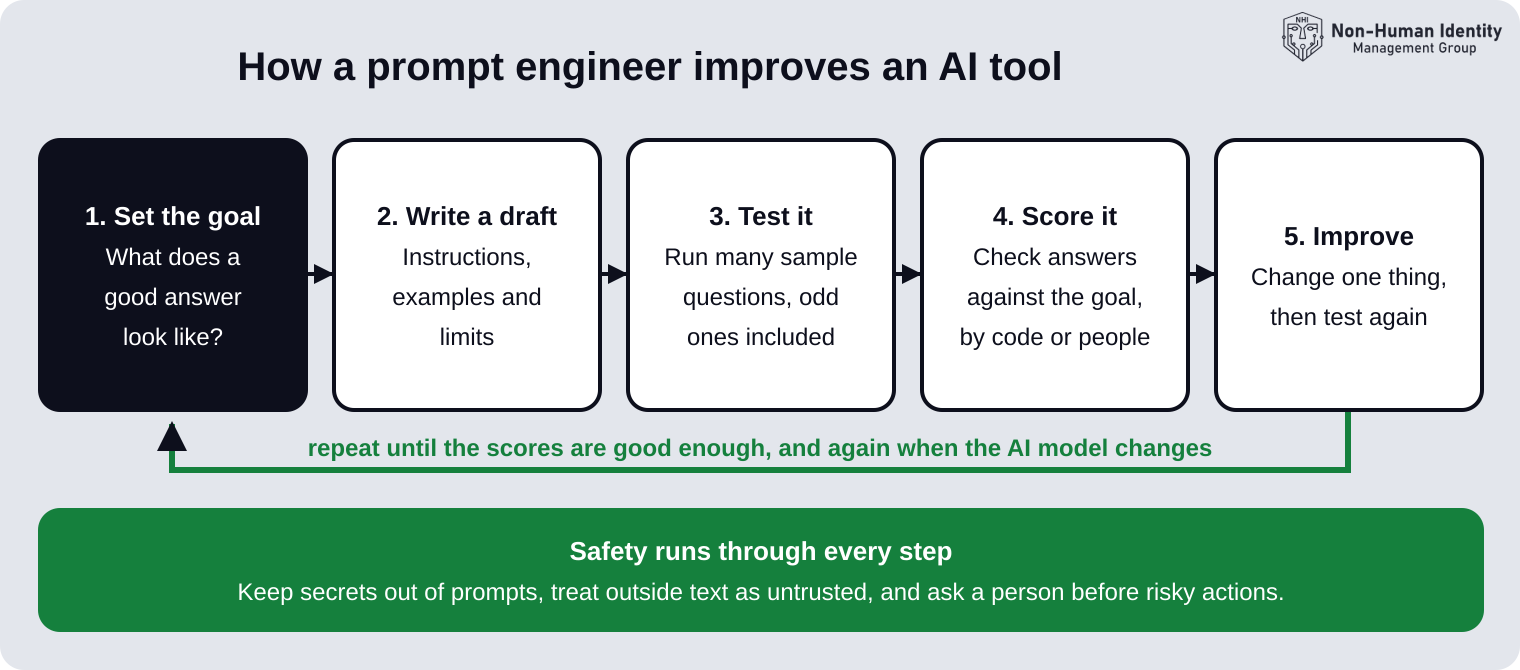
Safety is part of the job too. A security project called OWASP lists prompt injection, where hidden text tricks an AI tool, as a top risk for AI apps. Its advice includes setting clear limits in the instructions, labelling outside content as untrusted and asking a person before risky actions.[5] It also says no method is fully reliable, so these steps lower the risk rather than remove it.[5]
Skills and tools
- Clear writing. Short, exact instructions that leave little room for guessing.
- Testing habits. Building sample questions, keeping scores and changing one thing at a time.
- Knowing the subject. Prompts for a legal or health tool need someone who understands that field, or works closely with someone who does.
- Some technical skill. Many roles use spreadsheets, simple scripts or AI company test tools to run tests at scale.
- Teamwork. The 2025 job advert study found communication and teamwork among the skills employers asked for most.[6]
A worked example
Orla Rosen is a prompt engineer at Elm Pharmacy, a fictional chain of twenty shops. On Monday, her manager Uma Yilmaz asks her to improve the website's help assistant. Customers say it gives muddled answers about collecting prescriptions.
Orla starts with the goal, not the prompt. With Uma, she agrees the assistant should answer questions about opening hours and prescription collection, and send everything else to a person.
On Tuesday she builds a test set. It holds 120 sample questions taken, with names removed, from real customer emails. She adds tricky ones: typos, angry messages and a question about mixing two medicines.
She runs the current instructions. They score 88 out of 120. The worst failure is the medicine question. The assistant tried to answer it, when a pharmacist should.
On Wednesday she rewrites the instructions. She adds a clear rule that health questions go to a pharmacist, and two example answers. The new version scores 109. She checks the misses one by one.
On Thursday a colleague from security reviews her work. He spots that an old draft held a test password for the stock system. Orla removes it, and they ask the system's owner to change it.
On Friday she writes up the changes for Uma in plain words. She also books a retest for when the AI supplier releases its next model. The job is never quite finished, because the model and the questions keep changing.
Myths and mistakes
| What people think | What is true |
|---|---|
| Prompt engineering is about finding magic words. | It is mostly patient testing against a clear goal, then small changes.[1] |
| Lots of companies hire people called prompt engineers. | The exact title is rare in job adverts. The skill often sits inside other roles.[6] |
| If it worked once, it works. | AI answers vary, so you need many test questions and a score.[2] |
| Putting a password in the prompt is fine because users cannot see it. | Hidden instructions can leak. Keep secrets out of prompts and in proper secure storage. |
| A strong prompt makes the tool safe. | Instructions help, but no method is fully reliable. Add limits and human checks too.[5] |
What can I do this week?
- Work through a free prompting guide from an AI company, such as Anthropic's or OpenAI's.
- Pick one task, write ten test questions and score two versions of your prompt.
- Read about prompt injection so you know the main safety risk.
- Search job adverts for "prompt" as a skill and note which roles ask for it.
- Write up one small test as a short case study for your portfolio.
Checklist
- I can explain what a prompt and a system prompt are.
- I set a clear goal before writing a prompt.
- I test prompts on many sample questions, including odd ones.
- I keep a score and change one thing at a time.
- I never put passwords or keys into a prompt.
- I treat text from outside, such as web pages or files, as untrusted.
- I have one other strength to pair with prompting, such as a subject, writing or coding.
Common questions
Do I need to know how to code?
Not always, but it helps. You can learn prompting and testing with a chat tool and a spreadsheet. Many roles, though, expect simple scripts to run hundreds of tests or connect the AI tool to other systems. A little coding widens the jobs open to you.
Is prompt engineering a real job?
Yes, but the exact title is uncommon. A 2025 study found it in under half a percent of the technology job adverts it reviewed. More often, the skill is part of a wider role, such as AI engineer, product designer, content designer or AI security tester.
How much does a prompt engineer earn?
Pay varies a lot. It depends on the country, the employer and how technical the role is. We do not quote figures here. Check official careers services and current job adverts in your area for up-to-date pay ranges.[7]
How is this different from an AI security engineer?
A prompt engineer makes an AI tool give good, useful answers. An AI security engineer focuses on keeping AI tools safe from attack and misuse. The two jobs overlap on safe prompts and testing, and they often work together.
How do people get into this work?
Usually from a neighbouring job. Writers, support staff, testers, analysts and developers often pick up prompting while building AI tools at work. A small portfolio of tested prompts, with scores and lessons learned, can show the skill better than a certificate.
Where next?
Ready for the detail? Read the practitioner guide: Fine-Tuning vs Prompt Engineering. It goes further into when better prompts are enough, when to retrain a model instead and how to compare the cost and risk of each.
Also useful:
- Prompting Basics for Beginners
- Prompt Injection for Beginners
- How Large Language Models Work
- AI Security Engineer for Beginners
- AI Security Engineer Career Guide
Related NHI Mgmt Group resources: Secrets in Prompts · AI Hallucinations for Beginners · OWASP Top 10 for LLM Applications for Beginners
Key terms
- Prompt engineering
- Designing, testing and maintaining the instructions that shape how an AI model behaves.
- System prompt
- The standing instructions that set an AI tool's behaviour, limits and style.
- Large language model
- An AI system trained on large amounts of text to write and transform language.
- Few-shot examples
- A handful of sample questions and good answers placed in a prompt to show the AI what you want.
- Evaluation
- A set of test questions and a way of scoring the answers, used to check a prompt works.
- Hallucination
- An AI answer that sounds right but is wrong or made up.
Sources and further reading
- Prompt engineering overview. Claude Docs, Anthropic. https://platform.claude.com/docs/en/build-with-claude/prompt-engineering/overview, accessed 28 Nov 2026.
- Prompt engineering. OpenAI API documentation, OpenAI. https://developers.openai.com/api/docs/guides/prompt-engineering, accessed 28 Nov 2026.
- What is prompt engineering? Google Cloud. https://cloud.google.com/discover/what-is-prompt-engineering, accessed 28 Nov 2026.
- Define success criteria and build evaluations. Claude Docs, Anthropic. https://platform.claude.com/docs/en/test-and-evaluate/develop-tests, accessed 28 Nov 2026.
- LLM01:2025 Prompt Injection. OWASP Gen AI Security Project. https://genai.owasp.org/llmrisk/llm01-prompt-injection/, accessed 28 Nov 2026.
- Vu Quoc, A. and Oppenlaender, J. Prompt Engineer: Analyzing Hard and Soft Skill Requirements in the AI Job Market. arXiv:2506.00058v2, University of Oulu (LinkedIn adverts collected April 2025). https://arxiv.org/html/2506.00058v2, accessed 28 Nov 2026.
- Explore careers. National Careers Service (England). https://nationalcareers.service.gov.uk/explore-careers, accessed 28 Nov 2026.