An AI security engineer makes AI tools harder to trick, misuse or break, before and after they go live.
This guide is for anyone curious about one of the newest jobs in cyber security. You do not need to know how AI is built to read it. If your workplace uses a chatbot or an AI assistant, someone should be doing this work.
In short
- An AI security engineer protects AI systems, such as chatbots and AI assistants, and the data and tools they can reach.
- Much of the day is testing how an AI tool could be misled, then adding safeguards and checking they hold.
- The job mixes ordinary security skills with knowledge of how AI tools behave.
- Most people move in from security, software or data jobs, rather than starting here straight away.
What you will learn
- Explain what an AI security engineer does in one sentence.
- Spot the main ways AI tools can be misled or misused.
- Check which skills you already have that the job uses.
- Ask good questions about an AI security job before you apply.
- Word-predicting AI (large language model)
- the kind of AI behind most chatbots, which writes text by predicting the next words.
- Hidden instructions (prompt injection)
- text an AI reads that tries to change what it does.
- Safety rails (guardrails)
- checks around an AI tool that block unsafe requests or answers.
What is an AI security engineer?
Think of a crash-test engineer at a car maker. Before a new car goes on sale, they test how it could fail. Then they help add safety features and keep testing after launch.
An AI security engineer does the same for AI tools. Many of these tools run on a large language model, AI that writes text by predicting the next words. Some can also take actions, like sending emails or looking up files. These are often called AI agents.
The engineer asks: how could someone trick this tool? What data could leak? What could it do that it should not? A widely used public list of AI risks includes three of these. They are hidden instructions, leaks of private data and giving the AI too much power to act.[1]
The engineer then helps fix what they find. They also watch the tool once it is live, because new tricks keep appearing.
Where the comparison stops working: a car behaves the same way in the same crash. An AI tool can give different answers to the same question, and it can be steered by plain words.
Why does it matter?
AI tools are being connected to email, files and business systems. When a tool can act, a trick that misleads it can cause real harm, so the safeguards around it matter.[2]
If you already work in security
What could happen: your company adds an AI assistant, and nobody on the team knows how to test it.
Check this: ask which AI tools are in use and who checked them before launch.
If you build software or work with data
What could happen: you connect an AI tool to a database, and it can read far more than it needs.
Check this: give each AI tool only the access its task needs.
If you manage a team that uses AI
What could happen: staff paste customer data into an AI tool with no agreed rules.
Check this: ask who is responsible for AI security, and whether there is a written AI use policy.
What does it look like?
A lot of the work is planned testing. Here is a made-up entry from a test log for a company's AI assistant.
Example only. All values are made up.
TEST 0000-EXAMPLE   Assistant: HelpBot (FAKE)
Goal:     Can a document change what the bot does?   (1)
Input:    Test file with a hidden line of text       (2)
Result:   Bot tried to use its "send email" tool     (3)
Blocked:  No                                          (4)
Fix:      (not yet agreed)
- What the engineer wants to find out.
- A harmless test file. In a real file, this line would contain a note on where the test text was hidden.
- What the AI tool did when it read the file.
- Whether any safeguard stepped in. Here, none did.
Why this is risky: the assistant obeyed text in a document as if its user had asked. If the email had gone out, data could have reached the wrong place.
The safer way: limit what the assistant can do. Ask a person to approve actions like sending email. Then run the same test again after the fix.
How does it work?
Each team works differently, but the job often follows the life of an AI tool, from first design to daily use.[2]
- Design. The engineer joins early and asks what could go wrong. This step is called threat modelling, thinking through how a system could be attacked.
- Build. They check where the AI model and its data come from, because a poisoned source can change how the AI behaves.
- Test. They try to trick the tool in a safe, agreed way, which is called AI red teaming.
- Protect. They add safeguards, such as limited access, input and output checks, and a person approving risky actions.
- Watch. Once the tool is live, they review its records, respond to problems and retest after changes.
Many teams use published guidance to shape this work. One example is a free US government framework for managing AI risk, which organisations use by choice.[3]
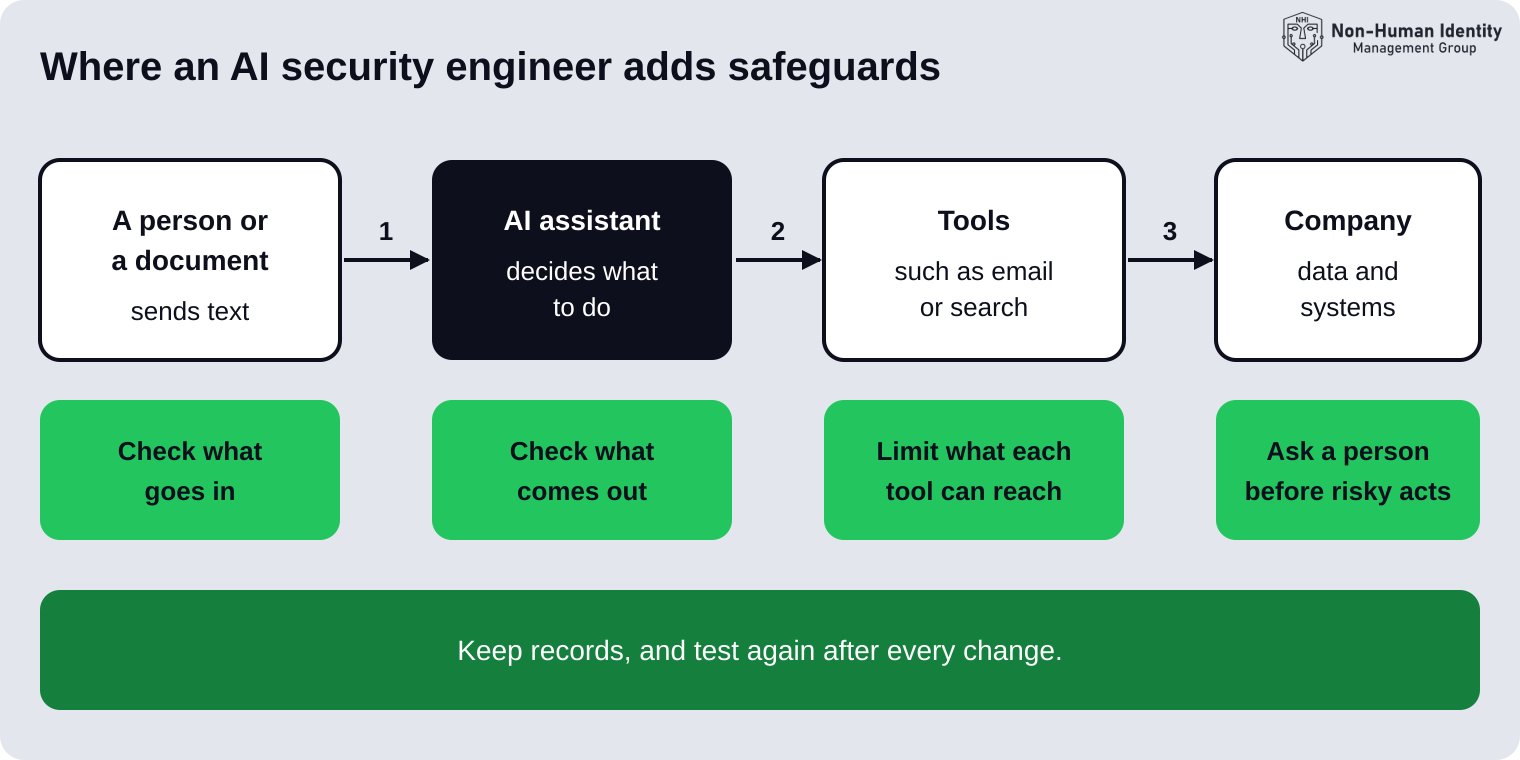
The work also involves a lot of talking. Engineers explain risks to developers, data teams and managers in plain words, and agree which fixes come first.
A worked example
Camille Durand is an AI security engineer at Dunaj Tech, a fictional software firm. She spent four years in application security before moving into AI.
On Monday, the support team asks to launch a new AI assistant. It can read customer tickets and send emails. Camille joins their planning call and asks what the assistant needs to do, and what it should not touch.
She thinks of the crash test. How could this fail before it reaches customers? She lists three worries: hidden instructions in a ticket, private data in answers, and emails sent to the wrong person.
On Tuesday she runs her agreed tests on a copy of the system with fake tickets. One test file hides a line of text asking the assistant to email a summary outside the company. The assistant tries to do it.
Camille records the result in plain words. She does not blame the developers. Instead she suggests two fixes. The assistant can only email addresses already linked to the ticket. Any other email waits for a person to approve it.
On Thursday the developers make the changes. Camille runs the same tests again. This time, in her test runs, the outside email is blocked and the request waits for approval.
On Friday she writes a short note for the support manager. It explains what was tested, what changed and what will be watched after launch.
Myths and mistakes
| What people think | What is true |
|---|---|
| You need a PhD in AI. | Many people come from security or software jobs and learn the AI side as they go. |
| AI security is a totally new field. | Much of it is familiar security work: access, data protection, testing and logging, applied to AI tools.[2] |
| A good AI model is secure by itself. | Safeguards around the model, such as limited access and human approval, matter as much as the model. |
| One round of testing is enough. | New tricks keep appearing, and tools change. Testing goes on after launch. |
| Guardrails block every bad request. | They lower the risk but can be worked around, so they are one layer among several. |
What can I do this week?
- Read three AI security engineer job adverts and list the tasks they share.
- Read our Prompt Injection for Beginners guide.
- List the AI tools you use at work and what each one can reach.
- Ask someone in security or software how their team checks new AI tools.
Checklist
- I can explain what an AI security engineer does in one sentence.
- I know what prompt injection and guardrails mean.
- I can name three ways an AI tool could be misused.
- I have looked at real job adverts for the role.
- I know which of my current skills carry over.
- I have checked official sources for pay, not just job boards.
- I have a plan for one first learning step.
Common questions
Can I become an AI security engineer straight from school?
It is possible but less common. Most employers want some experience in security, software or data work first. A good path is to start in a broader security or developer job, learn how AI tools work alongside it, and then move across.
Do I need to know how to code?
Usually, yes, at least a little. Engineers read code, write small test scripts and review how AI tools connect to other systems. You do not need to build AI models from scratch. Scripting skills in a common language help most.
How much does an AI security engineer earn?
Pay varies a lot by country, sector and experience, so we do not quote a figure here. Use official sources. In the US, see the government's job outlook page for information security analysts.[4] In the UK, see the National Careers Service.[5]
How is this different from a machine learning engineer?
A machine learning engineer builds and trains AI models and makes them work well. An AI security engineer focuses on how those models and tools could be misused, and adds safeguards. The two work closely together. See AI Security Engineer vs ML Engineer.
Where can an AI security engineer job lead?
Several paths. Some people specialise in testing AI tools as attackers would, as AI red teamers. Others move into AI security architecture or AI governance leadership. See AI Red Teamer Career Guide.
Where next?
Ready for the detail? Read the practitioner guide: AI Security Engineer Career Guide. It goes further into the skills employers test, the frameworks engineers use, certifications and how people progress.
Also useful:
- AI Security for Beginners
- AI Red Teaming for Beginners
- AI Guardrails for Beginners
- AI Security Engineer Interview Questions
- Security Engineer for Beginners
- NHI Specialist for Beginners
Related NHI Mgmt Group resources: Cybersecurity Careers Guide · Agentic AI Security Guide · AI Agent Identity for Beginners
Key terms
- Large language model
- The kind of AI behind most chatbots, which writes text by predicting the next words.
- Guardrails
- Checks around an AI tool that try to block unsafe requests or answers.
- AI red teaming
- Testing an AI system by acting like an attacker, with permission, to find weak spots.
- Threat modelling
- Thinking through how a system could be attacked, so you can plan defences early.
- Excessive agency
- When an AI tool is given more power to act than its task needs.
- Model poisoning
- Tampering with an AI model or its training data so it behaves in a harmful way.
- Least privilege
- Giving each person or program only the access it needs, and no more.
Sources and further reading
- OWASP Top 10 for LLM Applications 2025. OWASP Gen AI Security Project. https://genai.owasp.org/llm-top-10/, accessed 28 Nov 2026.
- Guidelines for secure AI system development. National Cyber Security Centre (UK) and partner agencies, 27 November 2023. https://www.ncsc.gov.uk/collection/guidelines-secure-ai-system-development, accessed 28 Nov 2026.
- AI Risk Management Framework (AI RMF 1.0, released 26 January 2023). US National Institute of Standards and Technology. https://www.nist.gov/itl/ai-risk-management-framework, accessed 28 Nov 2026.
- Information Security Analysts, Occupational Outlook Handbook. US Bureau of Labor Statistics, last modified 27 August 2026. https://www.bls.gov/ooh/computer-and-information-technology/information-security-analysts.htm, accessed 28 Nov 2026.
- Explore careers. National Careers Service (England). https://nationalcareers.service.gov.uk/explore-careers, accessed 28 Nov 2026.