Trust and safety is the work online platforms do to protect users from fraud, fake accounts and abuse.
This guide is for career changers, students and product managers who want to know what trust and safety teams do. It keeps to fraud and fake accounts. If you build or run any app where people sign up, post or trade, this work affects you.
In short
- Trust and safety teams write a platform's rules and act when people break them.
- Fake accounts are often made in bulk by software and used for spam, scams and fake reviews.
- Teams use automatic checks, user reports and human review together.
- Good teams also let users appeal, and they measure how well their checks work.
What you will learn
- Explain what trust and safety means in one sentence.
- Spot common signs of a fake account.
- Describe the steps a team takes from report to decision.
- Name the main jobs inside a trust and safety team.
- Platform rules (policy)
- the written rules that say what users may and may not do.
- Taking action (enforcement)
- what a platform does when someone breaks the rules, such as a warning or a ban.
- Second look (appeal)
- a request from a user to review a decision made about them.
What is trust and safety?
Think of the stewards at a big weekend market. They check that traders are who they say they are. They move on fake stalls and deal with complaints from shoppers.
Online platforms need the same kind of care. A platform is a website or app where people sign up and deal with each other. Examples include a marketplace, a review site or a social app. Trust and safety is the name for the field and the teams that manage the risks people can cause each other there.[1]
The field started out catching spammers and trolls. It has since grown into a large area of work.[2] This guide looks at one big part of it: fraud and fake accounts.
A fake account is an account that does not belong to a real person acting honestly. Some are made by hand. Many are made in bulk by software that fills in sign-up forms over and over.[4]
Where the comparison stops working: market stewards can see every stall with their own eyes. An online platform may have millions of accounts, so most first checks are done by software.
Why does it matter?
Fake accounts are rarely made for fun. They are used to send spam, spread harmful software, move stolen money and push fake reviews.[4]
If you are thinking about a career change
What could happen: you skip the field because you think it needs a coding background.
Check this: many roles are about judgement, writing clear rules and reviewing cases carefully.
Next: Fraud Analyst
If you are a product manager
What could happen: a new sign-up form is easy for people and just as easy for bots.
Check this: ask the trust and safety team to review new sign-up and posting features before launch.
If you run a small online business
What could happen: fake reviews of your shop, good or bad, mislead your customers.
Check this: never buy reviews or followers. In the US, a rule on fake reviews now applies.[5]
What does it look like?
When a check flags an account, a reviewer often sees a short case card. Here is a made-up one.
Example only. All values are made up.
Case 0000-FAKE   Queue: new seller accounts
Account: quickmoves-EXAMPLE    Created: 2 days ago
Email: [email protected]               (1)
Same device as 14 other new accounts            (2)
Listings: 30 posted in 1 hour                   (3)
Reports from users: 3 ("asked me to pay off-site")  (4)
Suggested action: pause listings, ask for ID check
- A new email address on its own proves little. Reviewers look at it with other signs.
- Many new accounts from one device can point to one person or one script making them.
- Posting far faster than a normal new seller is a common warning sign.
- Asking buyers to pay outside the platform is a common scam pattern.
Why this is risky: each sign alone could be innocent. Together, they suggest someone may be setting up to cheat buyers.
The safer way: the reviewer pauses the account and asks for a check, rather than banning it at once. A real seller can pass the check. The decision and the reason are recorded.
How does it work?
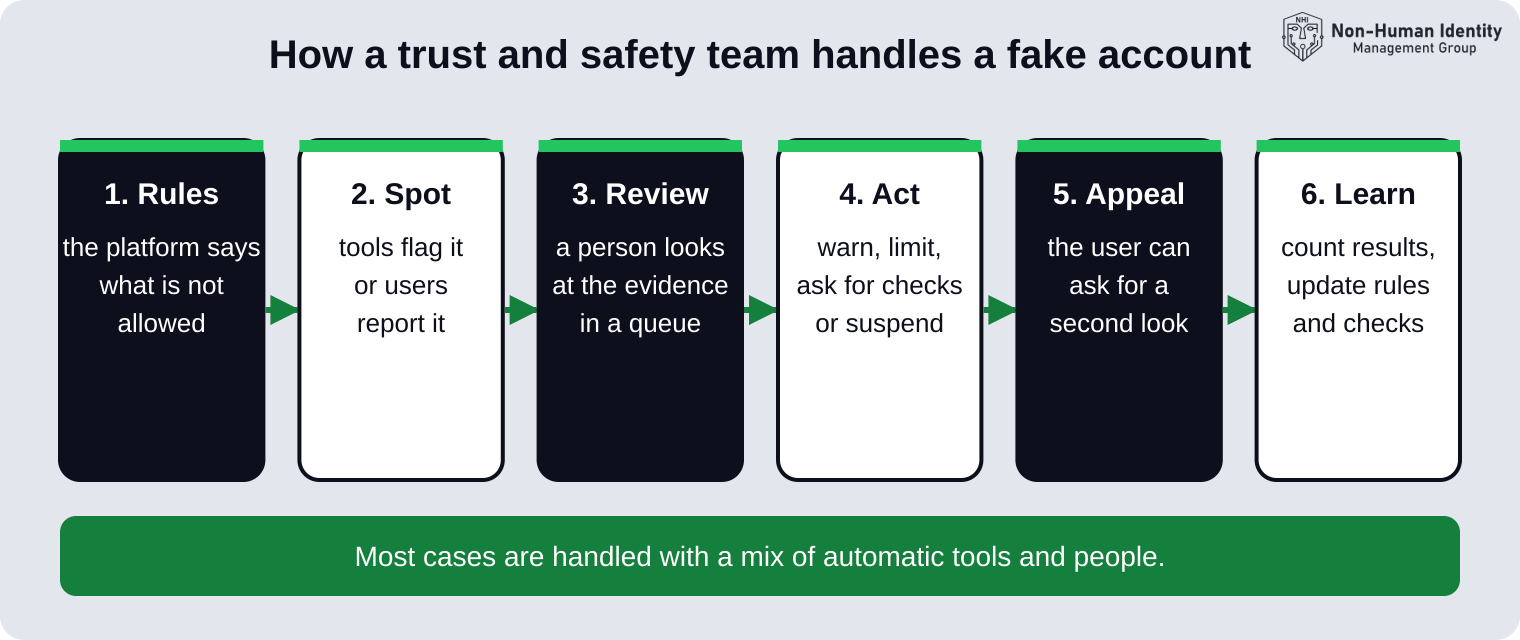
Most teams follow a loop like this.
- Write the rules. The policy team writes what is and is not allowed on the platform.[2]
- Spot problems. Software checks new sign-ups and account activity for warning signs. Users can also report accounts that worry them.
- Review. People check the cases software is unsure about. Work can be done by people, by automatic tools or by both.[6]
- Act. The team chooses a step that fits the risk, such as a warning, limits on the account or a suspension.[1]
- Allow an appeal. The user can ask for the decision to be looked at again.[1]
- Learn and report. The team counts what it found, updates its checks and may publish a transparency report, a regular public summary of its results.[1]
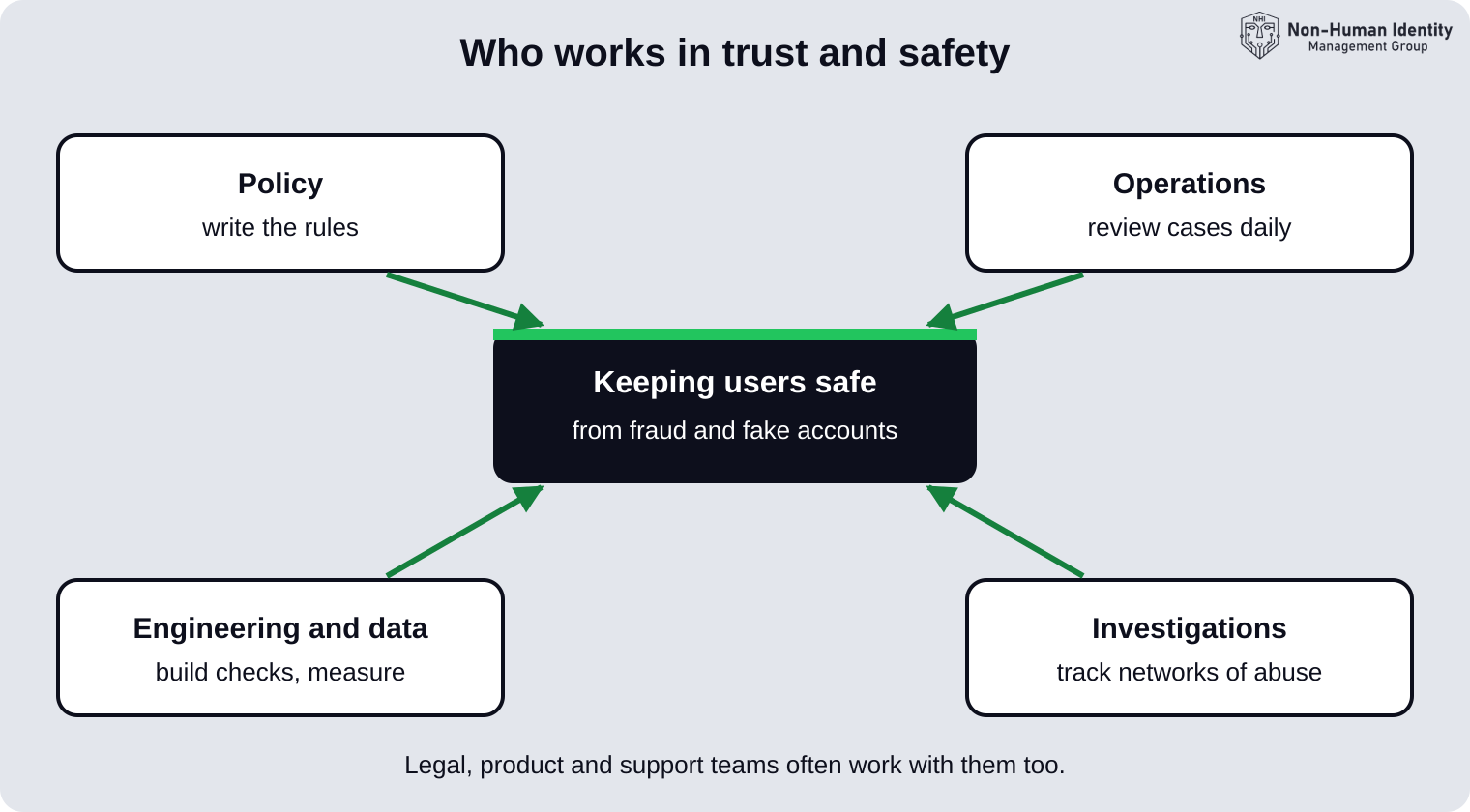
Many different people do this work. A team can include people who write the rules and people who review cases. It can also include investigators who track groups of cheats. Engineers build the checks, and data staff measure the results.[3]
A worked example
Dario Engel has just joined the trust and safety team at a fictional online marketplace for local services. People use it to book cleaners, painters and removal firms.
On Monday a customer, Wren Achterberg, reports a seller. The seller took a deposit by bank transfer, outside the site, and then stopped replying. The seller's profile copied photos from Rowan Removals, an honest firm on the same site.
Dario opens the case. The software has already linked this account to nine others made on the same device in one week. All of them use photos copied from other firms.
He checks the team's rules. Taking payment off the site and pretending to be another business both break them. He suspends all ten accounts and records the reason for each one.
Then he tells Rowan Removals that its photos were copied. He also sends Wren's case to the payments team, so they can help her with her bank.
On Wednesday one of the ten accounts appeals. Dario's team lead, Darius Kowal, gives it a second look. The account belongs to a real painter who shared a laptop at a library. Darius restores it and adds a note to the case.
At the end of the week, Dario and Darius suggest a new check. New sellers who post many listings in their first hour will be asked to verify their identity before the listings go live. The team agrees to try it for a month and measure the results.
Myths and mistakes
| What people think | What is true |
|---|---|
| Trust and safety is just deleting bad posts. | It also covers fraud, fake accounts, rules, investigations and measuring results. |
| Software can handle it all. | Most teams mix automatic checks with human review, especially for unclear cases. |
| Ban first, ask questions later. | Mistakes happen. A fair appeal lets real users get back in. |
| Hard sign-up checks fix fake accounts. | Heavy checks also put off real users. Teams match the check to the risk. |
| You need to be a programmer to work in it. | Many roles focus on policy, review, investigation or writing for users.[3] |
What can I do this week?
- Read the community rules of one app you use and note what it says about fake accounts.
- Find out how to report a suspicious account on that app.
- Look up one platform's transparency report and see what it counts.
- If you build products, ask who reviews new sign-up features for abuse.
Checklist
- The platform has written rules on fake accounts and scams.
- Users can report an account in a few clicks.
- Sign-ups and new activity are checked for warning signs.
- Unclear cases go to a person, not just to software.
- Each action is recorded with the reason.
- Users can appeal a decision and get an answer.
- The team measures results and updates its checks.
Common questions
Is trust and safety part of cyber security?
Partly. Both protect users, and they often work together. Cyber security mainly protects systems and data from attack. Trust and safety mainly deals with people who misuse a platform's normal features. Examples are fake sign-ups and scams run through listings or messages.
How do platforms spot fake accounts?
Usually by looking at many small signs together. These can include how fast an account acts, whether it shares a device with other new accounts and what users report. No single sign proves an account is fake, so unclear cases go to a person.
Do I need a degree to work in trust and safety?
Not always. Roles vary a lot. Some focus on reviewing cases, some on writing rules and some on data or engineering. Careful judgement, clear writing and an eye for patterns help in most of them. Check each job advert for what it asks for.
What happens if my account is banned by mistake?
Use the platform's appeal option, which is usually linked in the message or the help pages. Explain your case clearly and calmly. An appeal asks the platform to review its decision, and a fair process should give you an answer.
Is buying followers or reviews against the rules?
Usually yes. Many platforms ban it in their rules. In the US, a 2024 rule from the Federal Trade Commission also bans fake reviews. It also bans buying fake followers to look more popular for business reasons. Check the rules where you live.
Where next?
Ready for the detail? Read the practitioner guide: Fake Account Creation and Sign-up Fraud Guide. It goes further into the signals available at sign-up, layered controls chosen by risk and how to measure what gets through.
Also useful:
- Bots and Bot Traffic for Beginners
- Account Takeover for Beginners
- Account Takeover vs New Account Fraud
- Fraud Analyst
Related NHI Mgmt Group resources: Fraud Prevention Guide for Digital Businesses · Identity Proofing and KYC Guide · Fraud Prevention Glossary
Key terms
- Trust and safety
- The field and teams that manage the risks users of an online platform can cause each other.
- Fake account
- An account that does not belong to a real person acting honestly, often made in bulk by software.
- Policy
- The written rules that say what users may and may not do on a platform.
- Enforcement
- The action a platform takes when someone breaks its rules.
- Appeal
- A user's request for a platform to review a decision about them.
- Transparency report
- A regular public summary of how a platform handles risks and rule-breaking.
Sources and further reading
- Trust and Safety Glossary of Terms. Digital Trust and Safety Partnership. https://dtspartnership.org/glossary/, accessed 28 Nov 2026.
- Trust and Safety Fundamentals. Trust and Safety Professional Association (TSPA). https://www.tspa.org/curriculum/ts-fundamentals/, accessed 28 Nov 2026.
- Key Functions and Roles. Trust and Safety Professional Association (TSPA). https://www.tspa.org/curriculum/ts-curriculum/functions-roles/, accessed 28 Nov 2026.
- OAT-019 Account Creation. OWASP Automated Threats to Web Applications, OWASP Foundation. https://owasp.org/www-project-automated-threats-to-web-applications/assets/oats/EN/OAT-019_Account_Creation, accessed 28 Nov 2026.
- Federal Trade Commission Announces Final Rule Banning Fake Reviews and Testimonials. US Federal Trade Commission, 14 August 2024. https://www.ftc.gov/news-events/news/press-releases/2024/08/federal-trade-commission-announces-final-rule-banning-fake-reviews-testimonials, accessed 28 Nov 2026.
- Content Moderation and Operations. Trust and Safety Professional Association (TSPA). https://www.tspa.org/curriculum/ts-fundamentals/content-moderation-and-operations/, accessed 28 Nov 2026.