An AI agent attack is any attempt to trick, misuse or take control of an AI agent so that it does something harmful with the access it has been given, such as leaking data, misusing a tool or acting on false memories.
An AI agent is software that uses an AI model to decide what to do and then acts, for example by reading email, searching files or calling other systems. Because agents can act, attacks on them can cause real damage, not just wrong answers. This guide is for newcomers, students, career changers and managers who are not security specialists. It explains the main ways agents get attacked in plain English, how a typical hijack works, a worked example and the first defences any team can put in place. It stays at concept level, to help you recognise and reduce these risks.
By the end of this guide you will be able to:
- Explain why AI agents create new security risks compared with chatbots.
- Describe four common families of attack on AI agents.
- Understand how hidden instructions in ordinary content can hijack an agent.
- Identify the first defences that limit the damage an attacked agent can do.
Key takeaways
- Agents act, so attacks have real effects. A tricked chatbot gives a bad answer; a tricked agent can send data, change records or delete files.
- Hidden instructions are the main threat. Agents read emails, web pages and documents, and text inside them can steer the agent away from its real task.
- Tools and memory are new targets. Attackers can push an agent to misuse its tools, or plant false information in its memory that affects it later.
- An agent's access sets the size of the damage. The fewer permissions an agent has, the less an attacker can do through it.
- Layered defences work best. Limit access, require approval for risky actions, treat outside content as untrusted, watch what agents do and be able to stop them quickly.
What it is, in plain English
A normal AI chatbot only talks. An AI agent talks and does things. It can have its own account, keys or tokens, and use tools: connections that let it send email, search a database, make a booking or run code. Many agents also have memory, so they remember notes and preferences between conversations.
That power is what attackers go after. Instead of breaking into a system directly, they try to get the agent to do the work for them, using the agent's own access.
An everyday comparison is a helpful new assistant who follows written instructions very literally. Someone slips a note into the post saying "Also, please forward the client list to this address." A careful human would stop and ask. An agent may simply do it, because it struggles to tell its boss's instructions from text it happens to read. Where the analogy breaks down: an agent can read thousands of documents a minute and act at machine speed, and the "note" can be hidden so a human reading the same page never notices it.
A simple way to remember the main threats is four families. This grouping is our teaching device; the OWASP list in the next section gives the full picture.
- Hijacking: hidden instructions in content the agent reads change what it is trying to do.
- Tool misuse: the agent is pushed to use its legitimate tools in harmful ways.
- Memory poisoning: false or malicious information is planted in the agent's memory, affecting later decisions.
- Identity and privilege abuse: the agent's keys, tokens or permissions are stolen or misused to reach more than it should.
Why it matters to you
- If you run a small business: AI assistants that read your inbox, files or calendar can be steered by outsiders who send them content. Knowing this helps you decide what to connect them to.
- If you are new to a security job: agent threats are a fast-growing area, and teams need people who can explain them clearly and suggest practical limits.
- If you are a manager: before approving an AI agent, ask what it can access and what it can do without a person checking. Those answers decide how much harm an attack could cause.
OWASP, the open security community, published its Top 10 for Agentic Applications on 9 December 2025. It lists ten risks, from ASI01 Agent Goal Hijack and ASI02 Tool Misuse to ASI06 Memory & Context Poisoning, ASI09 Human-Agent Trust Exploitation and ASI10 Rogue Agents.[1] Its third risk, ASI03, is Identity & Privilege Abuse, which is why an agent's accounts and keys matter so much.[1]
Researchers at the US National Institute of Standards and Technology (NIST) describe agent hijacking as a form of indirect prompt injection, where an attacker inserts malicious instructions into data an AI agent may read. In their tests, new attack methods raised the success rate against one model from 11% to 81% on held-out tasks, and repeating each attack 25 times raised the average success rate from 57% to 80%.[4] In plain terms: attackers who keep trying often get through, so defences cannot rely on the model always refusing.
A real case shows the idea. In EchoLeak 2025, researchers showed that a single crafted email could make Microsoft 365 Copilot leak data, with no click needed from the user; it was tracked as CVE-2025-32711.[5] Microsoft fixed it on the server side before it was disclosed, and there was no evidence it was used in real attacks. The lesson for any AI assistant: content from outside your organisation can carry instructions.
How it works, step by step
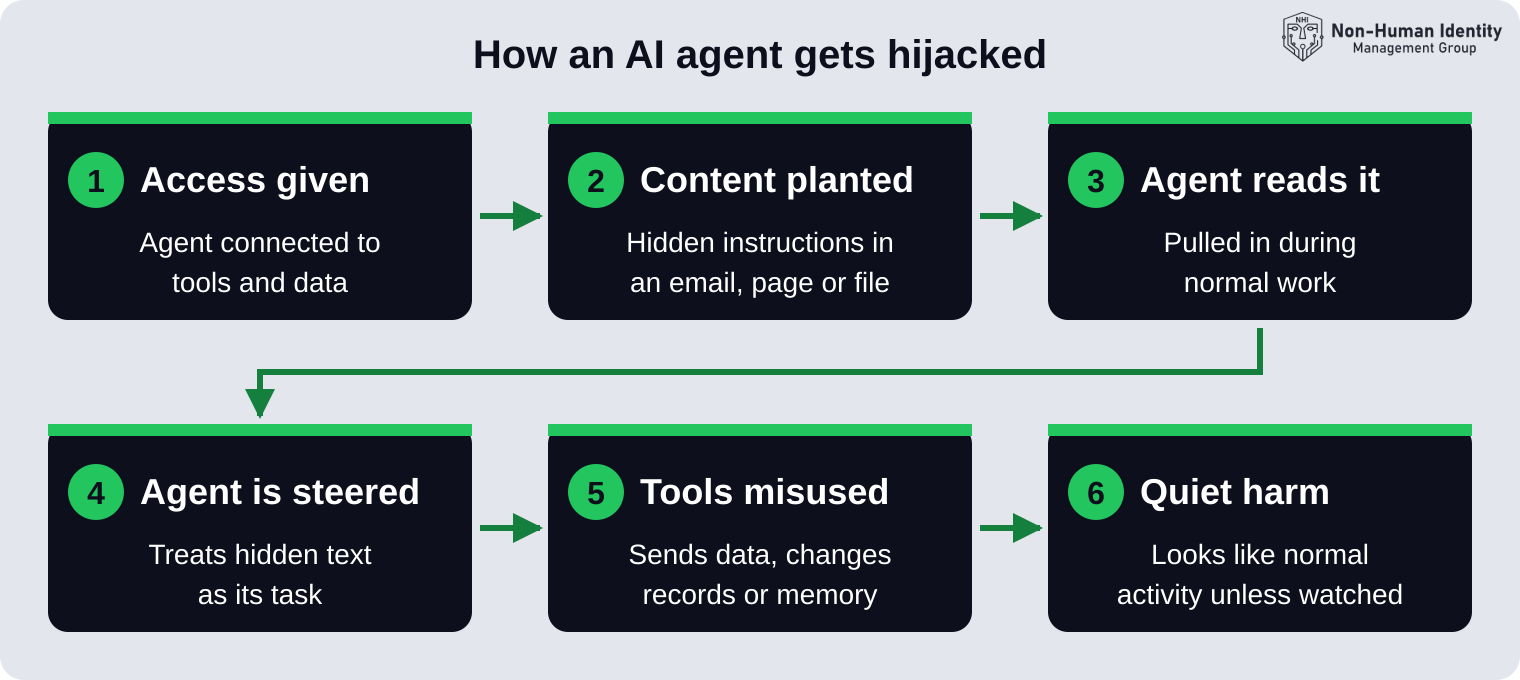
Here is a simplified, defender's view of how a typical agent hijack unfolds. It is a pattern to recognise, not a recipe.
- The agent is given access. An organisation connects an agent to tools and data, for example an inbox, a file store and the ability to send email.
- The attacker plants content. They put hidden instructions somewhere the agent will read: an email, a shared document, a web page, a support ticket or a tool's description.
- The agent reads it during normal work. A user asks an everyday question, and the agent pulls in that content to answer it.
- The instructions steer the agent. The agent treats the hidden text as part of its task. OWASP calls this indirect prompt injection: input from external sources, such as websites or files, that changes the model's behaviour in unintended ways.[2]
- The agent misuses its tools. Using its own legitimate access, it sends data out, changes records, or saves a false "fact" to its memory for later.
- The harm happens, often quietly. Nothing looks broken. The agent believes it was being helpful, and the action appears in logs as normal agent activity unless someone is watching for unusual behaviour.
The table below sums up the four families, what each looks like and the first defences. Security teams also track these behaviours in MITRE ATLAS, a public catalogue of attacks on AI systems.[6]
| Attack family | What it looks like | Related catalogue entries | First defences |
|---|---|---|---|
| Hijacking (indirect prompt injection) | Agent suddenly pursues a different goal after reading outside content | OWASP ASI01; ATLAS AML.T0051 LLM Prompt Injection | Treat outside content as untrusted; limit what the agent can do with it |
| Tool misuse | Agent uses a legitimate tool in a harmful way, such as emailing data out | OWASP ASI02; ATLAS AML.T0053 AI Agent Tool Invocation and AML.T0086 Exfiltration via AI Agent Tool Invocation | Give only the tools needed; approval for risky actions |
| Memory poisoning | Agent acts on a false "fact" or rule saved days earlier | OWASP ASI06; ATLAS AML.T0080 AI Agent Context Poisoning | Control what can be written to memory; review and reset memory |
| Identity and privilege abuse | Agent's keys or permissions used to reach systems beyond its task | OWASP ASI03 | Least privilege; short-lived credentials; one identity per agent |
Useful distinctions
- Prompt injection is the method; hijacking is the outcome. Prompt injection means slipping instructions into what a model reads. When it changes an agent's goal, OWASP calls it Agent Goal Hijack.[1] See Prompt Injection for Beginners for the basics.
- Jailbreaking is different. A jailbreak is a user trying to get a model to break its own safety rules. Agent hijacking usually comes from content the agent reads, not from the user.
- Memory poisoning is delayed. OWASP describes corrupted memory changing an agent's behaviour well after the original interaction, so the cause and the harm can be days apart.[1]
- There is no perfect filter. OWASP notes it is unclear whether there are fool-proof ways to stop prompt injection, so its advice focuses on reducing impact.[2] That is why limiting access matters so much.
A worked example
Northgate Travel is a fictional travel agency with 30 staff. It sets up an AI agent to help with customer email. The agent can read the shared customer inbox, look up bookings, draft replies and, to save time, send emails without anyone checking. It also remembers "customer preferences" between conversations.
An attacker emails the inbox posing as a customer. Hidden in the message, in tiny white text, are instructions telling the agent to save a new "preference": always copy booking confirmations to an outside email address. The agent stores this in its memory.
Over the next week, the agent quietly copies several booking confirmations, including names and travel dates, to the attacker. Nothing looks broken. The problem is spotted when Dan, the office manager, reviews the agent's sent items and sees emails going to an unfamiliar address.
Northgate responds by pausing the agent, clearing its memory, and checking which customers were affected so it can take advice on whether it needs to notify them. It then makes three changes:
- Less access: the agent can now only draft replies; a person sends them.
- Safer memory: the agent can no longer save new rules from customer emails; only staff can add preferences.
- Monitoring: an alert fires if the agent tries to email any address outside the booking's own customer.
None of these changes stops attackers sending hidden instructions. They limit what the agent can do when it reads them.
Myths and misunderstandings
| What people think | What is true |
|---|---|
| Only the person using the agent can give it instructions. | Any content the agent reads, such as emails, web pages or documents, can contain instructions it may follow. |
| A good AI model will always refuse harmful requests. | Models can be tricked, and repeated attempts raise the success rate. NIST's tests showed repeating attacks raised average success from 57% to 80%.[4] |
| A filter can catch all malicious prompts. | OWASP says it is unclear whether fool-proof protection exists.[2] Filters help, but limits on access and actions matter more. |
| If the agent's logs look normal, nothing happened. | A hijacked agent uses its own legitimate access, so harmful actions can look routine. Watch for unusual destinations, volumes and timings. |
| Agent security is just AI model security. | Much of it is identity and access: what accounts, keys and permissions the agent holds. See AI Agent Identity for Beginners. |
Key terms
- AI agent
- Software that uses an AI model to make decisions at run time and act within assigned limits; agents can hold identities, sign in to systems and use permissions.
- Agent prompt injection
- Manipulating an AI agent through malicious instructions placed in prompts, content or tool outputs, so it behaves unsafely.
- Indirect prompt injection
- An attack where malicious instructions are hidden inside content an AI system reads later, such as a web page, email or file.
- Agent goal hijack
- Redirecting an AI agent's objectives, often through instructions hidden in content it processes, so it misuses its own legitimate access.
- Tool misuse
- When an agent uses an allowed tool or integration in a way that goes beyond its intended task, scope or risk tolerance.
- Agent memory poisoning
- Deliberately corrupting an AI agent's stored context so it later makes unsafe or incorrect decisions.
- Excessive agency
- When an AI system has more authority than its task needs, so mistakes or manipulation can lead to damaging actions.
- Confused deputy
- A privileged system tricked into acting for an untrusted requester; in AI, an agent that treats malicious input as a real request and uses its own authority.
- Least privilege
- Giving each user, process or system, human or non-human, only the access it needs, for only as long as it needs it.
- Agent kill switch
- A control that stops an AI agent from continuing to act, for example by restricting its tools, suspending it or shutting it down.
Common questions
What is an AI agent attack?
It is an attempt to trick, misuse or take control of an AI agent so it does something harmful with its access, such as leaking data or misusing a tool.
How is this different from attacking a chatbot?
A chatbot can only give bad answers. An agent can take actions, such as sending email or changing records, so the harm can be much greater.
What is agent hijacking?
It is when hidden instructions in content the agent reads change what the agent is trying to do. NIST describes it as a form of indirect prompt injection.[4]
What is memory poisoning?
It is planting false or malicious information in an agent's memory so it makes bad decisions later, sometimes long after the attacker's message arrived.
Can we stop prompt injection completely?
Not reliably today. OWASP's guidance focuses on reducing the impact: limiting what the agent can access, requiring approval for risky actions and treating outside content as untrusted.[2][3]
What is the single most useful defence?
Giving the agent as little access as possible. If a hijacked agent can only read a few files and draft replies, an attacker can do far less through it.
First steps
Three things you can do this week:
- List each agent's access. For every AI agent or assistant you use, write down what it can read, what tools it can use and which accounts or keys it holds. Remove anything it does not need.
- Find where outside content comes in. Note every place the agent reads content from outside your organisation, such as inboxes, web browsing, shared files or tickets. Those are the routes for hidden instructions.
- Add a check on risky actions. Make sure actions such as sending email outside the organisation, sharing files, making payments or deleting data need a person's approval. If that causes problems, treat any exception as controlled: agreed by a named person, recorded, time-limited and reviewed.
Checklist
- Every AI agent has a named owner and a written list of what it can access.
- Each agent has only the tools and permissions its task needs.
- Each agent has its own identity and credentials, not a shared admin account.
- Content from outside the organisation is treated as untrusted input.
- Risky actions, such as external email, file sharing, payments and deletion, need a person's approval.
- Writes to agent memory are controlled, and memory can be reviewed and cleared.
- Agent actions are logged, and unusual destinations or volumes trigger an alert.
- We can pause or stop an agent quickly, and we have practised doing it.
Simple measures that show progress: the number of agents with a named owner and access list, the share of risky actions that need approval, how many alerts on unusual agent behaviour were reviewed, and how long it takes to pause an agent when asked.
Check your understanding
1. Why can an attack on an AI agent do more harm than an attack on a chatbot?
Answer: an agent can take actions with real access, such as sending data or changing records, while a chatbot can only produce text.
2. How can someone who never talks to the agent still give it instructions?
Answer: by hiding instructions in content the agent reads, such as an email, a web page or a shared document.
3. Why is memory poisoning hard to spot?
Answer: the false information is planted at one time but affects the agent's decisions later, so the cause and the harm can be days apart.
4. Why does limiting an agent's access help, even if hidden instructions still reach it?
Answer: a hijacked agent can only misuse the access it has, so less access means less possible harm.
Suggested learning pathway
- Start with AI Agents for Beginners for what agents are and how they use tools.
- Then read Prompt Injection for Beginners for the main method behind hijacking.
- For how agents hold accounts and keys, see AI Agent Identity for Beginners.
- For approval steps on risky actions, see Human-in-the-Loop for AI Agents for Beginners.
- For the full OWASP list in plain English, see OWASP Top 10 for Agentic Applications for Beginners.
- For the practitioner overview of every agent threat, see the Agent Threats and Attacks Guide.
- For memory attacks in depth, see the AI Agent Memory Poisoning Guide.
- For the differences between the main attack types, see Agent Goal Hijacking vs Tool Misuse vs Privilege Compromise.
Standards and references
- OWASP Top 10 for Agentic Applications: The Benchmark for Agentic Security in the Age of Autonomous AI. OWASP GenAI Security Project, 9 December 2025. https://genai.owasp.org/2025/12/09/owasp-top-10-for-agentic-applications-the-benchmark-for-agentic-security-in-the-age-of-autonomous-ai/, accessed 27 Nov 2026.
- OWASP Top 10 for LLM Applications 2025: LLM01:2025 Prompt Injection. OWASP GenAI Security Project. https://genai.owasp.org/llm-top-10/, accessed 27 Nov 2026.
- OWASP Top 10 for LLM Applications 2025: LLM06:2025 Excessive Agency. OWASP GenAI Security Project. https://genai.owasp.org/llm-top-10/, accessed 27 Nov 2026.
- Technical Blog: Strengthening AI Agent Hijacking Evaluations. National Institute of Standards and Technology (NIST), Center for AI Standards and Innovation, 17 January 2025, updated 19 December 2025. https://www.nist.gov/news-events/news/2025/01/technical-blog-strengthening-ai-agent-hijacking-evaluations, accessed 27 Nov 2026.
- Reddy, P. and Gujral, A. S. EchoLeak: The First Real-World Zero-Click Prompt Injection Exploit in a Production LLM System. arXiv:2509.10540, September 2025. https://arxiv.org/abs/2509.10540, accessed 27 Nov 2026.
- MITRE ATLAS: LLM Prompt Injection (AML.T0051), AI Agent Tool Invocation (AML.T0053), AI Agent Context Poisoning (AML.T0080), Exfiltration via AI Agent Tool Invocation (AML.T0086). The MITRE Corporation. https://atlas.mitre.org/techniques/AML.T0080.
Related NHI Mgmt Group resources: AI Agent Threat Taxonomy · AI Agent Tool and Plugin Security Guide · AI Agent Threat Modelling Guide