The OWASP Top 10 for Agentic Applications is a free list, published by the OWASP GenAI Security Project on 9 December 2025, of the ten most important security risks for AI agents: AI systems that can plan and take actions, not just answer questions.
This guide is for newcomers, students, career changers and managers who want to understand what the ten risks mean without a technical background. It explains each risk in plain English, shows where each one appears in the way an agent works, walks through a worked example and suggests simple first steps. It stays at concept level: for the detail on each risk, follow the links to our practitioner guides.
By the end of this guide you will be able to:
- Explain what an agentic application is and why it needs its own risk list.
- Describe each of the ten risks in one sentence.
- Identify where in an agent's work each risk tends to appear.
- Understand three practical steps to reduce agent risk this week.
Key takeaways
- Agents act, so mistakes have consequences. An agent can send emails, change records or run code, so a manipulated agent can cause real damage, not just give a wrong answer.
- The list has ten entries, ASI01 to ASI10. They run from Agent Goal Hijack to Rogue Agents, and each has its own short name.
- Identity is at the centre. ASI03, Identity and Privilege Abuse, covers agents acting beyond their intended scope, for example with leaked credentials.
- Give agents less. Fewer tools, narrower permissions and less freedom to act alone reduce how much harm any one problem can cause.
- People stay in charge. Human approval for high-impact actions helps, but people can be misled too, which is one of the ten risks.
What it is, in plain English
OWASP (the Open Worldwide Application Security Project) is a non-profit community that publishes free security guidance. Its best-known list is the OWASP Top 10 for web applications. Its GenAI Security Project published the OWASP Top 10 for Agentic Applications for 2026 on 9 December 2025, describing it as a clear starting point for builders, defenders and decision-makers to reduce agentic AI risks.[1] OWASP says it reflects input from over 100 researchers, practitioners, user organisations and technology providers, and was reviewed by an expert board.[3]
An AI agent is a piece of software built around a large language model that can decide which tools to use and take actions to complete a goal. OWASP's earlier list for language model applications explains that such systems can call functions or connect to other systems, and that the choice of which tool to use may be handed to the model itself.[4] An agentic application is any product built this way, such as an assistant that books meetings, a coding agent or an agent that handles support tickets.
A helpful comparison is a new office assistant. A chatbot is like an assistant who only gives advice. An agent is like an assistant who also holds keys to the filing room, a company card and a phone. The ten risks are the ways that assistant could be tricked, misled or handed too much. Where the analogy breaks down: an agent works at machine speed, can run many tasks at once and can be steered by text hidden in a document it reads, which a human assistant would usually notice.
An AI agent is also a non-human identity (NHI): it acts with its own identity and credentials, often using permissions a person delegates to it. See Non-Human Identities for Beginners.
Why it matters to you
- If you run a small business: AI assistants that can read your email, files or accounts are now common. The list helps you ask suppliers the right questions before switching on agent features.
- If you are new to a security job: "ASI01" or "ASI03" are becoming shared shorthand in risk reviews, threat models and vendor questionnaires.
- If you are a manager: the list gives you ten plain headings to check that agent projects have thought about security before they go live.
OWASP's launch post gives real examples behind several entries: hidden prompts that turned copilots into silent tools for leaking data (EchoLeak, under ASI01), an agent that bent legitimate tools into destructive actions (Amazon Q, under ASI02) and memory poisoning that changed an assistant's behaviour long after the first interaction (under ASI06).[2] These are not lab ideas: they are things that have already happened to well-known products.
How it works, step by step
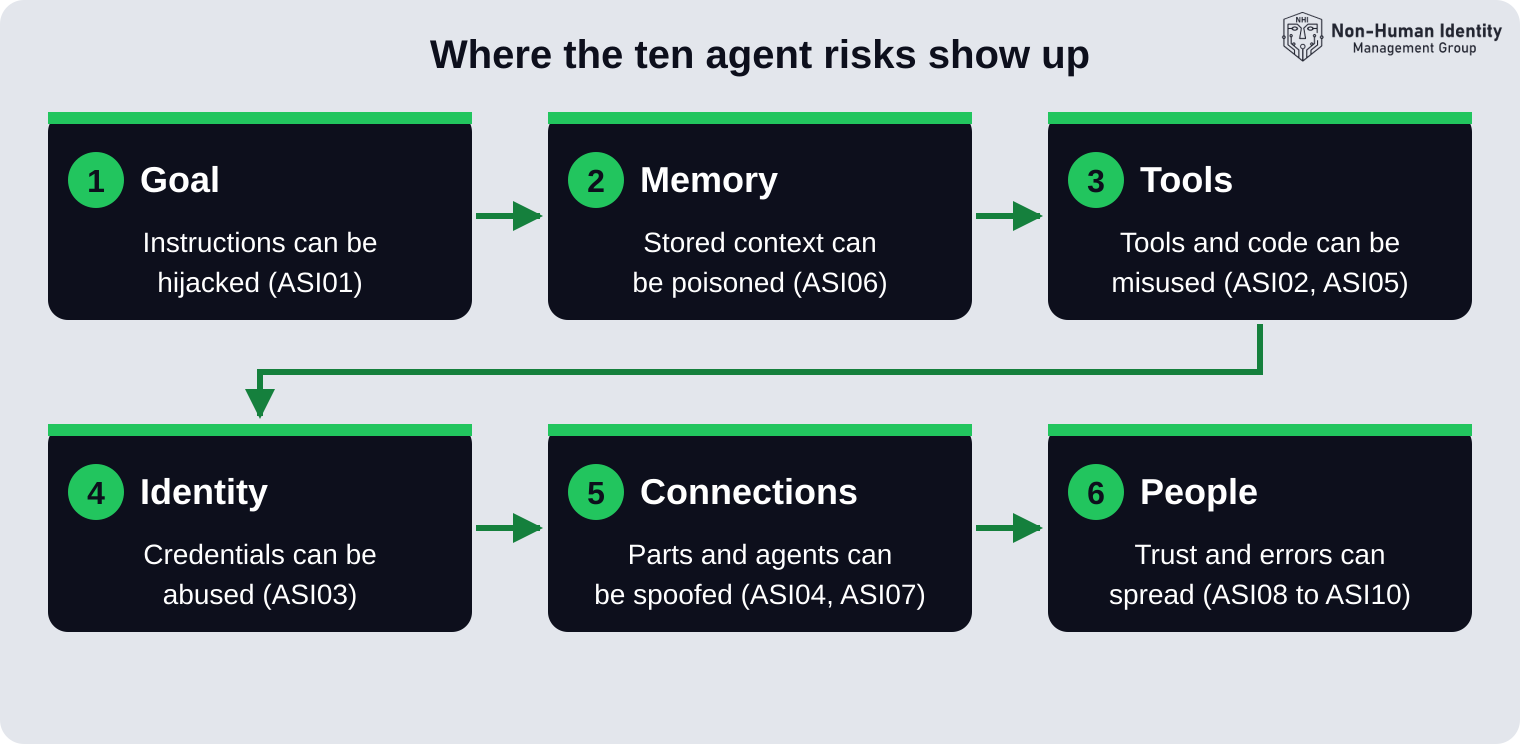
The easiest way to understand the list is to follow what an agent does and see where each risk enters. The names below are OWASP's own.[2]
- The agent receives a goal. A person, or another system, gives it a task. ASI01, Agent Goal Hijack: hidden or malicious instructions, for example inside an email or web page the agent reads, redirect it towards a different goal.
- It recalls memory and context. Many agents store notes and past conversations. ASI06, Memory and Context Poisoning: false or malicious information is planted in that memory and changes the agent's behaviour later.
- It chooses and uses tools. Tools are the actions it can take, such as sending email or querying a database. ASI02, Tool Misuse: the agent uses a legitimate tool in a harmful way. ASI05, Unexpected Code Execution: plain-language instructions end up running code that nobody intended.
- It acts with an identity and permissions. Each action is made with some account, token or key. ASI03, Identity and Privilege Abuse: the agent operates beyond its intended scope, for example with leaked or over-broad credentials.
- It connects to other parts and other agents. Agents rely on outside components and may talk to other agents. ASI04, Agentic Supply Chain Vulnerabilities: a poisoned component, such as a tool server, is loaded at run time. ASI07, Insecure Inter-Agent Communication: spoofed messages between agents send them the wrong way.
- Results flow on to people and systems. ASI08, Cascading Failures: one false signal spreads through automated steps and grows. ASI09, Human-Agent Trust Exploitation: a confident, polished explanation persuades a person to approve something harmful. ASI10, Rogue Agents: an agent drifts from its purpose, hides what it is doing or acts on its own.
The table gives the full list in order, with a one-line meaning and a link to our practitioner guide for each.
| ID and official name | In plain English | Learn more |
|---|---|---|
| ASI01 Agent Goal Hijack | Someone changes what the agent is trying to do. | OWASP Agentic Top 10 ASI01 Guide |
| ASI02 Tool Misuse | The agent uses an allowed tool to do harm. | OWASP Agentic Top 10 ASI02 Guide |
| ASI03 Identity and Privilege Abuse | The agent acts with more access than it should have. | OWASP Agentic Top 10 ASI03 Guide |
| ASI04 Agentic Supply Chain Vulnerabilities | A tool, plug-in or component the agent loads is poisoned. | OWASP Agentic Top 10 ASI04 Guide |
| ASI05 Unexpected Code Execution | Words turn into code that runs when it should not. | OWASP Agentic Top 10 ASI05 Guide |
| ASI06 Memory and Context Poisoning | False information is planted in what the agent remembers. | OWASP Agentic Top 10 ASI06 Guide |
| ASI07 Insecure Inter-Agent Communication | Messages between agents are faked or tampered with. | OWASP Agentic Top 10 ASI07 Guide |
| ASI08 Cascading Failures | One error spreads and grows through automated steps. | OWASP Agentic Top 10 ASI08 Guide |
| ASI09 Human-Agent Trust Exploitation | People trust a convincing agent and approve harm. | OWASP Agentic Top 10 ASI09 Guide |
| ASI10 Rogue Agents | An agent drifts from its purpose or acts on its own. | OWASP Agentic Top 10 ASI10 Guide |
Useful distinctions
- Agentic risks versus language model risks. The OWASP Top 10 for LLM Applications 2025 covers risks in chatbots and other model-based apps, including LLM06 Excessive Agency: damaging actions caused by giving a system too much functionality, too many permissions or too much autonomy.[4] The agentic list goes further into what happens once agents plan, remember, use tools and work together. See Agentic AI Security vs LLM App Security.
- Prompt injection is a technique, goal hijack is the outcome. Hidden instructions are one common way to hijack an agent's goal; poisoned memory or tampered messages are others.
- Least privilege and least agency. Least privilege limits what an identity can access. Least agency limits how much freedom an agent has to act on its own. You usually need both.
- Human approval is a control, not a cure. OWASP's LLM guidance suggests human approval for high-impact actions.[4] ASI09 is a reminder that the human can be persuaded too, so approvals need clear information and limits.
A worked example
Harbour Freight is a fictional logistics company with 200 staff. Its finance team wants an AI agent to read supplier invoices that arrive by email, match them to orders and queue payments for approval.
Leo, the security lead, walks the plan through the ten headings with the project team:
- Goal hijack (ASI01): invoices come from outside, so any text in them could contain hidden instructions. The team treats email content as untrusted data, not as commands.
- Tool misuse and identity (ASI02, ASI03): the first design gave the agent a finance account that could also change supplier bank details. Leo asks for a separate identity for the agent that can only read invoices and create draft payments, with short-lived credentials.
- Memory (ASI06): the agent's notes about suppliers are reviewed, and staff can see and clear them.
- Trust (ASI09): every payment still needs a person to approve it, and the approval screen shows the original invoice and the supplier's stored bank details side by side, not just the agent's summary.
- Cascading failures and rogue behaviour (ASI08, ASI10): a daily cap limits how many payments the agent can queue, and unusual activity raises an alert.
Two months after launch, a fake invoice arrives with a different bank account and text written to persuade the agent to mark it as urgent. The agent queues it, but the approver sees the bank details do not match the stored record and rejects it. The design did not stop the fake invoice reaching the queue, but the narrow permissions and the clear approval screen gave a person the chance to catch it.
Myths and misunderstandings
| What people think | What is true |
|---|---|
| Agent risks are the same as chatbot risks. | Agents take actions with tools and credentials, so problems can change data, move money or run code, not just produce a wrong answer. |
| A good system prompt keeps an agent safe. | Instructions to the model can be overridden or confused by content it reads. Limits on tools, permissions and actions need to sit outside the model too.[4] |
| If a human approves every action, the risks are covered. | People can be misled by confident explanations; that is ASI09.[2] Approvals need the right information and sensible limits. |
| The list is ranked, so ASI10 does not matter much. | Each entry is a significant risk in its own right. Treat all ten as headings to check, not as a league table. |
| Agents can share their user's login. | Sharing a person's credentials hides who did what and gives the agent all of that person's access. We suggest a separate, narrowly scoped identity for each agent. |
Key terms
- AI agent
- Software built around an AI model that can plan, choose tools and take actions to reach a goal.
- Agentic AI
- AI systems that can plan, decide and take actions, such as calling APIs, writing code or directing other agents, with little human oversight.
- Goal hijacking
- When an attacker or malicious instruction redirects an AI agent from its intended task to a harmful one.
- Indirect prompt injection
- Hiding instructions inside content an AI system reads later, such as an email or web page, so it treats them as part of its task.
- Tool misuse
- When an agent uses an allowed tool in a way that goes beyond its intended task or risk limits.
- Memory and context poisoning
- Putting false or malicious information into an agent's memory, history or stored context so it behaves wrongly later.
- Agentic supply chain
- The models, tools, plug-ins, prompts and memory stores an agent depends on to work.
- Excessive agency
- Giving an AI system more authority to act than its task needs.
- Least privilege
- Giving each user, process or system, human or non-human, only the access it needs, for only as long as needed.
- Least agency
- The agent version of least privilege: giving an AI agent only the minimum autonomy it needs for its task.
- Human in the loop (HITL)
- A design where a person must review or approve certain actions before they happen.
Common questions
When was the OWASP Top 10 for Agentic Applications published?
OWASP published it on 9 December 2025, as the Top 10 for Agentic Applications for 2026.[1]
What does ASI stand for?
The prefix reflects OWASP's Agentic Security Initiative, the part of the GenAI Security Project whose expert review board reviewed the list.[3] The entries run from ASI01 to ASI10.[2]
Is this the same as the OWASP Top 10 for LLM Applications?
No. The LLM list covers model-based applications in general; the agentic list focuses on agents that plan, remember and act. They overlap, and many teams use both. See OWASP Top 10 for LLM Applications Guide.
Which risk should I look at first?
It depends on what your agents can do. For many organisations, ASI03 is a sensible start, because narrowing an agent's identity and permissions limits the harm from several other risks.
Do I need to build agents to care about this list?
No. If you buy or switch on agent features in tools you already use, the same questions apply: what can the agent reach, what can it do, and who approves risky actions.
Does OWASP provide more help than the list?
Yes. OWASP released related resources alongside it, including a practical guide to securing agentic applications and an agentic AI threats and mitigations reference.[3]
First steps
Three things you can do this week:
- List your agents. Write down every AI tool in use that can take actions, not just answer questions, including features switched on inside existing software.
- Check what each one can reach. For each agent, note which account it uses, what data it can read and what actions it can take. Remove anything it does not need.
- Add approval for high-impact actions. Payments, deletions, permission changes and messages to customers are good candidates. Make sure the approver sees the original source, not only the agent's summary. Any temporary exception should be approved, recorded and time-limited.
Checklist
- We have a list of agents and the business owner of each.
- Each agent has its own identity, not a shared or personal login.
- Each agent's tools and permissions are limited to its task.
- Content from emails, documents and websites is treated as untrusted data.
- High-impact actions need human approval with clear information.
- Agent memory can be reviewed and cleared.
- Third-party tools and components an agent loads are approved and tracked.
- Agent actions are logged, and unusual activity raises an alert.
- We have a way to pause or switch off an agent quickly.
Check your understanding
1. What makes an agentic application different from a chatbot?
Answer: an agent can plan and take actions with tools and credentials, so problems can change things in the real world.
2. Which risk covers an agent acting with more access than it should?
Answer: ASI03, Identity and Privilege Abuse.
3. Why is human approval not enough on its own?
Answer: people can be persuaded by confident, polished agent explanations to approve harmful actions, which is ASI09.
4. What is the difference between least privilege and least agency?
Answer: least privilege limits what an identity can access; least agency limits how much freedom an agent has to act on its own.
Suggested learning pathway
- Start with AI Agents for Beginners if agents are new to you.
- Then read AI Agent Attacks for Beginners for how agents are attacked in general.
- For the most common entry point, read Prompt Injection for Beginners.
- For the identity side, read AI Agent Identity for Beginners.
- For approvals, read Human-in-the-Loop for AI Agents for Beginners.
- For the first risk in practitioner depth, see the OWASP Agentic Top 10 ASI01 Guide, then work through ASI02 to ASI10 from the table above.
- For limiting what agents can do, see Least Privilege and Least Agency.
- For the wider practitioner picture, see the Agentic AI Security Guide.
Standards and references
- OWASP Top 10 for Agentic Applications for 2026 (resource page). OWASP GenAI Security Project, 9 December 2025. https://genai.owasp.org/resource/owasp-top-10-for-agentic-applications-for-2026/, accessed 27 Nov 2026.
- OWASP Top 10 for Agentic Applications: The Benchmark for Agentic Security in the Age of Autonomous AI. OWASP GenAI Security Project, 9 December 2025. https://genai.owasp.org/2025/12/09/owasp-top-10-for-agentic-applications-the-benchmark-for-agentic-security-in-the-age-of-autonomous-ai/, accessed 27 Nov 2026.
- OWASP GenAI Security Project Releases Top 10 Risks and Mitigations for Agentic AI Security. OWASP GenAI Security Project, December 2025. https://genai.owasp.org/2025-12-09/owasp-genai-security-project-releases-top-10-risks-and-mitigations-for-agentic-ai-security, accessed 27 Nov 2026.
- LLM06:2025 Excessive Agency, OWASP Top 10 for LLM Applications 2025. OWASP GenAI Security Project. https://genai.owasp.org/llm-top-10/.
Related NHI Mgmt Group resources: Agentic AI for Beginners · Agentic AI Identity Guide · The OWASP Top 10 for Beginners